
Why a Lithium Battery Pack Arrives With No Output: BMS Shipping Mode, Sleep Current & Storage
A newly delivered lithium battery pack can appear completely dead: the device will not start, and a meter may show little or no voltage at the output connector. That does not always mean the cells are defective.
Some packs are intentionally shipped with their discharge path disabled. A battery management system may enter shipping, shutdown or deep-sleep mode to reduce storage drain and prevent the connected product from turning on accidentally. However, no output can also indicate undervoltage protection, a connector problem, incorrect measurement points or damage. The difference must be established through the pack’s approved wake-up and receiving-inspection procedure.
If a new lithium battery pack arrives with no output, first confirm whether the approved specification says it is delivered in shipping mode. Use only the documented charger, enable signal, button sequence, communication command or host-device connection to wake it. Do not bypass the BMS, short terminals or apply an improvised voltage. If the expected wake-up method fails, quarantine the pack and contact the supplier with its label, lot number, measurements and charger information.
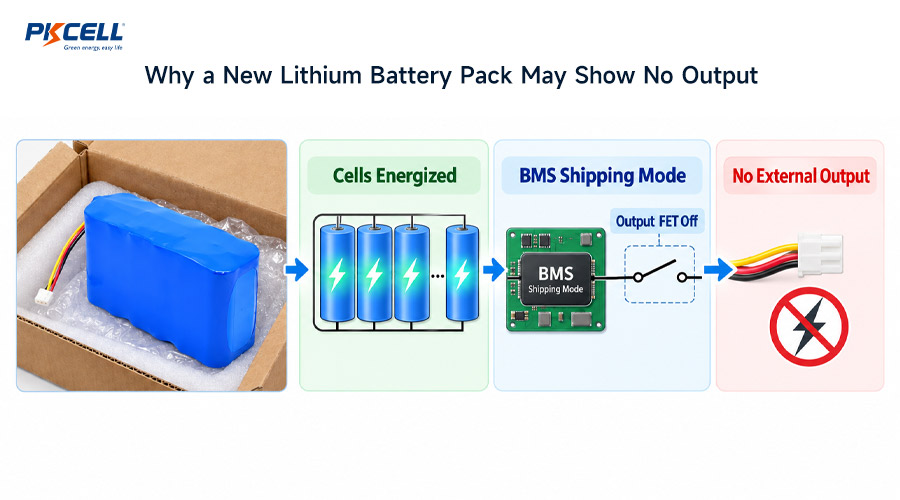
No Output Does Not Always Mean No Energy
A lithium battery pack normally contains cells, interconnections, sensing circuits and switching devices controlled by its BMS. In some designs, the BMS can open the charge or discharge field-effect transistors, commonly called FETs. When the discharge path is open, energy may remain inside the cells even though usable voltage is not present at the external output.
This distinction matters during incoming inspection. “No voltage at the connector,” “low cell voltage,” “BMS communication unavailable” and “the device will not start” are different observations. They should not automatically be recorded as the same failure.
PKCELL’s battery pack technology overview lists charging, switch and communication wake-up as possible BMS options. These are design choices, not universal instructions for every pack.
A battery pack’s wake-up behavior must come from its approved specification. There is no single reset procedure that is correct for every lithium battery or BMS.
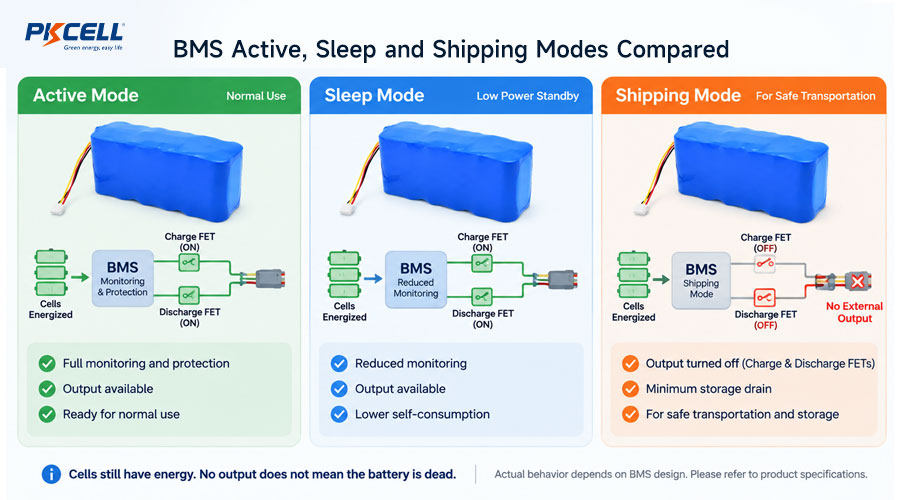
Shipping Mode, Sleep Mode and Shutdown Mode Are Different
The terminology varies between BMS and battery-gauge suppliers. For that reason, OEM documentation should define the electrical behavior instead of relying only on a mode name.
| Operating State | Typical Purpose | Possible Output Behavior | Typical Exit Condition |
|---|---|---|---|
| Normal or active mode | Power the host device and continuously monitor the pack. | Discharge output is normally available if no protection condition exists. | Already active; no wake-up is required. |
| Sleep mode | Reduce BMS consumption during inactivity while retaining selected monitoring functions. | Output may remain available, or it may depend on the BMS design. | Load current, charger connection, communication or another defined event. |
| Shipping or ship mode | Reduce current drain during transport and warehouse storage and prevent unintended activation. | Charge and/or discharge FETs may be off, producing no usable output. | Approved charger, hardware input, button, communication or host-system signal. |
| Shutdown or deep shutdown | Minimize power consumption after a command, timer or low-voltage condition. | The BMS and output path may be substantially powered down. | A manufacturer-defined startup condition; recovery may not be possible if cells have fallen too low. |
| Protection state | Respond to undervoltage, overcurrent, short circuit, temperature or another detected fault. | Charge, discharge or both may be disabled. | Removal of the fault plus the documented recovery condition. |
Texas Instruments documentation illustrates why pack-specific instructions matter. Some battery-management devices exit low-power states when charger voltage appears at the pack terminal; other designs can use a hardware enable input, communication command or timed condition. A method that wakes one design may do nothing on another.
Why Manufacturers Use BMS Shipping Mode
Reducing storage drain
The cells are not the only components consuming energy. The BMS, fuel gauge, balancing network, communication transceiver, status indicators and any electronics left connected to the pack can all contribute to storage current.
A low-power shipping state can significantly reduce the BMS portion of that drain. For example, one Texas Instruments reference design reports different consumption levels for standby and ship mode. Those values are specific to that reference design and must not be treated as generic performance figures for every battery pack.
Preventing unintended device operation
A product can consume energy during transport if its power button is pressed inside the packaging, if a sensor wakes repeatedly or if host electronics never enter their intended low-power state. Disabling the pack output provides an additional control against unintended activation.
Preserving charge for commissioning
A reduced storage load helps retain usable charge until the product is installed. It does not eliminate self-discharge, calendar aging or all BMS consumption, so the pack still requires a defined shelf-life limit and stock-management plan.
Air-transport rules can restrict the state of charge for particular lithium-ion shipments. That regulatory limit should not be treated as a universal recommendation for long-term warehouse storage. Confirm both requirements for the exact battery, shipping configuration, route and applicable regulations.
Sleep Current Determines How Long the Pack Can Wait
“Sleep current” is often used loosely. A useful storage analysis separates at least three contributors:
- Cell self-discharge: charge lost through electrochemical and internal processes.
- BMS quiescent or ship-mode current: energy used by monitoring, protection and control electronics.
- Host-device off-state current: current consumed by the connected product even when it appears switched off.
A simple capacity-divided-by-current calculation can help with an early estimate, but it is not a complete shelf-life prediction. Temperature, cell variation, usable state-of-charge window, BMS thresholds, connector leakage, component tolerances and calendar aging also matter.
For an OEM design, request a maximum guaranteed BMS current rather than relying only on a typical value. The specification should state the test temperature, battery voltage, mode-entry condition, communication state and which auxiliary circuits remain powered.
A Safe Receiving-Inspection Sequence
The following workflow is intended for trained receiving, engineering or quality personnel. It does not replace the supplier’s specification or workplace electrical-safety procedure.
- Inspect the shipment before electrical testing. Check for crushed packaging, punctures, swelling, leakage, corrosion, unusual odor, heat or damaged connectors.
- Verify identity and revision. Confirm the battery model, label, serial or lot number, BMS hardware and firmware revision where applicable.
- Confirm the connector and measurement points. Use the approved pinout and check polarity before connecting equipment.
- Review the specified delivery state. Determine whether the pack should arrive active, in ship mode or with a separate shipping connector or pull tab.
- Allow temperature stabilization when required. A pack arriving from a very hot or cold environment should be handled according to its specified conditioning procedure.
- Apply only the documented wake-up method. This may be an approved charger, power input, button, switch, enable pin, communication command or installation into the host product.
- Record the result. Document initial output voltage, charger response, wake-up time, BMS communication and output voltage after activation.
- Quarantine unexplained failures. Do not repeatedly force activation or open a sealed pack. Send the recorded evidence to the battery supplier.
How to Separate Shipping Mode From a Real Fault
| Observation | Possible Explanation | Appropriate Next Check |
|---|---|---|
| No output on every pack from the same shipment | Intentional shipping mode or an undocumented activation step. | Check the approved delivery-state and wake-up instructions. |
| Output appears after the approved charger is connected | The BMS was probably configured for charge wake-up. | Verify that voltage and communication remain normal after charger removal. |
| Only one pack in the lot remains inactive | Connector damage, storage depletion, BMS fault, fuse or assembly issue. | Quarantine it and compare traceable receiving-test data with accepted units. |
| Output appears but disappears when the device starts | Overcurrent protection, voltage sag, weak cells or an incompatible load. | Use the separate load-shutdown diagnostic process and confirm the real current profile. |
| The approved charger does not recognize the pack | Wrong charger, charge FET disabled, pinout error, sensor fault or deep discharge. | Stop repeated attempts and request supplier review of the recorded measurements. |
| Output is present at the pack but not at the device | Host connector, cable, interlock, fuse, switch or device-side issue. | Verify the complete power path against the approved drawing. |
For a broader review of damaged connectors, charger mismatch, weak cells and pack faults, see PKCELL’s 18650 battery pack troubleshooting guide. If the pack produces voltage at rest but shuts down when the load starts, the root cause is more likely related to load current, voltage sag or protection settings than shipping mode.
Storage Requirements to Define Before Mass Production
A product team should not wait for the first warehouse failure to decide how an inactive battery will be managed. The battery specification, packaging instruction and receiving plan should define:
- The exact name and electrical behavior of each low-power state
- How and when the pack enters shipping or shutdown mode
- Which charge and discharge paths are disabled
- Maximum quiescent current in active, sleep and ship modes
- The approved wake-up source, voltage range, signal or command
- Storage state-of-charge range and temperature limits
- Maximum storage interval before inspection or maintenance charging
- Expected output and communication behavior during incoming inspection
- Action limits for low voltage, failed wake-up or abnormal temperature
- BMS hardware, firmware and configuration revision control
The recommended state of charge and maintenance interval must come from the qualified cell and finished-pack specification. Generic advice such as “store every lithium battery at exactly 50%” is not sufficient for a production program.
Design the Wake-Up Experience Into the Product
Shipping mode is useful only when the factory, distributor, installer and end user know how the pack becomes active. A technically correct low-power state can still create returns if the activation step is missing from the packaging or host-device workflow.
For a removable battery, activation may occur when it is placed in an approved charger. For an embedded pack, the host product may provide an enable signal or charging input during first installation. A smart pack may require communication with the host controller. These choices affect the BMS, connector, firmware, production fixture and customer instructions.
PKCELL’s custom battery pack service supports application-specific voltage, capacity, BMS, temperature and connection requirements. Buyers can also compare available formats through the rechargeable battery product range, including configurable 18650 battery packs and LiFePO4 battery packs.
What to Include in a Battery Pack Inquiry
To obtain a useful engineering response, provide:
- Application and whether the battery is removable or embedded
- Cell chemistry, series/parallel configuration, voltage and capacity
- Continuous, peak, startup and off-state device current
- Expected shipping and warehouse duration
- Required storage temperature and state-of-charge window
- Preferred ship-mode entry and wake-up behavior
- Charger voltage, current, connector and charging architecture
- BMS communication interface and host-control requirements
- Pack dimensions, connector pinout, wire and enclosure requirements
- Destination market, shipping method, compliance requirements and annual volume
Need a Battery Pack With Defined Shipping and Wake-Up Behavior?
Send PKCELL your storage period, device off-state current, charger architecture, BMS interface, required wake-up method and production forecast. The engineering team can review the cell, BMS and pack requirements for your application.
Request a Custom Battery Pack Review
Explore Custom BMS and Battery Pack Options
Frequently Asked Questions
Why does my new lithium battery pack show zero volts?
The BMS may have disabled the discharge output for shipping, shutdown or protection. Other possibilities include incorrect measurement points, a connector problem, a fuse, storage depletion or damage. Check the approved delivery-state specification before treating the pack as defective.
How do I wake a lithium battery BMS from shipping mode?
Use only the method documented for that pack. Depending on the design, it may require the approved charger, a button or switch, an enable input, communication with the host or installation into the intended device. There is no universal BMS wake-up procedure.
Is sleep mode the same as shipping mode?
Not necessarily. Sleep mode often retains more monitoring or wake functions, while shipping mode generally aims for lower storage consumption and may disable the external power path. The precise behavior depends on the BMS hardware and firmware.
Can a battery discharge while its output is turned off?
Yes. Cells have self-discharge, and the BMS may continue consuming a small current. Electronics left connected to the pack can add further off-state drain. Output-off does not mean zero energy consumption.
Should every lithium battery be stored at the same state of charge?
No single percentage is appropriate for every cell, pack, storage period and transport method. Follow the qualified battery specification and distinguish warehouse recommendations from applicable transport state-of-charge rules.
When should a no-output pack be quarantined?
Quarantine it if it is damaged, swollen, leaking, hot, has an unusual odor, shows incorrect polarity or fails the documented wake-up and receiving-inspection procedure. Do not open or bypass the BMS to force an output.
Conclusion
A lithium battery pack that arrives with no output may be behaving exactly as designed. Shipping and shutdown modes can disable the external power path while reducing BMS consumption during logistics and storage. The correct response is not to force the pack on, but to verify its specified delivery state and apply its approved wake-up method.
For OEM projects, define shipping mode, maximum sleep current, storage limits, wake-up conditions and receiving tests before mass production. Clear electrical specifications and activation instructions prevent good packs from being rejected while making genuine storage or manufacturing failures easier to identify.
Post time: Sep-22-2026


