
For this application, PKCELL provides a customized 14500 lithium-ion battery pack in a 1S2P configuration. The solution is intended for integration into portable negative pressure wound therapy equipment.
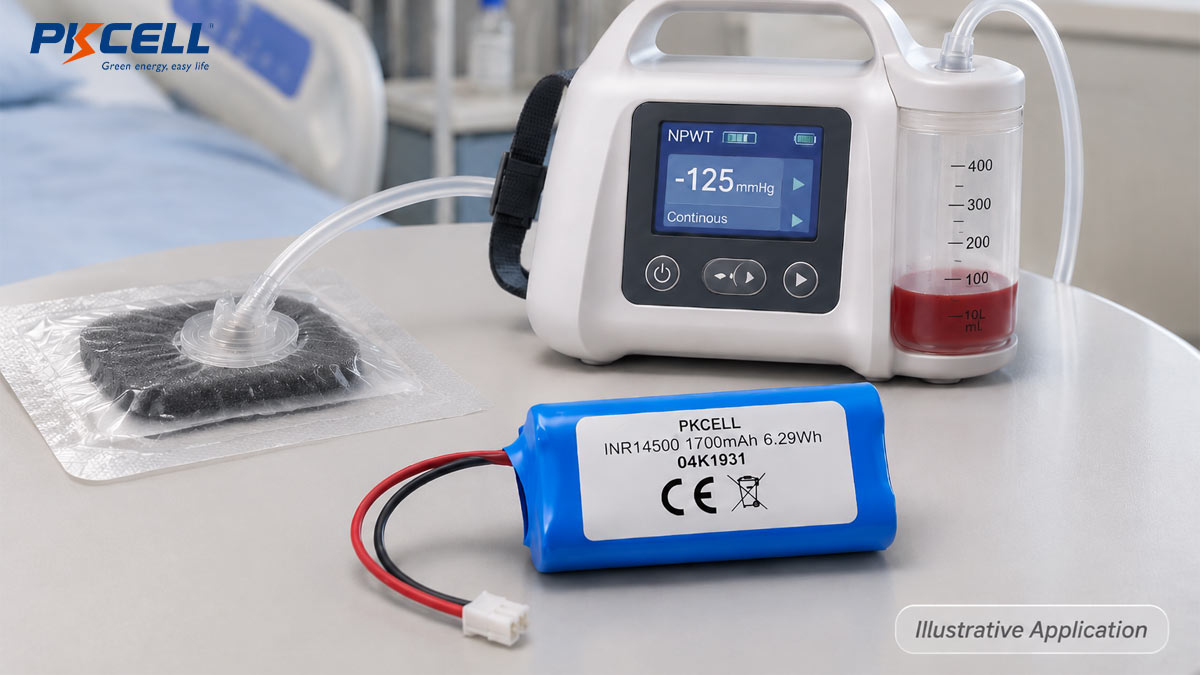
Application Background: Powering Portable NPWT Equipment
A negative pressure wound therapy pump combines several electrical components to manage its treatment functions. According to the supplied application description, the battery pack is intended to provide power for the following equipment modules:
Vacuum Motor
The pump's motor is one of the main electrical loads in the NPWT equipment.
Pressure Sensor
The sensor is part of the equipment's pressure monitoring system.
Control MCU
The control unit manages the electronic functions of the pump.
Display and Alarm System
These components provide operating information and equipment alerts.
The project description identifies two operating modes of the target pump:
Continuous Negative Pressure Drainage
The pump operates continuously during the specified treatment mode.
Intermittent Pressure Adjustment
The pump operates with intermittent pressure adjustment according to its control program.
These operating modes create different equipment load profiles. Battery selection and validation should therefore consider both continuous and intermittent operating conditions.
Battery Pack Configuration and Technical Specifications
The battery solution adopts two 14500 lithium-ion cells connected in a 1S2P arrangement. The following specifications are provided in the original project description.
| Battery Model | 14500 Lithium-Ion Cell |
|---|---|
| Configuration | 1S2P (1 Series, 2 Parallel) |
| Rated Voltage | 3.7V |
| Rated Capacity | 1700mAh |
| Full Charge Voltage | 4.2V |
| Discharge Cut-off Voltage | 2.75V |
| Working Current Profile | Low continuous current and micro-pulse current; exact current values not provided |
| Protection Board | Built-in protection for overcharge, over-discharge, overcurrent, short circuit, and temperature |
| Application | Portable Negative Pressure Wound Therapy Pump |
Battery Integration Considerations for NPWT Pumps
Integrating a battery into a portable wound therapy pump requires coordination between the battery pack and the equipment's electrical and mechanical design.
- Motor Load Profile:
Confirm the vacuum motor's continuous operating current and transient current requirements. The actual load should be checked against the battery and protection board specifications. - Operating Modes:
Evaluate battery performance under both continuous drainage and intermittent pressure adjustment modes. - Charging Compatibility:
Ensure that the charger and equipment charging circuit match the approved battery charging specifications. - Protection Coordination:
Confirm the protection board's current and temperature thresholds against the equipment's normal operating conditions. - Runtime Validation:
Determine the required operating duration through actual device load measurements and battery testing. The project description does not provide a verified runtime. - Mechanical Integration:
Check the available battery compartment, mounting arrangement, wire routing, and connector compatibility.
These checks help ensure that the selected battery configuration is compatible with the final medical device design. Actual operating performance should be confirmed through application-specific testing.
Customized Battery Solutions for Portable Medical Equipment
Portable medical equipment can have different requirements for battery size, voltage, capacity, operating current, charging methods, and protection functions. A suitable battery configuration should be selected according to the electrical and mechanical requirements of each device.
PKCELL provides battery options for different medical and healthcare electronics, including rechargeable lithium-ion and lithium-polymer battery solutions.
Looking for a Battery Pack for Your Medical Device?
Whether you are developing a portable wound therapy pump, diagnostic instrument, or other medical electronic equipment, battery selection should match the device's electrical requirements and available installation space.
Contact PKCELL to discuss your battery configuration, capacity, protection, and connection requirements.


