
How Long Does It Take to Charge an 18650 Battery?
Charging time for an 18650 battery depends on its capacity, the charger’s current, the cell’s starting state of charge, and the charging profile. A 2,500 mAh cell and a 3,500 mAh cell will not necessarily finish charging at the same time, even when connected to the same charger.
For engineers, product developers, and purchasing teams, estimating charging time is useful when selecting a cell for a flashlight, portable instrument, wireless device, or custom battery pack. The important question is not simply how quickly a charger can deliver current, but how quickly the battery can safely accept it.
How to Calculate 18650 Battery Charging Time
A useful first estimate compares the capacity that needs to be replenished with the actual charging current. Capacity is measured in milliamp-hours (mAh), while charging current is measured in milliamps (mA).
This is a simplified estimate, not an exact prediction of full-charge time. Lithium-ion charging normally includes a constant-current stage followed by a constant-voltage stage. During the final stage, current tapers down, so the battery can take longer to reach the charger’s full-charge termination point than the simple calculation suggests.
Example: Charging a 3,000 mAh 18650 Battery at 1 A
Assume a compatible 3,000 mAh cell starts near empty and the approved charger delivers a constant 1,000 mA during the initial stage.
3,000 mAh ÷ 1,000 mA = 3 hours.
Three hours is the idealized capacity-to-current calculation. The actual time to full charge will generally be longer because charging current decreases during the constant-voltage stage. The result also changes with the starting charge level, cell temperature, and the charger’s control behavior.
18650 Charging Time by Battery Capacity and Current
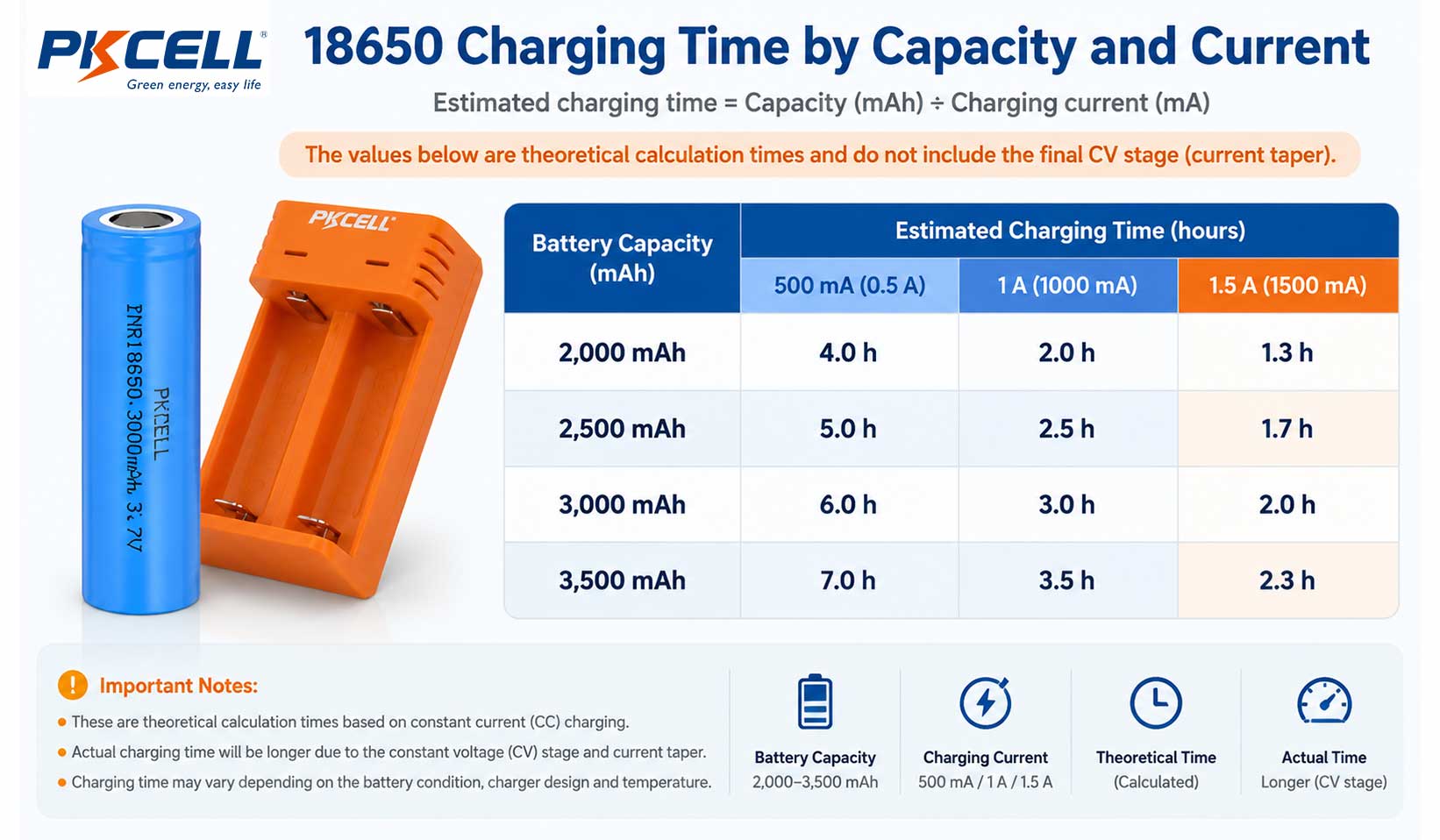
The following table provides idealized estimates for a battery replenishing its full rated capacity. It assumes a constant current throughout and does not include the final current taper, so use it for initial planning rather than as a promise of actual charge duration.
| Battery Capacity | 500 mA | 1 A | 1.5 A |
|---|---|---|---|
| 2,000 mAh | 4 hours | 2 hours | 1.33 hours |
| 2,500 mAh | 5 hours | 2.5 hours | 1.67 hours |
| 3,000 mAh | 6 hours | 3 hours | 2 hours |
| 3,500 mAh | 7 hours | 3.5 hours | 2.33 hours |
These figures are mathematical estimates only. They do not mean every 18650 cell can safely accept 1 A or 1.5 A. The permissible charge current must be confirmed for the exact model and operating conditions.
If your application requires a multi-cell assembly, charging time also depends on the pack configuration, BMS, charger output, and how the cells are balanced. For pack-level design, see PKCELL’s guide to choosing the correct BMS current rating.
What Affects the Actual Charging Time?
1. Battery Capacity and Starting Charge Level
A higher-capacity cell usually needs more charge to move from empty to full. However, a battery that starts at 40% charge will generally require less time than the same battery starting near empty.
For an initial estimate, calculate the approximate capacity that needs to be replenished rather than automatically using the entire nameplate capacity. The actual state of charge may not be known precisely unless the system measures it.
2. Charger Current and Cell Charge Limits
A higher charging current can shorten the initial charging stage, but only when the cell is rated for that current and the charger is correctly configured. The charger’s advertised maximum output is not proof that a particular cell can accept that current.
When comparing cells, review the specified charging method, maximum charge current, charge voltage, termination conditions, and temperature limits. PKCELL’s lithium battery charger selection guide provides additional context on matching a charger to a battery.
3. Constant-Voltage Charging and Current Taper
Standard lithium-ion charging commonly uses a constant-current stage followed by a constant-voltage stage. Once the cell approaches its specified charge-voltage limit, the charger holds the voltage and the charging current gradually declines. This finishing stage is one reason a battery does not always finish in the time predicted by a simple capacity calculation.
4. Temperature and Battery Condition
Charging outside the cell’s permitted temperature range can damage the battery or create a safety risk. Some chargers reduce current or suspend charging when temperature conditions are unsuitable. An aged cell may also behave differently from a new one because its internal resistance and usable capacity have changed.
Follow the manufacturer’s specified charging temperature limits. Do not attempt to compensate for slow charging by forcing additional current into a cold, hot, damaged, or otherwise unsuitable cell.
5. Battery Packs and the BMS
A battery pack containing multiple 18650 cells is not simply a single cell with a larger number printed on it. Series and parallel arrangements affect voltage, capacity, current distribution, and the requirements of the charging system. A BMS may also monitor cell-group voltage and temperature and may restrict or interrupt charging when necessary.
For custom assemblies, charging time should be calculated using the complete pack specification, approved charger, and BMS design rather than by multiplying a single-cell estimate without checking the configuration.
Can You Charge an 18650 Battery Faster?
A shorter charging time is possible when the cell and charging system support a higher permitted current. The goal should be to meet the product’s recharge-time requirement without exceeding the cell’s electrical or thermal limits.
- Choose a charger designed for the correct rechargeable lithium-ion chemistry and cell configuration.
- Confirm the maximum permitted charge current in the manufacturer’s datasheet.
- Use the correct charge-voltage limit and termination behavior for the specific cell.
- Allow for the constant-voltage finishing stage when planning turnaround time.
- Monitor temperature and validate charging under the application’s actual operating conditions.
Avoid using an unverified fast-charge setting simply because a charger offers it. The cell’s approved charging specification takes priority over the charger’s maximum capability.
18650 Charging Safety: What Should You Avoid?
Lithium-ion cells require controlled charging. Incorrect voltage, excessive current, physical damage, or charging outside the permitted temperature range can lead to failure. Safe charging practices include:
- Use a compatible charger with the correct voltage and current settings.
- Do not charge a swollen, leaking, dented, corroded, or otherwise damaged cell.
- Stop using the battery if it develops unusual heat, odor, leakage, or other signs of failure.
- Do not leave charging cells exposed to excessive heat, moisture, or conductive objects that could cause a short.
- Follow the cell manufacturer’s requirements for charging, protection, handling, and storage.
For a custom battery pack, charger compatibility and protection should be evaluated at the system level. A BMS is not a substitute for the correct cell, charger, wiring, and thermal design.
Need an 18650 Cell or Custom Battery Pack?
Share your target capacity, required charging time, operating current, pack voltage, dimensions, and annual volume. PKCELL can help evaluate suitable rechargeable lithium-ion cells and custom battery pack requirements.
Frequently Asked Questions
How long does it take to charge a 3,000 mAh 18650 battery?
At a hypothetical constant current of 1 A, the simple capacity calculation gives 3 hours. Actual full-charge time is generally longer because charging current tapers near full charge. The cell’s permitted current and the charger’s charging profile determine the real result.
How long does it take to charge an 18650 battery at 1 A?
Divide the capacity that needs to be replenished by 1,000 mA for an initial estimate. For example, 2,500 mAh divided by 1,000 mA equals 2.5 hours before accounting for the final charging stage and other losses.
Does a higher-capacity 18650 battery take longer to charge?
Usually, if the charging current and starting state of charge are comparable. A higher-capacity cell needs more charge to reach full capacity, although the exact time depends on the cell’s permitted charging rate and charger.
Can I use a 2 A charger for every 18650 battery?
No. A charger rated for 2 A does not mean every 18650 cell can safely accept 2 A. Check the approved charge current, charge voltage, temperature range, and charger compatibility for the exact cell.
Why does an 18650 battery take longer to reach 100%?
Lithium-ion charging normally reduces current during the constant-voltage finishing stage. The charger may also reduce current or pause charging when required by its control logic or temperature limits.
Conclusion
An 18650 battery may take a few hours to charge, but there is no single charging time that applies to every cell. Capacity and charging current provide a useful starting estimate; the constant-voltage finishing stage, starting charge level, temperature, battery condition, and charging controls determine the actual duration.
For reliable product design, select the cell and charger as a compatible system. Verify the exact datasheet, test the complete application, and avoid exceeding the manufacturer’s charging limits.
Explore PKCELL cylindrical lithium-ion batteries or contact PKCELL about your battery requirements.
Post time: Oct-26-2026


