
Key Highlights
- Rechargeable batteries are essential for sustainable, cost-effective, and high-performance IoT devices.
- Lithium-ion (Li-ion), Lithium Polymer (Li-Po), and Nickel-Metal Hydride (NiMH) are the core chemistries, each suiting specific IoT needs.
- Key selection criteria include capacity, energy density, cycle life, and charging speed.
- Best practices in charging, maintenance, and remote management are vital for longevity and reliability.
- PKCELL batteries offer a trusted and diverse range of quality solutions for IoT applications.
- Emerging battery technologies promise even more advanced power solutions for future IoT.
Introduction
Battery technology is changing fast, and much of this change is happening with rechargeable batteries made for IoT devices. IoT devices need good power to work well and be reliable. This is where rechargeable batteries be so useful. These batteries offer strong energy use, last a long time, and work with many types of chargers. People use them for smart sensors, wearable devices, and in big data centers. They are helping to shape how we store energy by giving a mix of good performance and care for the environment. Now, let’s look at why these batteries are so important for this system.
Why Rechargeable Batteries Are the Smart Choice for IoT
Single-Use vs. Rechargeable: A Comparative Look
Historically, many low-cost or short-lifecycle IoT devices relied on single-use (primary) batteries. These offer initial simplicity and are suitable for extremely low-power applications with infrequent use, or where battery replacement is easy and acceptable. However, their limitations are significant:
- Environmental Impact: They contribute to electronic waste and chemical pollution.
- Replacement Frequency: Requiring frequent manual replacement, leading to higher labor costs and device downtime.
- Long-Term Cost: While cheaper upfront, their repeated purchase makes them more expensive over the device’s lifespan.
In contrast, rechargeable (secondary) batteries overcome these drawbacks, offering a compelling proposition for the evolving IoT landscape.
The Undeniable Advantages of Rechargeables in IoT Applications
The benefits of integrating rechargeable batteries into IoT devices are multifaceted:
- Cost-Effectiveness: Despite a higher initial cost, their ability to be recharged hundreds or even thousands of times results in significant long-term savings on battery purchases and replacement labor.
- Environmental Sustainability: Reusability drastically reduces electronic waste, aligning with global environmental protection goals and corporate social responsibility initiatives.
- Performance Stability: Rechargeable batteries can provide a more consistent voltage output throughout their discharge cycle. They are also better equipped to handle the varying current demands often seen in IoT devices (e.g., brief high-current bursts for data transmission, followed by long periods of low-power sleep).
- Remote Management & Monitoring: When paired with sophisticated Battery Management Systems (BMS), rechargeable batteries allow for remote monitoring of their state of charge (SoC) and state of health (SoH), enabling predictive maintenance and optimizing device uptime..
Diving Deeper: Main Rechargeable Battery Types for IoT
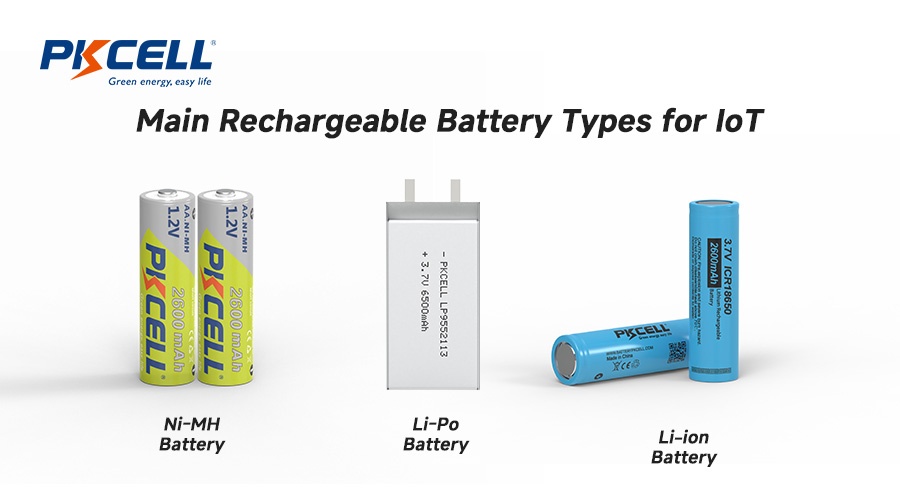
Lithium-Ion (Li-ion) Batteries
Li-ion batteries are pervasive in consumer electronics and are highly favored in IoT.
- Characteristics: High energy density (power in a compact size), no memory effect, and low self-discharge rate.
- Pros: Excellent for small, lightweight IoT devices like wearables and smart sensors where space is at a premium.
- Cons: Can be sensitive to extreme temperatures and require careful charging management to ensure safety and longevity.
- IoT Use Cases: Smartwatches, GPS trackers, miniature drones, and compact wireless sensors.
Lithium Polymer (Li-Po) Batteries
A variant of Li-ion, Li-Po batteries offer design flexibility.
- Characteristics: Utilize a polymer electrolyte, allowing for flexible form factors (thinner, customizable shapes) while maintaining high energy density.
- Pros: Ideal for uniquely shaped or ultra-thin IoT devices where traditional battery shapes won’t fit.
- Cons: Generally more expensive and can be more susceptible to physical damage if not properly protected.
- IoT Use Cases: Smart cards, flexible sensors, smart clothing, and slimline smart home devices.
Nickel-Metal Hydride (NiMH) Batteries
NiMH batteries are a mature and reliable technology.
- Characteristics: Environmentally friendlier than older chemistries (like NiCd), good cycle life, and more tolerant to overcharge/over-discharge.
- Pros: More cost-effective than lithium variants, generally safer, and robust in a wider range of temperatures, making them suitable for less demanding IoT environments.
- Cons: Lower energy density and higher self-discharge rate compared to lithium batteries.
- IoT Use Cases: Smart toys, some environmental monitoring stations, and devices where cost and safety are prioritized over extreme compactness.
The Horizon: Emerging Battery Technologies Shaping IoT’s Future
The battery landscape is continuously evolving, with exciting advancements promising even more potent solutions for IoT:
- Solid-State Batteries: Offer potential for even higher energy density, improved safety (no liquid electrolyte), faster charging, and longer lifespans. They are poised to revolutionize compact and high-performance IoT.
- Supercapacitors: While not traditional batteries, they can store and release energy very rapidly. They are often used in hybrid systems with batteries, providing peak power for quick data bursts or enabling energy harvesting in intermittent power environments.
- Wireless Charging: Though not a battery type, advancements in wireless power transfer are making charging IoT devices more seamless and automated, further reducing maintenance needs for a wider range of devices.
Key Features to Consider When Choosing Rechargeable Batteries for IoT
 Selecting the right battery is a critical design decision. Here are the main features to assess:
Capacity and Energy Density
- Capacity (mAh or Ah): Defines how much charge the battery can hold, which is referred to as battery capacity, directly impacting how long a device can operate on a single charge. Match this to your device’s total energy consumption.
- Energy Density (Wh/kg or Wh/L): Indicates how much energy a battery can store relative to its weight (specific energy) or volume (volumetric energy). High energy density is vital for small, lightweight, and portable IoT devices.
Cycle Life and Longevity
- Cycle Life: The number of complete charge-discharge cycles a battery can undergo before its capacity significantly degrades (e.g., to 80% of original). A higher cycle life reduces the frequency of battery replacement, crucial for long-term IoT deployments.
- Longevity (Calendar Life): How long the battery lasts when stored or used, regardless of cycles. Environmental factors like temperature heavily influence this.
Charging Speed and Convenience
Fast and efficient charging is very important for rechargeable batteries in IoT devices. The new chargers make batteries recharge quickly. They do this without harming battery health. This lets devices keep working without big breaks or delays.
Rechargeable batteries give you a good balance between quick charging and how long you can use them. Smart chargers help cut down the wait but still keep the battery working well for a long time. This is very important for IoT systems that need to work all the time.
For better IoT systems, it helps a lot to use chargers with different recharge speeds and safety features. These keep the batteries safe. They make sure the devices work well and meet all their energy needs.
Best Practices for Using Rechargeable Batteries in IoT Devices
Getting the most from a rechargeable battery in IoT devices depends on following the right steps. You should always use chargers that match the battery. This helps stop overcharging and lets the battery go through all its discharge cycles without problems, even when you use it many times.
How and where you store batteries also plays a big part. Storing batteries in the right environment helps them keep their charge. It stops them from losing power too fast. If you follow these tips, your IoT devices will work better and last longer.
Safe Charging and Discharging Techniques
Secure charging methods help lithium and nickel batteries work at their best over time. Using chargers made for safe battery cycles makes sure the charge stays stable, even when the workload is high.
Managing discharge cycles with care stops the fast loss of battery power. It is important to make sure that switching between charging and discharge is safe, as this keeps energy levels steady for IoT devices.
Balancing safe technology and setting rates right for battery use—and also testing each device—means energy supply will stay strong when in use. This shows how much efficient and safe practices matter for IoT networks as they get bigger.
Battery Maintenance and Storage Tips
Good storage habits help a lot with how you look after a rechargeable battery. Try to keep your devices cool. This helps the battery stay strong and work well.
- Keep rechargeable batteries charged between 30% and 70%. This keeps them in good shape, better than letting them get too empty.
- Use chargers that help control temperature in the environment. This can stop sudden drops in battery power.
- Devices that use a battery fast, like those run by remote, also need this care.
- Making the room steadier in both heat and cold helps stop lithium batteries from losing power too quickly.
Managing Battery Life in Remote IoT Installations
Remote management systems need to have steady lithium-powered batteries. These batteries are important for IoT networks that work over long distances. It is important to make sure these batteries are strong and can work for a long time. Teams should look at possible risks that happen when batteries lose power bit by bit over time. Good plans help them handle breakdowns and any changes in the way things work. This makes their devices able to handle different situations with ease.
Exploring Trusted Brands: Why PKCELL Batteries Stand Out for IoT
hen choosing batteries for mass production or critical IoT applications, partnering with a reliable manufacturer is essential. PKCELL is a reputable brand known for its reliability and quality, adhering to international standards. Their diverse portfolio includes various Li-ion and NiMH rechargeable batteries and specialized packs, offering solutions that precisely match IoT power and form factor needs. PKCELL’s compact Li-ion options are ideal for wearables and smart sensors, while their NiMH batteries provide a robust, cost-effective choice. Manufacturers benefit from consistent product quality, reliable supply chains, and competitive pricing, making PKCELL a strategic partner for powering IoT innovation.
Conclusion
Adding rechargeable batteries to your IoT devices gives you a simple and lasting energy source. This can help the battery last longer. With brands like PKCELL, you get good batteries that are steady, such as lithium and nickel-metal ones. These are made to fit different device needs. When you pick high-quality batteries, your devices work well, and there is less environmental impact because you use fewer throwaway batteries. Efficient discharge cycles mean you get steady power. This makes rechargeable batteries a smart choice for their strong build and for caring about the planet. Now is a good time to move toward using renewable energy.
Frequently Asked Questions
What type of rechargeable battery is best for IoT sensors?
For IoT sensors, lithium-ion batteries are often the best pick. They give high energy, last a long time, and charge quickly. Still, for some uses where the weight of the sensor and how much the battery can bend is important, lithium polymer batteries may also be a good choice.
How long do rechargeable batteries typically last in IoT devices?
Rechargeable batteries in IoT devices can last from 2 to 10 years. This depends on the type of battery, how you use it, and the environment it is in. Lithium-ion batteries usually last longer than nickel-metal hydride or lithium polymer ones. That is why many people use lithium-based batteries for energy-efficient uses.
Are rechargeable batteries safe for outdoor IoT applications?
Rechargeable batteries can be good for outdoor IoT uses if they are built to stand up to weather and changes in temperature. It is important to pick high-quality, tough batteries that are made for outdoor work. This helps make sure you get reliable performance and a battery that lasts a long time, even when things get rough. Always follow the maker’s rules for safety.
Can I use regular rechargeable batteries in all types of IoT devices?
Using regular rechargeable batteries in IoT devices might not always be the best idea. There can be problems because different batteries have different voltage and power levels. You should always look at the device’s details to make sure it works well and to prevent any damage or problems. It is good to buy the right battery type for your IoT use.
Post time: Jul-25-2025


