
Industrial Rechargeable Battery Selection Guide
Why NiMH Batteries Are Still a Good Choice for Industrial Applications
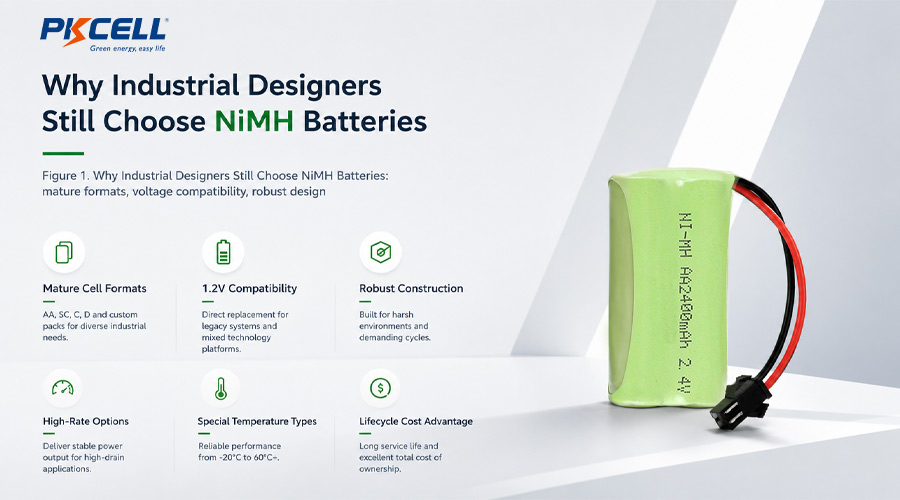
Lithium-ion dominates many new portable products, but it has not made nickel-metal hydride obsolete. NiMH batteries remain a practical industrial choice when a product values mature 1.2 V cell formats, robust pack construction, straightforward legacy integration, useful high-current performance, and a chemistry without a flammable organic electrolyte.
The right question is not whether NiMH or lithium is universally better. It is which chemistry delivers the required voltage, runtime, power, temperature performance, safety architecture, maintenance model, certification path, and total cost for a specific industrial product.
NiMH Is a Mature Industrial Battery Platform
NiMH cells typically use a nickel hydroxide positive electrode, a hydrogen-absorbing alloy negative electrode, an alkaline electrolyte, a metal case, separator, gasket, and pressure-relief structure. Cylindrical formats share a familiar mechanical footprint with many primary and older rechargeable battery systems. Panasonic’s NiMH technical handbook describes the chemistry as the successor to NiCd for rechargeable portable devices and identifies applications that include transportation, solar technology, medical equipment, communications, security systems, and automotive backup. It also emphasizes that specialized NiMH families are designed for different temperature, charge, discharge, and life requirements. PKCELL offers industrial NiMH cells in common cylindrical formats including AAA, AA, A, SC, C, and D options. The exact capacity, current, temperature, and cycle performance must be confirmed from the selected model’s datasheet.
NiMH remains relevant because industrial design rewards proven fit, predictable integration, and application-specific reliability—not only the highest energy density.
Seven Reasons NiMH Still Fits Industrial Applications
1. Compatibility with established 1.2 V platforms
Many instruments, emergency devices, medical products, radios, and control systems were designed around 1.2 V nickel-based cells. A NiMH redesign may preserve more of the existing voltage architecture, mechanical envelope, charger concept, and field-service process than a move to a higher-voltage lithium-ion cell.
For example, five cells in series produce a nominal 6 V pack, six produce 7.2 V, eight produce 9.6 V, and ten produce 12 V. The real voltage changes with SOC, current, temperature, and cell design, so the equipment must be checked across the full operating curve.
2. Robust safety characteristics
NiMH uses an aqueous alkaline electrolyte rather than the flammable organic electrolyte used in common lithium-ion cells. That can simplify the hazard profile for some products. However, NiMH cells can still heat, vent gas, leak electrolyte, or rupture when incorrectly charged, shorted, reversed, or exposed to excessive temperature. Good industrial design still requires cell-level safety review, current protection, temperature sensing where needed, charger controls, insulation, vent clearance, and mechanical testing.
3. Useful high-current performance
High-rate NiMH cell families can support tools, actuators, radios, medical equipment, and other loads with bursts or sustained current. The achievable rate depends on the exact cell, temperature, pack size, interconnects, and cooling. Do not select a cell by capacity alone. Review voltage sag, internal resistance, continuous current, pulse duration, wire gauge, connector rating, weld resistance, and pack temperature under the actual duty cycle.
4. Specialized temperature options
Industrial NiMH portfolios include standard, high-temperature, low-temperature, high-rate, long-life, and infrastructure-oriented variants. Panasonic documents specialized products for high ambient temperature, low-temperature operation, rapid charge, high-rate discharge, and long-life backup applications. This does not mean every NiMH cell works across those extremes. Charge and discharge ranges often differ, and specialty performance applies only to the designated model and qualified control method.
5. Practical replacement for some NiCd systems
NiMH avoids cadmium and can provide higher capacity than an equivalently sized legacy NiCd cell in many product families. It can be attractive when an OEM needs to update a nickel-based platform while preserving a similar cell voltage and mechanical format. A drop-in assumption is unsafe. NiMH and NiCd have different charge-termination behavior, heat generation, overcharge tolerance, self-discharge, and cell characteristics. The charger and pack must be requalified.
6. Flexible pack formats and terminations
NiMH cells can be assembled into different series and parallel configurations with tabs, leads, connectors, heat-shrink, holders, cases, fuses, thermostats, and NTC thermistors. This supports replacement packs and new OEM products with limited internal space. PKCELL’s custom NiMH battery-pack overview covers cell selection, pack configuration, connectors, charging requirements, prototyping, and industrial applications.
7. A competitive total-cost option
For a product that does not need lithium-ion energy density, NiMH may reduce redesign effort, electronics complexity, transport constraints, or field-service disruption. Total cost should include cells, charger, protection, tooling, testing, certification, logistics, replacement intervals, warranty risk, and device redesign—not just the cell price.
NiMH vs Lithium-Ion and LiFePO4
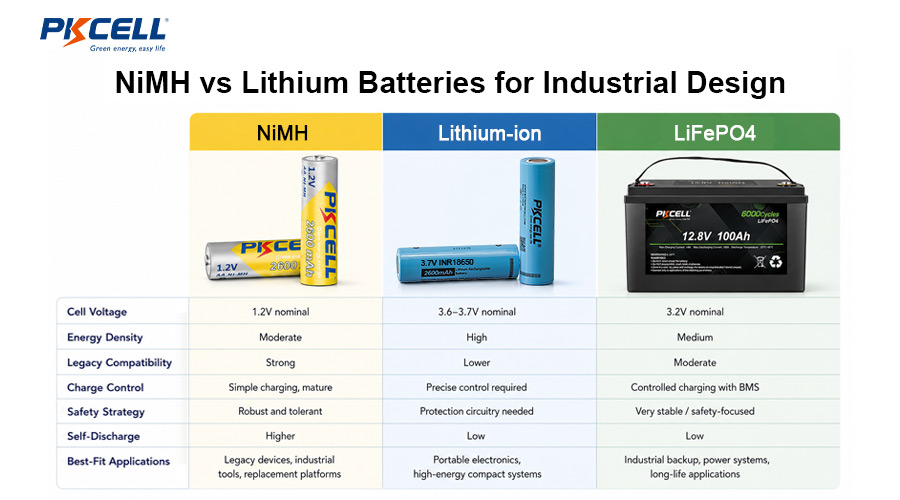
| Selection factor | NiMH | Li-ion | LiFePO4 |
|---|---|---|---|
| Nominal cell voltage | About 1.2 V | Commonly around 3.6–3.7 V | Commonly around 3.2 V |
| Energy density | Lower than common lithium systems | Often the strongest option where size and weight dominate | Usually below high-energy Li-ion but application-dependent |
| Legacy nickel-system compatibility | Potentially favorable after charger requalification | Usually requires voltage and charger redesign | Usually requires voltage and charger redesign |
| Charge control | Requires a NiMH-specific method using qualified termination and thermal controls | Requires precise CC/CV charging and protection | Requires chemistry-specific CC/CV charging and protection |
| Self-discharge | Can be higher; low-self-discharge variants are available | Generally lower, model-dependent | Generally lower, model-dependent |
| Safety architecture | No flammable organic electrolyte, but overcharge heat and venting must be managed | Needs careful protection against voltage, current, temperature, and internal faults | Thermally stable lithium chemistry, but still requires qualified protection |
| Best-fit examples | Legacy platforms, backup, instruments, medical, security, and communications | Weight- and runtime-sensitive portable devices | Long-life, power, backup, and industrial energy applications |
Where Industrial NiMH Batteries Make Sense
Emergency and backup equipment
Emergency lighting, alarm panels, access systems, e-call backup, and control equipment may benefit from established nickel-based architectures and specialty long-life or high-temperature cells. Standby charging requires a qualified strategy; continuous uncontrolled trickle charging can shorten life.
Medical and diagnostic equipment
Handheld monitors, diagnostic tools, home-care products, and portable medical equipment may use NiMH where robustness, familiar voltage, replaceability, or an established design history matters. PKCELL’s medical battery solutions include NiMH and custom pack options with wires, connectors, protection, NTCs, and documentation support.
Test instruments and industrial handhelds
Digital multimeters, gas detectors, measurement tools, radios, data loggers, and portable controllers can be good candidates when the device accepts the voltage curve and the selected cells meet runtime, load, and temperature requirements.
Security and communications systems
Alarm devices, access control, portable radios, backup communication equipment, and remote monitoring units may prioritize predictable service and mature charging over the lowest possible weight.
Tools, actuators, and mobile equipment
High-rate SC and other industrial cells can serve motorized or pulsed loads. Validate startup current, repeated pulses, connector and weld heating, end-of-discharge voltage, and cooling inside the final enclosure.
Is NiMH suitable for your industrial product?
Send PKCELL your voltage, capacity, current profile, runtime, available space, temperature range, charger, connector, annual volume, and certification requirements. The engineering team can compare NiMH with lithium-ion or LiFePO4 and propose a suitable pack architecture. Discuss Your Industrial Battery Project
NiMH Limitations That Must Be Designed Around
- Lower energy density: A NiMH pack may be larger or heavier than a lithium-ion pack with similar stored energy.
- Higher self-discharge: Long storage or standby intervals require the correct cell family and maintenance strategy.
- Charge heat: Temperature can rise near full charge, especially when the charge rate or termination method is unsuitable.
- Charge detection: Fast charging can require negative-delta-V, temperature rise, dT/dt, timer, or combined termination controls designed for the exact cells.
- More series cells: Reaching a higher pack voltage requires more 1.2 V cells, adding interconnects and opportunities for variation.
- Voltage-based SOC limits: The discharge curve and relaxation behavior can make simple voltage-only fuel gauging inaccurate.
- Pack imbalance: Cell capacity, self-discharge, temperature, and resistance differences still need control.
- Recycling requirement: NiMH avoids cadmium but still contains nickel and should enter an approved battery recycling stream.
NiMH is a poor fit when minimum mass, very high energy density, ultra-low self-discharge, or the smallest possible cell count dominates the design. In those cases, a lithium-ion or LiFePO4 pack may be more appropriate.
Charging Is the Core Engineering Requirement
NiMH charging should be designed from the selected cell manufacturer’s data. Slow, rapid, intermittent, standby, and high-temperature charging use different limits and termination strategies.
- Charge current and maximum permitted duration
- Temperature range for starting and continuing charge
- Negative-delta-V sensitivity where used
- Absolute temperature cutoff
- Rate-of-temperature-rise detection where applicable
- Safety timer and backup termination
- Precharge or recovery behavior for deeply discharged cells
- Standby or maintenance-charge strategy
- Cell-count and pack-voltage detection
- Response to an open or shorted NTC
A charger that worked with NiCd or another NiMH cell is not automatically qualified for a new NiMH pack.
Cell Matching and Temperature Sensing
Cells in a series NiMH pack carry the same current. A lower-capacity or higher-self-discharge cell can reach reversal or charge stress earlier than its neighbors. Production packs should use the same approved model and controlled lots, with matching criteria based on capacity, voltage behavior, resistance, and self-discharge as appropriate. Temperature sensing is especially valuable during rapid charging and in dense or high-temperature packs. NTC placement should track the thermally limiting cells rather than a cool enclosure wall. For multi-row packs, thermal mapping may justify more than one sensor. PKCELL’s custom battery pack service supports cell selection, pack structure, wires, connectors, terminations, temperature sensing, and application-specific protection.
A Practical Industrial NiMH Selection Workflow
- Define the device requirements. Record voltage range, current profile, runtime, recharge time, temperature, space, weight, service life, and target markets.
- Compare chemistries. Evaluate NiMH, Li-ion, and LiFePO4 against energy, power, safety architecture, charger, transport, and lifecycle cost.
- Select the NiMH family. Choose standard, high-rate, high-temperature, low-temperature, low-self-discharge, or long-life cells.
- Choose the S/P configuration. Model the full voltage curve, usable capacity, load sag, cell count, and imbalance risk.
- Design the charger. Define charge rate, termination, temperature limits, timers, maintenance strategy, and fault response.
- Design the pack. Specify matching, welds, tabs, wires, connector, fuse, thermostat or NTC, insulation, vent clearance, enclosure, and strain relief.
- Build production-intent samples. Use the intended cells, charger, harness, enclosure, sensor, and manufacturing process.
- Validate worst cases. Test charge, discharge, pulse load, temperature extremes, storage, overcharge controls, vibration, shock, and aging.
- Lock quality controls. Define approved suppliers, lot traceability, matching, assembly parameters, electrical tests, aging, and change notification.
Standard and custom options can be reviewed through PKCELL’s NiMH battery and pack range and broader rechargeable battery product catalog.
Common NiMH Selection Mistakes
- Choosing NiMH only because the cell fits the existing battery compartment
- Assuming a NiCd charger is automatically suitable for NiMH
- Using one generic temperature range for every NiMH model
- Selecting by capacity without checking voltage sag and discharge current
- Ignoring self-discharge during long storage or standby periods
- Using uncontrolled continuous trickle charge as a universal maintenance strategy
- Omitting temperature sensing during rapid charge
- Mixing cell models, lots, ages, capacities, or usage histories
- Designing no space or pathway for cell venting
- Comparing NiMH and lithium packs only by initial purchase price
- Skipping tests with the real charger and final device load
- Changing cells or charger firmware without requalification
What to Include in an Industrial NiMH Pack Inquiry
- Application, target market, and existing battery or charger details
- Nominal, minimum, and maximum device voltage
- Required capacity, runtime, and end-of-life runtime
- Continuous, peak, startup, and standby currents
- Charge source, target charge time, and maintenance-charge behavior
- Operating, charging, and storage temperatures
- Available dimensions, weight, mounting, and enclosure conditions
- Wire, connector, tab, fuse, thermostat, and NTC requirements
- Prototype quantity, annual volume, launch schedule, and target cost
- Required quality, safety, environmental, and market documentation
Frequently Asked Questions
Are NiMH batteries better than lithium-ion for industrial equipment?
Neither chemistry is universally better. NiMH can be advantageous for mature 1.2 V platforms, robust replaceable packs, nickel-system upgrades, and applications that do not need maximum energy density. Lithium-ion is often preferable when weight, volume, runtime, or low self-discharge dominates.
Can NiMH replace NiCd without changing the charger?
Do not assume so. Although both use a nominal 1.2 V cell architecture, their charge acceptance, termination response, heat generation, capacity, and maintenance-charge requirements differ. Requalify the charger and pack using the exact NiMH cell data.
Do industrial NiMH packs need a BMS?
Many NiMH packs do not use the same cell-monitoring BMS architecture as lithium-ion packs, but they still need appropriate charge control and may require a fuse, thermostat, NTC, current protection, timer, voltage monitoring, or application-specific electronics.
How long does an industrial NiMH battery last?
Life depends on the exact cell, charge method, depth of discharge, temperature, overcharge exposure, storage SOC, load, and maintenance strategy. Use the selected cell’s cycle and standby data, then validate the complete pack under the real duty cycle.
Are NiMH batteries suitable for high-temperature standby use?
Specialized high-temperature and long-life NiMH cells are available, but standard cells should not be assumed suitable. Select a qualified model and verify the standby-charge method, enclosure temperature, sensor placement, and expected service life.
What certifications can PKCELL support for NiMH batteries?
PKCELL operates quality and environmental management systems including ISO 9001 and ISO 14001. Depending on the exact NiMH cell, pack design, destination market, and project scope, support may include CB/IEC 62133-1, CE, RoHS, REACH, MSDS/SDS, and other product-specific documents. UN 38.3 and UL 1642 apply to lithium batteries or lithium cells and should not be listed as generic NiMH requirements. Confirm the certification route through PKCELL’s battery certificates and compliance information.
What is PKCELL’s manufacturing capacity for bulk orders?
PKCELL’s published company information describes a 28,000 m² manufacturing facility, more than 20 automated production lines, and a professional team of more than 400 people. Current public content cites annual capacity of up to 500 million battery units. Available NiMH pack capacity depends on the cell format, assembly, charger or electronics, harness, testing, certification, and forecast. Buyers should request a project-specific capacity review.
How can I get a bulk quote for industrial NiMH batteries?
Provide the cell size or pack drawing, voltage, capacity, continuous and peak current, charge method, temperature range, wire and connector, annual forecast, first-order quantity, destination country, documentation requirements, packaging, and requested Incoterm. Request bulk NiMH battery pricing.
What is the MOQ, and can buyers order NiMH samples first?
Samples are available subject to model and project status. Some PKCELL product pages state a minimum formal-order value starting from USD 500, while the actual MOQ depends on the cell, custom pack structure, connector, tooling, certification, and production process.
Can PKCELL customize an industrial NiMH battery pack?
Yes. Customization can include voltage, capacity, series/parallel configuration, cell format, tabs, wires, connector, fuse, thermostat, NTC, casing, label, charger interface, and packaging. Final specifications should be validated with the actual charger, device load, temperature range, and mechanical environment.
What quality records should an industrial buyer request?
Define cell model and lot traceability, incoming inspection, capacity and resistance criteria, self-discharge or aging checks, weld and assembly controls, pack voltage, temperature-sensor testing, charge-discharge verification, final inspection, data retention, change notification, and corrective-action requirements.
Conclusion: NiMH Still Wins Where the Application Fits
NiMH remains a strong industrial option when a product benefits from mature 1.2 V formats, reliable cylindrical construction, high-rate variants, specialized temperature families, legacy compatibility, and a well-understood service model. Its lower energy density, self-discharge, charging requirements, and heat near full charge must be designed honestly. The best result comes from comparing complete battery systems rather than choosing chemistry from a headline specification.
Request an Industrial NiMH Battery Pack Review
Share your voltage, capacity, current, runtime, charger, dimensions, connector, temperature range, quantity, and compliance needs with PKCELL. Our engineering team can evaluate the cell family, pack configuration, charging, sensing, testing, and volume-production requirements. Send Your NiMH Battery Requirements
Post time: Aug-17-2026


