
Last updated: June 4 2026 | For consumers, engineers, OEM buyers and product developers choosing between LIR2032 rechargeable coin cells and CR2032 lithium coin cells.
Quick Answer
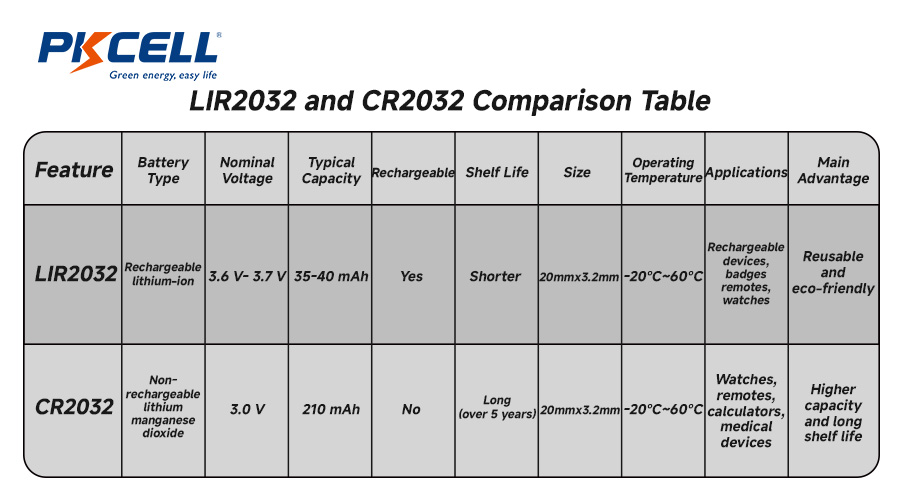
LIR2032 and CR2032 have the same physical size, but they are not the same battery. Both are about 20mm in diameter and 3.2mm thick. However, LIR2032 is a rechargeable lithium-ion coin cell with a nominal voltage around 3.6V or 3.7V, while CR2032 is a non-rechargeable lithium manganese dioxide coin cell with a nominal voltage of 3V.
Do not replace CR2032 with LIR2032 unless the device clearly supports 3.6V–3.7V rechargeable coin cells. Do not charge CR2032 batteries. Using the wrong battery may cause poor performance, leakage, overheating, device damage or safety risks.
Safety Warning
CR2032 batteries are not rechargeable. Never charge, open, puncture, heat or short-circuit a CR2032 battery. LIR2032 batteries should only be charged with a compatible charger or charging circuit designed for rechargeable lithium-ion coin cells.
LIR2032 vs CR2032: Main Differences
What Is a CR2032 Battery?
A CR2032 is a 3V non-rechargeable lithium manganese dioxide coin cell battery. It is widely used because it is compact, affordable, stable in low-drain applications and has a long shelf life when stored correctly.
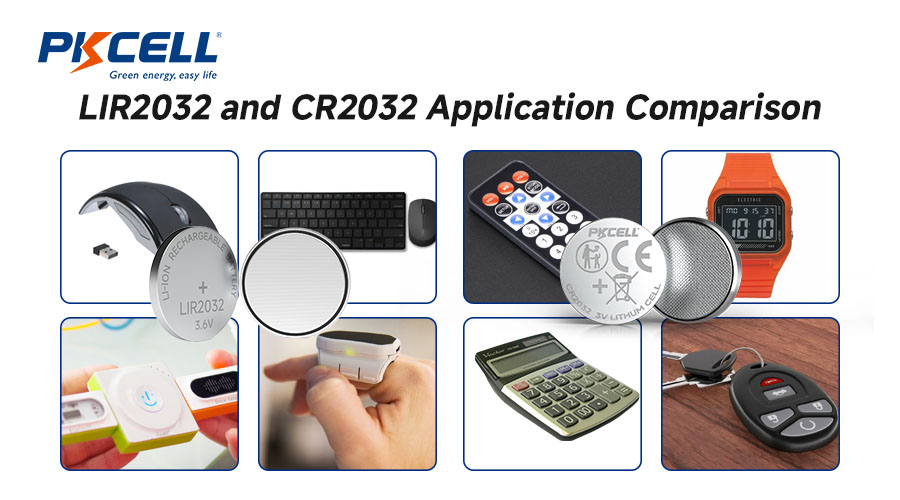
CR2032 Is Commonly Used In
- Car key fobs
- Watches and calculators
- Medical devices and digital thermometers
- Remote controls and small sensors
- Computer motherboard CMOS backup
- Security devices and meters
What Is a LIR2032 Battery?
A LIR2032 is a rechargeable lithium-ion coin cell battery with the same 20mm × 3.2mm physical size as CR2032. Its key advantage is rechargeability, but its voltage is higher than a standard CR2032. That difference makes compatibility more complex.
LIR2032 Is Better Suited For
- Devices specifically designed for rechargeable coin cells
- Small electronics with compatible charging circuits
- Applications requiring repeated charge and discharge cycles
- Projects where the circuit supports 3.6V–3.7V operation
Can LIR2032 Replace CR2032?
Usually, no. Although LIR2032 and CR2032 are the same size, LIR2032 has a higher voltage. A device designed only for a 3V CR2032 battery may not tolerate 3.6V–3.7V input.
Can CR2032 Replace LIR2032?
Sometimes CR2032 can physically fit where LIR2032 is used, but it is not always electrically suitable. CR2032 has a lower voltage and cannot be charged. If the device expects a rechargeable LIR2032 or has a built-in charging circuit, CR2032 should not be used.
Important: Never place a CR2032 battery into a device that will try to recharge it. CR2032 is not designed for charging and may leak, overheat, swell or rupture.
What Happens If You Charge a CR2032 Battery?
Charging a CR2032 battery is unsafe. CR2032 cells are primary lithium batteries, meaning their chemistry is designed for single-use discharge, not repeated charging.
Which Battery Should You Choose?
Choose CR2032 If
- Your device manual specifies CR2032 or 3V coin cell power.
- You need long shelf life and stable low-drain performance.
- The device is a key fob, remote, watch, calculator, meter or medical device.
- You want a simple replacement battery without charging.
Choose LIR2032 If
- The device specifically supports rechargeable LIR2032 batteries.
- The charging circuit is designed for lithium-ion coin cells.
- The device can safely operate at 3.6V–3.7V.
- You need repeated charging instead of single-use replacement.
Application Guide
OEM and B2B Battery Selection Considerations
For OEM projects, LIR2032 vs CR2032 selection should not be based only on physical size. Engineers and buyers should evaluate voltage tolerance, charging circuit, expected runtime, safety, certification, storage life, connector or tab requirements and long-term supply stability.
PKCELL Coin Cell Battery Solutions
Need LIR2032 or CR2032 Batteries for OEM Projects?
PKCELL can support coin cell battery selection for small electronics, medical devices, smart devices, meters, remotes, key fobs and OEM projects. Depending on project requirements, buyers can request suitable rechargeable coin cell or non-rechargeable lithium coin cell options, as well as tabbed cells, leads, connectors, packaging and export documentation.
Best fit: CR2032 replacement projects, LIR2032 rechargeable coin cell applications, small device battery design, OEM coin cell sourcing and customized battery assembly support.
Safety Tips
- Do not charge CR2032 batteries.
- Do not use LIR2032 in 3V-only devices unless compatibility is confirmed.
- Do not mix rechargeable and non-rechargeable coin cells.
- Use only a compatible charger or charging circuit for LIR2032.
- Follow the device manual or engineering specification.
- Keep coin cell batteries away from children and pets.
- Do not short-circuit, puncture, crush, open or heat coin cells.
- Recycle used batteries according to local regulations.
FAQ
Conclusion
LIR2032 and CR2032 look similar because they share the same 20mm × 3.2mm size, but they are not interchangeable by default. LIR2032 is rechargeable and usually has a higher voltage, while CR2032 is a non-rechargeable 3V lithium coin cell.
For replacement use, follow the device manual. For OEM projects, choose based on voltage tolerance, charging design, runtime, safety, mounting method, certification and long-term supply requirements.
Post time: Sep-06-2023


