18650 Battery Selection Guide
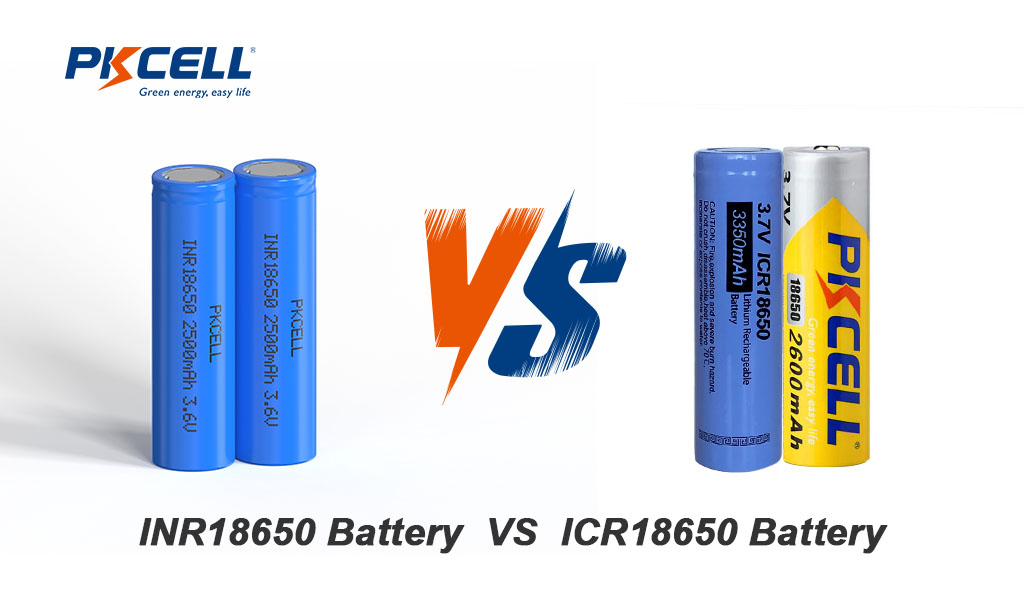
INR vs ICR 18650 Batteries: Differences & Selection
INR and ICR are common designations for rechargeable 18650 lithium-ion cells. They can indicate different cathode families and performance priorities, but the letters alone do not define capacity, current, safety, cycle life, or replacement compatibility.
Updated: September 2026
What Do INR and ICR Mean on an 18650 Battery?
The number 18650 describes a cylindrical cell format roughly 18 mm in diameter and 65 mm long. Actual maximum dimensions vary by manufacturer, and a protected cell can be longer than a bare industrial cell because a protection board and terminal assembly are added.
The letters are commonly used as chemistry or product-family designations:
ICR 18650
ICR is commonly associated with lithium cobalt oxide or cobalt-rich cathode systems. Many ICR products are designed around high energy storage and moderate discharge requirements.
INR 18650
INR is commonly associated with lithium nickel manganese cobalt oxide, often called NMC or NCM. The family includes both energy-oriented and high-power cell models.
These naming conventions are not a universal specification system. Manufacturers use different model codes, cathode blends, electrode designs, additives, and performance targets. Two cells marked INR18650 can have dramatically different capacity, impedance, charge rate, and maximum discharge current.
Treat INR and ICR as useful clues, not as substitutes for a datasheet.
INR vs ICR 18650 Battery Comparison
| Decision factor | ICR 18650 | INR 18650 |
|---|---|---|
| Common cathode association | Lithium cobalt oxide or cobalt-rich lithium-ion | Nickel-manganese-cobalt lithium-ion, with manufacturer-specific ratios |
| Typical design direction | Often optimized for energy and runtime at moderate loads | Can be optimized for energy, balanced performance, or high power |
| Capacity | Frequently energy-oriented, but capacity is model-specific | Ranges from high-power lower-capacity cells to high-capacity energy cells |
| Discharge current | Often lower than a purpose-designed power cell; verify the exact limit | Some models support high continuous current, but the INR label does not guarantee it |
| Internal resistance | Depends on cell construction, age, temperature, and state of charge | Power-oriented models may be designed for lower impedance; verify AC and DC test methods |
| Thermal behavior | Requires strict control of charge, load, temperature, and mechanical abuse | NMC-based designs may offer a different balance of stability and power, but still require full protection |
| Cycle life | Determined by exact model and test conditions | Determined by exact model and test conditions; INR is not automatically longer-lived |
| Nominal voltage | Commonly around 3.6V or 3.7V | Commonly around 3.6V or 3.7V |
| Charging | Usually requires controlled CC-CV charging to a model-specific limit | Usually requires controlled CC-CV charging to a model-specific limit |
| Best selection method | Compare the exact manufacturer datasheets at the required load, temperature, cutoff voltage, life target, and pack configuration. | |
The broad trade-off is useful during early sourcing: ICR often points toward an energy-focused cell, while INR can point toward a more balanced or power-focused design. It is not accurate to claim that every ICR has more capacity or every INR has higher current, better safety, or longer cycle life.
Real Datasheet Example: INR vs ICR Is Not a Fixed Formula
The following examples illustrate why cell-level specifications matter more than the three-letter category. They are not class averages and should not be used as direct replacements without engineering review.
| Specification | Molicel INR-18650-P28A | Samsung SDI ICR18650-26J |
|---|---|---|
| Product direction | Power-oriented INR cell | Energy/moderate-current ICR cell |
| Typical capacity | 2,800mAh | 2,600mAh |
| Minimum capacity | 2,700mAh in the cited datasheet version | 2,550mAh in the cited specification |
| Nominal voltage | 3.6V | 3.63V |
| Charge voltage | 4.2V | 4.2V |
| Published maximum continuous discharge | 35A | 10A in the cited newer specification; other document versions may differ |
| Discharge cutoff | 2.5V | 2.75V |
| Maximum dimensions | 18.6 mm diameter × 65.2 mm height | 18.4 mm diameter × 65.0 mm height |
Even in this simple comparison, charge voltage and nominal voltage are similar while current limits, cutoff voltage, and physical tolerances differ. The Molicel datasheet also provides discharge curves across current and temperature, demonstrating that one current or capacity number cannot describe every operating condition.
Datasheet version matters: Cell specifications can change between revisions. Record the manufacturer, complete model, datasheet revision, production lot requirements, and approved supplier as part of the product specification.
Which Is Safer: INR or ICR?
No cylindrical lithium-ion cell is safe simply because it carries an INR or ICR label. Safety depends on cathode and anode design, separator, electrolyte, cell manufacturing quality, safety devices, charge state, temperature, mechanical integration, and the protection implemented at pack and equipment level.
INR cells are often described as having a more balanced thermal and power profile than traditional cobalt-rich ICR designs. That may help explain their use in many modern high-power applications. It does not remove the possibility of thermal runaway or permit operation beyond the datasheet.
Protection still required
- Overcharge, over-discharge, and overcurrent protection
- External short-circuit protection
- Cell and pack temperature monitoring
- Correct fuse and current-interrupt strategy
- Cell balancing for appropriate series packs
- Mechanical restraint, insulation, spacing, and propagation controls
- A charger matched to the approved cell and pack voltage
- Firmware limits and fault handling appropriate to the application
Molicel states that its industrial cells are intended for products equipped with a battery management unit and warns against individual consumer use outside permitted applications. This is a useful reminder that a bare cell rating is only one part of a safe battery system.
Can INR Replace ICR in an 18650 Battery Pack?
Sometimes an engineering team can qualify an INR cell as a replacement, but it is not a drop-in decision. Similar size and nominal voltage do not guarantee compatibility.
| Replacement check | Why it matters |
|---|---|
| Maximum charge voltage and charging profile | The existing charger must remain within the replacement cell's permitted voltage, current, temperature, and termination limits. |
| Discharge cutoff voltage | A BMS designed for one cutoff may over-discharge the other cell or leave usable energy unavailable. |
| Continuous and pulse current | The cell must support startup, motor, radio, heater, and fault currents without excessive voltage sag or temperature rise. |
| Capacity and runtime | A higher-current cell may have different capacity, efficiency, or runtime under the actual load profile. |
| Dimensions and terminals | Bare-cell tolerances, flat-top versus button-top construction, tabs, and protection boards affect fit and connection. |
| Pack cell matching | Do not mix old and new cells or different models in one series/parallel pack without a qualified design process. |
| Thermal model and protection settings | Temperature rise, cooling, current limits, balancing, and fault thresholds may require revalidation. |
| Compliance and approval | A cell change can affect transport reports, product certifications, traceability, warranties, and customer approval. |
For consumer replacement products, use only the battery type and part number approved by the device or battery-pack manufacturer. Rebuilding a welded 18650 pack with loose cells requires appropriate engineering, assembly equipment, insulation, testing, and safety controls.
How to Choose Between INR and ICR 18650 Cells
Choose from the load profile, not the chemistry nickname
Build a current-versus-time profile that includes standby current, continuous operation, startup events, wireless transmissions, motors, pumps, heaters, and fault conditions. Specify both the amplitude and duration of each peak.
Use minimum capacity for conservative runtime estimates
Typical capacity describes a representative result. Minimum capacity is more useful for design margins and incoming acceptance. Estimate watt-hours, then apply converter efficiency, cutoff voltage, temperature, aging, cell imbalance, and reserve margin.
Review discharge curves and temperature data
A cell rated for high current at room temperature may behave differently in cold or hot conditions. Compare voltage sag and temperature rise at the real current. Confirm that the product remains inside both cell and component limits.
Separate cell choice from pack architecture
Series cells raise voltage; parallel cells raise capacity and current capability. The BMS, busbars, welds, fuse strategy, sensors, wiring, connector, enclosure, and charger must all be sized for the pack configuration.
Typical application direction
Energy-focused moderate loads
An approved ICR model may fit electronics, backup equipment, and portable products that prioritize runtime and operate within a moderate current envelope.
Balanced or high-power loads
An approved INR model may fit power tools, robotics, portable medical equipment, mobility systems, appliances, and industrial devices that need verified current capability.
These are starting points only. Modern INR families also include high-capacity energy cells, and individual ICR models have different power ratings. The correct question is always whether the exact model satisfies the full specification.
OEM 18650 Cell Selection Checklist
- Define voltage architecture. Specify series count, nominal pack voltage, maximum charge voltage, minimum system voltage, and charger behavior.
- Document continuous and peak loads. Include magnitude, duration, repetition, duty cycle, and simultaneous loads.
- Set runtime and life targets. Define minimum watt-hours, charge frequency, depth of discharge, calendar life, and required capacity retention.
- Specify the environment. Include charging, discharging, and storage temperatures plus shock, vibration, humidity, altitude, and foreseeable abuse.
- Design the protection system. Select BMS/PCM functions, balancing, temperature sensors, fuses, current limits, communication, and fault response.
- Confirm mechanical integration. Check cell dimensions, holder or weld method, insulators, spacing, vent direction, cooling, and enclosure strength.
- Validate samples in the final product. Test capacity, pulse voltage, temperature rise, charging, aging, faults, and worst-case production tolerances.
- Control sourcing and changes. Approve the exact manufacturer and model, datasheet revision, documentation, lot traceability, forecast, and change-notification process.
PKCELL 18650 Battery Support
PKCELL supplies cylindrical lithium-ion cells and custom 18650 battery packs for OEM projects. Available project options can include cell selection, series/parallel configuration, PCM/BMS, wiring, connectors, temperature sensing, casing, labeling, and documentation support.
Review PKCELL cylindrical Li-ion batteries and the guide to reading a lithium-ion cell datasheet before finalizing a pack design.
Common INR and ICR Selection Mistakes
- Assuming every INR is a high-drain cell: current capability varies widely within the INR family.
- Assuming every ICR has higher capacity: compare exact models and test conditions.
- Ranking safety by letters alone: protection, quality, state of charge, temperature, and pack design remain critical.
- Choosing by mAh only: voltage sag and heat may prevent a high-capacity cell from meeting a high-power load.
- Using a charger's nominal voltage as proof of compatibility: charge current, cutoff, temperature, and termination also matter.
- Ignoring protected-cell length: an added PCB can make a protected 18650 longer than a bare cell.
- Mixing cell models, ages, or states of health: mismatch can create imbalance, heating, and premature cutoff.
- Using cells without traceable datasheets: rewrapped, counterfeit, or unknown cells cannot be qualified from printed claims alone.
Frequently Asked Questions
What is the main difference between INR and ICR 18650 batteries?
ICR is commonly associated with cobalt-rich, energy-oriented lithium-ion cells. INR is commonly associated with nickel-manganese-cobalt cells and can cover energy, balanced, or high-power designs. Exact performance depends on the specific model.
Is INR always better than ICR?
No. INR may be preferable for many modern power applications, while an approved ICR may suit a moderate-load, energy-focused design. Compare the required specifications with the complete datasheets.
Can I replace ICR18650 with INR18650?
Only after confirming charge voltage, cutoff voltage, current, capacity, dimensions, protection, temperature, pack matching, and equipment approval. The 18650 size alone is not enough.
Are INR batteries safer than ICR batteries?
Some INR designs offer a favorable balance of thermal stability and power, but the label does not guarantee safety. Both require quality cells, appropriate protection, correct charging, mechanical design, and operation within limits.
Which 18650 chemistry is best for high-drain equipment?
Choose a cell whose manufacturer explicitly rates it for the required continuous and pulse current. Many power-oriented cells are INR, but chemistry letters cannot replace the current and temperature data.
Does a higher-capacity 18650 give longer runtime?
It can under the same compatible load and test conditions. At high current or low temperature, voltage sag, heat, efficiency, and device cutoff may change usable runtime.
Can I mix INR and ICR cells in one pack?
Do not mix chemistries, models, capacities, ages, or states of health unless a qualified battery engineer has designed and validated that specific system. Production packs normally use matched cells of one approved model.
Do INR cells need a BMS?
Yes, a lithium-ion pack still requires protection appropriate to its configuration and application. INR chemistry does not eliminate overcharge, over-discharge, short-circuit, overcurrent, temperature, or balancing requirements.
Conclusion: Choose the Exact Cell, Not Just INR or ICR
INR and ICR describe broad battery directions, not complete performance guarantees. ICR often points toward energy-focused use at moderate current. INR includes many balanced and high-power designs, as well as energy-oriented models. Neither category is automatically the best choice for every device.
Start with voltage, energy, current, temperature, lifetime, mechanical, safety, compliance, and supply requirements. Then qualify an exact manufacturer and model using its current datasheet and tests in the final battery pack.
Need Help Selecting an 18650 Cell?
Send PKCELL your voltage platform, load profile, runtime target, temperature range, pack dimensions, charging method, annual volume, and documentation needs. Our team can review suitable cell and custom pack options for your application.
Post time: May-11-2024