
Video Doorbell Battery Life: How OEMs Test Motion Events, Wi-Fi, and Night Vision
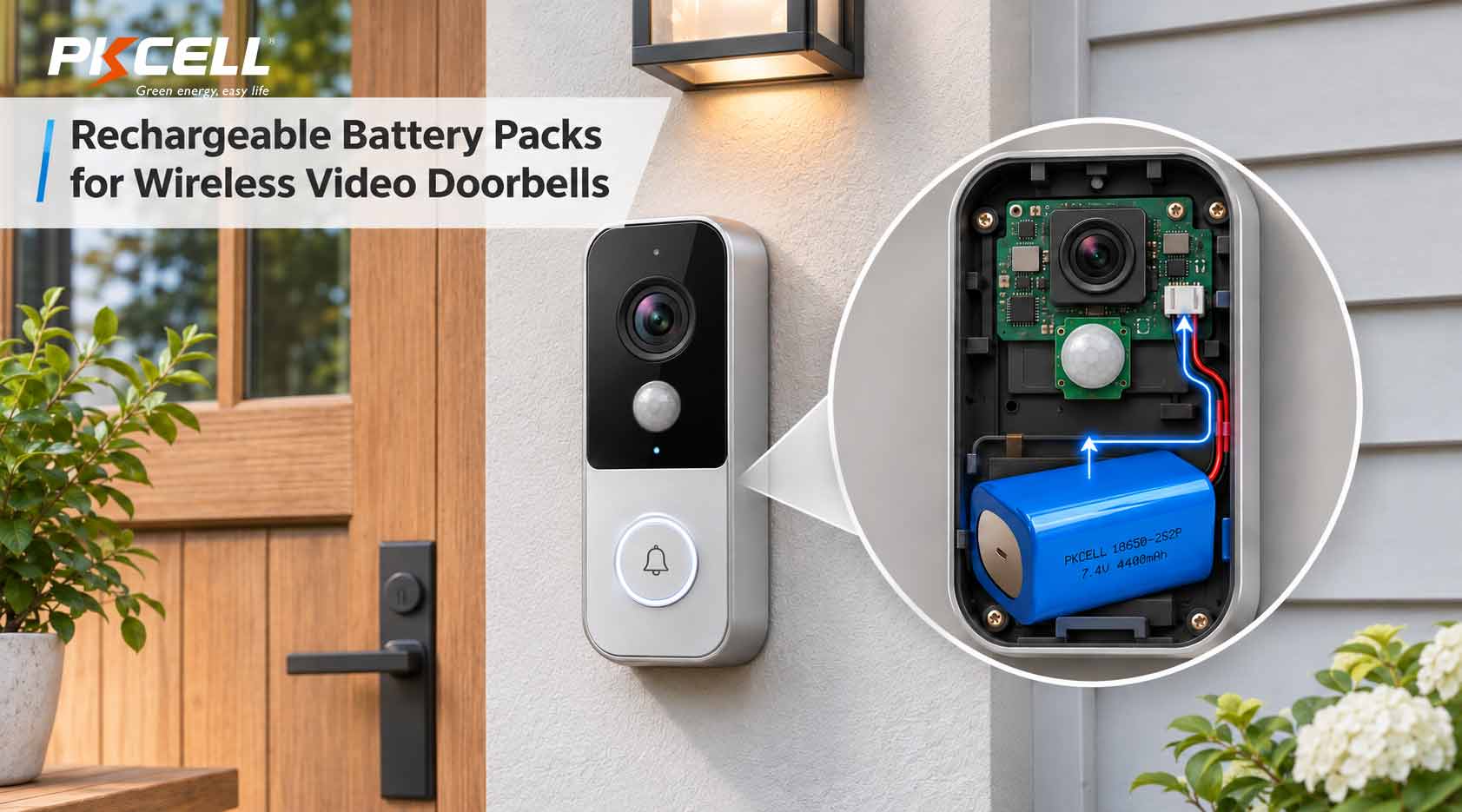
Battery life is a key performance factor in wireless video doorbells. Users expect continuous monitoring, motion alerts, video recording and remote viewing without frequent recharging.
Unlike devices with a constant load, video doorbells operate through repeated wake-up and standby cycles. Camera activation, Wi-Fi transmission, infrared illumination and two-way audio can all increase energy consumption. For OEMs, understanding these operating conditions is essential when designing rechargeable battery packs.
1. Why Do Motion Events Have Such a Big Impact on Video Doorbell Battery Life?
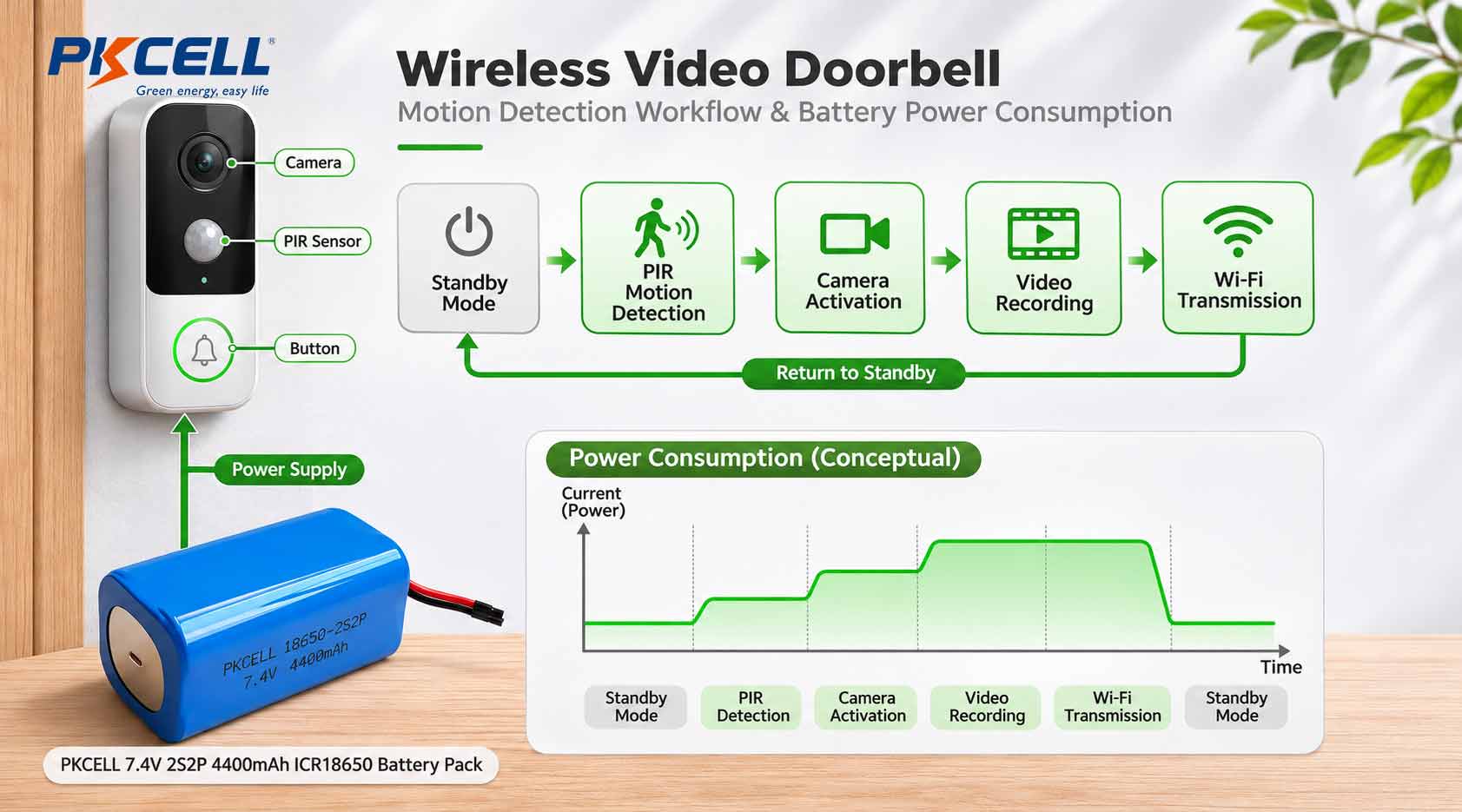
A video doorbell may remain in standby for hours, but each detected event can activate multiple power-consuming components.
A typical motion-triggered sequence includes:
- Motion detection: A PIR sensor identifies activity.
- Camera wake-up: The controller activates the camera and image processor.
- Recording: Video is captured for the configured duration.
- Wireless transmission: Wi-Fi sends video or event notifications.
- Return to standby: High-power components enter a low-power state.
Frequent pedestrians, passing vehicles, moving plants and pets can increase unnecessary activations. Longer recording periods also increase energy consumption.
Arlo’s Video Doorbell Battery Life Guide identifies frequent motion and audio recordings as factors affecting battery performance. Activity filtering does not necessarily reduce electrical consumption if the device continues monitoring the same area.
What Should OEMs Measure?
| Test Parameter | Measurement Focus |
|---|---|
| Daily motion events | Total system activations |
| Recording duration | Time spent capturing video |
| False triggers | Unnecessary wake-up frequency |
| Event energy | Battery energy consumed per complete event |
For reference, Texas Instruments explains the low-power and active power architecture of battery-powered cameras in its Video Doorbell Power Rails Design Note.
Related reading: Lithium Batteries for Real-Time Remote Activity Monitoring Boxes.
2. How Does Wi-Fi Activity Affect Video Doorbell Battery Consumption?
Wi-Fi supports motion notifications, video uploading, remote commands, live streaming and two-way audio. These functions can create substantial differences in energy consumption depending on how frequently they are used.
OEM engineers should evaluate three important conditions:
- Connection activity: Measure standby current and the energy required to establish or restore a connection.
- Video transmission: Measure current and energy during video uploading and live viewing.
- Weak signal conditions: Test whether poor coverage increases transmission time or repeated connection attempts.
Metal doors, exterior walls and distance from the router can affect wireless performance. A video doorbell should therefore be tested under both strong and weak Wi-Fi conditions.
Wi-Fi Validation Scenarios
| Scenario | What to Evaluate |
|---|---|
| Strong signal | Normal connection and upload energy |
| Weak signal | Retries and reconnection behavior |
| Network interruption | Recovery time and additional consumption |
| Live viewing | Continuous streaming current |
Optimizing wireless wake-up intervals, antenna placement and reconnection behavior can help reduce avoidable power consumption.
For more information, see PKCELL’s Battery Pack Runtime Calculation Guide.
3. Why Does Night Vision Increase Video Doorbell Battery Consumption?
At night, video doorbells may activate infrared LEDs or white-light illumination to capture images in low-light environments. These additional loads can increase energy consumption during recording.
A typical night-vision system may include:
- Infrared or white-light LEDs.
- Camera image sensor and image processor.
- Ambient light sensor.
- IR-cut filter mechanism, where used.
The actual energy difference depends on the camera design, illumination intensity, recording duration and firmware settings.
Recommended Night Vision Tests
| Test Condition | Measurement Focus |
|---|---|
| Daylight | Baseline recording energy |
| Low light | Image processing and illumination activation |
| Night vision | IR LED current and total event energy |
OEMs should use realistic day-and-night event frequencies when estimating battery life. A device installed in a poorly lit entrance may activate infrared illumination more frequently than one in a well-lit location.
4. How Can OEMs Calculate Realistic Video Doorbell Battery Life?
Battery runtime should include continuous standby consumption and energy used by motion events, nighttime recording and remote viewing.
Energy Calculation Model
Standby energy:
Estandby = Vbattery × Istandby × 24
Event energy:
Eevent = Vbattery × Iaverage × Time ÷ 3600
Daily energy:
Edaily = Estandby + Eday + Enight + Elive + Eaudio
Wi-Fi energy should be added separately only when it is not already included in the measured event consumption.
Practical Calculation Example
Consider an illustrative 3.7V, 6000mAh battery pack with the following operating assumptions:
| Parameter | Assumed Value |
|---|---|
| Standby current | 0.25mA |
| Daytime events | 18 × 12 seconds |
| Nighttime events | 8 × 18 seconds |
| Live viewing | 2 × 60 seconds |
| Two-way audio | 2 × 30 seconds |
| Additional Wi-Fi energy | 0.025Wh/day |
Assume average battery-side currents of 350mA for daytime events, 550mA for nighttime events, 450mA for live viewing and 300mA for audio.
The calculated daily consumption is:
Total daily consumption:
Edaily = 0.2803Wh/day
The nominal battery energy is:
Assuming an 80% usable energy fraction, 80% end-of-life capacity retention and a 90% design reserve factor:
Estimated runtime:
12.79 ÷ 0.2803 = approximately 46 days
This is an illustrative calculation, not a product-life guarantee. Actual runtime depends on event frequency, wireless conditions, temperature, battery aging and device firmware.
5. How Should OEMs Validate Battery Packs for Video Doorbells?
A battery pack should be evaluated together with the camera, Wi-Fi module, infrared illumination, audio system and charging circuit. Capacity alone cannot establish whether the complete device will meet its runtime target.
OEM Battery Validation Checklist
| Validation Area | Key Items to Test |
|---|---|
| Standby | Sleep current and sensor monitoring |
| Motion events | Wake-up energy and recording duration |
| Wi-Fi | Signal strength, uploading and reconnection |
| Night vision | IR LED activation and event energy |
| Battery discharge | Voltage stability and peak current |
| Charging | Voltage, current and temperature limits |
| Temperature | Outdoor hot and cold conditions |
| Battery aging | Capacity retention and runtime |
Choosing a Suitable Battery Pack
PKCELL provides rechargeable battery solutions for video doorbells and wireless security devices through its Smart Home Battery Solutions.
Depending on the device architecture, OEMs can evaluate:
- 3.7V 18650 Battery Packs for cylindrical cell configurations.
- 7.4V 18650 Battery Packs for higher-voltage configurations.
- Li-Polymer Batteries for compact device structures.
PKCELL also offers custom battery pack development, including cell configuration, protection circuits, wiring, connectors and structural customization.
Information Required for OEM Projects
- Device operating voltage and standby current.
- Motion-event frequency and recording duration.
- Peak current during video and night vision operation.
- Wi-Fi and live-view requirements.
- Battery compartment dimensions.
- Target runtime and operating temperature.
- Estimated annual order quantity.
Developing a Custom Video Doorbell Battery Pack?
PKCELL supports rechargeable battery pack development for smart-home and security applications. Share your device power requirements, motion-event profile and battery compartment dimensions to discuss a suitable configuration and sample evaluation.
Conclusion
Video doorbell battery life depends on motion-event frequency, Wi-Fi activity, night vision and standby consumption, not just nominal battery capacity.
For OEM manufacturers, measuring the complete event-driven power profile and validating the battery pack under realistic operating conditions are essential steps toward more predictable runtime and a better user experience.
Post time: Nov-09-2026


