
Can You Take Rechargeable Batteries on a Plane? Rules for 18650, 21700 and USB-C Batteries
Planning to travel with rechargeable batteries? Whether you are carrying spare 18650 cells for a flashlight, 21700 batteries for electronic equipment, a USB-C power bank for your phone, or rechargeable batteries for other portable devices, understanding airline battery rules before departure can help you avoid delays at airport security.
Not all rechargeable batteries are treated the same way. Airlines consider several factors, including battery chemistry, watt-hour (Wh) rating, whether the battery is installed in a device, and whether it is being carried as a spare. Carry-on and checked baggage also have different requirements.
In 2026, additional restrictions on power banks have made these distinctions even more important. Travelers should pay particular attention to the permitted number of power banks, their storage location, and restrictions on charging or using them during a flight.
Spare cylindrical lithium-ion cells belong in carry-on baggage with individually protected terminals.
Check the actual Wh rating, not just the mAh or USB-C output wattage.
Check power-bank quantity, in-flight charging and usage rules before departure.
1. First, Identify What Type of Rechargeable Battery You Are Carrying
Before checking airline limits, identify the battery configuration. A loose cylindrical cell, a customized battery pack, a battery installed inside a laptop, and a USB-C power bank may all contain lithium-ion technology, but they are not handled in exactly the same way.
Common rechargeable battery types carried by passengers
- 18650 batteries: Rechargeable cylindrical lithium-ion cells commonly found in flashlights, portable equipment and battery packs.
- 21700 batteries: Larger cylindrical lithium-ion cells used in compatible portable devices and custom battery assemblies.
- Li-ion battery packs: Multiple cells connected in series or parallel, often used in laptops, cameras, tools and other electronic products.
- USB-C power banks: Portable battery chargers that store electrical energy and provide power through USB-C or other output ports.
- USB-C rechargeable batteries: Individual rechargeable cells with an integrated USB-C charging interface, such as certain AA and AAA products.
- Devices with built-in batteries: Phones, tablets, laptops, cameras and other electronics with batteries installed inside the equipment.
An important distinction is that USB-C is a charging interface, not a battery chemistry or capacity category. A rechargeable AA battery with a USB-C port and a large USB-C power bank are different products, even though both use the same connector standard.
For a broader overview of rechargeable battery types and safe handling, see Uses and Precautions for Lithium-ion Battery Packs.
2. Can You Take 18650 Batteries on a Plane?
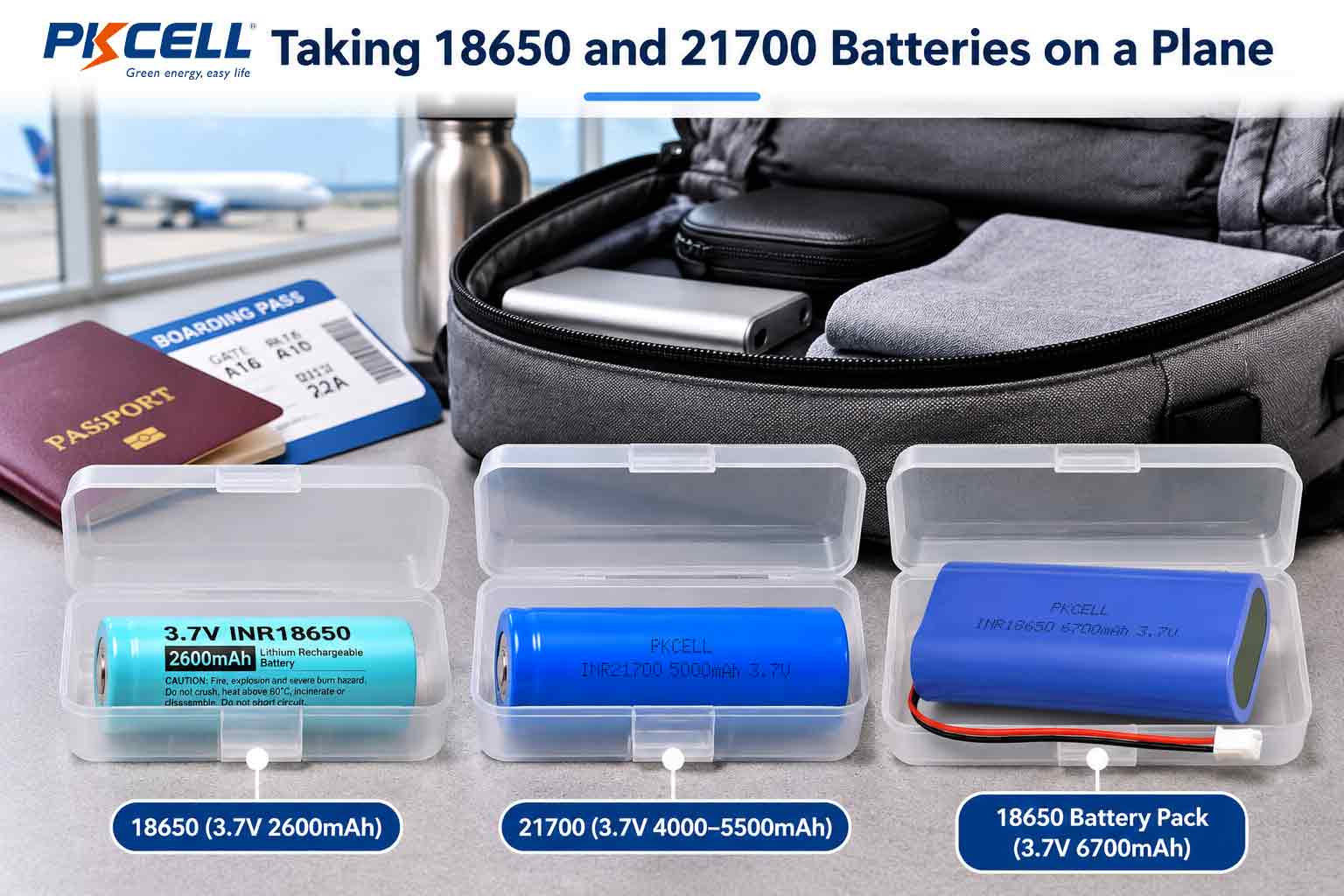
Yes. Spare 18650 lithium-ion cells for personal use can generally be carried on passenger aircraft when they meet the applicable watt-hour limits and are properly protected. However, they must be placed in carry-on baggage rather than checked luggage.
The 18650 designation describes the physical cell format. It does not determine the permitted battery capacity or automatically guarantee airline acceptance.
For example, PKCELL offers a 3.7V 2600mAh 18650 lithium-ion battery. Its nominal energy can be calculated as follows:
This example is well below the common 100Wh passenger-battery threshold for an individual spare cell.
How to carry spare 18650 cells safely
- Place each loose cell in an individual battery case or protective pouch.
- Prevent exposed positive and negative terminals from touching metal objects.
- Keep batteries away from keys, coins, tools and other conductive items.
- Do not carry cells with damaged wrappers, dents, corrosion or other visible damage.
- Keep spare cells in your cabin baggage and remove them before any gate-check of that bag.
If you are carrying a complete 18650 battery pack rather than individual cells, calculate the watt-hour rating of the entire pack. Do not apply the individual cell’s Wh rating to the finished pack.
Explore the PKCELL 18650 battery range and 18650 battery pack solutions for examples of cylindrical cells and assembled battery configurations.
3. Can You Take 21700 Batteries on a Plane?
Yes. A 21700 rechargeable lithium-ion cell is generally subject to the same passenger baggage principles as an 18650 cell. The important factors are its actual watt-hour rating, whether it is installed in a device or carried as a spare, and the airline’s restrictions.
A 21700 cell is physically larger than an 18650, but the size designation alone does not determine its air-travel eligibility.
For example, a 3.7V 5000mAh 21700 cell has a nominal energy rating of:
PKCELL’s 3.7V ICR21700 lithium-ion battery range provides an example of this cylindrical battery format, with different capacity options.
Like 18650 cells, spare 21700 cells should be individually protected against short circuits and carried in cabin baggage.
Does a larger 21700 battery automatically require airline approval?
No. A 21700 cell is not automatically restricted simply because it is larger than an 18650. The watt-hour rating is what matters for lithium-ion battery capacity limits.
However, a battery pack assembled from multiple 21700 cells can have a much higher total energy rating than one individual cell. Always check the finished pack label and specifications.
For a technical comparison of the two formats, see How to Choose Between 21700 vs 18650 Battery Cells.
4. Can You Take USB-C Batteries and Power Banks on a Plane?
USB-C products need to be separated into two categories: rechargeable batteries with built-in USB-C charging ports and portable power banks with USB-C output ports.
USB-C rechargeable batteries
Some rechargeable AA and AAA batteries have an integrated USB-C charging port. These are individual rechargeable cells, not necessarily power banks.
For example, PKCELL’s 1.5V USB-C Lithium Rechargeable AA Battery has a listed energy rating of 3600mWh, equivalent to 3.6Wh.
When carrying rechargeable lithium cells of this type, check the actual product specifications and follow the same relevant battery protection and baggage requirements. Do not assume that the USB-C connector changes the airline’s battery classification.
See the complete PKCELL USB-C rechargeable battery range for additional product formats.
USB-C power banks
A USB-C power bank contains an internal rechargeable battery and is treated as a spare lithium battery for passenger baggage purposes.
Its USB-C output rating, such as 30W, 65W or 100W, describes the maximum power it can deliver under supported conditions. It does not represent the total energy stored inside the battery.
Travelers should look for the rated watt-hour value printed on the power bank or in its official product documentation.
5. Understand the 100Wh and 160Wh Battery Limits
Airline lithium-ion battery rules are generally based on watt-hours rather than the physical dimensions of the battery or its milliamp-hour rating alone.
If the Wh rating is not printed clearly on the battery, it can be calculated using nominal voltage and amp-hour capacity.
For capacity shown in milliamp-hours:
Examples of common battery capacities
| Battery example | Nominal voltage | Capacity | Energy |
|---|---|---|---|
| 18650 cell | 3.7V | 2600mAh | 9.62Wh |
| 21700 cell | 3.7V | 5000mAh | 18.5Wh |
| USB-C power bank example | 3.7V internal battery | 20000mAh | 74Wh |
| USB-C power bank example | 3.7V internal battery | 30000mAh | 111Wh |
These are illustrative calculations, not specifications for every product. Always use the actual battery’s rated nominal voltage and capacity.
What do the different Wh ranges mean?
| Battery energy | General passenger rule | What to remember |
|---|---|---|
| Up to 100Wh | Generally permitted without airline approval, subject to baggage and quantity restrictions. | Spare batteries and power banks must remain in carry-on baggage. |
| Over 100Wh to 160Wh | Airline approval is generally required for eligible spare batteries or devices. | Power banks may face stricter restrictions. Do not assume approval is available. |
| Over 160Wh | Generally not permitted in ordinary passenger baggage. | Special cargo dangerous-goods arrangements may be required. |
For power banks specifically, the safest planning choice is a model rated at 100Wh or less. The 2026 IATA passenger guidance restricts power banks to a maximum of two units not exceeding 100Wh, while other published authority guidance describes an approval process for some larger batteries. Airline restrictions may be stricter.
For the latest official requirements, consult the FAA passenger battery guidance, the UK Civil Aviation Authority’s 2026 battery rule update, and the IATA passenger guidance.
6. Carry-On vs. Checked Baggage: Where Should Batteries Go?
One of the most common mistakes travelers make is assuming that all batteries can be packed in checked luggage if they are switched off.
In fact, spare lithium-ion batteries and power banks must be carried in the passenger cabin. Devices with batteries installed may be eligible for checked baggage under specific conditions.
| Item | Carry-on baggage | Checked baggage | Important condition |
|---|---|---|---|
| Loose spare 18650 cells | Yes | No | Protect each cell against short circuits. |
| Loose spare 21700 cells | Yes | No | Use individual protective cases. |
| Spare lithium-ion battery pack | Yes | No | Capacity and approval requirements apply. |
| USB-C power bank | Yes | No | Follow the applicable power-bank quantity and Wh limits. |
| Laptop or camera with installed battery | Yes | Generally yes, subject to restrictions | Completely switch off if checked and protect against damage and accidental activation. |
| Portable device with a 100–160Wh battery | Subject to approval | Subject to approval and applicable conditions | Check the operating airline before departure. |
Whenever possible, keep battery-powered electronics in cabin baggage. If your carry-on bag is taken at the boarding gate and transferred to the aircraft hold, remove spare lithium batteries and power banks before handing it over.
7. New Power Bank Restrictions in 2026
Airlines and aviation authorities have introduced additional power-bank precautions in response to concerns about lithium battery overheating and fire incidents.
Under the 2026 ICAO-related rule changes and passenger guidance, travelers should pay attention to the following requirements:
- Carry-on only: Power banks must be kept in cabin baggage and must not be placed in checked luggage.
- Quantity limit: The updated passenger guidance limits travelers to a maximum of two power banks.
- Capacity: Use power banks rated at no more than 100Wh as the practical travel limit.
- No onboard recharging: Do not recharge the power bank using an aircraft power outlet.
- In-flight use: Do not assume that you can use a power bank to charge your phone or other devices. The UK CAA advises against this, and individual airlines may impose stricter restrictions.
- Safe storage: Keep power banks protected and accessible. The 2026 IATA guidance advises against placing them in overhead lockers.
These restrictions are particularly important for international travelers because airline policies can differ even when flights operate under the same general international aviation framework.
8. How to Pack Rechargeable Batteries Safely
Even when a battery is within the permitted watt-hour range, it must still be protected against physical damage and accidental short circuits.
Before leaving for the airport
- Check the battery chemistry and rated Wh.
- Read the manufacturer’s battery label.
- Confirm the airline’s quantity restrictions.
- Place each spare cylindrical cell in a protective case.
- Cover exposed terminals where necessary.
- Keep spare batteries away from metal objects.
- Separate power banks from loose batteries.
- Check that no battery is swollen, damaged or leaking.
- Keep relevant product specifications available.
- Remove spare batteries before gate-checking luggage.
What if the battery label does not show Wh?
Use the manufacturer’s rated nominal voltage and capacity to calculate the watt-hour value. Keep the product datasheet or official documentation available as supporting information.
However, if airport staff cannot verify the battery’s capacity, the airline may refuse to accept it. A calculated value or screenshot should not be treated as a guarantee of acceptance.
Can damaged rechargeable batteries travel?
Damaged, swollen, recalled or overheating lithium batteries should not be taken onto an aircraft. Do not attempt to carry a damaged battery by simply placing it inside a protective case.
If a battery becomes hot, swells or emits smoke during a flight, notify cabin crew immediately. Do not attempt to handle or disassemble it yourself.
9. Are Battery Samples Allowed in Passenger Luggage?
There is an important difference between carrying personal electronic devices and transporting batteries for commercial purposes.
Passenger baggage allowances are intended for personal-use batteries. They should not be used as a substitute for regulated commercial battery transportation.
For example, a buyer or sales representative traveling with 18650 cells, 21700 cells or customized battery packs as product samples for distribution, demonstration or resale should not assume that ordinary personal baggage allowances apply.
The U.S. Federal Aviation Administration specifically states that batteries carried for further sale or distribution, including vendor samples, are not covered by the ordinary passenger allowance.
Commercial shipments require the appropriate dangerous-goods classification, packaging, documentation and transport arrangements. These requirements are different from the rules for passengers carrying personal electronics.
For more information on commercial battery transportation, see Understanding the Increase in Postage Costs: A Closer Look at Lithium Battery Shipments.
10. Frequently Asked Questions
Can I bring loose 18650 batteries in my carry-on bag?
Yes, spare 18650 lithium-ion cells for personal use can generally be carried in cabin baggage if they meet the applicable Wh limits. Each cell should be individually protected against short circuits. Loose cells should not be placed in checked luggage.
Can I bring 21700 batteries on an international flight?
Generally yes, subject to the same lithium-ion battery capacity and packaging requirements. The 21700 format itself does not determine whether the cell is allowed. Check its actual watt-hour rating and the airline’s restrictions.
Can I put a power bank in checked luggage?
No. Spare lithium-ion power banks must be carried in cabin baggage. They should not be packed in checked luggage, even if they are switched off.
Can I bring a 20000mAh power bank on a plane?
Many 20000mAh power banks are rated around 74Wh when based on a 3.7V internal battery, which is below 100Wh. However, check the actual Wh rating on the product label and the airline’s current power-bank quantity and usage restrictions.
Does a 100W USB-C power bank exceed the 100Wh limit?
Not necessarily. Watts (W) describe output power, while watt-hours (Wh) describe stored energy. A 100W power bank can have a stored energy rating below 100Wh. Check the battery’s actual Wh specification.
Can I use my power bank during a flight?
Restrictions vary by airline. The 2026 guidance prohibits recharging power banks using aircraft power and advises against using them to charge other portable devices. Some airlines impose stricter restrictions, including a complete ban on in-flight power-bank use.
Can I carry a battery with a capacity above 100Wh?
Some spare lithium-ion batteries between 100Wh and 160Wh may be carried with airline approval, subject to applicable quantity limits. However, power banks face stricter rules in some 2026 guidance. Batteries exceeding 160Wh are generally not permitted in ordinary passenger baggage.
Can I take a rechargeable USB-C AA battery on a plane?
Generally, yes, if it meets the applicable battery requirements. Check the battery chemistry, rated Wh, terminal protection and airline rules. A USB-C charging port does not make an individual rechargeable AA cell equivalent to a power bank.
Conclusion
Taking rechargeable batteries on a plane is generally possible, but the correct baggage arrangement depends on the battery’s watt-hour rating and whether it is installed in a device or carried as a spare.
For 18650 and 21700 cells, focus on individual terminal protection and carry-on storage. For USB-C power banks, check the actual Wh rating, quantity limit and 2026 in-flight restrictions. For devices with installed batteries, confirm the conditions for checked baggage before departure.
The most reliable approach is to check the battery label, calculate its watt-hour rating if necessary, protect every spare battery against short circuits and confirm the latest rules with your airline.
For battery manufacturers and OEM buyers, clear product labeling, accurate energy ratings and appropriate battery documentation also help make battery handling and transportation requirements easier to understand.
Looking for Rechargeable Battery Solutions?
PKCELL provides rechargeable lithium-ion cells, 18650 and 21700 battery products, USB-C rechargeable batteries and customized battery pack solutions for different applications.
Whether you are sourcing cylindrical cells, developing a portable electronic device or evaluating a customized battery pack, share your voltage, capacity, application and project requirements with our team.
Post time: Nov-16-2026


