
Portable Audio Production Device Battery Guide: Powering Music Synthesizers with 3.7V Li-ion and LiPo Cells
Portable music synthesizers, grooveboxes, samplers, and compact audio workstations have changed how creators make music. A producer can now sketch beats on a train, design patches in a hotel room, or perform with a battery-powered synth rig outdoors.
But great mobility depends on a quiet, stable, and correctly specified battery. For audio electronics, the battery is not just a runtime component. It affects enclosure design, charging behavior, heat management, output reliability, and the user’s confidence during a live set.
- LiPo pouch cells are useful when thin, compact industrial design matters.
- 18650 Li-ion cells are strong candidates when higher discharge capability, pack flexibility, and rugged operation are priorities.
- Custom battery pack design can help match voltage, capacity, connectors, protection, and certification needs.
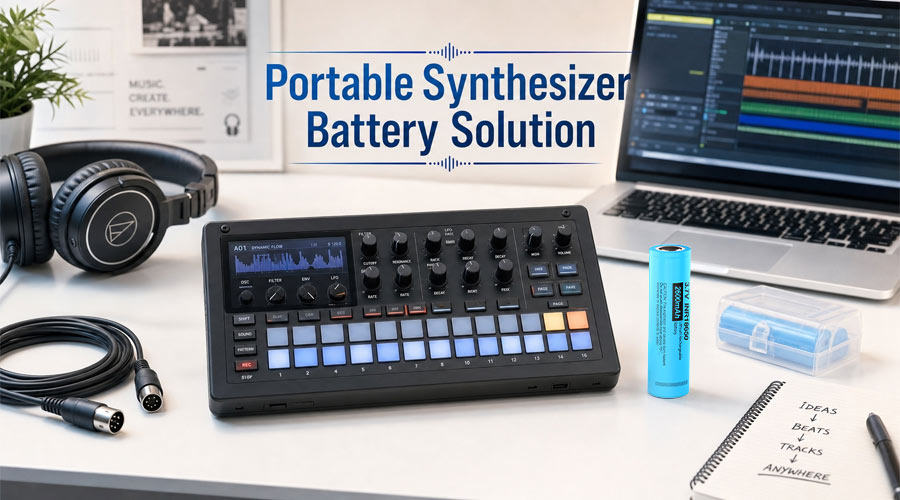
Why Battery Choice Matters in Portable Music Synthesizers
A portable audio production device is different from a simple consumer gadget. It may run digital signal processors, displays, pads, LEDs, sequencers, MIDI or USB interfaces, headphone amplifiers, speakers, and storage circuits at the same time. When these loads change quickly, the power system must remain stable.
If the battery is poorly matched, users may experience sudden shutdowns, shortened runtime, charging limitations, heat buildup, or performance instability during high-load sessions. For a music producer, that can mean losing a creative idea. For a hardware brand, it can mean returns, support tickets, and reputation damage.
Two 3.7V Battery Options for Portable Audio Devices
PKCELL’s product pages highlight two battery formats that can be relevant for portable audio design: the 3.7V 2400mAh LP703478 lithium polymer pouch cell and the 3.7V 2900mAh 18650 wide-temperature Li-ion battery. Each suits a different product design strategy.
3.7V 2400mAh LP703478 LiPo Battery
This flat lithium polymer cell is suitable for compact devices where the internal space is thin or rectangular.
- Nominal voltage: 3.7V
- Capacity: 2400mAh
- Size: 7.0 x 34 x 78 mm
- Operating temperature: -20 to 60°C
- Max constant charging current: 1200mA
- Max continuous discharging current: 1200mA
- Self-discharge rate: ≤3% per month at 25°C
3.7V 2900mAh 18650 Wide-Temp Li-ion Battery
This cylindrical cell is a strong option for battery packs that need higher current capability and wider operating temperature tolerance.
- Nominal voltage: 3.7V
- Capacity: 2900mAh
- Max constant charging current: 2900mA
- Max continuous discharging current: 4350mA
- Cycle life: 500+
- Operating temperature: -40 to 85°C
- Self-discharge rate: ≤3% per month at 25°C
LiPo Pouch Cell vs. 18650 Cell for Synthesizer Design
Both battery types can serve portable music equipment, but they solve different engineering problems. The decision should begin with the physical product concept, then move to electrical load, charging architecture, certification, and serviceability.
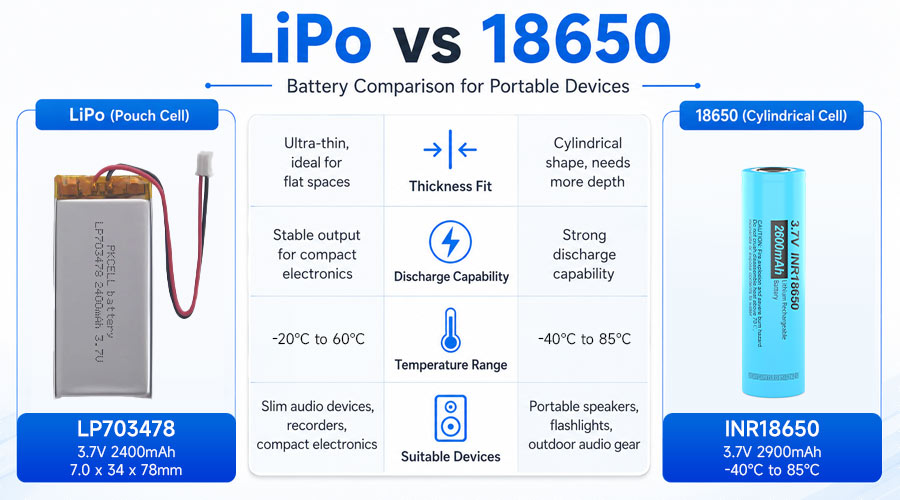
| Design Factor | LP703478 LiPo Pouch Cell | 2900mAh 18650 Li-ion Cell |
|---|---|---|
| Best fit | Slim desktop synths, handheld samplers, compact MIDI controllers, pocket grooveboxes | Rugged portable workstations, modular battery packs, outdoor audio tools, higher-load devices |
| Mechanical advantage | Flat 7.0mm profile helps save thickness in tight enclosures | Cylindrical format is widely used in pack construction and can be combined in series or parallel |
| Current capability | 1200mA max continuous discharge, suitable for moderate-load compact electronics | 4350mA max continuous discharge, useful for more demanding electronics |
| Temperature range | -20 to 60°C | -40 to 85°C, better for challenging environments |
| Typical design priority | Thinness, lightness, clean enclosure layout | Power headroom, pack scalability, rugged operation |
How to Specify a Battery for Portable Audio Production Equipment
1. Estimate Real Runtime from the Device Load
Start by measuring or estimating average current consumption across real use cases: idle mode, sequencing, speaker playback, headphone monitoring, screen brightness, USB activity, wireless communication, and maximum processing load. A synthesizer that looks efficient on paper may draw much more power when LEDs, audio output, and DSP are active together.
2. Match Discharge Current to Peak Demand
Audio devices can have changing current demand. A safe design leaves discharge headroom above the expected average load. The 3.7V 2400mAh LiPo cell lists a 1200mA max continuous discharge current, while the 3.7V 2900mAh 18650 wide-temp battery lists 4350mA. That makes the 18650 option more suitable where the product has higher load peaks or several powered subsystems.
3. Consider Noise-Sensitive Power Architecture
Music production gear depends on clean signal paths. Battery selection should be evaluated alongside voltage regulation, grounding, PCB layout, shielding, and audio output design. Even a good battery can perform poorly if the power system introduces switching noise into analog audio circuits.
4. Design for Charging Safety and User Convenience
For rechargeable synthesizers, users expect USB charging, clear battery indicators, and protection against overcharge, over-discharge, overcurrent, and short circuits. A custom Battery Management System can help align protection parameters, communication protocols, and charging behavior with the product’s exact requirements.
5. Plan for Certifications Early
Portable audio devices are often shipped internationally. Battery-related certification planning should not wait until the final production stage. PKCELL’s product pages mention certifications such as IEC, CE, MSDS, and support for services such as UN38.3, CE, and UL for battery packs. These requirements can affect timeline, documentation, packaging, and shipping.
Application Scenarios: Where Each Battery Makes Sense
Compact Pocket Synthesizer
A pocket synthesizer or handheld sampler usually prioritizes thinness and low weight. In this case, the 3.7V 2400mAh LP703478 LiPo battery can support a compact internal layout while offering useful capacity for portable creativity.
Portable Groovebox or Beat Machine
A groovebox with pads, LEDs, display, storage, USB MIDI, and headphone output may need more current headroom. A 3.7V 18650 cell or a custom 18650 battery pack can provide stronger discharge capability and flexible pack design.
Outdoor Performance or Field Recording Companion
For devices used in colder or hotter environments, wide-temperature performance becomes more important. The 3.7V 2900mAh 18650 wide-temp battery, with an operating range of -40 to 85°C, is better aligned with demanding field conditions.
Professional Custom Audio Hardware
For OEM and ODM projects, a custom pack may be the best route. Cell selection, series and parallel configuration, connector type, wire length, protection circuit, enclosure fit, and certification support can all be adjusted to match the product.
Common Battery Design Mistakes in Portable Synthesizers
- Choosing capacity before measuring load: Capacity only matters when it matches the real current draw and voltage conversion efficiency.
- Ignoring peak current: A battery may have enough mAh but still fail under high instantaneous demand.
- Leaving no room for swelling, insulation, or mechanical tolerance: Especially with pouch cells, enclosure design must account for safety spacing and protection.
- Treating the battery as separate from audio quality: Power regulation and layout decisions can affect noise performance.
- Planning certification too late: Battery documentation and transport testing can influence launch schedules.
FAQ: Portable Audio Production Device Batteries
What is the best battery for a portable music synthesizer?
The best battery depends on the device shape, current demand, runtime target, charging method, and operating environment. A thin LiPo pouch cell is often a good fit for slim devices, while an 18650 Li-ion cell or pack can be better for higher-load or rugged designs.
Is a 3.7V battery enough for a synthesizer?
Many compact electronic products begin with a 3.7V lithium cell and use power management circuits to generate the voltages needed by processors, displays, audio circuits, and interfaces. The final design depends on the full power architecture.
Why use an 18650 battery in portable audio gear?
18650 cells are widely used, scalable in battery packs, and suitable for applications that need higher current capability. The PKCELL 3.7V 2900mAh wide-temp 18650 battery also offers a broad operating temperature range, which can help field-use devices.
Can battery packs be customized for synthesizers?
Yes. Custom battery packs can be designed with specific voltages, capacities, connectors, terminations, protection circuits, and Battery Management System features to match the audio device’s requirements.
Conclusion: Build for Runtime, Reliability, and Creative Flow
A portable synthesizer battery must do more than power on the device. It should support stable performance, fit the enclosure, protect the user, simplify charging, and preserve the creative session from the first idea to the final pattern.
For slim handheld designs, the 3.7V 2400mAh LP703478 LiPo battery offers a compact pouch-cell format. For higher-load or wide-temperature applications, the 3.7V 2900mAh 18650 Li-ion battery provides stronger current capability and rugged operating range. For commercial audio hardware, the smartest choice is often a customized battery solution built around the product’s real electrical and mechanical needs.
Need a battery for a portable music production device? Share your voltage, runtime target, enclosure size, connector requirements, and expected load profile to start selecting the right cell or custom pack.
Post time: Jun-12-2026


