
Planning Long-Term Battery Spare Parts Supply: What OEM Brands Need to Consider
For OEM brands, a battery procurement strategy should not end when the first production order is delivered. Electronic products may remain in service for years after their original manufacturing run, creating ongoing demand for replacement battery packs, warranty support, distributor stock, and maintenance programs. Meanwhile, battery cells, electronic components, connectors, and manufacturing configurations can change. Planning long-term battery spare parts supply requires a coordinated approach to product lifecycle management, sourcing continuity, inventory forecasting, and replacement compatibility.
OEM brands should establish a battery spare parts strategy before mass production begins. The plan should cover the product support period, expected replacement demand, approved battery configurations, alternative cell qualification, inventory levels, storage conditions, supplier change notifications, and last-time-buy procedures. This helps protect the availability of compatible battery packs even when original components become difficult to source.
1. Why Long-Term Battery Spare Parts Planning Matters
An OEM product’s commercial lifecycle is often longer than its initial production schedule. A device may stop being manufactured while distributors continue selling existing inventory, customers keep using installed equipment, and service departments remain responsible for warranty and repair requests.
Rechargeable batteries are particularly important in this situation. A battery pack combines electrochemical cells, protection electronics, wiring, connectors, insulation, and sometimes communication functions. A replacement must satisfy the original product’s electrical, mechanical, charging, and safety requirements.
For manufacturers of portable electronics, industrial equipment, medical devices, security systems, and wireless products, long-term battery requirements may include:
- Warranty replacement batteries for products already sold;
- Paid replacement battery packs after the warranty period;
- Distributor and regional service-center inventory;
- Replacement batteries for older product generations;
- Maintenance contracts and long-term service commitments;
- Spare parts for refurbished or returned equipment.
If the original battery model becomes unavailable, the OEM may need to qualify a new cell, redesign the pack, update device firmware, or repeat compatibility testing. These activities can be expensive when they are triggered by an urgent shortage rather than planned in advance.
A battery sourcing strategy should support the expected service life of the finished product, not just the manufacturing schedule of its first generation.
For businesses developing rechargeable products, PKCELL’s rechargeable battery product range provides references for lithium-ion cells, lithium polymer batteries, NiMH batteries, and custom battery packs.
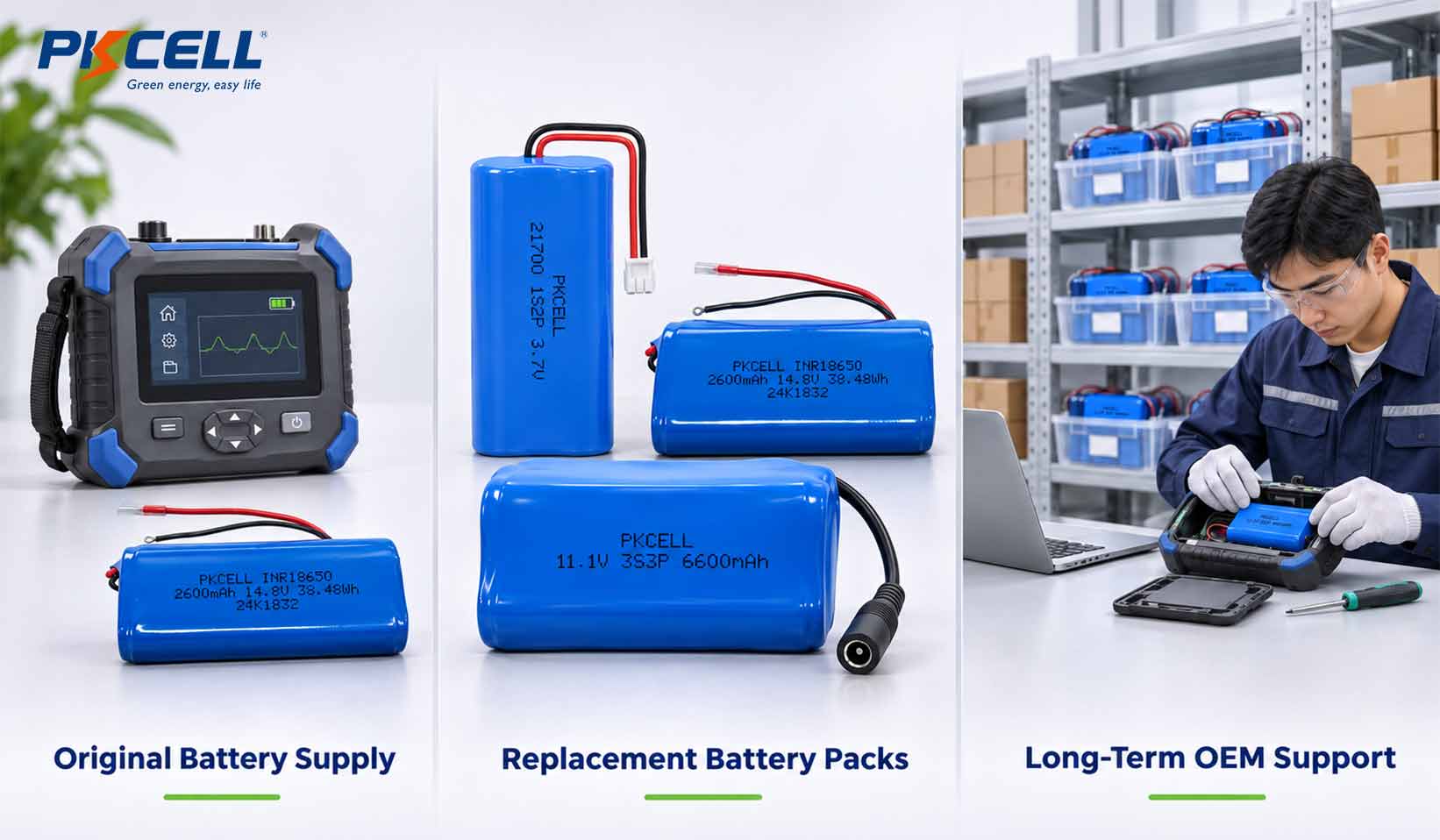
2. Understanding the Battery Supply Lifecycle
The original production schedule and the spare parts support period should be managed as two related but separate procurement requirements. Replacement demand can continue even after finished-product production has declined.
Product launch and initial production
At launch, the OEM establishes the approved battery specification, supplier, cell model, pack configuration, connector, protection circuit, and validation requirements. These records become the reference for future replacement orders.
Stable mass production
During regular production, battery demand is generally linked to finished-product output. Procurement teams should monitor material availability, actual consumption, production forecasts, lead times, and supplier capacity.
Product maturity and declining production
As the product approaches the end of its main production cycle, original battery demand may decrease. However, the installed product base remains in service. Warranty claims, repairs, and distributor requirements can continue to create demand for the same battery configuration.
After-sales and service support
At this stage, purchases may become smaller and less predictable. MOQ, replenishment lead time, inventory rotation, and compatibility with the original device become more important than production-volume pricing alone.
Battery and product end of life
Eventually, the original cell model, BMS component, connector, or complete battery pack may become difficult to source. The OEM must decide whether to maintain existing stock, qualify an alternative, redesign the replacement pack, or arrange a final purchase before discontinuation.
| Lifecycle stage | Typical battery demand | OEM planning priority |
|---|---|---|
| Product launch | Samples and initial production quantities | Approve the battery configuration and supplier |
| Mass production | Regular production orders | Monitor sourcing, consumption, and lead times |
| Product maturity | Production plus replacement demand | Separate service demand from production demand |
| After-sales support | Smaller, irregular orders | Manage spare parts inventory and compatibility |
| End of life | Declining demand with continuing service obligations | Qualify alternatives or plan a last-time buy |
3. Maintaining Compatibility Across Replacement Battery Packs
A replacement battery should not be approved simply because it has the same nominal voltage and a similar capacity. Two lithium battery packs with matching headline specifications may still differ in dimensions, discharge capability, connector polarity, BMS behavior, charging characteristics, or communication protocol.
OEM brands should maintain a controlled battery specification that identifies the complete approved configuration.
Electrical compatibility
- Battery chemistry and exact cell model;
- Nominal, minimum, and maximum operating voltage;
- Rated capacity and usable energy requirements;
- Continuous and peak discharge current;
- Charging voltage and permitted charging current;
- Protection thresholds and recovery behavior;
- Temperature sensing and BMS communication requirements.
Mechanical and interface compatibility
- Pack length, width, thickness, and dimensional tolerances;
- Connector manufacturer, model, pinout, and polarity;
- Wire gauge, wire length, and routing direction;
- Mounting points, insulation, enclosure, and label position;
- Compatibility with the original charger and device housing.
Maintain a controlled battery configuration record
A useful configuration record should include the approved drawing, bill of materials, cell model, BMS revision, firmware version, connector specification, label artwork, test report, and golden sample identification.
Each replacement order should be traceable to the approved configuration. If a component changes, the OEM should know which production batches and service inventories may be affected.
For customized battery packs requiring specific voltage, capacity, connectors, protection electronics, or housing, review PKCELL’s customized battery service.
4. Forecasting Lithium Battery Pack Spare Parts Demand
Replacement demand is usually less predictable than original production demand. A finished product may have a stable monthly production schedule, while battery replacement requests arrive irregularly across different countries and service channels.
OEM brands should establish a separate spare parts forecast using the installed product base, historical replacement rates, warranty information, and expected support period.
Build a basic replacement demand model
For example, if an OEM has 20,000 active devices in service and uses an illustrative annual replacement assumption of 2%, the initial forecast would be:
This is a planning illustration, not a universal battery failure rate. Actual assumptions should be based on field data, product operating conditions, warranty history, and service records.
Separate different sources of demand
- Warranty demand: replacements expected during the warranty period;
- Paid service demand: replacement orders after warranty expiration;
- Distributor demand: battery stock held by regional distributors;
- Maintenance demand: replacements associated with scheduled servicing;
- Contingency demand: additional quantities for unexpected product or supply events.
Use different forecast horizons
Short-term forecasts support purchasing and delivery scheduling. Medium-term forecasts help suppliers plan materials and production capacity. Long-term forecasts help OEM teams identify cell discontinuation risks and decide when to qualify alternative components.
A rolling forecast should be updated using actual replacement orders, remaining installed product quantities, distributor inventory, and product retirement information.
5. Managing Battery Inventory, MOQ, and Purchasing Costs
Spare parts procurement creates a balancing challenge. OEMs need enough inventory to support service requests, but excessive purchasing can tie up working capital and increase the risk of long-term storage degradation.
The right inventory strategy depends on replacement frequency, supplier lead time, minimum order quantity, product support commitments, storage capacity, and battery shelf-life requirements.
Separate production stock from service stock
Production inventory supports scheduled manufacturing. Service inventory supports warranty claims, repair centers, and replacement orders. Combining the two can make it difficult to identify whether stock is sufficient for future after-sales obligations.
OEMs should consider separate records for:
- Production battery inventory;
- Warranty replacement inventory;
- Distributor and regional service inventory;
- Reserved inventory for critical customers;
- Inventory awaiting inspection or disposition.
Calculate a practical reorder point
For irregular spare parts demand, safety stock should reflect demand variation, supplier lead-time uncertainty, and the business impact of a stockout. A critical industrial device may justify a different stock policy from a consumer product with shorter replacement lead times.
Evaluate MOQ against long-term demand
When annual replacement demand is low, a supplier’s minimum order quantity may exceed immediate requirements. Buyers can discuss scheduled releases, consolidated orders, planned production batches, or other commercially agreed inventory arrangements where feasible.
Consider total spare parts ownership cost
- Purchase price and freight;
- Storage and warehouse handling;
- Inventory financing and working capital;
- Periodic inspection and stock rotation;
- Potential battery aging during storage;
- Obsolescence and unsold inventory;
- Replacement qualification and engineering costs;
- Urgent transportation when stock is unavailable.
The lowest unit price does not always create the lowest long-term cost. Availability, traceability, and inventory condition are equally important to an OEM service program.
6. Storage and Aging of Rechargeable Lithium Batteries
Ordering replacement batteries in advance does not automatically guarantee that they will remain suitable for use several years later. Rechargeable batteries are electrochemical products, and storage conditions influence their condition over time.
Temperature, storage state of charge, storage duration, cell chemistry, packaging, and manufacturer recommendations all matter. A battery kept in an unsuitable environment may experience accelerated degradation before it reaches the service department.
Establish model-specific storage requirements
- Follow the selected battery manufacturer’s specified storage temperature range.
- Follow the specified storage state of charge rather than assuming all rechargeable batteries use the same value.
- Keep batteries in approved packaging with suitable terminal protection.
- Prevent exposure to moisture, direct sunlight, excessive heat, and mechanical damage.
- Record receipt date, production date, lot number, and storage location.
- Inspect inventory according to a documented schedule.
- Follow manufacturer instructions for voltage checks and maintenance charging.
Use a traceable stock rotation system
A first-in, first-out process can reduce the time individual batches remain in storage. However, battery inventory management should also consider production date, storage history, inspection status, and manufacturer-defined storage limits.
OEMs should not assume that a battery stored for several years can be installed without inspection. A suitable receiving and release procedure should verify that the stock remains within the approved condition and documentation requirements.
For an additional reference on battery sleep current, BMS shipping mode, and warehouse storage, read PKCELL’s article Why a Lithium Battery Pack Arrives With No Output: BMS Shipping Mode, Sleep Current & Storage.
7. Building a Reliable OEM Battery Supplier Relationship
Long-term battery supply depends on more than whether a supplier can manufacture the original pack today. OEM procurement teams should discuss how the supplier manages component changes, production records, material sourcing, and future product availability.
Discuss component lifecycle visibility
Ask whether the supplier can identify the critical components used in the approved pack, including cells, BMS components, connectors, wires, protection devices, and housing materials.
The goal is to understand which components could affect future production if they become unavailable or undergo a specification change.
Establish a supplier change notification process
OEM brands should agree on how the supplier communicates changes that may affect form, fit, function, safety, or compliance.
Examples include:
- Cell manufacturer or model changes;
- Changes to cell dimensions, capacity, or discharge ratings;
- BMS component, PCB, or firmware revisions;
- Connector manufacturer or pinout changes;
- Changes in wire specifications or insulation materials;
- Changes to pack construction, label, or housing;
- Changes to test documentation or certification status.
A supplier change should trigger an agreed review process. Depending on the change, the OEM may need document review, sample evaluation, compatibility testing, or renewed product-level validation.
Review traceability and production records
For each delivered batch, the OEM should retain sufficient information to identify the battery model, production date, lot, configuration revision, and relevant inspection records.
PKCELL’s article on battery pack quality inspection before bulk orders discusses approved specifications, golden samples, production-intent inspection, and change control. These principles are also useful when managing future replacement orders.
For customized battery protection and monitoring requirements, review PKCELL’s battery pack BMS and protection technology.
8. Managing 18650 and 21700 Battery Discontinuation
Battery cell availability is an important part of long-term spare parts planning. An OEM may use a specific 18650 battery, 21700 battery, lithium polymer battery, or another rechargeable cell format. Even when the general cell size remains common, the exact approved model, manufacturer, capacity, discharge rating, or production source may change.
A replacement decision must therefore be based on the complete specification, not simply the cell’s physical format.
Monitor early signs of component obsolescence
- Longer or less predictable replenishment lead times;
- Reduced availability of the approved cell model;
- Supplier announcements about product revisions;
- Changes in minimum order quantities;
- Repeated allocation or delivery constraints;
- Discontinuation notices for critical electronic components.
Evaluate alternative battery configurations
For products originally using cylindrical cells, an OEM may need to compare available 18650 and 21700 battery pack configurations. However, these formats are not automatically interchangeable.
A 21700 cell has different physical dimensions from an 18650 cell. A change can affect pack geometry, weight, mounting, wiring, thermal behavior, capacity, voltage under load, and enclosure compatibility.
For example, PKCELL provides different configurations of 18650 lithium battery packs and a 3.7V 1S2P 21700 battery pack. These are useful references for discussing different pack architectures, not automatic replacement equivalents.
For products using compact pouch cells, review the rechargeable battery product range and discuss the required dimensions and electrical specifications with the engineering team.
Three possible responses to discontinuation
| Response | When to consider it | Key evaluation |
|---|---|---|
| Last-time buy | The original configuration remains suitable but will no longer be available. | Forecast remaining service demand, storage exposure, shelf-life limits, and budget. |
| Alternative cell qualification | A technically suitable replacement cell is available. | Compare dimensions, voltage, capacity, current, charging limits, temperature, and lifecycle performance. |
| Redesigned replacement pack | The original cell or component cannot be replaced without structural or electrical changes. | Evaluate enclosure fit, BMS, connector, charging, firmware, validation, and documentation. |
Plan the last-time buy carefully
A last-time buy is a final purchase of a component or battery configuration before discontinuation. It can protect service availability, but an excessive purchase may create inventory that ages before it is used.
Before approving a final order, estimate the remaining installed product base, expected replacement demand, service support period, supplier lead time, available storage conditions, and stock already held across the company and its distributors.
If an alternative cell or pack is selected, document the new revision and compatibility status. Do not silently substitute a different model under the original battery part number.
9. OEM Battery Spare Parts Planning Checklist
Before launching a long-term battery spare parts program, OEM brands should confirm that the following information and processes are available.
- Define the expected product service and support period.
- Separate original production demand from after-sales replacement demand.
- Maintain the approved battery drawing, BOM, and specification revision.
- Record the exact cell model, BMS, connector, wiring, and label configuration.
- Build a replacement demand forecast using installed product data.
- Establish minimum stock, reorder points, and safety stock policies.
- Review supplier MOQ, lead times, and replenishment arrangements.
- Document battery storage, inspection, and stock rotation requirements.
- Agree on supplier change notification and component lifecycle communication.
- Define alternative cell qualification and pack redesign procedures.
- Establish last-time-buy approval criteria.
- Maintain batch traceability and service replacement records.
OEM brands looking to develop a new rechargeable battery configuration or establish a replacement pack specification can review PKCELL’s customized battery solutions.
Planning Long-Term Battery Supply for Your OEM Products?
Whether you need recurring replacement batteries, a custom lithium battery pack, an alternative cell evaluation, or a new configuration for an existing product, PKCELL can discuss your project requirements.
To help the team assess your needs, prepare the original battery model, chemistry, voltage, capacity, dimensions, connector information, estimated annual demand, and required support period.
Frequently Asked Questions
How long should OEM brands plan to supply replacement batteries?
The support period should be based on the finished product’s expected service life, warranty commitments, customer agreements, applicable regulations, and market expectations. It should be defined during product planning rather than after the original battery becomes unavailable.
Can an OEM replace a discontinued 18650 or 21700 battery with another model?
Possibly, but the alternative must be evaluated against the original electrical, mechanical, charging, thermal, and protection requirements. A different cell format or model may require a new battery pack design and device-level validation.
Should OEM brands purchase all spare batteries in advance?
Not necessarily. Large advance purchases can increase working capital and storage-aging risks. A better strategy considers demand forecasts, supplier lead times, MOQ, inventory rotation, and the cost of potential shortages.
What happens if a battery supplier changes the original cell model?
The supplier should communicate the change through an agreed notification process. The OEM should review the new specification, assess compatibility, and determine whether sample testing, engineering approval, or product-level validation is required.
How can an OEM reduce the risk of battery spare parts shortages?
Maintain accurate demand forecasts, monitor critical component availability, agree on change notifications, define safety stock, qualify alternatives before they are urgently needed, and establish a documented last-time-buy process.
Can a battery manufacturer support replacement packs for an existing product?
A manufacturer can evaluate an existing battery pack using its specification, photographs, dimensions, electrical requirements, connector details, and application information. The feasibility of reproducing or redesigning the pack depends on available technical information and component availability.
Conclusion: Treat Battery Spare Parts as a Long-Term Product Commitment
Long-term battery spare parts supply is an important part of OEM product lifecycle management. A battery may remain necessary long after the original production schedule has ended, and its replacement availability can directly affect warranty support, repair operations, distributor relationships, and customer confidence.
By separating production and service demand, maintaining controlled battery specifications, forecasting replacement quantities, managing storage, monitoring component availability, and preparing alternatives before discontinuation, OEM brands can reduce supply interruptions and improve long-term product support.
The most effective time to plan battery spare parts supply is during the original product development stage. Early cooperation between the OEM and battery manufacturer makes it easier to establish a consistent replacement strategy before the first supply challenge occurs.
Need a Long-Term Battery Supply Partner?
Share your existing battery specification, replacement requirements, expected annual demand, and product support period with PKCELL to discuss rechargeable battery sourcing and custom replacement pack possibilities.
Post time: Nov-04-2026


