
Lithium Polymer Battery Size Chart: Decode LiPo Models
Model numbers such as LP402025, LP503035 and LP803860 often contain useful information about a lithium polymer battery’s nominal dimensions. Once you understand the code, you can quickly screen pouch cells for thickness, width and length before reviewing the detailed specification.
However, a LiPo model number is only a starting point. The finished battery may be larger after adding the protection circuit, tabs, tape, wires and connector. This guide explains how to read common size codes, use a lithium polymer battery size chart and prepare an accurate OEM battery request.
Quick Answer: How Do You Read a LiPo Battery Code?
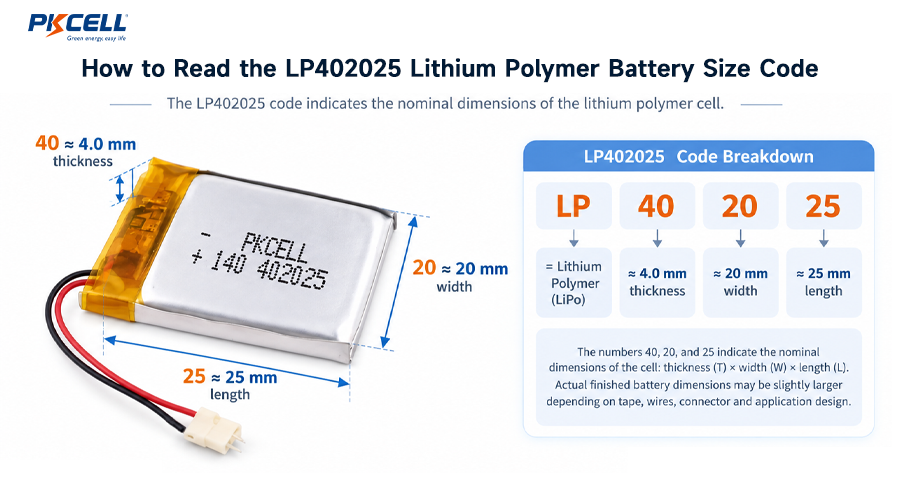
Many lithium polymer pouch-cell model numbers use a six-digit code after the prefix “LP.” The code commonly represents:
For example, LP803860 commonly indicates a pouch cell approximately 8.0 mm thick, 38 mm wide and 60 mm long.
LP402025 commonly indicates a cell approximately 4.0 mm thick, 20 mm wide and 25 mm long. Depending on how the finished assembly is measured, a product specification may show a slightly greater maximum length or thickness.
What Does “LP” Mean in a Battery Model?
In the PKCELL product range, the prefix LP identifies a lithium polymer or lithium-ion polymer pouch battery. These cells use a flexible laminated pouch rather than the rigid metal can found on cylindrical batteries such as 18650 or 21700 cells.
LiPo pouch cells are commonly selected for compact electronics because they can be produced in many combinations of thickness, width and length. Browse the
PKCELL lithium polymer battery range
to compare standard models and capacity classes.
How to Decode LP402025
Approximately 4.0 mm nominal thickness
Approximately 20 mm nominal width
Approximately 25 mm nominal length
PKCELL lists the LP402025 lithium polymer battery
as a compact 3.7V model available around the 140–160mAh capacity range. A related specification lists a typical 150mAh version.
You may also see a product table showing dimensions close to 4 × 20 × 26 mm. That does not necessarily mean the code is wrong. The nominal cell code, pouch dimensions and maximum finished dimensions may be defined at different measurement points.
How to Decode LP803860
Approximately 8.0 mm nominal thickness
Approximately 38 mm nominal width
Approximately 60 mm nominal length
The LP803860 is substantially larger than the LP402025 and can support a higher-capacity application. PKCELL’s
LP803860 battery guide
describes a 3.7V, 2000mAh example with nominal dimensions of approximately 8 × 38 × 60 mm.
A PKCELL drawing for an assembled LP803860 pack shows that the maximum finished dimensions can be slightly larger after adding packaging and a protection circuit. The drawing also defines the wire length, connector and PCM arrangement.
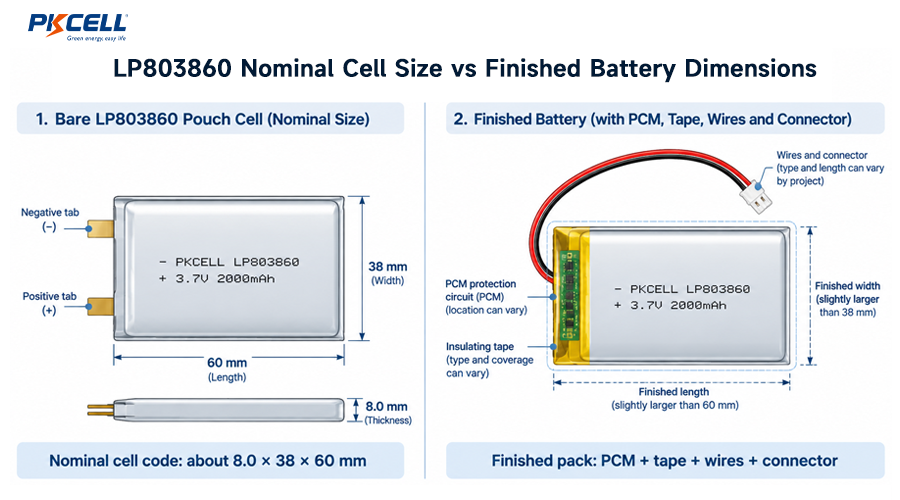
Read the model code for initial size screening. Use the approved mechanical drawing for enclosure design and production release.
Lithium Polymer Battery Size Chart
The following chart shows how common PKCELL LiPo model codes relate to nominal dimensions. Capacities are representative product examples rather than values guaranteed by the size code.
| LiPo Model | Approximate Nominal Size | Example Capacity | Code Interpretation | Possible Application Category |
|---|---|---|---|---|
| LP401230 | 4.0 × 12 × 30 mm | About 105mAh | 40 / 12 / 30 | Small sensor, compact wearable |
| LP402025 | About 4.0 × 20 × 25 mm | About 140–160mAh | 40 / 20 / 25 | GPS accessory, wearable, small medical device |
| LP402030 | 4.0 × 20 × 30 mm | About 200mAh | 40 / 20 / 30 | Bluetooth device, sensor, portable electronics |
| LP552035 | 5.5 × 20 × 35 mm | About 350mAh | 55 / 20 / 35 | Tracker, audio device, handheld accessory |
| LP503035 | 5.0 × 30 × 35 mm | About 500mAh | 50 / 30 / 35 | Portable monitor, controller, smart device |
| LP801735 | 8.0 × 17 × 35 mm | About 400mAh | 80 / 17 / 35 | Narrow handheld device |
| LP802046 | 8.0 × 20 × 46 mm | About 800mAh | 80 / 20 / 46 | IoT terminal, portable instrument |
| LP603450 | 6.0 × 34 × 50 mm | About 1100mAh | 60 / 34 / 50 | Consumer electronics, monitoring equipment |
| LP853450 | 8.5 × 34 × 50 mm | About 1500mAh | 85 / 34 / 50 | Handheld equipment, smart electronics |
| LP803860 | 8.0 × 38 × 60 mm | About 2000mAh | 80 / 38 / 60 | Medical equipment, GPS terminal, larger portable device |
| LP103450 | 10 × 34 × 50 mm | About 2000mAh | 10 / 34 / 50 | High-capacity compact device |
Small cells such as the LP402025 can also be reviewed in PKCELL’s
30–200mAh lithium polymer battery range.
Larger cells, including the LP803860, appear in the
2000–5000mAh LiPo product range.
Why the Code May Not Match the Finished Battery Size Exactly
The model code usually describes the nominal pouch-cell dimensions. The battery delivered to an OEM may include several additional components.
Protection Circuit Module
A PCM can add length, width or thickness depending on where it is installed. Its components and insulation also require physical clearance.
Tabs and Seal Area
Pouch cells include a sealed perimeter and electrode tabs. A drawing may distinguish the active body, pouch edge, tab area and maximum overall dimensions.
Tape, Foam and Insulation
Protective tape, fish paper, foam pads and insulating films add small but important amounts to the finished dimensions.
Wires and Connector
The connector body, cable exit direction, bend radius and wire length require space beyond the cell body. Connector placement can determine whether the battery can actually be installed in the device.
Manufacturing Tolerance
Pouch-cell dimensions are not perfectly identical from unit to unit. The approved drawing should state maximum dimensions or tolerances suitable for mechanical design.
Cell Expansion During Use
The enclosure should not clamp or puncture the pouch. The mechanical design may require allowance for normal dimensional change over life, temperature and state of charge. The required allowance must come from the approved cell and application design review.
Does the Size Code Tell You the Battery Capacity?
No. The code indicates nominal dimensions, not a guaranteed milliamp-hour rating.
A larger cell volume can create more room for active material, but capacity also depends on chemistry, electrode design, required current capability, safety margin, manufacturing process and the supplier’s approved specification.
Two batteries with similar outer dimensions may therefore have different capacity, maximum discharge current, charge rate or cycle-life characteristics. For example, the
LP503035 product page
describes a 500mAh example, but the size code itself does not mathematically produce “500mAh.”
The Model Code Can Suggest
- Approximate nominal thickness
- Approximate nominal width
- Approximate nominal length
- Basic pouch-cell form factor
The Model Code Does Not Confirm
- Capacity or watt-hours
- Maximum charge or discharge current
- Connector and polarity
- PCM or NTC configuration
- Final dimensions and tolerance
- Certification coverage
How to Compare LiPo Sizes for an OEM Device
1. Measure the Usable Battery Space
Measure the smallest available thickness, width and length inside the real enclosure. Account for ribs, screw bosses, PCB components, cable paths, connector access and assembly tolerances.
2. Define the Orientation
Identify which surface faces the PCB, display, enclosure wall or heat source. Also define the wire exit direction and connector location.
3. Reserve Mechanical Clearance
Do not design the cavity to equal the nominal code dimensions. Use the supplier’s maximum finished dimensions and the clearances required by the validated mechanical design.
4. Check Capacity and Current Separately
After screening by size, verify capacity, runtime, continuous load, peak current, charging current and device cutoff voltage.
5. Confirm the Complete Battery Assembly
Decide whether the quotation includes a bare cell or an assembly with PCM, NTC, wires, connector, foam, label and custom packaging.
PKCELL’s guide to the
advantages and limitations of lithium polymer batteries
provides additional selection considerations for compact OEM products.
Common LiPo Size-Code Mistakes
Assuming Every Supplier Uses the Same Code
Similar-looking model numbers may be interpreted differently by another manufacturer. Confirm the dimension order and units instead of relying only on the part number.
Using Nominal Dimensions for the Enclosure
The finished assembly can be larger because of tolerances, pouch sealing, PCM, insulation and wiring.
Ignoring the Cable Exit
A cell may fit inside the cavity while the cable cannot bend safely or the connector cannot be inserted.
Selecting Capacity From Size Alone
Capacity must be confirmed from the datasheet. Similar dimensions do not guarantee equivalent energy, current capability or cycle life.
Replacing a Cell by Matching Only the Six Digits
A replacement must also match voltage, charge limit, capacity, current, polarity, connector, PCM behavior, NTC and mechanical tolerances.
Confusing Cell Dimensions With Pack Dimensions
A bare pouch cell and a protected, wired battery pack based on that cell are not necessarily the same size.
OEM LiPo Battery Specification Checklist
- Maximum finished thickness, width and length
- Preferred LiPo model or candidate size code
- Required capacity and minimum acceptable capacity
- Nominal and maximum charge voltage
- Continuous, peak and startup current
- Charging current and charge-time target
- PCM protection functions and thresholds
- NTC value, curve, location and connector pin
- Connector manufacturer and part number
- Pinout, polarity and mating connector
- Wire gauge, length, color and exit direction
- Operating, charging and storage temperatures
- Foam, tape, label and insulation requirements
- Device drawing and available battery cavity
- Target market and required compliance documents
- Prototype quantity and annual production forecast
PKCELL supports consumer-electronics projects with customized cell size, protection circuit, connector, wiring and pack structure. Review the
OEM consumer electronics battery solutions
for common application and integration examples.
Need a LiPo Cell That Fits Your Device?
Send PKCELL your available battery space, capacity target, load profile, connector, wire direction, protection requirements and annual forecast. The engineering team can compare standard LiPo models or review a custom battery design.
Frequently Asked Questions
What does 402025 mean on a lithium polymer battery?
It commonly indicates approximate nominal dimensions of 4.0 mm thickness, 20 mm width and 25 mm length. Check the supplier’s drawing because finished dimensions and measurement conventions can differ.
What size is an LP803860 battery?
The nominal cell size is approximately 8.0 × 38 × 60 mm. An assembled battery with PCM, tape and wiring may have slightly greater maximum dimensions.
Does LP803860 always mean 2000mAh?
No. The code identifies approximate dimensions, not guaranteed capacity. PKCELL offers a 2000mAh example, but capacity must be confirmed from the exact specification.
Are LiPo dimensions listed as thickness × width × length?
That is a common convention for six-digit pouch-cell codes, including the examples in this guide. It is not safe to assume every supplier follows the same order, so confirm the drawing.
Why is an LP402025 product sometimes listed as 26 mm long?
The code can describe a nominal 25 mm class cell while the product table or finished drawing uses a different measurement point or maximum assembled dimension. The approved drawing should control the mechanical design.
Can I replace a LiPo battery with another model of the same size?
Only after confirming voltage, charge profile, capacity, current capability, connector, polarity, PCM, NTC, dimensions and compliance requirements. Matching the size code alone is insufficient.
Can PKCELL customize the connector and wire length?
Yes. PKCELL supports project-specific cell size, cable length, connector, polarity, PCM, NTC, label and packaging subject to engineering review.
Conclusion
A lithium polymer battery size chart helps engineers decode models such as LP402025 and LP803860 quickly. In the common PKCELL naming pattern, the six digits describe approximate nominal thickness, width and length.
The code does not define capacity, current capability, connector, protection circuit or maximum finished dimensions. Use it to create a shortlist, then approve the battery from its electrical specification and mechanical drawing.
For a standard or customized pouch-cell solution, submit your enclosure dimensions and electrical requirements through the
PKCELL battery inquiry form.
Post time: Sep-18-2026


