
Lithium Battery Voltage Chart: Li-ion vs LiFePO4 from 1S to 4S
A “3.7V” lithium-ion battery reaches about 4.2V when fully charged, while a “3.2V” LiFePO4 cell normally charges to about 3.65V. Once cells are connected in series, that difference is multiplied across the pack. This lithium battery voltage chart provides the nominal, full-charge, and reference cutoff voltages for common 1S, 2S, 3S, and 4S configurations.
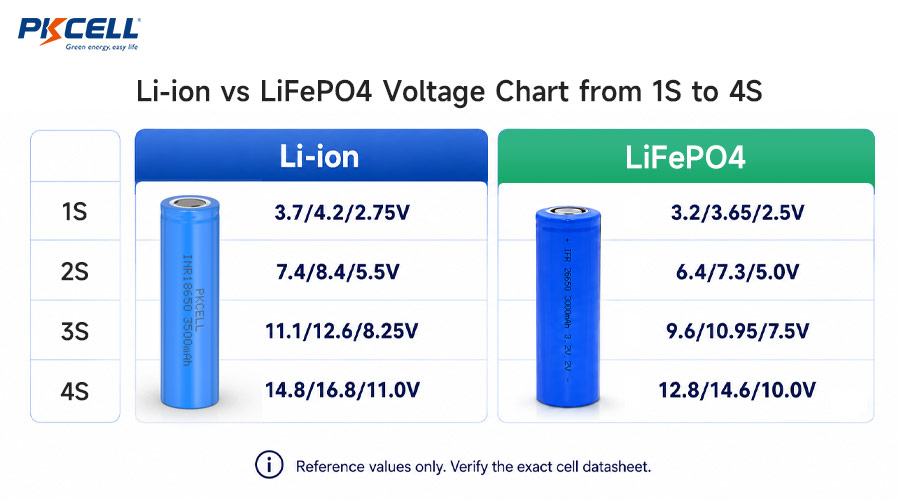
Complete Li-ion and LiFePO4 Voltage Chart
The values below are reference figures for conventional 4.2V lithium-ion cells and 3.65V LiFePO4 cells. Actual charge and discharge limits must always come from the selected cell and battery-pack datasheets.
| Chemistry | Series | Nominal Voltage | Full-Charge Voltage | Reference Discharge Cutoff |
|---|---|---|---|---|
| Li-ion | 1S | 3.7V | 4.2V | 2.75V |
| Li-ion | 2S | 7.4V | 8.4V | 5.5V |
| Li-ion | 3S | 11.1V | 12.6V | 8.25V |
| Li-ion | 4S | 14.8V | 16.8V | 11.0V |
| LiFePO4 | 1S | 3.2V | 3.65V | 2.5V |
| LiFePO4 | 2S | 6.4V | 7.3V | 5.0V |
| LiFePO4 | 3S | 9.6V | 10.95V | 7.5V |
| LiFePO4 | 4S | 12.8V | 14.6V | 10.0V |
Reference basis: PKCELL specifications list 3.7V nominal, 4.2V charge cutoff, and 2.75V discharge cutoff for a representative Li-ion cell. A PKCELL 4S LiFePO4 pack is specified at 12.8V nominal, 14.2–14.6V maximum charging voltage, and 10.0V discharge cutoff. Some Li-ion cells use 3.6V nominal labeling or different minimum voltages.
What Do 1S, 2S, 3S, and 4S Mean?
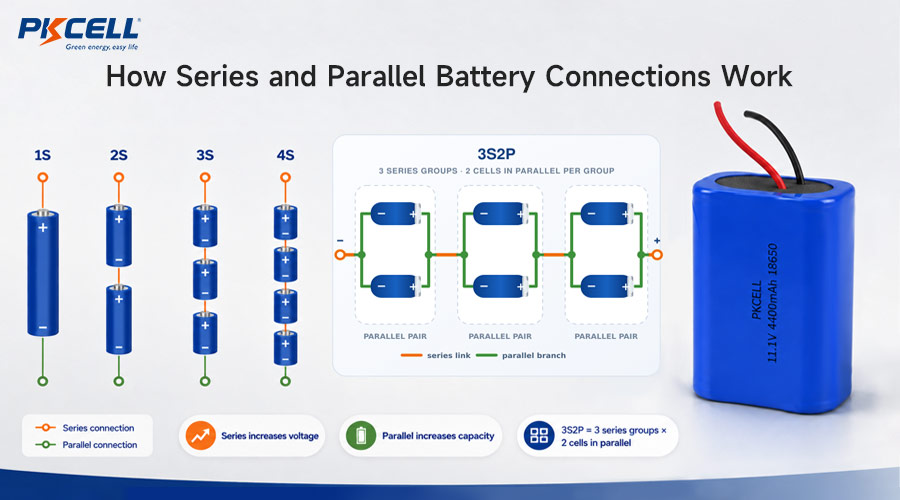
The “S” indicates the number of cells or parallel cell groups connected in series. Series connections increase voltage. They do not increase amp-hour capacity.
For example, three 3.7V Li-ion groups in series form a 3S pack:
The letter “P” describes parallel groups. Parallel connections increase capacity and available current while keeping the same nominal voltage. A 3S2P pack therefore contains three series groups, with two cells in parallel in each group. PKCELL supplies common 7.4V 2S 18650 battery packs, 11.1V 3S 18650 battery packs, and 14.8V 4S 18650 battery packs for applications requiring different input-voltage ranges.
Li-ion vs LiFePO4 Voltage: Why the Numbers Differ
Conventional Li-ion
- Typical nominal voltage: 3.6V or 3.7V per cell
- Typical full-charge voltage: 4.2V per cell
- Higher energy density for a given size and weight
- Common in portable electronics, robotics, medical devices, and tools
- Requires a Li-ion-compatible charger and protection circuit
LiFePO4
- Typical nominal voltage: 3.2V per cell
- Typical upper charge voltage: 3.65V per cell
- Flatter discharge-voltage curve
- Strong thermal stability and long cycle-life potential
- Common in energy storage, backup power, mobility, marine, and industrial systems
The chemistries are not interchangeable solely because two packs have similar names or fit the same enclosure. A 4S LiFePO4 pack is labeled 12.8V nominal, but a 3S Li-ion pack is labeled 11.1V and reaches 12.6V when full. A device designed around one voltage window may shut down early, overcharge the pack, or operate incorrectly with the other. Browse PKCELL’s 3.7V 18650 Li-ion cells and 3.2V LiFePO4 cells to compare available cell formats before selecting a series configuration.
Nominal, Full-Charge, and Cutoff Voltage Explained
Nominal voltage is a rating, not a fixed measurement
Nominal voltage is a convenient representative value used to classify a cell or pack. The terminal voltage changes throughout charging and discharging. A 3.7V Li-ion cell is not expected to remain at exactly 3.7V during operation.
Full-charge voltage determines charger compatibility
Full-charge voltage is the upper voltage used by the chemistry-specific constant-current/constant-voltage charging process. Standard 4.2V Li-ion and 3.65V LiFePO4 cells need different charger settings.
A charger should be selected from the battery’s chemistry, series count, approved charge voltage, and current limit—not from the nominal voltage printed on the enclosure alone.
Cutoff voltage is model-dependent
The discharge cutoff in the chart is a reference endpoint, not a universal BMS recommendation. Cell manufacturers may specify different minimum voltages. The finished pack may also use a higher system cutoff to provide design margin, reduce voltage sag problems, or support longer service life.
Can Battery Voltage Estimate State of Charge?
Voltage can provide a rough state-of-charge indication, but it is not a precise fuel gauge. A reading is affected by current, temperature, cell age, internal resistance, and the time elapsed since charging or discharging. The limitation is especially important for LiFePO4. Its relatively flat discharge curve means that a small measurement error can correspond to a large difference in remaining capacity through the middle of the cycle. For more dependable monitoring:
- Measure resting voltage after the battery has been disconnected from significant load or charge.
- Use coulomb counting when accurate remaining capacity is important.
- Compensate for current, temperature, and cell aging.
- Monitor individual series groups instead of relying only on total pack voltage.
- Recalibrate the state-of-charge estimate at known full or empty reference points.
How to Select the Correct Pack Voltage
1. Define the device voltage window
Record the minimum operating voltage, maximum allowable input voltage, brownout threshold, and any transient limits. Check the entire battery range rather than matching only the nominal number.
2. Choose the chemistry
Li-ion is often selected when compact size and energy density are major priorities. LiFePO4 is frequently considered when cycle life, voltage stability, and thermal robustness carry more weight.
3. Calculate the required series count
Multiply the cell’s minimum, nominal, and maximum voltages by the proposed series count. Confirm that all three results remain compatible with the load and charging architecture.
4. Size capacity and current separately
Series count determines voltage. Runtime and current capability depend on cell capacity, parallel count, discharge rate, temperature, wiring, connector resistance, and thermal design.
5. Match the charger and BMS
The charger must match the chemistry and series count. The BMS should provide appropriate cell-level overcharge, over-discharge, overcurrent, short-circuit, and temperature protection. Cell balancing is particularly important in multi-series packs. PKCELL offers battery charger options and custom lithium battery pack solutions for projects requiring matched cells, protection electronics, connectors, housings, and pack configurations.
Common Battery Voltage Mistakes
- Using nominal voltage as the charger voltage: a 3.7V Li-ion cell normally requires a 4.2V CC/CV charge profile, not a fixed 3.7V supply.
- Assuming every Li-ion cell uses the same limits: high-voltage and specialized cells can have different specifications.
- Mixing Li-ion and LiFePO4 chargers: their charge ceilings differ significantly.
- Checking only total pack voltage: one series group can become overcharged or depleted while the total still appears reasonable.
- Ignoring voltage sag: heavy current can temporarily pull the terminal voltage below the resting value and trigger an early system shutdown.
- Replacing a “12V” battery by label alone: 3S Li-ion, 4S LiFePO4, and lead-acid batteries have different voltage windows and charging requirements.
Frequently Asked Questions
What voltage is a fully charged 1S Li-ion battery?
A conventional 1S Li-ion battery is typically 4.2V when fully charged. Some specialized cells use a different charge ceiling, so the cell datasheet remains authoritative.
What is the full-charge voltage of a 3S lithium-ion battery?
A standard 3S pack using 4.2V Li-ion cells reaches 12.6V: 4.2V × 3 = 12.6V.
What is the full-charge voltage of a 4S LiFePO4 battery?
The typical upper value is 14.6V, based on 3.65V per cell. Depending on the product specification and intended service-life strategy, a finished pack may use a lower charging target. PKCELL’s referenced 12.8V pack specifies a 14.2–14.6V maximum charging range.
Can I charge LiFePO4 with a Li-ion charger?
Do not assume compatibility. A charger intended for standard Li-ion cells may apply too much voltage to the same series count of LiFePO4 cells. Use a charger explicitly matched to the pack chemistry, series count, and datasheet.
Is a 4S LiFePO4 battery the same as a 12V battery?
It is commonly marketed as a 12V-class replacement because its nominal voltage is 12.8V. Compatibility still depends on the equipment’s input range, charging system, surge current, BMS, and low-voltage cutoff.
Why does battery voltage drop under load?
Current flowing through the cell’s internal resistance and the pack’s conductors creates voltage sag. The amount depends on current, temperature, state of charge, cell condition, wiring, and connector resistance.
Final Takeaway
A useful lithium battery voltage chart must show more than the number printed on the label. For every proposed pack, compare its minimum, nominal, and maximum voltage against the complete operating window of the device. Conventional Li-ion cells are commonly rated at 3.6–3.7V nominal and 4.2V fully charged. LiFePO4 cells are commonly rated at 3.2V nominal and up to 3.65V when charged. Multiplying those values by the number of series groups provides the starting point for 1S through 4S pack selection.
Need a Battery Pack Matched to Your Voltage Window?
Send PKCELL your chemistry, operating-voltage range, capacity, continuous and peak current, dimensions, connector, quantity, application, and certification requirements. The engineering team can help evaluate the cell configuration, BMS, charger, wiring, and enclosure for your project.
Request a Battery Pack Quote Explore Custom Battery Services
Post time: Aug-28-2026


