
Lithium Batteries for High-Powered Flashlights: A Practical Guide for OEM and B2B Buyers
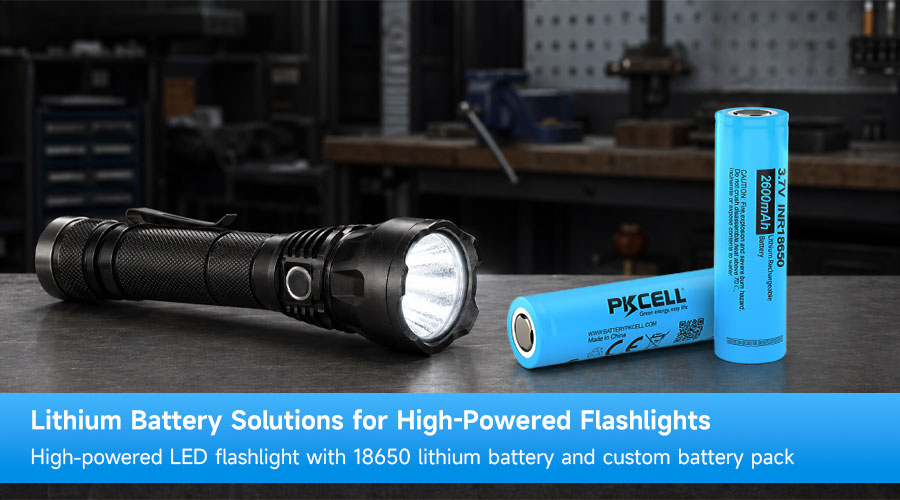
High-powered flashlights depend on more than LED quality. The battery determines brightness stability, runtime, charging reliability, safety, and user experience. For manufacturers, distributors, and lighting brands, choosing the right lithium battery for a flashlight is a product-level decision, not just a component purchase.
Modern LED flashlights often use rechargeable lithium-ion cells because they offer high energy density, long service life, and compact design flexibility. PKCELL notes that lithium batteries for LED flashlights can support larger capacity and longer cycle life compared with many ordinary battery options, making them suitable for portable lighting products that need repeated use.
Why Lithium Batteries Are Used in High-Powered Flashlights
High-powered flashlights need a battery platform that can deliver stable voltage, strong current output, and reliable recharge performance. This is why cylindrical lithium-ion cells, especially 18650 batteries, are widely used in LED flashlights, headlamps, portable lamps, power tools, and other compact devices.
For flashlight design teams, lithium-ion batteries offer several practical advantages:
- High energy density: More usable energy in a compact size.
- Rechargeable use: Better long-term value for frequently used lighting products.
- Stable output: Helps maintain brightness consistency during operation.
- Flexible pack design: Cells can be configured for different voltage and capacity targets.
- Broad application fit: Suitable for consumer, outdoor, industrial, and professional lighting products.
18650 Batteries: The Common Choice for Rechargeable Flashlights
The 18650 lithium-ion battery is one of the most common choices for rechargeable flashlights because it balances capacity, output capability, availability, and product design flexibility. PKCELL’s 18650 battery range includes multiple capacity options, such as 2000mAh, 2200mAh, 2600mAh, 3000mAh, 3350mAh, and 3500mAh models for different application needs.
When a single 18650 cell is enough
A single 3.7V 18650 cell is often suitable for compact flashlights, everyday carry lights, inspection lights, and general rechargeable LED lighting. This type of design keeps the product simple, lightweight, and cost-efficient.
When a battery pack is better
For brighter flashlights, longer runtime, or professional lighting systems, a custom pack may be a better choice. PKCELL provides 18650 battery pack solutions with customizable voltage, capacity, dimensions, wires, connectors, housing, and packaging.
3.7V vs 7.4V 18650 Battery Pack for LED Flashlights
One important design decision is whether the flashlight should use a 3.7V single-cell platform or a 7.4V pack. PKCELL’s guide on 3.7V vs 7.4V 18650 battery pack solutions for LED flashlights explains that the difference affects brightness capability, driver design, runtime stability, and product complexity.
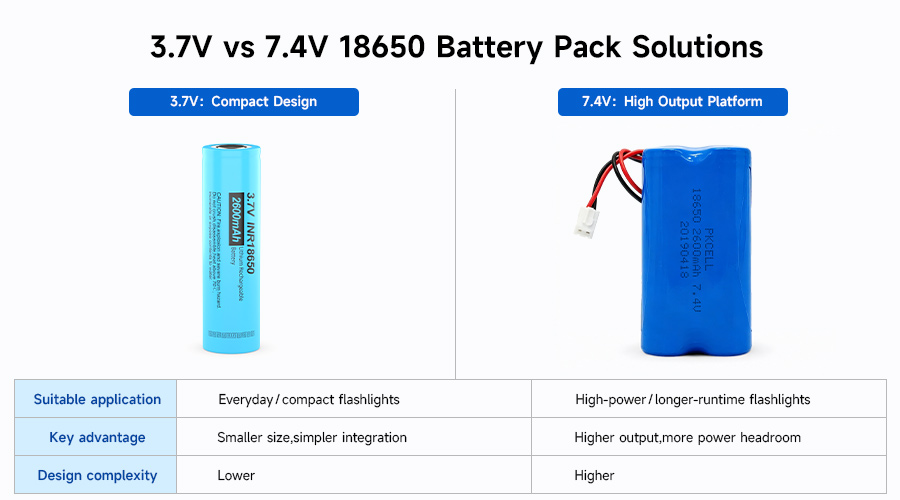
| Battery Solution | Typical Structure | Best For | Main Advantage |
|---|---|---|---|
| 3.7V 18650 battery | 1S1P single-cell design | Compact flashlights, EDC lights, portable LED lamps | Simple design, compact size, easier charging architecture |
| 7.4V 18650 battery pack | 2S1P or customized pack design | Higher-output flashlights, professional lighting, longer-range designs | Higher voltage platform for stronger output and driver flexibility |
| Custom 18650 battery pack | Series and parallel configuration | OEM flashlight projects, industrial lighting, specialized devices | Customized voltage, capacity, connector, size, and protection design |
Capacity, Discharge Rate, and Runtime: What Buyers Should Compare
Many buyers start with capacity because mAh is easy to compare. Capacity matters, but it is only one part of the decision. A flashlight battery must also support the current demand of the LED driver, especially in high, turbo, or strobe modes.
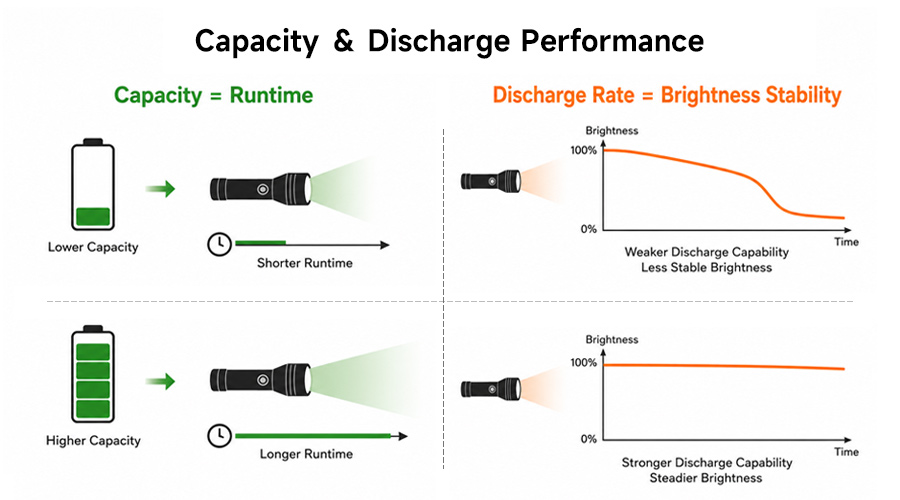
Capacity affects runtime
A higher-capacity lithium battery generally supports longer operating time under similar load conditions. For example, PKCELL lists multiple 18650 capacity options, allowing buyers to select a suitable balance between cost, runtime, and size.
Discharge capability affects brightness stability
High-powered LED flashlights may need stronger discharge performance than basic lights. If the discharge capability is too low, the flashlight may dim quickly, trigger protection, or fail to maintain its advertised brightness.
Temperature affects real-world performance
Outdoor flashlights may be used in cold, hot, wet, or demanding environments. PKCELL’s cylindrical lithium-ion battery information highlights discharge temperature ranges and long-cycle performance, which are important for lighting products used beyond indoor conditions.
How to Choose a Lithium Battery for a High-Powered Flashlight
- Confirm the flashlight voltage platform. Decide whether the product requires 3.7V, 7.4V, or a customized battery pack voltage.
- Match the physical size. Check whether the design uses 18650, 18350, 16340, 14500, or another cylindrical cell format.
- Balance capacity and discharge rate. Choose higher capacity for runtime, but ensure discharge capability supports the flashlight’s peak output.
- Plan the charging method. Decide whether charging happens through a removable charger, USB charging board, magnetic charging interface, or integrated pack system.
- Evaluate protection requirements. Battery protection should consider overcharge, over-discharge, short circuit, overcurrent, and temperature control.
- Customize for OEM production. For branded flashlight projects, review connector type, wire length, casing, label, certification needs, and packaging.
Other Lithium Battery Sizes for Compact Flashlights
Although 18650 cells are common, not every flashlight needs that size. Smaller flashlights and headlamps may use compact cylindrical lithium-ion batteries such as 16340, 18350, or 14500 cells.
For example, PKCELL features a 16340 lithium-ion battery for professional LED lighting systems, including flashlights, headlamps, camping lanterns, and portable LED lights. Compact cells are useful when product size and weight are more important than maximum runtime.
PKCELL also explains in its article about 18350 batteries in flashlights that battery sizes are not freely interchangeable. A shorter cell may not safely replace an 18650 cell because dimensions, capacity, and compatibility requirements differ.
Common Mistakes in Flashlight Battery Selection
Choosing the highest mAh without checking discharge current
A high-capacity cell may provide longer runtime at moderate power, but it may not be the best option for a high-drain flashlight. Always compare capacity and discharge requirements together.
Using the wrong battery size
An 18350, 16340, 14500, and 18650 cell may look similar to non-specialists, but they differ in size and performance. Never replace one format with another unless the flashlight design officially supports it.
Ignoring battery pack design
For OEM flashlights, the battery is part of the system. Cell choice, pack structure, BMS design, connector, housing, and charger all affect product reliability.
Overlooking supplier capability
B2B buyers should look for stable manufacturing capacity, customization support, quality control, sample availability, and experience with lighting applications. PKCELL positions itself as a rechargeable battery manufacturer with long-term production experience and global service coverage.
FAQ: Lithium Batteries for High-Powered Flashlights
What is the best lithium battery for a high-powered flashlight?
The best option depends on the flashlight design. Many rechargeable flashlights use 18650 lithium-ion batteries, while higher-output or longer-runtime models may use 21700 cells or customized 18650 battery packs.
Is a 3.7V or 7.4V battery pack better for LED flashlights?
A 3.7V solution is simpler and suitable for compact lights. A 7.4V pack can support more demanding designs, but it requires proper driver, charging, and protection design.
Can I use an 18350 battery instead of an 18650 battery?
No, not unless the flashlight manufacturer specifically allows it. The two battery sizes have different dimensions and capacity characteristics, and using the wrong size may cause poor performance or damage.
Do flashlight brands need custom battery packs?
Custom battery packs are useful when a flashlight project requires a specific voltage, capacity, connector, casing, runtime target, or protection design. This is common in OEM and professional lighting projects.
Conclusion: Build the Flashlight Around the Right Battery Platform
Lithium batteries for high-powered flashlights should be selected based on the full product requirement: voltage, size, discharge rate, capacity, runtime, protection, charging, and operating environment. For simple compact lights, a quality 18650 cell may be enough. For professional or OEM flashlight projects, a custom 18650 battery pack can provide better design control and market fit.
Planning a rechargeable flashlight project? Explore PKCELL’s 18650 lithium-ion batteries, custom 18650 battery packs, and cylindrical Li-ion battery solutions to match your product’s voltage, capacity, and performance needs.
Post time: Jul-23-2026


