
LIR2450 vs LIR2032: Size, Capacity and Applications
LIR2450 and LIR2032 are rechargeable lithium-ion coin cells with a similar nominal voltage, but they are designed for different space, runtime and load requirements. The larger LIR2450 typically offers substantially more capacity and current capability; the thinner LIR2032 is easier to integrate into compact products.
For OEM buyers and product engineers, the right choice is not simply “the battery with more mAh.” A cell has to fit the enclosure and holder, remain within the device’s electrical limits, support the real load profile and work with a correctly configured charging circuit. This guide compares the two formats around those practical decisions.
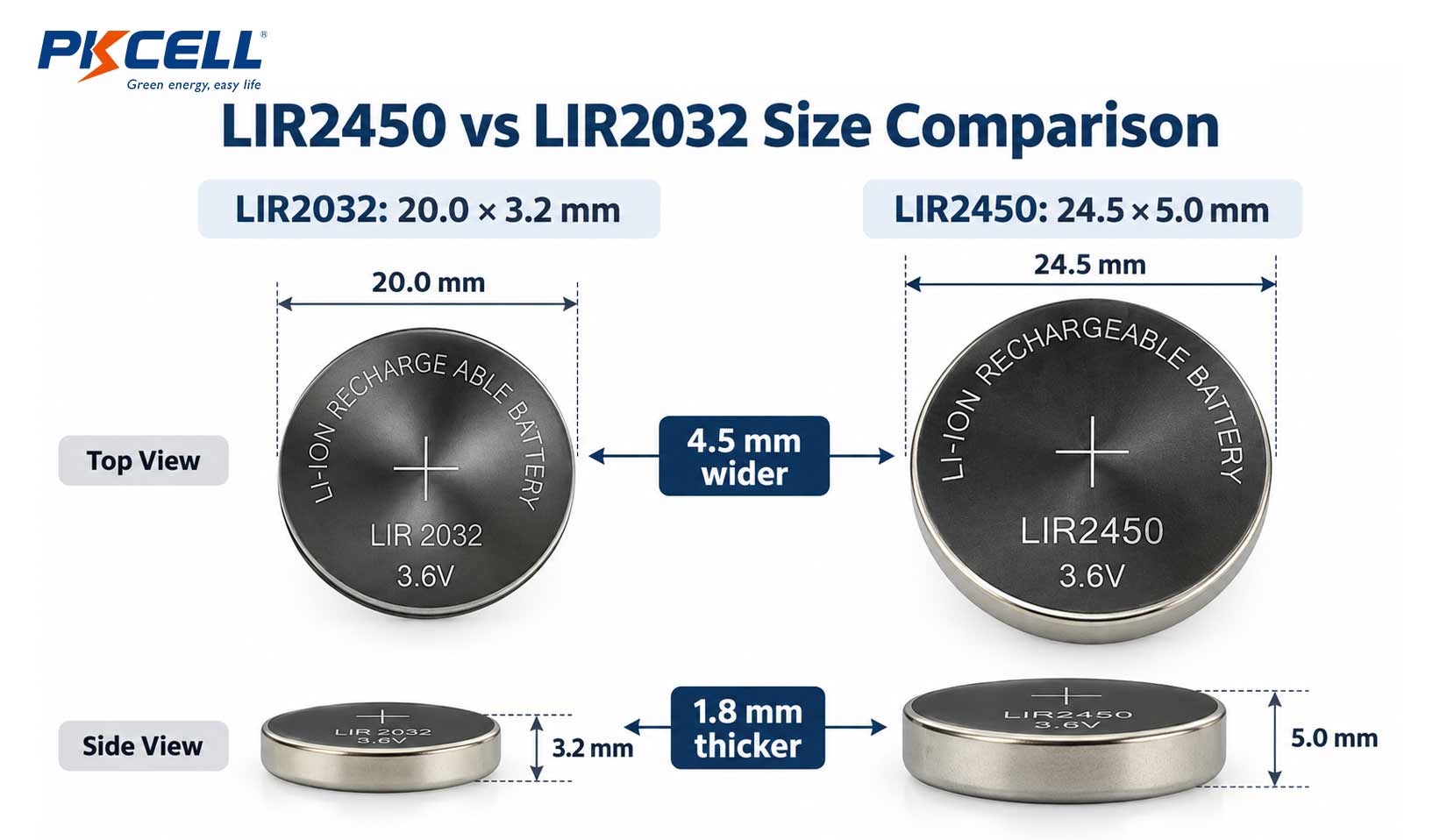
LIR2450 vs LIR2032 Specifications at a Glance
The following figures are from PKCELL’s current product-family table. Individual product pages also show 40 mAh for one LIR2032 SKU and 110 mAh or 120 mAh for LIR2450 SKUs, so procurement and engineering teams should freeze the exact part number and approved datasheet before qualification.
| Parameter | LIR2032 | LIR2450 | Design implication |
|---|---|---|---|
| Battery chemistry | Rechargeable lithium-ion | Rechargeable lithium-ion | Both require a charger matched to the exact cell specification. |
| Nominal voltage | 3.7 V in the family table | 3.7 V in the family table | Similar nominal voltage does not make charge-current settings interchangeable. |
| Diameter | 20.0 mm | 24.5 mm | LIR2450 needs 4.5 mm more diameter and about 50% more circular footprint area. |
| Height | 3.2 mm | 5.0 mm | LIR2450 is 1.8 mm thicker, a critical difference in slim enclosures. |
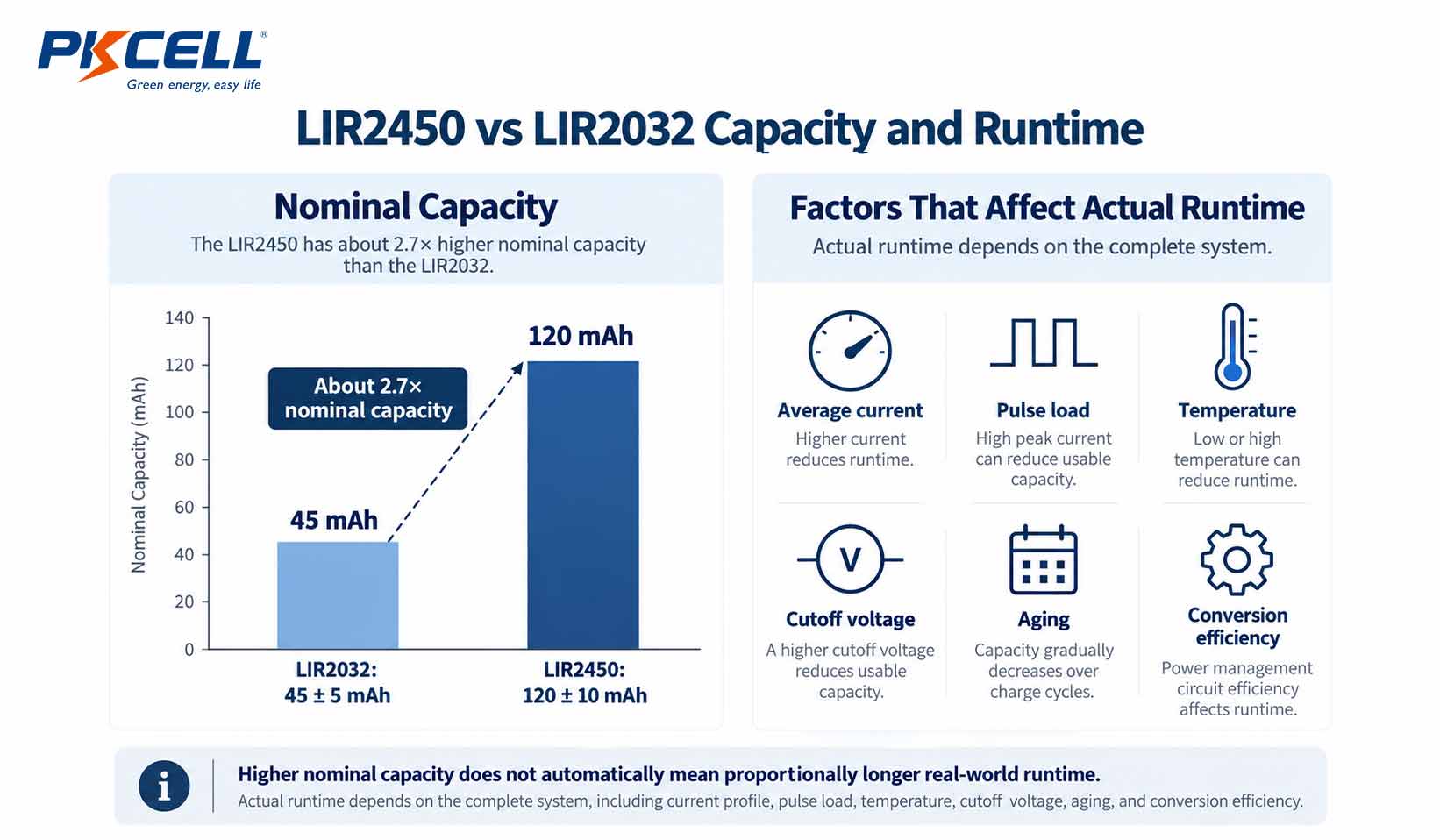
| Nominal capacity | 45 +/- 5 mAh | 120 +/- 10 mAh | LIR2450 provides about 2.7 times the nominal charge capacity on these reference values. |
| Approximate weight | 2.6 g | 5.3 g | LIR2032 better serves highly weight-sensitive products. |
| Representative page maximum charge current | 20 mA for the 40 mAh SKU | 60 mA for the 120 mAh SKU | Configure the charger from the final datasheet, not from the case code. |
| Representative page continuous discharge | 5-10 mA | 20-30 mA | LIR2450 can suit a higher load, but every pulse profile still needs validation. |
See the individual 40 mAh LIR2032 product page and 120 mAh LIR2450 product page for SKU-level starting points.
Size Difference: What 2032 and 2450 Mean in a Real Design
The model code is a fast size reference, but the approved drawing should control the mechanical design. In PKCELL’s table, the LIR2032 measures 20.0 mm across and 3.2 mm high. The LIR2450 measures 24.5 mm across and 5.0 mm high.
Enclosure and PCB consequences
Moving from LIR2032 to LIR2450 increases the circular footprint by about 50%. When the greater height is included, the simple cylindrical envelope is approximately 2.34 times larger. That can affect more than the holder outline:
- PCB keep-out area and routing around the holder
- Enclosure wall clearance and battery-door geometry
- Spring-contact travel and retention force
- Access for insertion, removal and service
- Product balance, drop behavior and vibration resistance
- Clearance for tabs, leads, insulation and welding features
Electrical similarity does not create mechanical compatibility. A 24.5 mm battery cannot be treated as an upgrade for a holder designed around a 20 mm cell.
If the cell will be welded to tabs or installed as a wired assembly, request the full drawing rather than designing from the bare-cell diameter alone. Explore the broader PKCELL button cell range when an intermediate diameter, lower profile or different chemistry may fit the mechanical envelope better.
Capacity and Runtime: Why 120 mAh Does Not Mean an Exact 2.7x Service Life
Using the family-table nominal values, 120 mAh divided by 45 mAh is about 2.67. Under identical test conditions and the same load, the LIR2450 should therefore offer materially longer time between charges. Yet a direct runtime multiplier is only an early estimate.
Usable runtime depends on the device’s cutoff voltage, continuous and pulse current, temperature, cell age, self-discharge, regulator efficiency and charger behavior. A wireless product may average only a small current but still demand short radio peaks that cause voltage sag. A cell can retain charge while the device resets because the pulse voltage falls below the system threshold.
A better first-pass runtime calculation
Use this screening formula before prototype testing:
Estimated runtime (hours) = usable capacity (mAh) / average load (mA)
Do not automatically use 100% of the nameplate capacity. Apply an engineering allowance for the operating temperature, aging, conversion loss, cutoff voltage and peak-load behavior. Then verify the estimate on production-representative hardware across the expected environmental range.
Electrical and Charging Compatibility
Both products belong to the rechargeable LIR family, and the referenced PKCELL pages identify 3.6 V nominal SKUs while the family table uses 3.7 V. This labeling difference is a reason to approve a precise specification, not a reason to assume that all LIR coin cells share identical limits.
A conventional LIR cell commonly uses a controlled single-cell lithium-ion CC/CV charge profile, but charge voltage, current, termination, temperature limits and protection requirements must come from the exact datasheet. PKCELL’s 40 mAh LIR2032 page lists a maximum constant charge current of 20 mA, while the 120 mAh LIR2450 page lists 60 mA. A charger configured for the larger cell could exceed the smaller cell’s limit.
- Validate the maximum charge voltage and charger accuracy.
- Set charge current for the approved cell, including precharge behavior.
- Check termination at the low currents used by coin cells.
- Control charging outside the permitted temperature range.
- Include standby current from the charger, regulator and protection path.
- Test over-discharge, short-circuit and reverse-polarity risks at system level.
For more circuit-level detail, read the LIR2032 charger guide. If the design may also accept a disposable 2032-size cell, review the separate LIR2032 vs CR2032 compatibility guide; a CR2032 must never be charged.
Need a Cell and Charger Review?
Share the available battery space, load profile, charging source, operating temperature and annual volume. PKCELL can help you compare an LIR2032, LIR2450 or another rechargeable button-cell format.
LIR2450 vs LIR2032 Applications
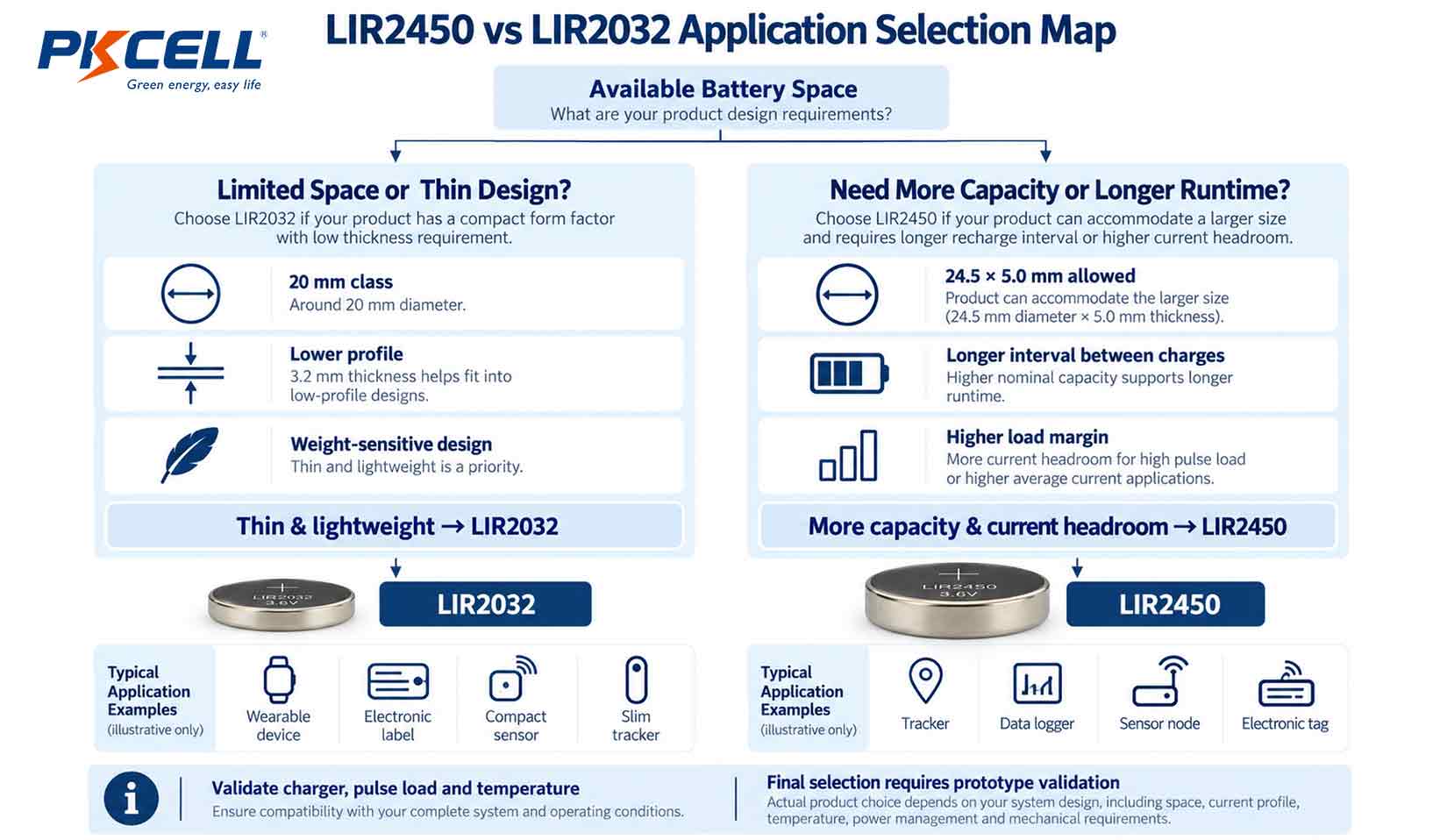
The best application is defined by the actual duty cycle and available space, not by a generic list printed on a product page. As a practical starting point, LIR2032 favors thin and lightweight designs; LIR2450 favors longer intervals between charges and greater load headroom.
Choose LIR2032 when:
- The enclosure is thin and limited to a 20 mm holder.
- Low weight is important for a wearable, badge or compact tag.
- The device has a modest average load and controlled pulses.
- Regular access to charging is acceptable.
- A 40-45 mAh class cell meets the validated runtime target.
Choose LIR2450 when:
- The enclosure can accept a 24.5 x 5.0 mm cell.
- Longer time between charges is a primary requirement.
- The load profile needs more continuous-current headroom.
- Added cell weight is acceptable.
- A 110-120 mAh class SKU matches the energy budget.
Common application patterns
| Application pattern | Likely starting point | What to validate |
|---|---|---|
| Thin wearable or electronic badge | LIR2032 | Thickness, skin-side temperature, charging interval and weight |
| Compact sensor with frequent recharging | LIR2032 | Sleep current, radio pulse, cutoff voltage and charger leakage |
| Wireless sensor needing longer service between charges | LIR2450 | Mechanical space, pulse voltage, temperature and recharge time |
| Rechargeable tracker or data logger | LIR2450 if space allows | Transmission schedule, storage interval, battery access and retention |
| Medical or safety-related electronics | Only the qualified part number | Risk analysis, traceability, documentation, change control and full system testing |
For a broader discussion of voltage classes and device matching, see PKCELL’s 3.7 V battery guide.
Can You Replace LIR2032 With LIR2450?
Usually not without redesign. The LIR2450 is 4.5 mm wider and 1.8 mm thicker. It will not fit a holder or enclosure built for LIR2032. Even if a wired cell allows mechanical relocation, the charging current, load response, mounting method and safety documentation must be revalidated.
The reverse substitution also needs review. An LIR2032 may fit a redesigned assembly but provides much less capacity and lower representative continuous-current capability. A prototype that powers up is not proof that the smaller cell will meet runtime, pulse-load or cycle-life requirements.
OEM Selection Checklist
- Define the mechanical envelope: maximum diameter, thickness, holder, tabs, leads and service clearance.
- Map the load: sleep current, active current, pulse magnitude and duration, duty cycle and abnormal loads.
- Set the voltage window: maximum input, brownout threshold, regulator dropout and end-of-discharge cutoff.
- Calculate usable runtime: include conversion losses, temperature, aging and an appropriate margin.
- Match the charger: verify charge voltage, current, termination, power path and temperature control.
- Prototype the final system: test with production-representative cells, enclosure, firmware and radio behavior.
- Qualify supply requirements: confirm part revision, tolerances, certifications, transport documents, lot traceability and change notification.
Frequently Asked Questions
Which is bigger, LIR2450 or LIR2032?
LIR2450 is bigger. PKCELL lists it at 24.5 mm in diameter and 5.0 mm high, compared with 20.0 mm by 3.2 mm for LIR2032.
Which has more capacity, LIR2450 or LIR2032?
The referenced standard family values are 120 +/- 10 mAh for LIR2450 and 45 +/- 5 mAh for LIR2032. Specific SKUs vary, so use the approved datasheet in runtime calculations.
Are LIR2450 and LIR2032 interchangeable?
No. Their diameter, thickness, capacity, weight and current limits differ. A mechanical or electrical redesign may be required even though both are rechargeable LIR coin cells.
Does LIR2450 last longer than LIR2032?
It will generally run longer under comparable conditions because it has more nominal capacity. The actual improvement depends on load, pulses, cutoff voltage, temperature, cell age and conversion efficiency.
Can both batteries use the same charger?
Do not assume so. The referenced LIR2032 and LIR2450 pages list different maximum charge currents. Confirm charge voltage, current, termination and temperature limits for the exact cell.
What information should I send for an OEM quote?
Include the available space or drawing, voltage range, average and peak current, charging method, operating temperature, mounting style, target runtime, annual volume and required certifications.
Conclusion: Select the Cell Around the Product
LIR2032 is the stronger starting point for a slim, light product with moderate energy needs and regular charging. LIR2450 is the stronger starting point when the enclosure has room and the product needs more capacity, longer intervals between charges or greater current headroom.
Whichever format looks promising, approve the exact SKU rather than the case name alone. A defensible selection combines the cell datasheet, mechanical drawing, charging design, load profile and tests in the finished product.
Compare LIR Coin Cells for Your Project
Send PKCELL your device drawing and power profile for a practical LIR2032 vs LIR2450 review, sample request or wholesale quotation.
Post time: Oct-26-2026


