
LIR2032 Charger Guide: Current, Voltage & Circuit
Choosing a LIR2032 charger is not as simple as finding a coin-cell holder with a USB cable. LIR2032 is a rechargeable lithium-ion cell that needs a controlled single-cell charging process, a precise voltage limit, a suitably low current, and reliable charge termination.
Quick answer: Charge a conventional LIR2032 with a dedicated one-cell lithium-ion CC/CV charger set to the exact cell specification, commonly 4.2V. For PKCELL’s 40mAh product page, the listed maximum constant charging current is 0.5C, or 20mA. Treat 20mA as a ceiling rather than a universal default, and validate a lower current when charge time permits.
*Confirm the final cell datasheet. The PKCELL product page identifies a 3.6V/40mAh product, while its family table lists LIR2032 at 3.7V and 45±5mAh. The article uses the product-page 20mA maximum and shows calculations for both capacity references.
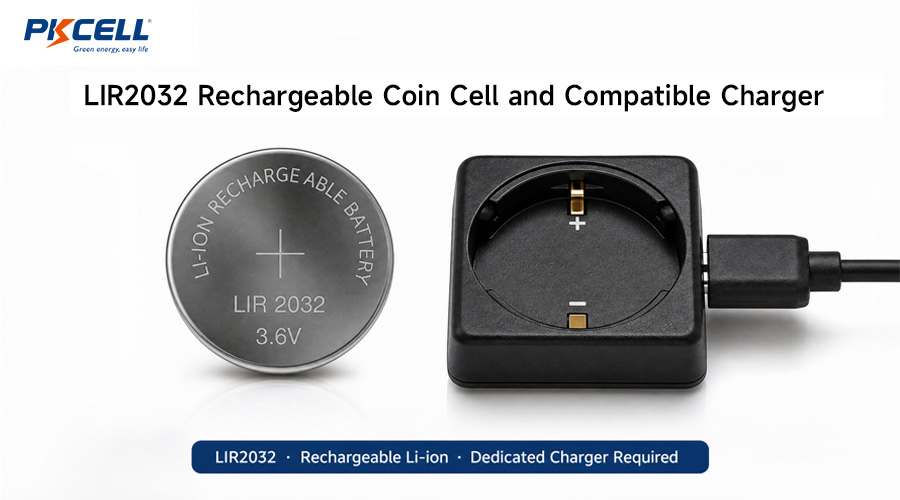
What Is an LIR2032 Battery?
LIR2032 is a rechargeable lithium-ion coin cell in the 20mm diameter and 3.2mm height class. It looks similar to a CR2032, but its chemistry, voltage, capacity, and charging requirements are different.
PKCELL’s current LIR2032 product page lists these headline values:
| Parameter | PKCELL Page Value | Design Meaning |
|---|---|---|
| Battery type | Rechargeable lithium-ion coin cell | Requires a charger designed for one-cell lithium-ion chemistry. |
| Nominal voltage | 3.6V on product summary; 3.7V in family table | Nominal voltage is not the charge cutoff. |
| Capacity | 40mAh headline; 45±5mAh table entry | Use the approved lot specification for current and runtime calculations. |
| Maximum constant charge current | 0.5C / 20mA | Do not exceed the applicable product limit. |
| Dimensions | 20.0 × 3.2mm | Holder contacts and polarity still need mechanical validation. |
| Approximate weight | 2.6g | Relevant for wearables, tags, and compact sensors. |
For OEM projects, the exact model revision and datasheet should take precedence over a category page or generic charger label. PKCELL’s broader lithium-ion button-cell range includes different LIR capacities and sizes, so one charging current cannot be copied across every model.
How to Charge LIR2032 Correctly
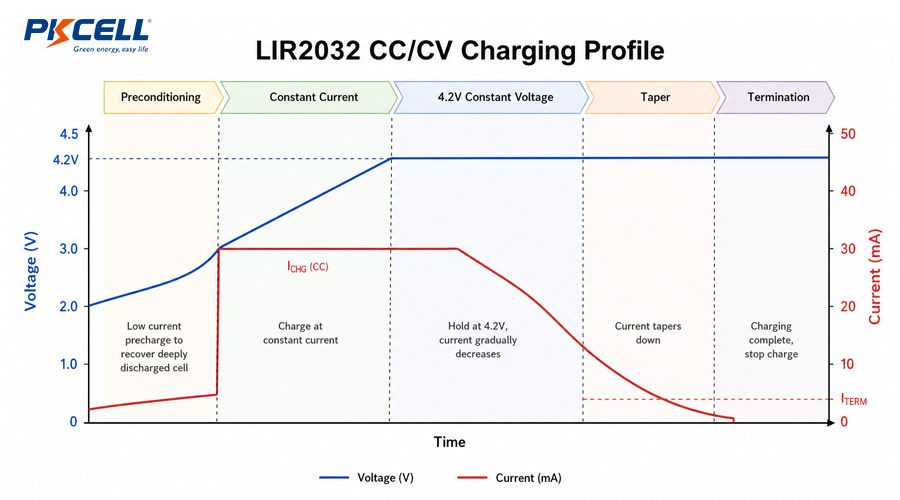
A conventional LIR2032 uses the single-cell lithium-ion charge sequence: preconditioning when the cell is deeply discharged, constant-current charging, constant-voltage charging, and current-based termination.
1. Preconditioning
If the cell voltage is below the charger’s preconditioning threshold, the charger applies a reduced current. This avoids immediately applying the full programmed current to a deeply depleted cell. The threshold and precharge ratio must match the cell and charger design.
2. Constant Current
The charger supplies the programmed current while cell voltage rises. For the PKCELL 40mAh page value, the published maximum is 20mA. A product designed for longer charge time may use a lower current to reduce thermal stress and improve margin.
3. Constant Voltage
When the cell reaches its specified charge voltage, commonly 4.2V for this lithium-ion class, the charger holds voltage while current tapers. The voltage accuracy matters because a coin cell has little thermal mass and limited capacity.
4. Charge Termination
The charger ends charging when taper current reaches its defined termination threshold. It may later start a controlled recharge if voltage drops below a set level. LIR2032 should not be indefinitely “trickle charged” using a simple resistor as if it were a different rechargeable chemistry.
A 5V USB source is only the input supply. It must feed a compatible charger circuit; it must never be connected directly to the LIR2032 cell.
How to Choose LIR2032 Charge Current
Start with the exact cell’s recommended and maximum charge-current limits. C-rate expresses current relative to capacity:
| C-rate | 40mAh Cell | 45mAh Cell | Engineering Interpretation |
|---|---|---|---|
| 0.1C | 4mA | 4.5mA | Low current and long charge time; requires a charger that regulates accurately at this level. |
| 0.2C | 8mA | 9mA | A conservative development candidate when charge time permits; validate against the final datasheet. |
| 0.3C | 12mA | 13.5mA | Middle-ground current requiring thermal and cycle validation. |
| 0.5C | 20mA | 22.5mA | PKCELL page maximum is 20mA, so the product limit caps this example at 20mA. |
A practical selection sequence:
- Confirm whether the cell is the 40mAh version, 45±5mAh version, or another approved LIR2032.
- Use the datasheet’s recommended current when available.
- Keep the programmed current at or below the applicable maximum; for the cited product page, no more than 20mA.
- Choose a lower current when temperature rise, cycle-life target, energy-source limits, or enclosure conditions require more margin.
- Validate charging across input tolerance, battery tolerance, temperature, aging, and simultaneous device operation.
How Long Does an LIR2032 Take to Charge?
A first estimate divides capacity by constant current. The actual cycle takes longer because current tapers during constant-voltage charging and may begin with preconditioning.
| Programmed Current | 40mAh Ideal CC Time | 45mAh Ideal CC Time | Real-World Note |
|---|---|---|---|
| 4mA | 10 hours | 11.25 hours | Actual total time is longer after CV taper and any preconditioning. |
| 8mA | 5 hours | 5.63 hours | Suitable only if the charger can regulate and terminate accurately at low current. |
| 10mA | 4 hours | 4.5 hours | Check thermal rise, termination, and device load. |
| 20mA | 2 hours | 2.25 hours | Represents the cited page maximum; it is not a guaranteed total charge time. |
Do not promise a charge time from current alone. Initial state of charge, preconditioning, source voltage, charger dropout, temperature regulation, CV taper, termination setting, cell age, and any device load all change the result.
How to Choose a LIR2032 Charger
A suitable LIR2032 recharger should be specified by electrical behavior, not only by the slot size or the words “coin cell charger.” Check all of the following:
- Chemistry: Explicit support for one-cell rechargeable lithium-ion, not CR2032, ML2032, VL2032, NiMH, or alkaline.
- Regulation voltage: The exact charge voltage required by the approved LIR2032, commonly 4.2V.
- Low-current range: Accurate programmable current in the required range, typically well below chargers designed for 18650 cells.
- Preconditioning: Controlled recovery behavior for a deeply discharged cell.
- Termination: A termination threshold low enough to detect the taper current of a 40–45mAh cell.
- Temperature control: NTC input or host control if required by the cell and product risk assessment.
- Reverse leakage: Low battery drain when USB or external power is removed.
- Polarity and holder: Reliable positive/negative contact, insertion control, and resistance to reverse placement.
- Power path: Required when the device must operate correctly while charging.
- Status and fault output: Clear indication for charging, complete, temperature fault, timeout, or missing battery.
PKCELL lists a broader Li-ion charger category, but its visible products are mainly larger cylindrical-cell chargers. Do not assume that an 18650 charger supports LIR2032 merely because both use lithium-ion chemistry.
External LIR2032 Recharger vs Embedded Circuit
| Architecture | Best Fit | Advantages | Key Risks to Control |
|---|---|---|---|
| External cradle charger | Removable cells and service stations | Keeps heat and charging electronics outside the device | Wrong cell inserted, reversed polarity, poor contact, unverified current or voltage |
| Embedded linear charger | USB-powered wearables, sensors, tags, compact electronics | Low component count and direct control of product behavior | Thermal rise, system-load interference, leakage, no power path |
| Integrated power-path charger | Products that operate while charging | Separates system load from battery-charge measurement | More firmware, layout, quiescent-current, and validation complexity |
| Shunt / energy-harvesting charger | Solar, intermittent, or very-low-power sources | Can accept weak or continuous energy sources | Float-voltage accuracy, source limiting, load disconnect, temperature, and over-discharge |
For a consumer replacement charger, the cell holder and misuse controls are central. For an OEM embedded product, power-path behavior, standby current, temperature, and firmware control can matter more than the physical charger size.
LIR2032 Charging Circuit Design
A basic embedded architecture starts with a regulated input, input protection, a one-cell lithium-ion charger IC, the LIR2032 holder or tabbed cell, and load-side protection. The circuit should not be reduced to a 5V source and a resistor because that arrangement does not provide accurate constant-voltage regulation or charge termination.
Simple Standalone Linear Charger
Microchip’s MCP73831/2 is an example of a one-cell linear charger that uses CC/CV charging, programmable current, preconditioning options, termination, status output, reverse-discharge protection, and thermal regulation. Its specified programmable current range begins at 15mA, so it can be considered for 15–20mA LIR2032 designs but not for an 8mA target.
20mA target → RPROG ≈ 50kΩ
15mA target → RPROG ≈ 66.7kΩ
These resistor values are calculated examples. Select the correct 4.20V device option, preconditioning ratio, termination ratio, input/output capacitors, tolerances, and layout from the current IC datasheet. Confirm that the final current never exceeds the cell limit.
Low-Current Charger with Power Path
For products that must operate while charging, an IC designed for wearables can provide better control. Texas Instruments’ BQ25120A supports charge currents from 5mA to 300mA, termination down to 500µA, power-path management, programmable battery voltage, battery-temperature monitoring, and low-current system operation. Those features can help with a small LIR2032, but they add configuration and firmware responsibilities.
Energy-Harvesting or Continuous Low-Power Source
Analog Devices’ LTC4070 is an example of a low-current shunt charger for intermittent or continuous sources, with selectable 4.0V, 4.1V, or 4.2V float voltage and NTC-related conditioning. This architecture needs a full system review of source current, load behavior, over-discharge, heat, and the exact LIR2032 requirements.
Charging While the Device Is Running
If the system load is connected directly across the battery while a simple charger is operating, load current can be mistaken for battery current. The charger may fail to reach its termination threshold, remain in constant-voltage mode, or report an inaccurate charge-complete state.
Use one of these strategies:
- Turn the device off during charging.
- Ensure the active load is small enough that termination still works, then verify every operating mode.
- Use a charger with power-path management so input power can supply the system while the battery is charged separately.
- Let firmware reduce radio, display, motor, or sensor activity during charging.
The right choice depends on user experience, input power, thermal limits, battery capacity, and whether accurate state-of-charge indication is required.
Temperature, Protection, and Standby Current
The PKCELL product page lists a broad operating-temperature range, but it does not establish the allowable charge-temperature window in the visible summary. Charge temperature should therefore be taken from the final cell datasheet and enforced by the charger or host system.
A coin-cell product should address:
- Overcharge protection through accurate charger regulation and termination
- Over-discharge cutoff before the cell is damaged
- Short-circuit and excessive-load current behavior
- Temperature sensing or charge inhibit where required
- Reverse-polarity prevention
- Battery-holder contact resistance and retention
- Charger and system leakage when stored
Standby current matters because the cell stores only tens of milliamp-hours. A circuit that draws 20µA continuously consumes about 0.48mAh per day before cell self-discharge and application load are considered. Charger shutdown current, regulator quiescent current, LEDs, pull resistors, protection circuits, and sensor sleep current should all be included in the budget.
Never Charge CR2032 in an LIR2032 Charger
CR2032 and LIR2032 share the same nominal physical size, but CR2032 is a non-rechargeable 3V lithium manganese dioxide cell. It must not be placed in a charger or device that will attempt to recharge it.
Likewise, LIR2032 should not be treated as a drop-in replacement for CR2032. Its 3.6–3.7V nominal voltage and 4.2V full-charge level can exceed the input range of a device designed only for a 3V primary cell.
PKCELL’s detailed LIR2032 vs CR2032 comparison explains the chemistry, voltage, rechargeability, and replacement risks. An OEM product that uses a rechargeable cell should be mechanically and electrically designed to prevent insertion of a non-rechargeable CR2032 where practical.
Common LIR2032 Charging Mistakes
Connecting the Cell Directly to 5V
USB voltage is higher than the normal LIR2032 charge limit and does not provide CC/CV control. A charger IC or validated charger module is required.
Using a Charger Designed for 18650 Cells
Many cylindrical-cell chargers use hundreds of milliamps. That can greatly exceed the 20mA maximum listed for the cited LIR2032 product.
Choosing Current from the Cell Name
Different manufacturers and variants can have different capacities and current limits. Even PKCELL’s page shows 40mAh in the product summary and 45±5mAh in its model table. Freeze the exact specification.
Ignoring Termination at Low Current
A charger designed for a large battery may have a termination threshold too high or too coarse for a small coin cell. Check the minimum configurable termination current and accuracy.
Allowing the System Load to Prevent Termination
When the product operates while charging, load current can keep the charger active. Use a power path or validate the combined load and termination behavior.
Charging Outside the Approved Temperature Range
Do not use the discharge or general operating range as the charge-temperature specification. Confirm the exact charging limits.
OEM LIR2032 Charger Validation Checklist
- Exact LIR2032 model and revision
- Minimum, typical, and maximum capacity
- Nominal and maximum charge voltage
- Recommended and maximum charge current
- Preconditioning threshold and current
- Termination current and accuracy
- Automatic recharge threshold
- Input voltage and transient protection
- Battery reverse leakage
- Charge-temperature limits and NTC
- System load during charging
- Power-path behavior
- Holder polarity and contact resistance
- Over-discharge and short-circuit response
- Charge time and temperature rise
- Aged-cell and tolerance testing
- Wrong-cell insertion controls
- Required compliance documentation
Need LIR2032 Cells for an OEM Charging Design?
Send PKCELL your device voltage range, cell capacity, target charge time, input source, charging-circuit diagram, standby-current budget, mounting style, temperature range, annual volume, and required documentation.
Frequently Asked Questions
How do you charge an LIR2032 battery?
Use a dedicated one-cell lithium-ion charger with the voltage, current, preconditioning, and termination settings required by the exact LIR2032. A conventional version commonly uses a 4.2V CC/CV profile.
What charger should I use for LIR2032?
Choose a charger explicitly rated for rechargeable LIR2032 or a configurable one-cell lithium-ion circuit that can regulate accurately in the required low-current range. Do not assume an 18650, ML2032, or generic coin-cell charger is compatible.
Can I charge LIR2032 with 5V?
Not directly. A 5V USB supply can power a compatible charger IC, but the IC must limit current, regulate the cell voltage, and terminate charging.
What is the maximum LIR2032 charge current?
It depends on the exact product. PKCELL’s cited 40mAh page lists a maximum constant charge current of 0.5C or 20mA. Other LIR2032 versions require their own specifications.
Can I use a 20mA charger for every LIR2032?
No. Twenty milliamps is the published maximum for the cited PKCELL product page, not a universal LIR2032 value. Check the specific cell capacity and datasheet.
How long does an LIR2032 take to recharge?
A 40mAh cell has an ideal two-hour constant-current calculation at 20mA, but the complete cycle takes longer because of preconditioning and constant-voltage taper. Lower current increases charge time.
Can I charge CR2032 in an LIR2032 recharger?
No. CR2032 is non-rechargeable. Charging it can cause leakage, overheating, swelling, rupture, or equipment damage.
Can the device operate while LIR2032 is charging?
It can if the circuit is designed for it. A power-path charger is often preferable because system current can otherwise interfere with charge termination.
Does PKCELL offer tabbed or customized LIR2032 cells?
PKCELL supports rechargeable lithium-ion button cells with options such as tabs and customized integration for suitable OEM projects. Confirm the cell, mounting, and charging requirements when requesting a quote.
Conclusion
The right LIR2032 charger provides more than a 20mm slot. It matches the exact lithium-ion coin cell’s voltage, regulates a low charging current, handles deep discharge, terminates correctly, controls temperature, and prevents the system load from confusing the charging process.
For the cited PKCELL 40mAh product page, 20mA is the maximum constant charging current. A lower value may provide more engineering margin when charge time allows, but it must still be validated with the final cell and charger. Never charge CR2032, never connect LIR2032 directly to 5V, and never copy a large-cell charger circuit without checking its minimum current and termination range.
Post time: Sep-01-2026


