
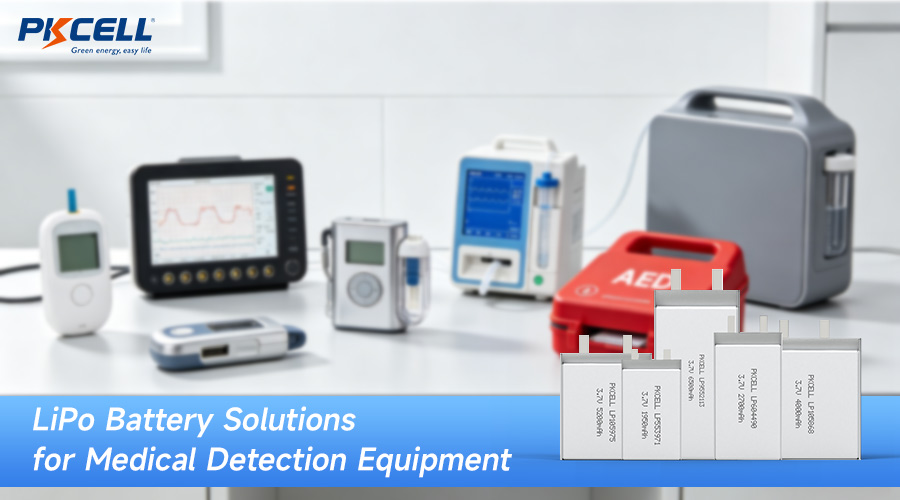
Key Highlights About LiPo Batteries for Medical Equipment
-
LiPo batteries provide up to 200-250 Wh/kg, enabling lightweight, portable diagnostic tools without sacrificing runtime.
-
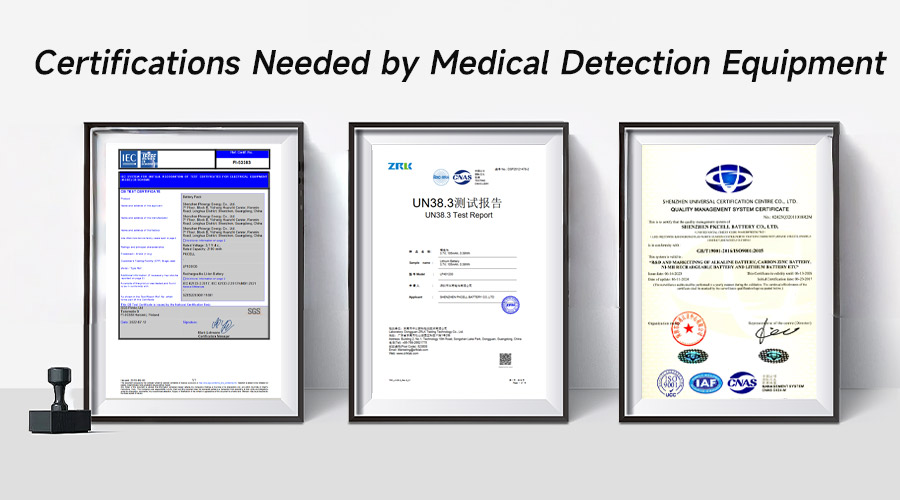
Medical-grade batteries must pass rigorous IEC 62133 and UN38.3 certifications to ensure stability in clinical environments.
-
The pouch-cell design allows for ultra-slim and custom shapes, perfect for ergonomic handheld detection scanners.
-
A consistent voltage output is critical for sensitive medical sensors to maintain data accuracy during detection.
-
Integrated BMS (Battery Management Systems) monitor cell health in real-time, preventing overcharge and thermal runaway.
Introduction
In the high-stakes world of healthcare diagnostics, the reliability of a medical device battery can be the difference between a successful screening and a critical equipment failure. As medical technology shifts toward portability and point-of-care testing, selecting the right battery for medical device applications has become a core focus for engineers and sourcing departments alike.
What Medical Detection Devices Need for Their Power
Modern medical detection equipment—ranging from portable ultrasound scanners to blood glucose monitors—requires power sources that balance high performance with absolute safety. For detection devices, the power source must meet three primary criteria:
-
Precision: Stable voltage levels to prevent signal noise in sensitive diagnostic sensors.
-
Portability: High capacity-to-weight ratios for handheld mobility.
-
Longevity: A long cycle life (typically 500+ cycles) to reduce the total cost of ownership for hospitals.
Safety & Certifications: The Non-Negotiables in Medical Power
In the medical industry, a battery is a safety-critical system.
The Essential Certification Trio:
-
IEC 62133: The international gold standard for the safety of rechargeable lithium cells. It involves rigorous testing for thermal abuse and mechanical shock.
-
UN38.3: Crucial for B2B logistics, ensuring that the li polymer battery can be safely transported by air or sea worldwide.
-
ISO 9001: Reflects a company’s commitment to a consistent Quality Management System, ensuring every batch meets high-tier manufacturing specs.
Why LiPo is the Gold Standard for Medical Detection
A lipo battery (Lithium Polymer) is often the preferred choice due to its unique chemical architecture. Unlike traditional cylindrical cells, a li polymer battery uses a solid or gel-like electrolyte, which significantly reduces the risk of leakage and allows for a lighter, more compact build.
Beyond basic power, the Li-Polymer chemistry offers several distinct advantages tailored for the medical industry:
-
Customizable Shapes: Since they do not require a metal casing, LiPo cells can be manufactured in “credit card” thinness or curved shapes to fit the latest ergonomic detection tools.
-
Safety Profile: The gel electrolyte makes Li-polymer batteries less prone to thermal runaway compared to liquid-electrolyte lithium-ion cells.
-
Low Self-Discharge: Medical devices often sit in emergency kits or storage. LiPo batteries retain their charge longer, ensuring the device is ready the moment it’s needed.
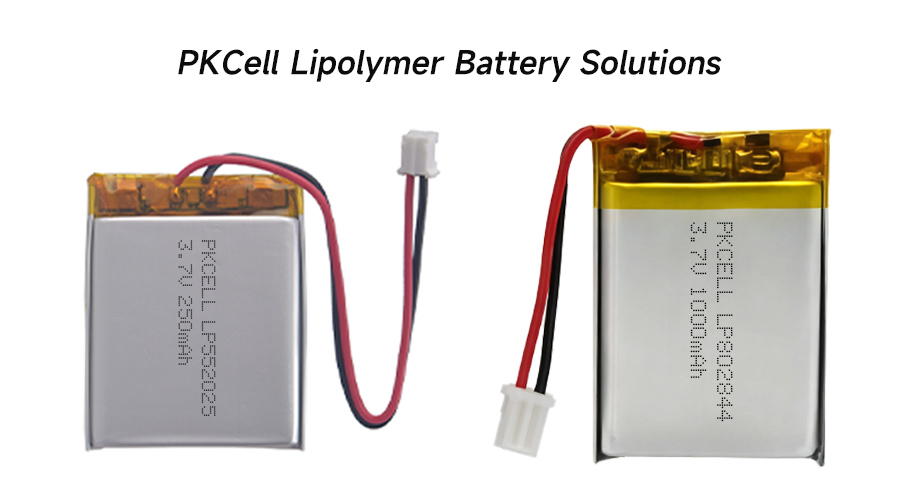
PKCell Featured Solutions: LP55202 & LP802844
We provide high-discharge and high-capacity LiPolymer Battery solutions tailored for medical detection workstations and handheld scanners.
Technical Specifications Table
|
Model |
Capacity |
Nominal Voltage |
Dimensions (TWL) |
Best For |
|
LP552025 |
250mAh |
3.7V |
5.5 x 20 x 25 mm |
Heavy-duty mobile detection monitors |
|
LP802844 |
1000mAh |
3.7V |
8.0 x 28 x 44 mm |
Compact handheld scanners & sensors |
Note: Custom connectors (JST, Molex, etc.) and specific NTC thermistors can be integrated into these packs upon request to meet your device’s unique engineering requirements.
Intelligent Protection: PCM vs. Smart BMS
For medical detection equipment, we offer two levels of electronic protection:
-
Protection Circuit Module (PCM): Acts as a safety switch against over-charge, over-discharge, and short circuits.
-
Smart Battery Management System (BMS): Acts as the “brain,” providing real-time telemetry on State of Charge (SOC) and State of Health (SOH) to prevent unexpected shutdowns during critical patient scans.
Industrial Data & Market Trends (2025–2030)
The medical battery landscape is undergoing a rapid transformation, driven by the shift toward home-based care and portable diagnostics.
The 13.8% CAGR Opportunity
Recent industrial data indicate that the global medical batteries market is projected to grow at a Compound Annual Growth Rate (CAGR) of 13.8% from 2025 through 2030. This surge is fueled by:
-
Miniaturisation: The demand for smaller, thinner devices is pushing engineers toward high-density li polymer battery pouch cells.
-
Remote Patient Monitoring (RPM): A growing need for long-cycle-life batteries that can sustain continuous monitoring.
-
Decentralised Testing: Portable blood analyzers now require the same energy density previously reserved for stationary hospital workstations.
About PKCELL: Your Trusted B2B Battery Manufacturer
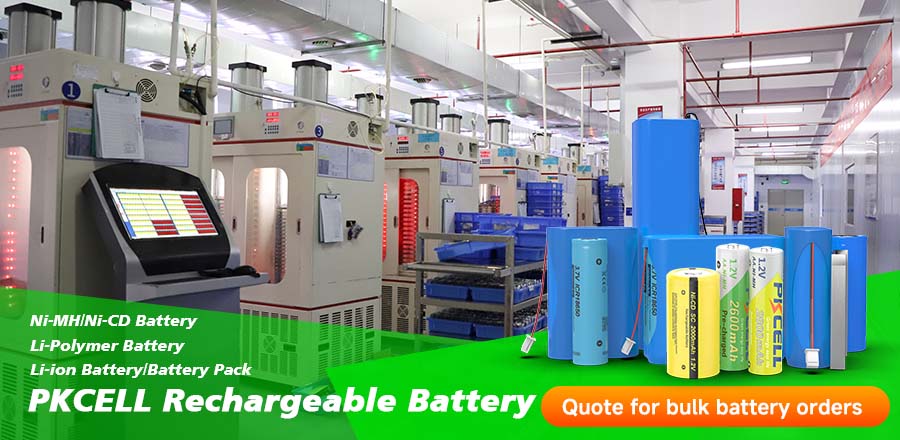
Shenzhen PKCELL Battery Co., Ltd. is a leading high-tech enterprise in China with over 20 years of expertise. Our 28000-square-meter facility and 500+ professionals are dedicated to producing the highest quality Li-ion, LiPo, and custom battery packs.
We understand that for distributors and manufacturers, compliance is king. Our products carry all necessary global certifications, ensuring seamless export and clinical acceptance. Whether you need an off-the-shelf cell or a custom-engineered solution, PKCELL provides the reliability your clients demand.
Contact Our Engineers and Sales
Frequently Asked Questions (FAQs)
Q1: What certifications are mandatory for a medical device battery?
A: Most global markets require IEC 62133 for safety and UN38.3 for safe transport.
Q2: Can I customize the dimensions of a Li Polymer battery?
A: Yes. One of the greatest strengths of li polymer battery technology is its flexibility in thickness, width, and length to fit specific device housings.
Q3: How many cycles can I expect from a PKCELL LiPo battery?
A: Under standard operating conditions, our cells typically maintain >80% capacity after 500 cycles.
Q4: Is it safe to use LiPo batteries in handheld detection equipment?
A: Absolutely. When equipped with a high-quality BMS and certified to IEC standards, LiPo batteries are among the safest high-density power sources available.
Q5: What is the lead time for bulk B2B orders?
A: Standard models usually take 2–4 weeks, while custom-engineered packs typically range from 6–8 weeks.
Post time: Apr-23-2026


