
LiPo Battery Packs for Portable Projectors: What OEM Buyers Need to Consider
Portable projectors are becoming increasingly popular for home entertainment, outdoor movie nights, business presentations, travel and compact smart entertainment systems. As these devices become smaller and more versatile, their battery systems must support more than simply keeping the projector powered on.
A portable projector may combine a high-brightness light source, image processing hardware, wireless connectivity, speakers, cooling fans and intelligent control functions in one compact enclosure. Each component contributes to overall power consumption, while the battery must fit within limited internal space without compromising weight, thermal management or product reliability.
For OEM buyers, selecting a LiPo battery pack for a portable projector requires evaluating the complete device architecture. Battery capacity, voltage, discharge capability, charging strategy and mechanical integration should all be considered before finalizing a supplier or approving a production sample.
Evaluate power consumption across brightness, streaming and audio modes.
Match pouch-cell dimensions, weight, wiring and protection to the enclosure.
Coordinate battery placement, temperature monitoring and charging behavior.
1. Understand the Projector’s Complete Power Requirements
Before selecting a battery, OEM teams should identify how the projector operates under different conditions. Two portable projectors with similar dimensions may have significantly different energy requirements depending on their optical systems, processing hardware, connectivity and intended usage.
For example, a compact projector primarily used for occasional presentations may have a different power profile from a smart projector designed for extended video streaming and higher brightness output.
Identify the main power-consuming components
- Optical light source: LED or laser-based projection systems have different electrical requirements depending on their architecture and brightness settings.
- Image processing board: The processor, memory and display control electronics consume power throughout normal operation.
- Wireless connectivity: Wi-Fi and Bluetooth functions may increase power consumption during streaming, screen casting and wireless control.
- Audio system: Built-in speakers and audio amplifiers contribute additional power demand, especially at higher volume levels.
- Cooling system: Fans and thermal-control components may operate continuously while the projector is running.
- Additional functions: Autofocus, automatic keystone correction, sensors and standby electronics can also affect the overall energy budget.
OEM buyers should request a power breakdown from the engineering team rather than estimating battery requirements from the projector’s advertised brightness or product dimensions.
2. Match Battery Capacity to Real Projector Runtime
One of the most important purchasing decisions is how long the projector should operate without external power.
However, projector runtime is not constant across all operating modes. Higher brightness, wireless streaming, louder audio and more demanding processing workloads can increase average power consumption. Eco mode may reduce energy demand, but its actual effect should be measured on the finished device.
Build a mode-based power consumption profile
| Projector operating mode | Conditions to evaluate | Battery consideration |
|---|---|---|
| High-brightness projection | Maximum intended brightness and normal cooling operation | Higher energy demand and potential thermal accumulation |
| Eco projection | Reduced brightness and standard video playback | Potentially longer operating time |
| Wireless streaming | Wi-Fi streaming with audio enabled | Additional processing and wireless power consumption |
| HDMI playback | External video source and normal audio output | Different load distribution across internal electronics |
| Standby mode | Wireless standby, remote control and background functions | Long-term energy consumption during inactivity |
The average power consumption across these operating modes provides a more useful basis for battery sizing than a single maximum-current measurement.
Calculate energy requirements in watt-hours
For OEM sourcing, watt-hours (Wh) are more useful than comparing mAh values alone because different battery packs may operate at different nominal voltages.
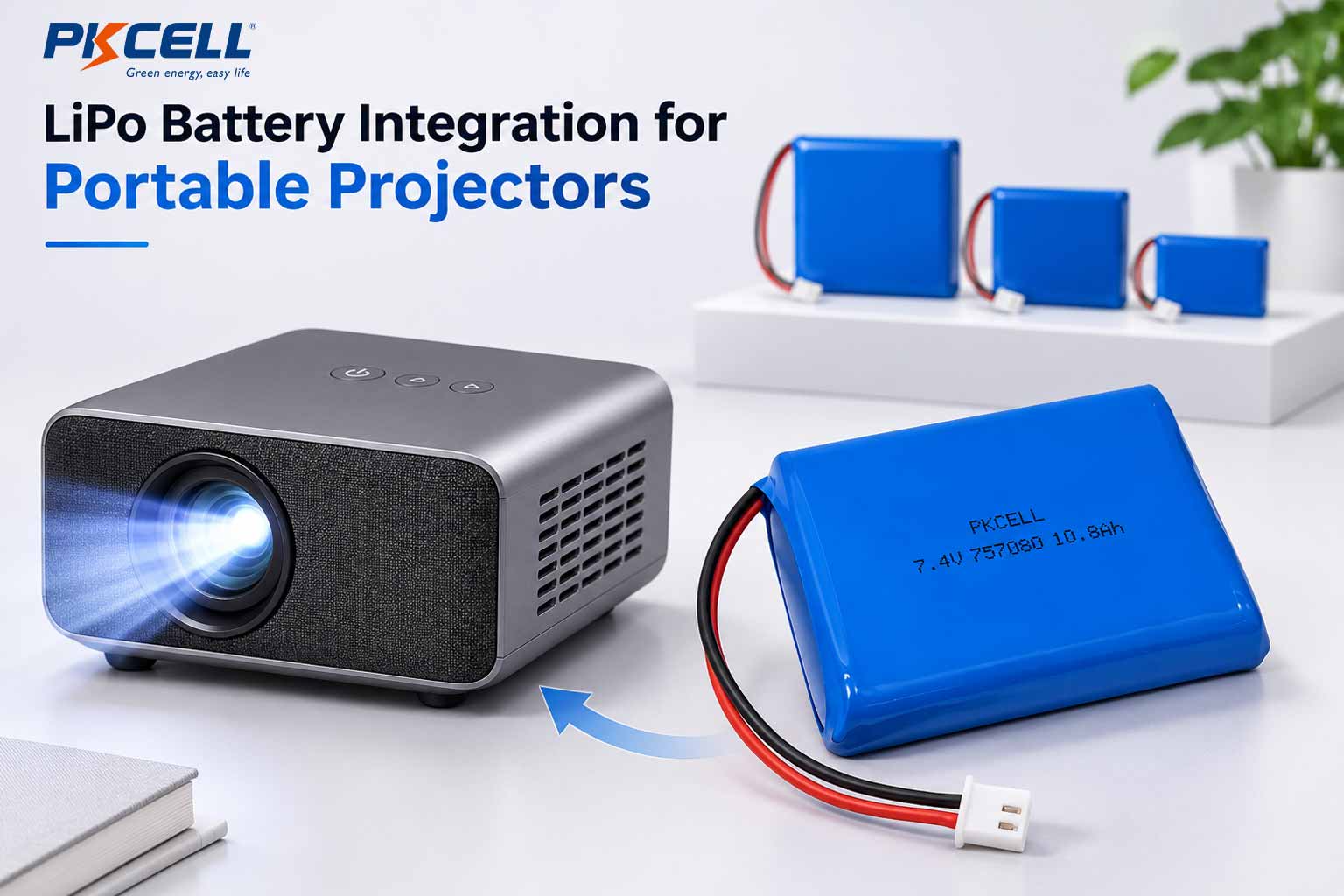
For example, PKCELL’s 7.4V 10800mAh LP757080 LiPo battery provides a catalog reference of approximately 79.9Wh nominal energy.
This figure can help illustrate how voltage and capacity translate into energy. It should not be interpreted as the actual usable energy or guaranteed runtime inside a projector. Conversion losses, discharge cutoffs, temperature, aging and the projector’s actual load all affect the final result.
Estimated Runtime (hours) ≈
Usable Battery Energy (Wh) ÷ Average Device Power (W)
When calculating usable energy, account for the battery’s permitted discharge window and the efficiency of the projector’s power conversion circuits.
For a more detailed explanation of load-based runtime calculations, refer to How to Calculate Lithium Battery Pack Runtime from a Real Device Load Profile.
3. Select a LiPo Pack That Fits the Projector’s Internal Structure
One reason OEM developers consider lithium polymer batteries is their pouch-cell construction. Unlike cylindrical batteries, LiPo cells can be manufactured in different flat and rectangular dimensions, offering more flexibility when designing compact consumer electronics.
This can be useful for portable projectors where the battery must share limited internal space with the optical engine, mainboard, cooling fan and speaker assembly.
What should buyers evaluate?
- Battery dimensions: Confirm the maximum available length, width and thickness, including the protection circuit, insulation and connectors.
- Weight distribution: Consider how battery placement affects the projector’s balance, portability and stability during installation.
- Connector orientation: Confirm cable exit direction, connector dimensions, pinout and polarity.
- Mechanical protection: Provide appropriate support and clearance to prevent bending, puncturing, excessive compression or abrasion of the pouch cell.
- Assembly space: Account for wiring, insulation, protective materials and manufacturing tolerances.
- Serviceability: Determine whether the battery needs to be replaceable during product maintenance.
Buyers can review the PKCELL Li-Polymer Battery range for examples of available pouch-cell formats.
For instance, the LP803860 3.7V 2000mAh LiPo battery provides a reference for a flat pouch-cell design. Its actual suitability must still be assessed against the projector’s voltage, energy and discharge requirements.
4. Consider Heat Management Around the Battery
Thermal management is particularly important in portable projector design. The optical light source, processing board and power electronics can generate heat during extended projection sessions. Cooling fans and ventilation paths are therefore important parts of the overall product architecture.
The battery should not be positioned simply wherever space is available. Its location must be evaluated alongside the projector’s internal heat sources and airflow design.
Important thermal integration considerations
- Avoid placing the pouch cell directly against high-temperature components or heat sinks.
- Evaluate the battery temperature during continuous high-brightness operation.
- Consider how exhaust airflow and internal ventilation affect battery temperature.
- Provide appropriate thermal clearance and mechanical protection.
- Evaluate charging conditions after extended projector operation.
- Determine whether an NTC temperature sensor is required and identify an appropriate mounting position.
An NTC sensor should monitor a representative battery temperature rather than simply being attached to the nearest enclosure surface. Its location should be confirmed through thermal mapping and actual device testing.
For additional guidance, see NTC Thermistor Placement in Lithium Battery Packs
5. Coordinate Battery Voltage, Protection and Charging
A projector’s battery voltage must be compatible with its power management architecture. The battery pack, voltage converters, charging circuit and mainboard should be evaluated as one system.
Battery voltage and power conversion
OEM buyers should confirm:
- Required nominal and maximum battery voltage;
- Operating voltage range and low-voltage shutdown threshold;
- Maximum continuous and peak discharge current;
- Voltage conversion efficiency under different projector loads;
- Power requirements of the optical system and mainboard;
- Battery protection and host-controller coordination.
A pack with sufficient capacity may still be unsuitable if its voltage range or discharge capability does not match the projector’s power architecture.
Charging and operation while connected to power
Some portable projector designs allow users to operate the device while connected to an external power adapter. Others may support charging only when the projector is switched off or operating under reduced power conditions.
These behaviors should be defined during product development.
If USB-C charging or USB Power Delivery is supported, buyers should clarify the required input voltage, negotiated power profiles, charging current, connector configuration and power-path design.
For operation while charging, the engineering team must determine how incoming adapter power is shared between the projector’s operating load and battery charging. Insufficient adapter capacity or excessive thermal load may require charging-rate reduction or other operating restrictions.
6. Evaluate Battery Protection and User Experience
For a consumer projector, battery protection is not only a safety requirement. It also influences product availability, remaining-runtime accuracy and the overall user experience.
Depending on the pack architecture, the protection circuit or BMS may need to support:
- Overcharge and over-discharge protection;
- Overcurrent and short-circuit protection;
- Temperature monitoring and protection;
- Suitable protection thresholds for the selected cell configuration;
- Battery voltage and state-of-charge monitoring;
- Communication with the projector’s mainboard, where required.
Battery percentage indicators should also be evaluated under real projector workloads. A displayed remaining percentage based only on voltage may not accurately represent the remaining playback time across different brightness and operating modes.
OEM developers should consider low-battery warnings, automatic shutdown behavior and sufficient warning time for users to save settings or connect external power.
7. Validate Real Playback Time Before Mass Production
A battery pack should not be approved based solely on its datasheet or a single laboratory discharge test. The final projector needs to be tested using its intended operating modes and production-intent battery assembly.
| Validation item | Test conditions | What OEMs should record |
|---|---|---|
| Runtime | Full brightness and Eco mode | Actual projection time and remaining battery energy |
| Streaming | Wi-Fi streaming and HDMI playback | Average power consumption and operating stability |
| Audio | Different speaker volume levels | Changes in total system energy consumption |
| Thermal performance | Extended projection and different ambient temperatures | Battery, BMS and enclosure temperatures |
| Charging | Normal charging and operation while connected to power, if supported | Charging time, temperature and power distribution |
| Low battery | Operation near the device’s low-voltage cutoff | Warning accuracy, output stability and shutdown behavior |
| Battery aging | Representative aged battery samples | Runtime retention and voltage behavior |
Test results should be compared with the product’s original runtime target. If performance differs significantly between operating modes, the product team should define how advertised runtime figures will be presented to customers.
8. What Should OEM Buyers Ask a Battery Supplier?
When comparing battery manufacturers, buyers should look beyond quoted capacity and unit price. The supplier should be able to evaluate the battery according to the projector’s electrical, mechanical and production requirements.
Before requesting a quotation, prepare the following information:
- Projector model and intended application;
- Target battery voltage and nominal capacity;
- Required operating time under different brightness modes;
- Measured average and peak power consumption;
- Maximum battery dimensions and weight;
- Internal battery compartment drawing;
- Charging input and USB-C requirements, if applicable;
- Connector type, wire length and cable exit direction;
- Required PCM/BMS and NTC configuration;
- Operating, charging and storage temperature conditions;
- Required certifications and destination markets;
- Prototype quantity, annual demand and production schedule.
For projects requiring specific dimensions, voltage, capacity, protection circuits, connectors or wiring, explore PKCELL Customized Battery Pack Solutions.
OEM developers can also review PKCELL’s Consumer Electronics Battery Solutions to understand the company’s broader rechargeable battery integration capabilities.
9. Consider Long-Term Supply and Production Consistency
After the prototype stage, battery sourcing becomes a production and quality-management decision. A battery that performs well in a few engineering samples must also remain consistent across subsequent production batches.
OEM buyers should establish clear expectations for:
- Approved cell models and controlled battery specifications;
- Incoming cell inspection and batch traceability;
- Battery assembly and protection-board inspection;
- Capacity and electrical performance testing;
- Connector, wiring and dimensional consistency;
- Change notification for cells, components and production processes;
- Compliance documentation for the actual battery configuration;
- Production capacity, lead time and long-term supply arrangements.
Transport documents and applicable product certifications should be confirmed according to the final battery configuration and target markets. OEM buyers should not assume that documentation for one battery model automatically covers a different customized pack.
Looking for a Custom LiPo Battery Pack for Your Portable Projector?
Whether you are developing a mini projector, portable smart projector or rechargeable entertainment device, PKCELL can discuss customized lithium battery requirements based on your product’s voltage, capacity, dimensions, connectors, protection and application conditions.
Share your battery compartment drawing, power consumption profile, target runtime and project quantity to start a battery sourcing discussion.
Frequently Asked Questions
1. Are LiPo batteries suitable for portable projectors?
LiPo pouch cells can be considered for portable projectors where compact dimensions, lightweight construction and flexible battery placement are important. The final selection depends on the projector’s energy requirements, voltage architecture, discharge capability and thermal conditions.
2. How much battery capacity does a portable projector need?
There is no universal capacity requirement. Battery sizing depends on average projector power consumption, target operating time, voltage architecture, conversion efficiency and usable discharge energy. OEMs should establish these values through actual device measurements.
3. Does higher battery capacity always mean longer projector runtime?
Not necessarily. Runtime also depends on the projector’s power consumption, operating mode, voltage conversion efficiency, battery cutoff limits and aging. A larger capacity should be evaluated together with the complete system power budget.
4. Can a portable projector operate while charging?
Yes, if the projector’s charging and power-path architecture supports this function. The adapter’s available output power, system load, battery charging current and thermal conditions must all be considered.
5. Can a standard LiPo battery be customized for a projector?
Yes. Depending on project requirements, customization may involve battery dimensions, voltage, capacity, protection circuitry, NTC, connectors, cable length and mechanical structure. Final specifications must be verified through prototype testing.
6. What information should I send when requesting a projector battery quotation?
Provide the projector’s voltage requirements, power consumption, target runtime, battery compartment dimensions, charging method, connector requirements, temperature conditions, target market and estimated order quantity. This allows the supplier to assess the application more accurately.
Conclusion
Selecting a LiPo battery pack for a portable projector involves much more than choosing a battery with a high mAh rating. The battery must support the projector’s optical system, processing hardware, audio and cooling functions while fitting within the product’s weight, size and thermal limitations.
For OEM buyers, the most reliable approach is to start with a real operating power profile, calculate the required energy, define the battery integration requirements and validate the complete projector under realistic usage conditions.
Working with a battery supplier early in product development can also help reduce mechanical redesigns, unsuitable battery specifications and production-stage integration issues.
Need a rechargeable battery solution for your next portable projector project? Contact PKCELL to discuss your custom LiPo battery requirements.
Post time: Nov-16-2026


