
LiFePO4 Battery Solutions for Heated Lunch Boxes and Heated Apparel
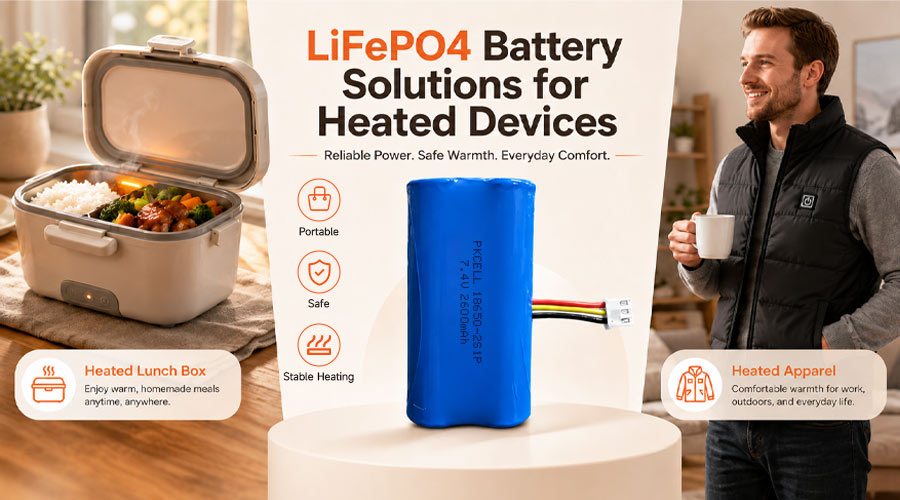
Portable heating products are becoming more common in daily life: heated lunch boxes keep meals warm at work, heated jackets support outdoor workers, and thermal vests help consumers stay comfortable in cold weather. Behind every reliable warming product is a battery pack that must deliver stable power, manage heat safely, and fit the product’s real-world use.
For products such as heated lunch boxes and heated apparel, a LiFePO4 battery for heated devices can be a practical choice because the chemistry is known for stable output, long cycle life, and strong safety characteristics when designed into a proper battery pack.
- 7.4V battery packs are commonly used when portable heating products need more power than single-cell devices.
- 2600/3000mAh packs can suit compact heated products with moderate runtime targets.
- 8000mAh packs are better aligned with longer heating sessions and higher-capacity wearable systems.
Why Heated Devices Need the Right Battery Pack
Heating products place a different kind of demand on batteries than ordinary electronics. A Bluetooth speaker, sensor, or remote control may draw modest current, but a heating element can require sustained power for a long period. That makes battery safety, discharge capability, temperature management, and pack protection especially important.
In a heated lunch box, the battery may need to support controlled warming without making the outer shell uncomfortable or unsafe. In heated clothing, the battery must be compact enough to wear, stable enough for movement, and protected against over-discharge, short circuit, and abnormal operating conditions.
Two 7.4V LiFePO4 Battery Options for Heating Applications
PKCELL provides two relevant 7.4V LiFePO4 battery pack options for portable heating devices: the 7.4V 2600/3000mAh IFR18650 LiFePO4 Battery and the 7.4V 8000mAh IFR18650 LiFePO4 Battery. The first is positioned for safe, long-lasting power in heated lunch boxes, while the second is presented for heated apparel.
7.4V 2600/3000mAh IFR18650 LiFePO4 Battery
A compact 7.4V option for portable heated products where moderate capacity, stable output, and long cycle life are important.
- Nominal voltage: 7.4V
- Capacity range: 2600/3000mAh
- Max constant charging current: 2600mA
- Max continuous discharging current: 3900mA
- Cycle life: 2000+ at 25°C, 1C
- Self-discharge rate: ≤3% per month at 25°C
- Operating temperature: -20 to 60°C
7.4V 8000mAh IFR18650 LiFePO4 Battery
A higher-capacity 7.4V pack for applications that need longer heating time or stronger power reserves.
- Nominal voltage: 7.4V
- Capacity: 8000mAh
- Max constant charging current: 8000mA
- Max continuous discharging current: 12000mA
- Cycle life: 2000+ at 25°C, 1C
- Self-discharge rate: ≤3% per month at 25°C
- Operating temperature: -20 to 60°C
Heated Lunch Box Battery Design: What Matters Most
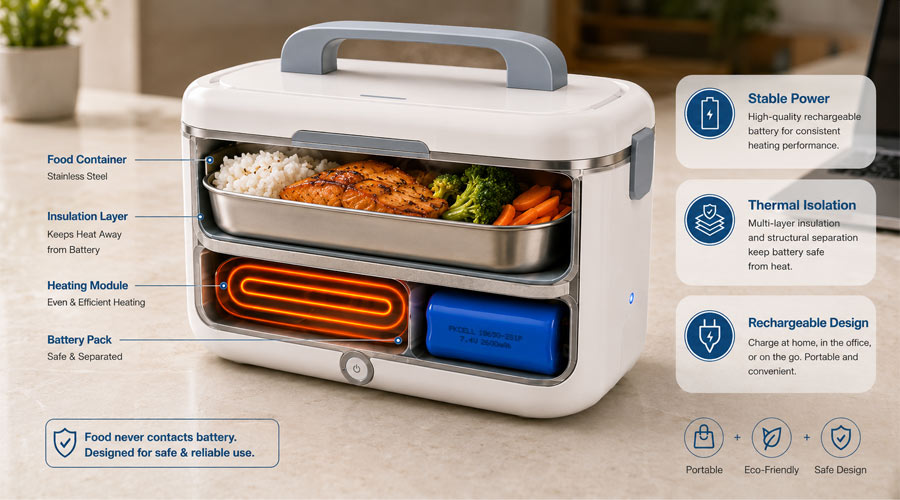
A heated lunch box is a consumer product that combines food contact design, heating control, portability, and charging convenience. The battery pack must support the heat profile without making the product bulky or difficult to use.
Stable Heating Output
The user expects food to warm consistently. Battery voltage, heating element resistance, and control logic should be matched so the device can avoid weak heating at low charge levels or aggressive heating that drains the pack too quickly.
Safety Around Heat and Food
Because the product already generates heat, the battery compartment should be isolated from the heating chamber. Thermal sensors, insulation, secure wiring, and over-temperature protection should be considered early in the design.
Compact Runtime Balance
A 2600/3000mAh 7.4V battery pack can be suitable when the design target is a compact heated lunch box with controlled warming time. If the product is expected to heat for longer periods or support higher wattage, a larger pack may be required.
Heated Apparel Battery Design: Comfort, Runtime, and Safety
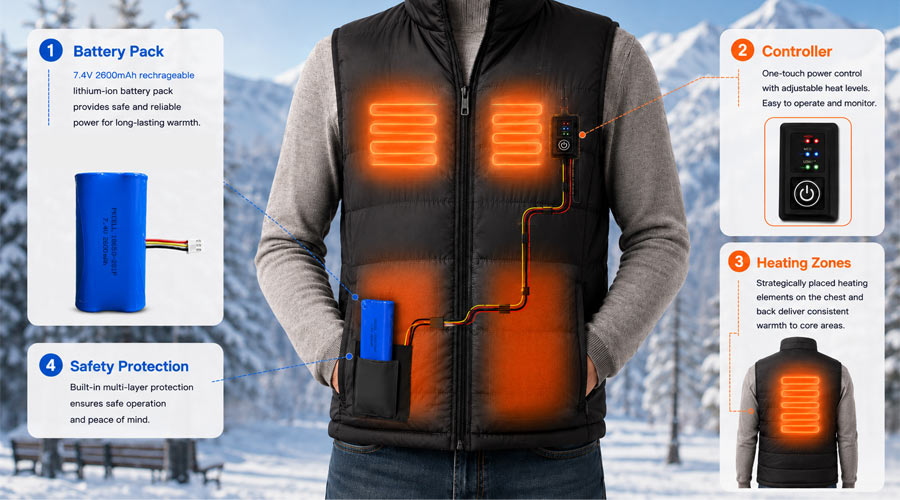
Heated jackets, thermal vests, heated gloves, heated shoes, and electric thermal clothing need battery packs that are not only powerful but also wearable. A battery that performs well electrically can still fail the product experience if it is too heavy, awkwardly shaped, or uncomfortable in a pocket.
Higher Capacity for Longer Wear Time
The 7.4V 8000mAh LiFePO4 battery pack is positioned for heated apparel and provides a larger energy reserve than smaller packs. That can help products support longer warming sessions, multiple heating zones, or higher heat settings, depending on the final system design.
Movement and Connector Reliability
Wearable heating products bend, move, and face repeated plugging and unplugging. Connector selection, cable strain relief, pocket placement, and pack casing should be tested under real use conditions, not only on a lab bench.
User-Controlled Heat Levels
Multi-level heating control helps balance comfort and battery life. A well-designed controller lets users switch between preheat, high, medium, and low modes instead of forcing the battery to operate at maximum output continuously.
2600/3000mAh vs. 8000mAh: Which Pack Fits Your Product?
| Design Factor | 7.4V 2600/3000mAh Pack | 7.4V 8000mAh Pack |
|---|---|---|
| Best fit | Compact heated lunch boxes, small warming devices, lightweight heating products | Heated jackets, thermal vests, multi-zone heated apparel, longer-runtime products |
| Runtime strategy | Moderate runtime with smaller size and lower weight | Longer runtime or stronger power reserve |
| Discharge capability | Up to 3900mA continuous discharge | Up to 12000mA continuous discharge |
| Product experience | Better when compactness is a priority | Better when heating duration matters more than smallest pack size |
| Recommended evaluation | Test heating time, surface temperature, and charger behavior | Test comfort, pocket placement, cable movement, and multi-zone heating load |
Battery Pack Checklist for Heated Product Development
- Define heating wattage first: The heating element and target temperature determine the battery load.
- Measure current in every mode: Preheat, high, medium, low, standby, and cutoff behavior should all be tested.
- Protect the pack: Use a suitable BMS for overcharge, over-discharge, overcurrent, short-circuit, and thermal protection.
- Design around real temperatures: Keep the battery away from direct heating zones and validate enclosure temperature rise.
- Check comfort and ergonomics: For heated clothing, pack weight, pocket location, and cable routing affect user satisfaction.
- Plan charging and certification early: Charger compatibility, battery labels, transport requirements, and safety documentation can affect launch timing.
FAQ: Batteries for Heated Lunch Boxes and Heated Apparel
Why use LiFePO4 batteries for heated devices?
LiFePO4 batteries are often chosen for applications that value stable output, long cycle life, and safety-focused chemistry. For heating products, they still need to be integrated with a suitable BMS, charger, enclosure, and thermal design.
Is a 7.4V battery suitable for heated clothing?
Yes, many heated apparel systems use battery packs around this voltage range, but the final choice depends on heating element design, target temperature, runtime, connector type, and safety requirements.
Which battery is better for a heated lunch box?
A 7.4V 2600/3000mAh pack may fit compact heated lunch boxes with moderate runtime targets. Larger-capacity packs can be considered when the product needs longer heating time or higher wattage.
Can the battery pack be customized?
Yes. Heated device projects often require custom pack structure, connectors, cable length, casing, BMS parameters, charger pairing, and certification support to match the final product design.
Conclusion: Match Battery Capacity to Heating Experience
Heated lunch boxes and heated apparel both need portable power, but they do not use batteries in the same way. Lunch boxes focus on controlled warming, insulation, and compact product structure. Heated clothing focuses on comfort, runtime, movement, and safe wearable integration.
For compact heating products, a 7.4V 2600/3000mAh LiFePO4 battery pack can provide a balanced starting point. For heated apparel and longer-runtime designs, a 7.4V 8000mAh LiFePO4 battery pack offers more capacity and stronger discharge capability.
Developing a heated lunch box, heated jacket, thermal vest, or wearable warming product? Share your voltage, wattage, runtime target, connector, enclosure size, and charging requirements with PKCELL’s battery team.
Contact PKCELL for a Heating Device Battery SolutionPost time: Jun-12-2026


