
Key Highlights
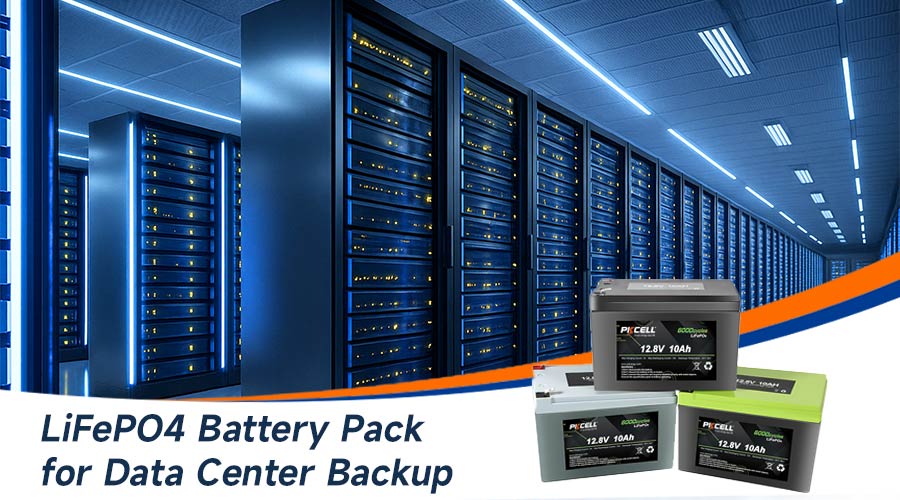
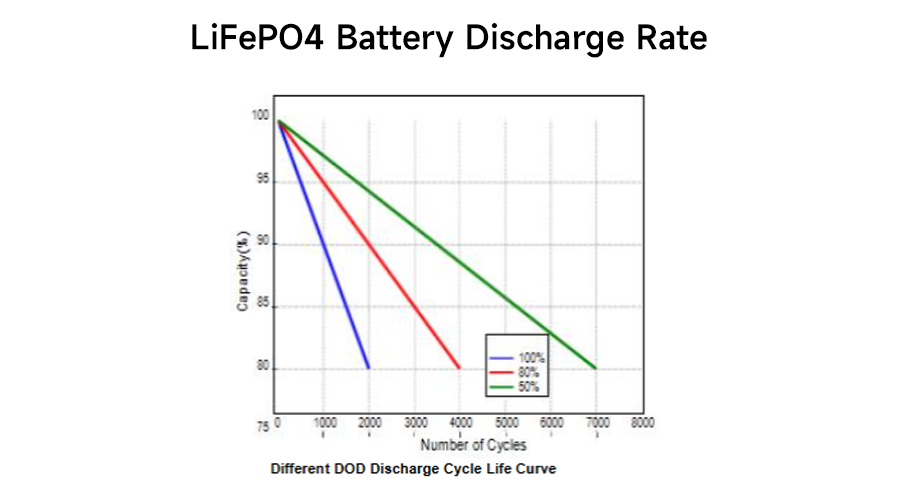
- LiFePO4 batteries offer 3,000 to 6,000+ deep cycles, outlasting traditional VRLA batteries by up to 10 times.
- The LiFePO4 lithium iron phosphate chemistry is inherently stable, significantly reducing the risk of thermal runaway in server rooms.
- A 100Ah LiPo4 battery is 40% smaller and 50% lighter than its lead-acid equivalent.
- Every pack features a sophisticated BMS for real-time monitoring of voltage, current, and temperature.
- While the initial investment is higher, the total cost of ownership (TCO) over 10 years is roughly 30% of lead-acid systems.
Table of Contents
1. The Shift to Lithium Ion Phosphate Battery in Data Centers
2. What Core Battery Requirements Do Data Center UPS Have?
3. Technical Excellence: Why the LiFePO4 Cell is the Best Choice
4. Choosing Your Spec: 12V vs. 48V LiFePO4 Battery Systems
5. Data Comparison: LiFePO4 vs. Traditional Lead-Acid
6. PKCELL: Your Professional B2B Battery Manufacturer
7. Frequently Asked Questions (FAQs)
1. The Shift to Lithium-Ion Phosphate Battery in Data Centers
As data centers evolve to support AI and high-performance computing, the demand for reliable backup power has never been higher. For decades, Lead-Acid (VRLA) batteries were the only option. However, modern facilities are rapidly transitioning to the LiFePO4 lithium battery due to its superior performance and reliability.
A lithium-ion Phosphate battery provides the high discharge rates required during power transitions without the "memory effect" or frequent maintenance associated with older technologies. For sourcing departments, this means fewer replacements and significantly reduced risk of downtime.
2. What Core Battery Requirements Do Data Center UPS Have?
Data center UPS (Uninterruptible Power Supply) systems are not typical energy storage applications; they demand a specific set of performance criteria:
- Instantaneous High-Rate Discharge: When the grid fails, the battery must deliver massive amounts of power instantly to keep the servers running until the generators take over.
- Minimal Footprint & Floor Loading: With rack space at a premium, batteries must offer high energy density. Reducing the weight is also vital to prevent exceeding the structural load limits of raised floors.
- Thermal Stability: Data centers generate immense heat. The backup power system must operate reliably in high-density environments without requiring excessive dedicated cooling.
- Remote Monitoring & Intelligence: In a "lights-out" facility, the ability to monitor the health of every lifepo4 cell remotely via a Management System is essential for predictive
4. Choosing Your Spec: 12V vs. 48V LiFePO4 Battery Systems
PKCELL provides modular solutions designed to scale with your facility's energy needs.
The Versatility of 12V Systems
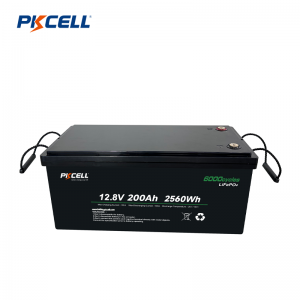
For smaller server closets or edge computing stations, the 12V LiFePO4 battery is the ideal building block. Our Lifepo4 12V 100AH and Lifepo4 12V 200AH models are the most ideal. They are designed for easy "drop-in" replacement of VRLA batteries. They fit standard racks and offer immediate upgrades in runtime and reliability.
High-Density 48V Infrastructure
Large-scale data centers typically can utilize a 48V LiFePO4 battery architecture. By connecting multiple 100Ah LiFePO4 battery modules in parallel, engineers can create massive energy reservoirs. These systems integrate seamlessly with large-scale UPS inverters, providing hours of backup for high-load server racks.
5. Data Comparison: LiFePO4 vs. Traditional Lead-Acid
| Feature | PKCELL LiFePO4 (LFP) | Lead-Acid (VRLA) |
| Cycle Life (80% DOD) | 4,000 - 6,000 Cycles | 300 - 500 Cycles |
| Service Life | 10 - 15 Years | 3 - 5 Years |
| Energy Density | 120 - 160 Wh/kg | 30 - 50 Wh/kg |
| Charge Time | 1 - 2 Hours | 8 - 12 Hours |
| Weight (12V 100Ah) | ~11 kg | ~30 kg |
| BMS Monitoring | Integrated & Smart | None |
6. Frequently Asked Questions (FAQs)
A: Absolutely. Lifepo4 lithium iron phosphate is chemically stable and does not off-gas toxic fumes.
A: Yes. You can connect our LiPo4 12V 200AH modules in parallel to increase capacity or in series to increase voltage, provided the BMS is configured for your specific setup.
A: The integrated BMS constantly monitors for over-voltage, under-voltage, and over-current. If it detects an anomaly, it automatically disconnects the LiFePo4 cell array to prevent damage.
7. PKCELL: Your Professional B2B Battery Manufacturer
PKCELL is a leading manufacturer specializing in rechargeable solutions. With over 20 years of expertise, we have become a trusted partner for global sourcing departments and product engineers. Our 28,000 sqm facility and 500+ professionals produce 500,000 pieces monthly.
We also hold ISO9001, CE, and RoHS certifications. Most importantly, our batteries are UN38.3 certified, ensuring safe and compliant international shipping. Beyond the standard LiPo4 12V 100AH modules, we provide custom battery pack designs tailored to specific voltage and dimensional requirements.
Post time: Mar-17-2026


