
5 Key Facts
- A high-performance lithium ion battery offers up to 4x the energy density of a primary alkaline cell in high-drain scenarios.
- A single li ion battery typically survives 500 to 1,000 recharge cycles, effectively replacing over 1,000 alkaline units during its service life.
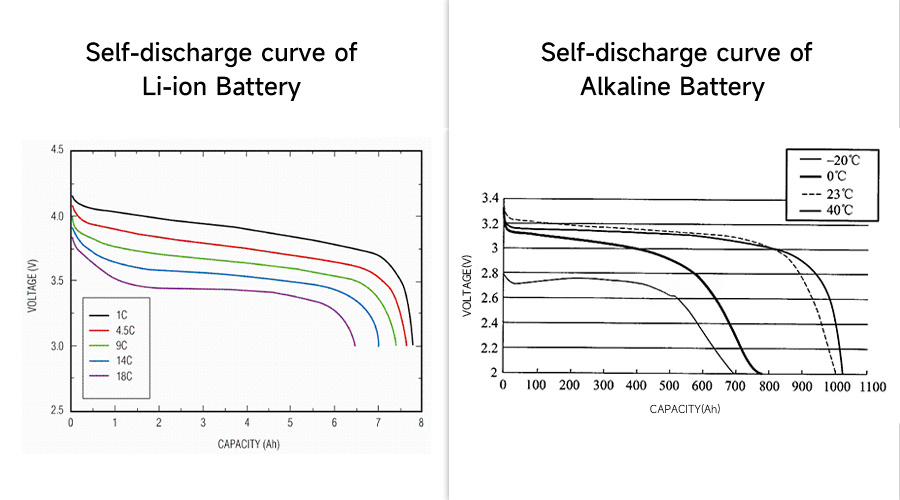
- Li-ion systems provide a flat discharge curve at 3.7V, whereas alkaline batteries suffer from “voltage sag,” dropping from 1.5V to below 1.0V during use.
- New global mandates require stricter carbon footprint labeling and a 30% State of Charge (SoC) limit for air-shipping any lithium ion battery.
- In industrial IoT and medical sectors, the labor cost of replacing alkaline batteries often exceeds the initial hardware cost, making Li-ion the superior TCO (Total Cost of Ownership) choice.
Chemical & Physical Differences
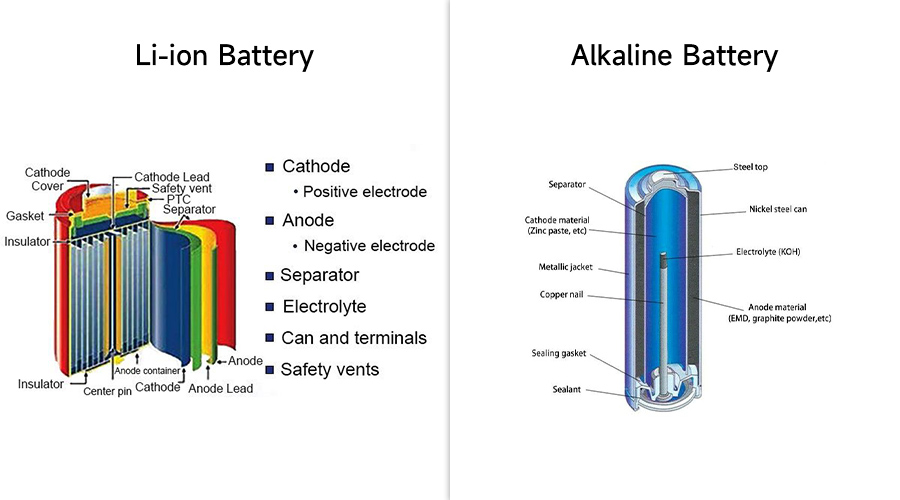
- Anatomy of an Alkaline Cell: Utilizing a Zinc and Manganese Dioxide (Zn/MnO2) chemistry with a potassium hydroxide electrolyte, the primary alkaline cell is a reliable “legacy” technology. It is safe and standardized, but its chemistry limits its ability to discharge rapidly without significant energy loss.
- Anatomy of a Li-ion Cell: A lithium ion battery uses lithium cobalt or manganese as the cathode and carbon-based materials (graphite) as the anode. This chemistry allows for the high-speed movement of ions, facilitating the high-drain performance required by medical and industrial electronics.
Energy Density: Li-ion technology packs significantly more “punch” in a smaller footprint. While alkaline cells are restricted by their cylindrical formats, a li ion battery supplier can provide lithium ion polymer (LiPo) variants that are ultra-thin, fitting into the sleek, ergonomic designs modern consumers demand.
Performance Comparison
- Voltage Stability: A li ion battery maintains a nominal voltage of 3.7V throughout most of its discharge cycle. In contrast, an alkaline battery starts at 1.5V and immediately begins a steady decline.
- Discharge Curves: In high-drain applications, such as a GPS tracker or a motorized medical tool, alkaline batteries fade fast. The lithium ion battery maintains peak performance until the very end of its charge.
- Self-Discharge & Shelf Life: Ultra Alkaline batteries are world-renowned for a 10-year shelf life, making them ideal for emergency backup. However, for active-use devices, the rechargeable lithium battery is superior, losing only 1–3% of its charge per month.
- Temperature Tolerance: Li-ion excels in extreme heat and cold (operating from -20°C to 60°C), whereas alkaline electrolyte efficiency drops significantly below freezing.
Cost-Benefit Analysis
Procurement managers often focus on the “Initial Unit Price.” An alkaline AA might cost pennies in bulk, while a lithium ion battery requires a higher upfront investment.
However, the Long-term ROI tells a different story. If your product is used daily, a consumer would need to buy 500 alkaline batteries to match the lifecycle of just one li ion battery. Furthermore, while Li-ion requires a Battery Management System (BMS) or PCM for safety, the reduction in physical waste and the increase in product “premiumness” often outweigh these integration costs.
Application Suitability
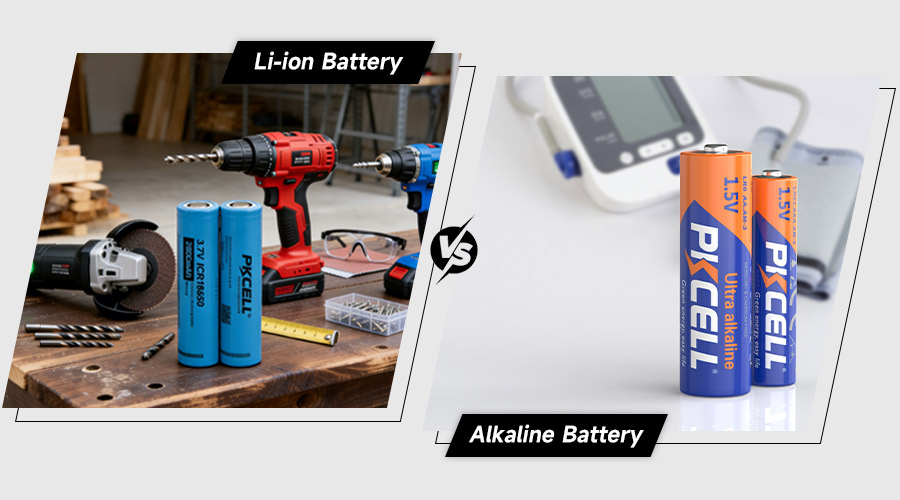
- High-Drain Devices: For power tools, medical equipment, and high-end LED flashlights, the li ion battery is the only logical choice due to its high capacity (mAh) and ability to handle high discharge rates.
- Low-Drain Devices: For remote controls, smoke detectors, and wall clocks, the primary alkaline cell remains the king of convenience.
- Custom Battery Packs: Many 2026 industrial projects require specific voltages (7.4V, 11.1V, etc.). A professional li ion battery supplier can engineer custom packs that combine multiple cells into a single, certified power infrastructure.
Environmental Impact & Global Compliance
In 2026, “Green Energy” is a regulatory requirement. The ecological footprint of disposing of thousands of single-use alkaline batteries is becoming a liability for brands. Switching to a lithium ion battery supports corporate sustainability goals and ensures compliance with 2026 EU and North American recycling mandates.
PKCELL ensures all products meet the rigorous standards of ISO9001, CE, RoHS, and the critical UN38.3 certification, which is mandatory for the international transport of lithium products.
Data Comparison Table: 2026 Standards
| Feature | Alkaline (Primary) | Lithium Ion Battery (Rechargeable) |
| Nominal Voltage | 1.5V (Sloping) | 3.7V – 3.8V (Stable) |
| Energy Density | ~100 Wh/kg | 250+ Wh/kg |
| Cycle Life | 1 (Single Use) | 500 – 1,000+ Cycles |
| BMS Required | No | Yes (For Safety & Longevity) |
| Best For | Low-drain / Backup | High-drain / Industrial / Medical |
| Initial Cost | Low | Medium to High |
Why Partner with PKCELL?
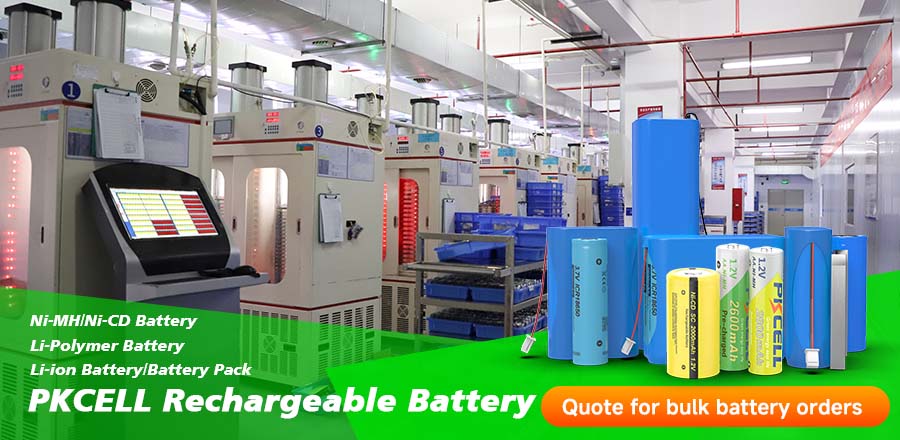
Shenzhen PKCELL Battery Co., Ltd. is one of the largest battery manufacturing enterprises in China. Since 1998, we have focused on delivering “Green energy, easy life.”
- Manufacturing Power: Our 28,000 sqm facility and 500+ professionals produce over 500 million units annually.
- One-Stop Solution: We are a unique li ion battery supplier that also masters alkaline, Ni-MH, and LiFePO4 chemistries, providing a total power solution for your entire product line.
- Global Reach: With dedicated offices in the USA and Canada, we understand the 2026 logistical challenges of international battery distribution.
Contact Us for Wholesale Price
Conclusion
If you are building a low-cost, low-energy toy, alkaline is your first choice. But for any device that represents the future of technology—be it a wearable medical sensor or a professional power tool—the lithium ion battery is the undisputed champion of efficiency and sustainability.
FAQs
Q: Can a li ion battery replace alkaline in all devices?
A: Not directly. Because a li ion battery operates at 3.7V, it will damage a device designed for 1.5V alkaline cells unless a voltage regulator is used.
Q: How does the weight of Li-ion compare to Alkaline?
A: A lithium ion battery is approximately 30-50% lighter than an alkaline battery of equivalent energy capacity, making it ideal for portable or wearable tech.
Q: What is the typical lifespan of a PKCELL li ion battery pack?
A: Most PKCELL packs are rated for 500–1,000 cycles. If charged once every two days, the battery will perform reliably for over 3–5 years.
Post time: Jan-08-2026


