
Flashlight Battery Engineering Guide
How to Choose the Right Rechargeable Battery for High-Power Flashlights
A high-lumen LED is only as reliable as the battery system behind it. The right choice must balance voltage, usable capacity, discharge current, runtime, heat, mechanical space and protection—not capacity alone.
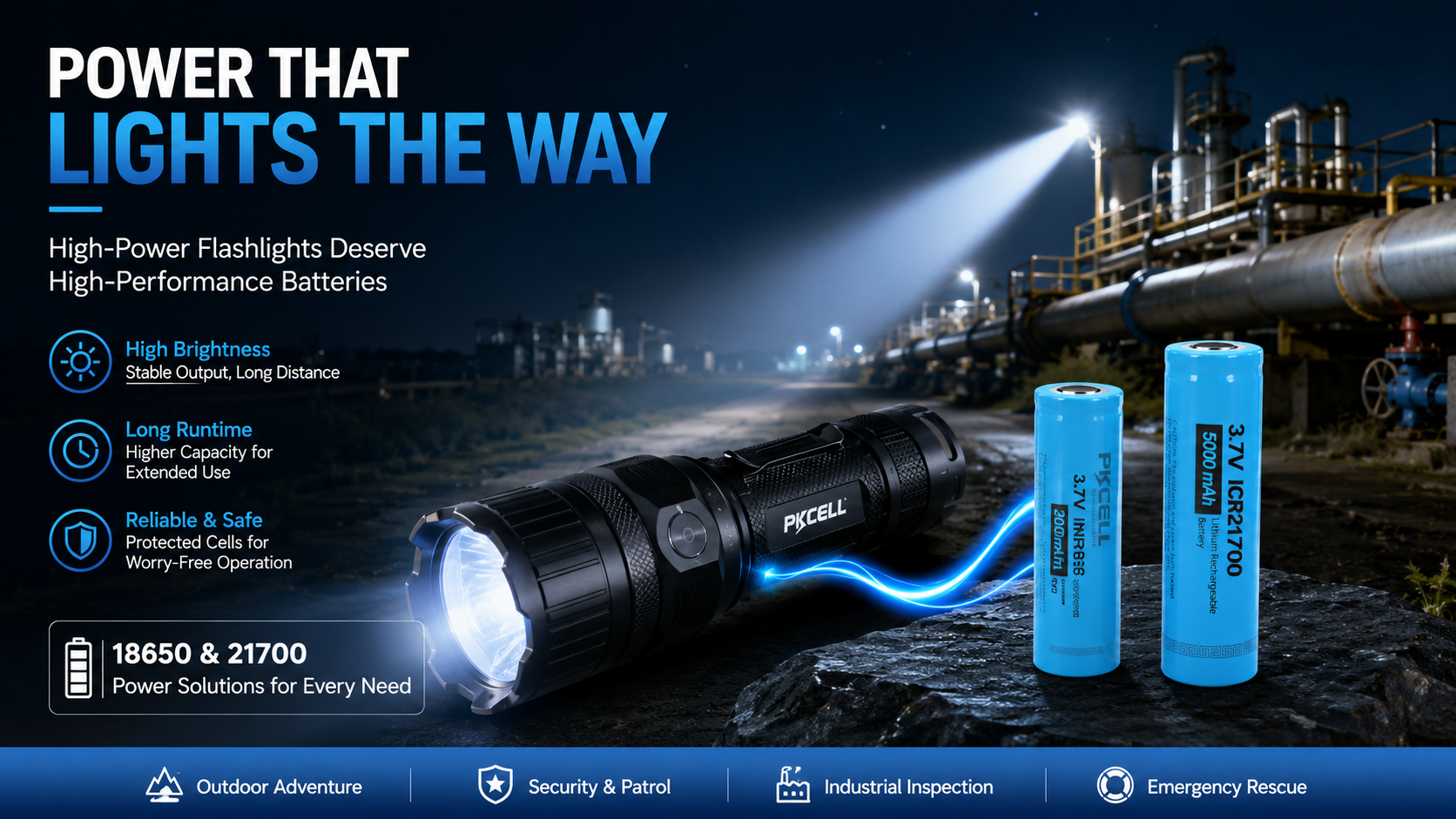
Engineering takeaway: a larger mAh rating can increase runtime, but it does not automatically make a battery suitable for a high-power flashlight. The LED driver, continuous and peak current, voltage window, heat dissipation and protection strategy must be reviewed together.
What a High-Power Flashlight Battery Must Do
Modern flashlights may operate in low-output navigation, sustained work-lighting, short turbo bursts, strobe or emergency signaling modes. Each mode places a different load on the battery. In practice, the battery must provide enough current without excessive voltage sag while keeping cell temperature and protection limits under control.
01
Match the LED Driver
Battery voltage must stay within the driver’s input range. A single-cell 3.7V architecture and a 7.4V two-series architecture are not interchangeable without redesigning the electronics.
02
Deliver Required Current
High-output modes can draw several amperes. The selected cell or pack must meet the current requirement at the expected temperature and state of charge, not only under ideal test conditions.
03
Balance Runtime and Heat
Useful runtime depends on battery energy and driver efficiency. Thermal step-down may reduce brightness before the battery is empty, so electrical and thermal design should be tested together.
Start with Voltage, Current and Energy
Three specifications provide the fastest first-pass screening:
- Voltage (V): must match the flashlight driver and charging architecture.
- Capacity (Ah): indicates charge storage, but does not prove high-current capability.
- Energy (Wh): is approximately nominal voltage multiplied by capacity and is more useful than mAh when comparing systems with different voltages.
Runtime caution: estimated runtime is not simply battery capacity divided by LED current. Driver losses, voltage cut-off, cold-temperature performance, aging, turbo-mode duty cycle and thermal regulation all reduce usable runtime.
18650 Batteries: A Practical Standard for Compact Flashlights
The 18650 format remains a common choice for rechargeable flashlights because it combines a compact cylindrical shape with a mature supply chain and broad availability of holders, chargers and protection options.
PKCELL’s 3.7V 2600mAh 18650 Li-ion battery is listed with up to 3.9A continuous discharge and 500+ cycles under the stated product test conditions. It can be evaluated for compact flashlights whose operating current remains within validated electrical and thermal limits.
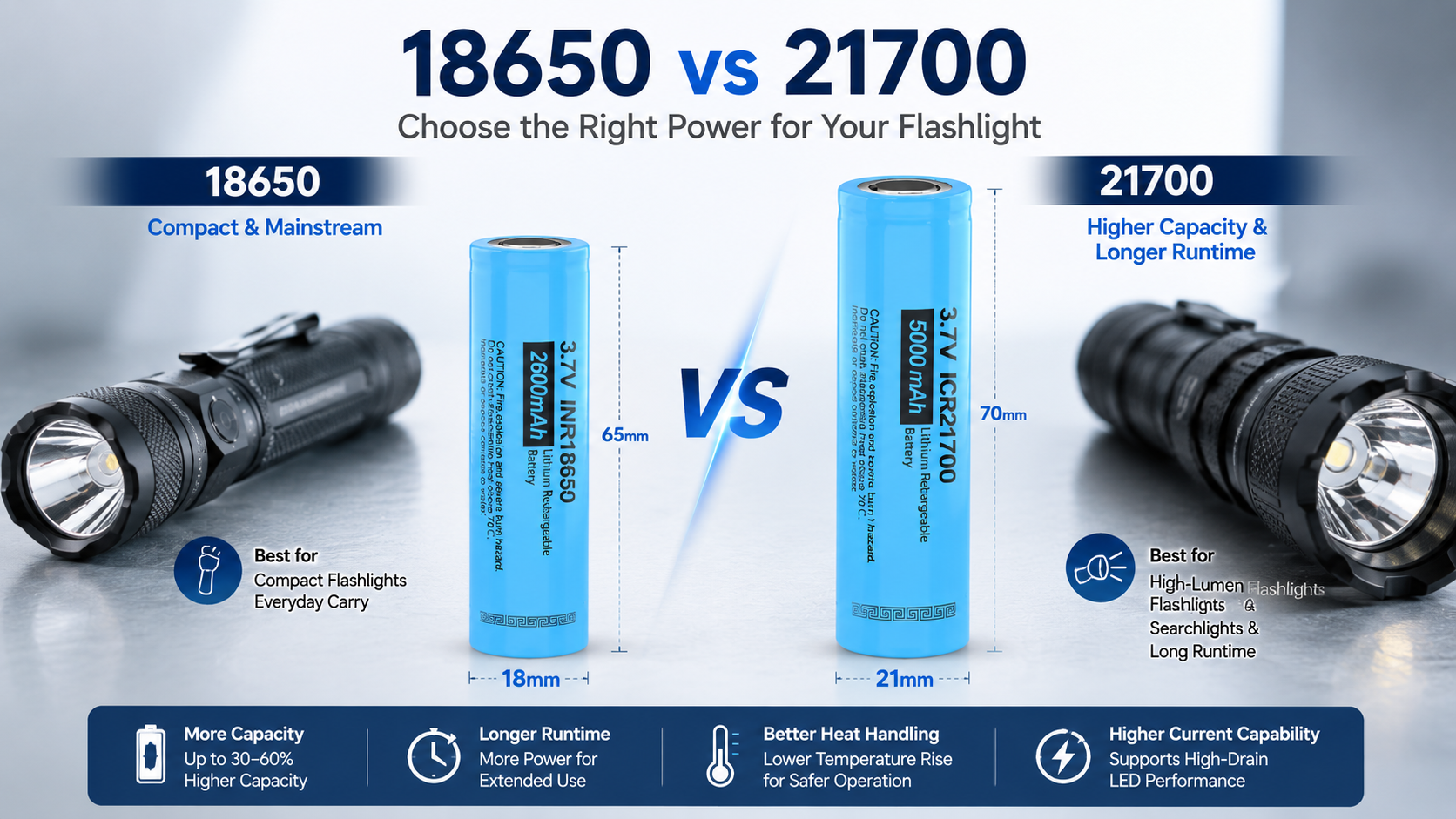 Image placeholder 2: 18650 vs 21700 size and application comparison
When a 21700 Cell Is the Better Choice
A 21700 cell is wider and longer than an 18650, allowing more active material and higher capacity in a single-cell design. This can extend runtime or reduce the number of cells required, provided the flashlight housing, holder, charging circuit and thermal design are built for the larger format.
The PKCELL 3.7V ICR21700 Li-ion cell range includes multiple high-capacity variants. The exact model and current rating should be confirmed against the flashlight’s continuous and peak load before production.
For a deeper format comparison, see the PKCELL guide: 21700 vs 18650: Which Battery Is Right for You?
Why Professional Lighting Equipment Uses Battery Packs
A single cylindrical cell is often sufficient for a handheld flashlight, but professional searchlights, emergency lamps and portable work lights may need higher voltage, longer runtime or a remote battery compartment. A multi-cell pack can provide the required energy and packaging flexibility.
The PKCELL 7.4V 2S4P 13400mAh ICR18650 battery pack uses two series groups and four parallel cells per group. Its product specifications list a maximum continuous discharge current of 6.7A and 500+ cycles under stated conditions.
This pack is suitable only for lighting equipment designed around a 7.4V nominal input. It must not be connected to a flashlight intended for a single 3.7V cell.
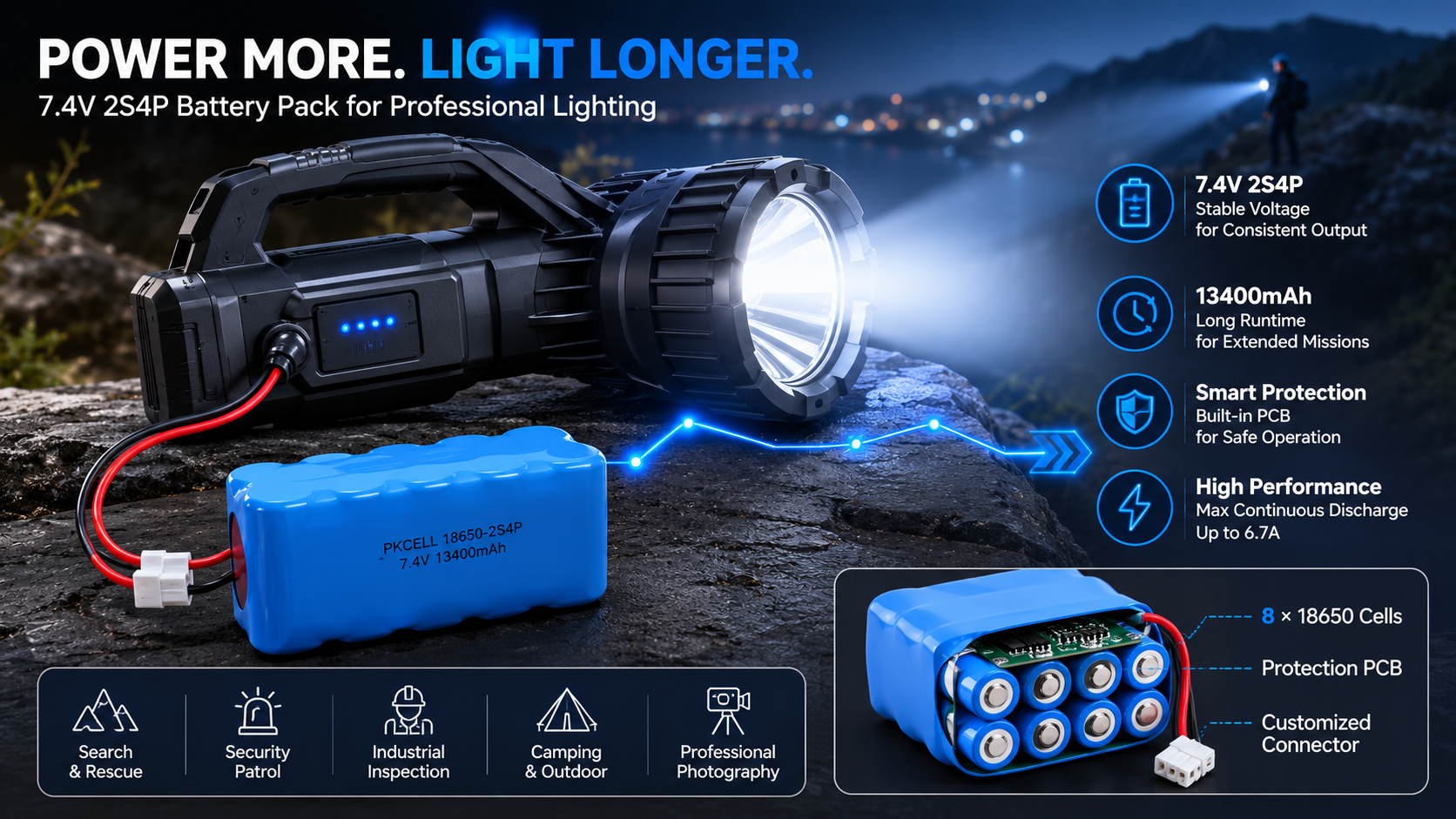 Image placeholder 3: battery-pack integration for a professional searchlight
How Battery Choice Changes Real Flashlight Performance
Brightness Stability
A cell with insufficient current capability can experience voltage sag, causing the driver to reduce output or enter protection earlier than expected.
Useful Runtime
Higher capacity generally supports longer runtime, but only the energy above the driver’s cut-off voltage is usable.
Thermal Performance
Cell internal resistance, current draw, enclosure ventilation and LED heat all influence operating temperature.
Charging Time
Larger cells and parallel packs store more energy and may require a higher-capacity charger or a longer charging window.
Weight and Balance
Moving from one 18650 cell to a 21700 cell or multi-cell pack changes grip diameter, center of gravity and total product weight.
Service Life
Cycle life is affected by charge voltage, depth of discharge, temperature, storage state of charge and current stress.
Flashlight Battery Design Checklist
Before approving a cell or battery pack, confirm the following information with the flashlight, LED-driver and charger suppliers:
Common Battery Selection Mistakes
- Selecting by mAh alone: capacity does not prove that a battery can safely support the required current.
- Assuming 18650 and 21700 are drop-in replacements: they differ in size, contact geometry and sometimes terminal style.
- Ignoring driver compatibility: a 7.4V pack can damage a single-cell flashlight circuit.
- Using loose cells without a protection strategy: consumer and professional products require appropriate electrical and mechanical safeguards.
- Skipping thermal validation: the complete flashlight must be tested at maximum output, low state of charge and worst-case ambient temperature.
- Mixing cells: do not mix different models, capacities, ages or states of charge in one battery assembly.
Recommended PKCELL Battery Options
The following options cover three different flashlight design directions. Final selection should be based on electrical testing and mechanical integration.
Compact Design
3.7V 2600mAh 18650 Cell
Best for: compact handheld flashlights, inspection lights and mainstream single-cell designs.
Why consider it: established format, compact dimensions and a listed continuous discharge current up to 3.9A.
Longer Runtime
3.7V ICR21700 Cell Range
Best for: larger handheld flashlights, outdoor search lights and designs prioritizing single-cell runtime.
Why consider it: higher capacity potential than a typical 18650 cell, subject to model-specific current validation.
Professional Lighting
7.4V 2S4P 13400mAh Pack
Best for: professional searchlights, portable work lights and lighting systems with a separate battery compartment.
Why consider it: higher system voltage, substantially greater stored energy and integrated pack-level customization options.
Quick Selection Path
Why Battery Validation Matters
Application ExperienceFlashlight battery selection is an application-engineering task. Cell data should be checked against the complete device, including the LED driver, charger, enclosure, contacts, wiring and thermal path.
PKCELL SupportPKCELL provides cylindrical Li-ion cells and custom battery packs with configurable series/parallel layouts, leads, connectors and protection parameters. Samples can be used for electrical, runtime and thermal verification before mass production.
Frequently Asked Questions
Usually not without redesign. A 21700 cell is larger, so the battery compartment, contacts and charging system must be compatible. The driver current and protection requirements must also be checked.
A higher-capacity 21700 cell will generally provide longer runtime under the same load and system efficiency. Actual runtime still depends on driver cut-off voltage, brightness mode, temperature and cell condition.
It is not universally better. A 7.4V pack is appropriate only when the flashlight electronics are designed for that voltage. It is useful for professional lighting systems that need more energy or a higher-voltage driver architecture.
No. Capacity mainly affects runtime. Brightness depends on LED power, driver design, battery voltage under load, current capability and thermal management.
Protection can reduce risks related to overcharge, over-discharge, overcurrent and short circuit, but the flashlight must be designed for the protected cell’s added length and current limit. Product-level safety also depends on the charger, enclosure and thermal design.
Provide nominal and maximum voltage, continuous and peak current, target runtime, available dimensions, connector type, charging method, operating temperature, waterproofing needs and required certifications.
Need a Battery for a High-Power Flashlight Project?
Share your LED-driver voltage, current profile, runtime target, available space and operating environment. PKCELL can help evaluate an 18650 cell, 21700 cell or custom rechargeable battery pack for your lighting design.
Post time: Jul-10-2026


