
How to Choose the Correct BMS Current Rating for a Lithium Battery Pack
Choosing the correct BMS current rating is essential for building a safe, reliable lithium battery pack. If the BMS is too small, the pack may shut down during normal operation. If it is selected only by the highest advertised amp number, the design may ignore cell limits, heat, wiring, connectors, fuse protection, and charging current.
Need help selecting a BMS for a custom lithium battery pack? PKCELL can support battery pack design, voltage and capacity matching, BMS protection, connector selection, and OEM/ODM production.
What Does BMS Current Rating Mean?
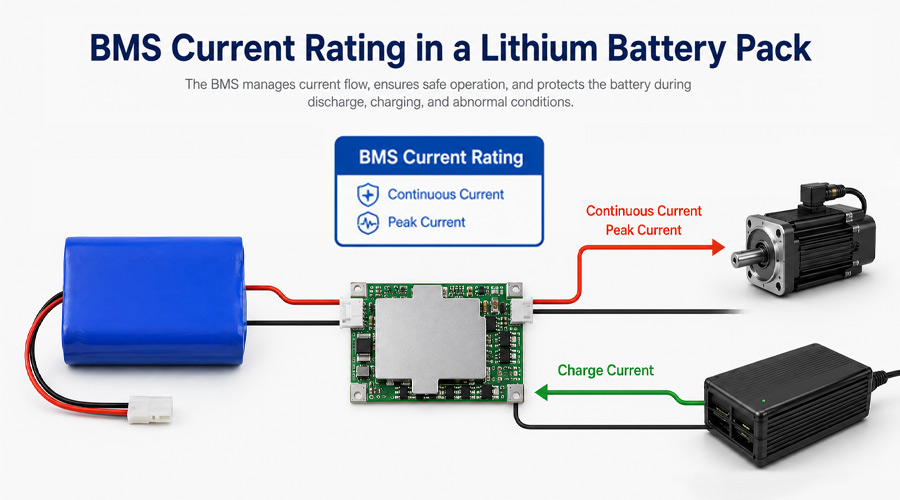
A battery management system, or BMS, protects a lithium battery pack from unsafe operating conditions such as overcharge, over-discharge, overcurrent, short circuit, and excessive temperature. In many rechargeable lithium battery packs, the BMS also supports cell balancing and improves long-term pack reliability.
PKCELL’s customized battery pack service includes BMS design support for lithium battery packs, helping customers match protection settings to the voltage, capacity, discharge current, charge current, and application environment.
The BMS current rating tells you how much current the protection board is designed to pass or control. However, one amp number is not enough. You need to check continuous discharge current, peak discharge current, charge current, overcurrent protection, and thermal performance.
Continuous Current vs Peak Current
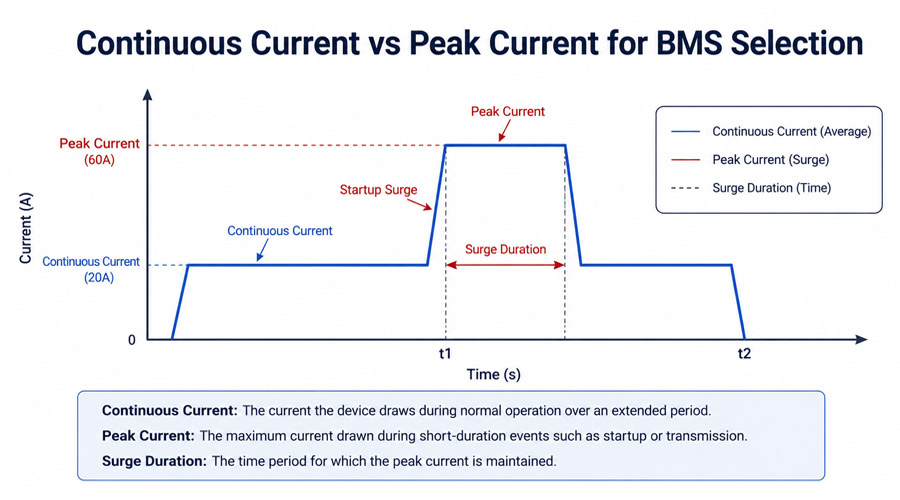
The most common BMS sizing mistake is confusing continuous current with peak current. Continuous current is the current the battery pack must deliver during normal operation. Peak current is a short burst, often caused by motor startup, inverter surge, compressor startup, or stall conditions.
| Rating Type | Meaning | Selection Tip |
|---|---|---|
| Continuous discharge current | The current the BMS can carry during normal long-term operation. | Choose a rating above the real continuous load with a practical safety margin. |
| Peak discharge current | A short burst current allowed for startup or surge conditions. | Check both the amp value and the allowed duration, such as 5 seconds or 10 seconds. |
| Charge current | The maximum current allowed into the battery during charging. | Match this to the charger, solar controller, or charging system. |
| Overcurrent protection | The point where the BMS disconnects or limits output. | Set it high enough to avoid nuisance trips, but low enough to protect the cells and pack hardware. |
How to Calculate the Right BMS Current Rating
1. Calculate the Maximum Continuous Load
Start with the device powered by the battery: inverter, motor controller, lighting system, medical device, tracking device, power tool, or industrial equipment. For DC loads, current can be estimated from power and voltage.
For example, a 2,000W inverter on a 24V lithium battery may draw about 83A before efficiency loss. After considering inverter efficiency and lower battery voltage under load, the actual current may be closer to 95A to 110A. In this case, a 100A BMS may be too close to the limit, while a 150A BMS is often more practical.
2. Check the Lithium Cell C-Rate
The BMS should never allow more current than the cells can safely provide. Cell current capability is often described by C-rate.
A 100Ah lithium battery pack rated for 1C continuous discharge can theoretically support 100A continuous discharge. A 100Ah pack rated for 0.5C continuous discharge should be treated as a 50A continuous pack, even if a larger BMS is installed.
If you are comparing pack formats, PKCELL’s 3.7V/7.4V/12V/24V/36V/72V Li-ion battery pack page is a useful internal reference for customizable lithium battery pack voltage options.
3. Add a Safety Margin
A practical rule is to choose a BMS continuous current rating around 20% to 30% above the expected continuous load. This reduces heat stress and helps prevent shutdowns during normal operation.
The correct BMS current rating is limited by the weakest part of the pack: cells, BMS, nickel strips, busbars, wires, connectors, fuse, and thermal design.
4. Confirm Peak Current and Surge Duration
Motors, inverters, pumps, and compressors often require a short surge current. This is why peak current rating matters. A BMS labeled “200A peak” is not complete information unless the datasheet also states how long that peak current is allowed.
For example, some lithium battery specifications separate maximum continuous discharge current from short pulse current. This shows why the duration of the current event is just as important as the amp rating.
5. Match the Charge Current Rating
A BMS may support high discharge current but a lower charge current. This is important for solar energy storage, fast chargers, alternator charging, and industrial charging systems.
If your charger outputs 60A, the BMS charge current rating should support that current, and the cells must also be rated for that charging level. For long cycle life, many lithium battery packs are operated below their absolute maximum charge current.
6. Check Temperature and Pack Installation
BMS current ratings are often measured under controlled test conditions. Real battery packs may be installed in sealed plastic cases, metal enclosures, RV compartments, outdoor cabinets, e-bike frames, or compact industrial devices. Heat can reduce the practical current capability of the BMS.
For high-current packs, review MOSFET quality, PCB copper thickness, heat dissipation, temperature sensor placement, wire gauge, and airflow. If the pack will operate in high-temperature or enclosed conditions, choose a stronger BMS or request a custom pack design.
7. Coordinate the BMS with Wiring, Connectors, and Fuse
The BMS is only one part of the current path. The wires, connectors, busbars, nickel strips, and fuse must all match the expected system current. A high-current BMS connected with undersized wiring is not a safe high-current battery pack.
For projects that need a ready-to-integrate battery solution, see PKCELL’s rechargeable battery products or contact the engineering team through the battery quote form.
Example BMS Current Rating Choices by Application
| Application | Main Current Concern | BMS Selection Tip |
|---|---|---|
| E-bike or scooter battery pack | Motor acceleration and controller current limit | Match the BMS discharge rating to the controller current, with enough peak current for acceleration. |
| Solar energy storage battery | Inverter load and charging current | Check inverter surge, charger current, cable size, and fuse protection. |
| Medical or industrial device battery | Stable output and high reliability | Use conservative current limits and confirm temperature protection requirements. |
| Power tool or robotics battery | Short burst current and stall current | Peak current duration and overcurrent delay are critical. |
| 18650 lithium battery pack | Cell parallel count and discharge current | Calculate current from the cell C-rate and pack configuration before choosing the BMS. |
For more background on pack structure, you can also read PKCELL’s guide: What is a 18650 Lithium Battery Pack and How Does It Work?
Common Mistakes When Choosing a BMS Current Rating
- Choosing by capacity alone: a 100Ah battery does not automatically require a 100A BMS. The application current matters.
- Ignoring peak current: inverters and motors can draw much higher current during startup.
- Oversizing beyond the cell limit: a larger BMS does not make low-discharge cells safe for high-current use.
- Forgetting charge current: BMS charge current and discharge current may be different.
- Ignoring heat: a BMS inside a compact case may run hotter than it does on an open test bench.
- Using undersized wiring: cables, connectors, and fuses must be selected as part of the same electrical system.
FAQ: BMS Current Rating for Lithium Batteries
Can I use a higher amp BMS than my battery needs?
Yes, within reason. A higher-rated BMS can reduce heat and prevent nuisance shutdowns, but it should not allow more current than the cells, wiring, connectors, and fuse can safely handle.
Is a 100A BMS enough for a 100Ah lithium battery?
Not always. If the cells are rated for 1C continuous discharge, 100A may be acceptable from the cell perspective. But you still need to check load current, surge current, charge current, temperature, wiring, and safety margin.
What happens if the BMS current rating is too low?
The battery may shut off during normal operation, especially during inverter startup, motor acceleration, compressor startup, or other surge events. The BMS may also run hot under continuous load.
Should the BMS rating be the same as the fuse rating?
Not necessarily. The fuse is usually selected to protect the wiring and interrupt dangerous fault current. The BMS, fuse, wire, and connector ratings must be coordinated as a system.
Can PKCELL help choose a BMS for a custom lithium battery pack?
Yes. PKCELL supports custom rechargeable battery pack projects, including voltage, capacity, cell configuration, BMS protection, connector, casing, and application matching. You can request a battery quote here.
Conclusion
Choosing the correct BMS current rating is not about selecting the largest amp number. It is about matching the BMS to the real continuous load, peak surge current, charge current, lithium cell C-rate, thermal environment, and the full current path of the battery pack.
If your application requires a reliable rechargeable lithium battery pack, the safest approach is to define the voltage, capacity, continuous current, peak current, charging method, operating temperature, size limit, and certification requirements before production.
Looking for a custom lithium battery pack with the right BMS current rating? Share your battery chemistry, voltage, capacity, size, quantity, application, discharge current, charge current, and certification requirements with PKCELL.
Request a Custom Battery Quote
View Li-ion Battery Pack Options
Post time: Jul-28-2026


