
How to Choose Rechargeable Batteries for Portable LED Lights
Portable work lights, camping lanterns, emergency lamps and cordless desk lights may all use LEDs, but their battery requirements are not the same. The right rechargeable battery must match the device voltage, target runtime, current demand, enclosure and charging design—not just the capacity printed on the label.
This guide focuses on four portable lighting products: rechargeable work lights, camping lanterns, emergency lights and cordless desk lamps. It does not treat them as one generic LED category. Each has a different operating pattern, and those differences influence battery format, pack voltage and usable capacity.
Start with the Lighting Product Duty Cycle
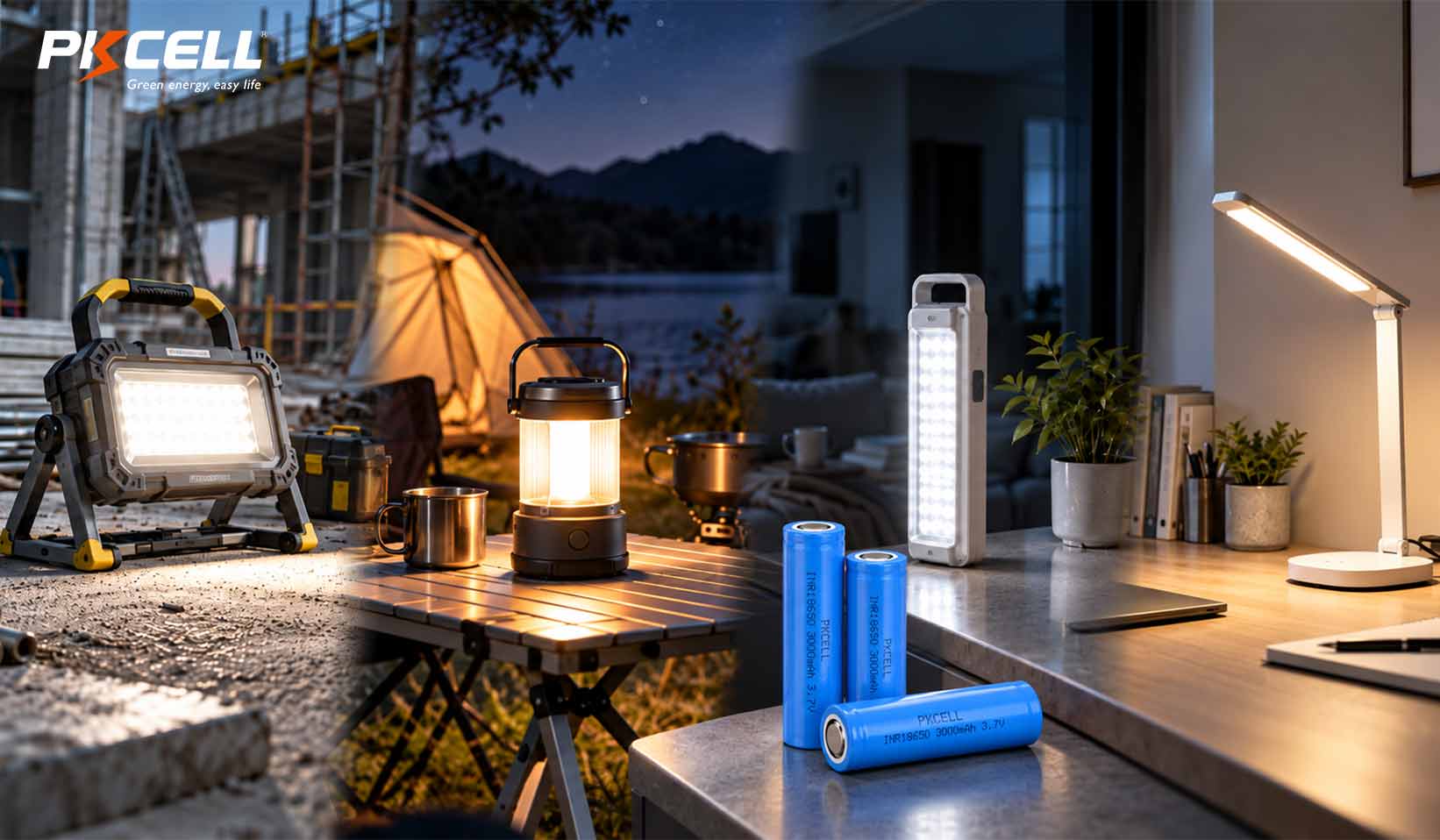
Before choosing a cell, define how the light is expected to work. A work light may run at high output for several hours on a job site. A camping lantern may operate at a moderate setting through the evening, with occasional bright bursts. An emergency light may spend most of its life on standby and then need to operate reliably during an outage. A wireless desk lamp may prioritize slim design, comfortable weight and convenient daily charging.
| Portable lighting type | Main battery priority | Key engineering questions |
|---|---|---|
| Portable work light or inspection lamp | Output stability, sustained current and runtime | What is the continuous load at the highest intended mode? How is heat removed? |
| Camping lantern | Long evening runtime, portability and recharge convenience | What are the typical brightness setting and hours of use per charge? |
| Emergency light | Reliable backup operation and predictable standby behavior | How long must the light operate during an outage, and how is readiness checked? |
| Wireless desk lamp | Low profile, low weight and useful runtime at normal brightness | What battery thickness is available, and how much space is reserved for the driver and charging circuit? |
These duty cycles matter because battery capacity alone cannot tell you whether a light will maintain brightness. The LED driver, system efficiency, dimming strategy, cutoff voltage and current peaks all affect usable runtime.
18650 vs 21700 vs LiPo for Portable LED Lights
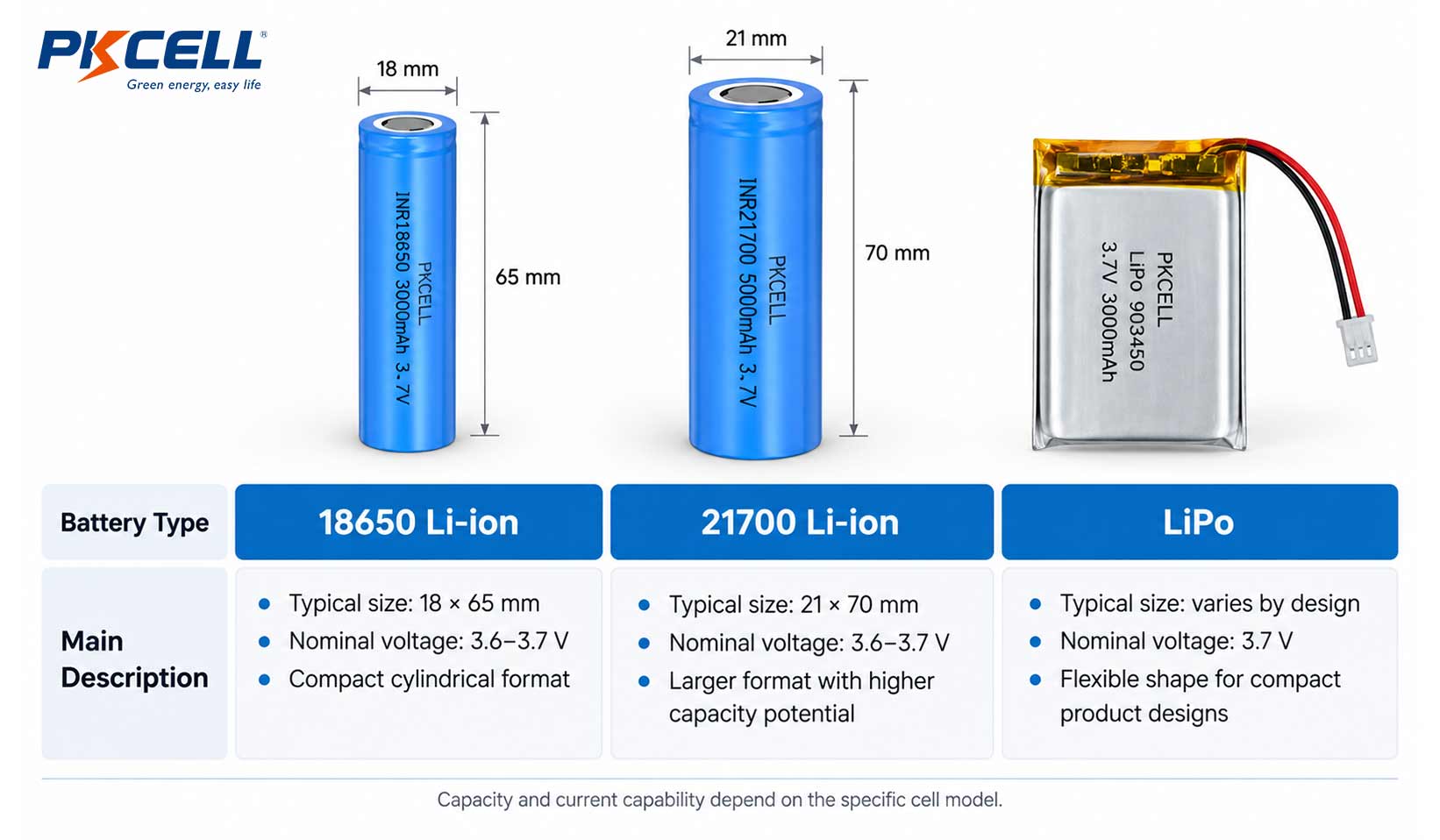
These formats solve different packaging and power problems. Cylindrical cells have standardized shapes and a rigid metal can. LiPo pouch cells offer more freedom in thickness and outline, but need mechanical support and protection against puncture, crushing and bending.
| Battery option | Potential advantages | Trade-offs | Consider it when |
|---|---|---|---|
| 18650 cylindrical Li-ion | Established format, broad capacity choices and straightforward integration into cylindrical holders or packs | Round cell geometry may limit use of thin internal spaces; current capability varies by model | A work light or lantern has a cell compartment designed for cylindrical cells and needs a balance of size and runtime |
| 21700 cylindrical Li-ion | Larger cell format can provide more capacity per cell in suitable models | Needs more diameter and length clearance; a larger cell is not automatically a higher-current cell | The product housing can accommodate the larger format and longer runtime is important |
| LiPo pouch cell | Flat shape, flexible dimensions and good use of thin enclosures | Requires robust enclosure support, protection and a suitable pack design; current ratings are model-specific | A cordless desk lamp or slim lantern needs a flat battery behind a diffuser or base |
For a more detailed cylindrical-cell comparison, see 21700 vs 18650 battery selection. For projects where enclosure shape is the main constraint, PKCELL’s guide to the advantages and limitations of lithium polymer batteries explains the design trade-offs.
Match Battery Voltage to the LED Driver
Voltage compatibility is a first-pass filter. A single-cell lithium-ion design commonly uses a 3.6 V or 3.7 V nominal cell, while a two-cell series pack is commonly labeled 7.2 V or 7.4 V nominal. The actual operating voltage changes across the state-of-charge range, so the LED driver must be designed for the full battery voltage window—not just the nominal figure.
- Confirm the driver’s minimum and maximum input voltage.
- Check whether the light uses a boost, buck or buck-boost driver.
- Verify the cutoff threshold and how brightness behaves as battery voltage falls.
- For a multi-cell pack, match the charger and protection circuit to the exact series configuration.
Do not replace a single-cell battery with a higher-voltage pack simply to increase brightness. The driver, wiring, protection and thermal design must support the pack voltage. For pack-based designs, review the available 18650 battery options and confirm the precise cell or pack specification before finalizing the design.
Estimate Runtime from Power Consumption
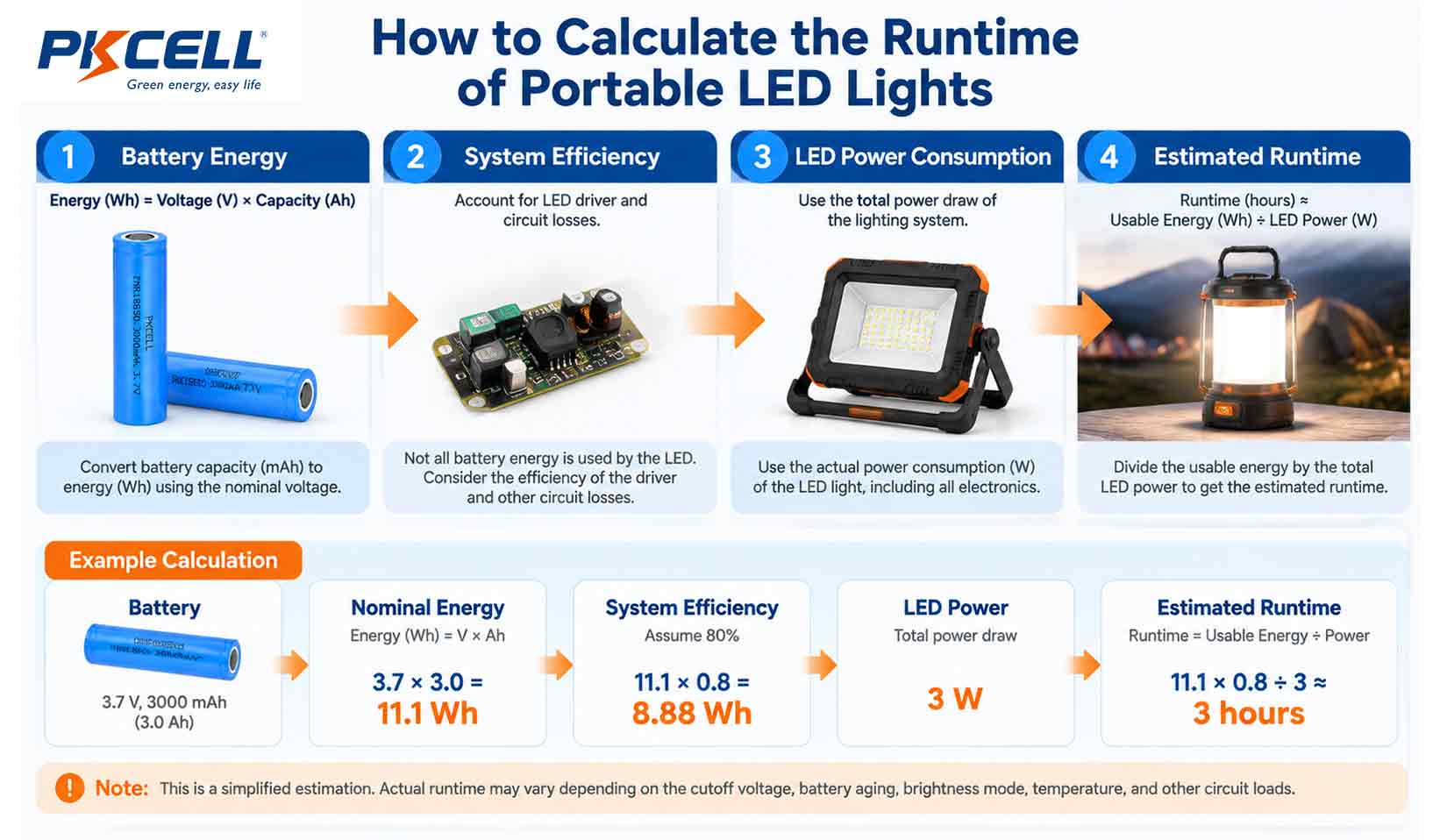
A runtime estimate is more useful when it starts with the light’s electrical load rather than comparing mAh figures from batteries with different voltages. For a first-pass calculation, estimate the energy available from the battery and divide it by the power consumed by the lighting system.
Battery energy (Wh) ≈ nominal voltage (V) × capacity (Ah)
Estimated runtime (hours) ≈ usable battery energy (Wh) × system efficiency ÷ LED system power (W)
For example, a nominal 3.7 V, 3.0 Ah cell represents approximately 11.1 Wh of nominal energy before considering usable-capacity limits and system losses. If a light consumes 3 W and the assumed driver efficiency is 85%, a rough estimate is 11.1 Wh × 0.85 ÷ 3 W, or about 3.1 hours. This is an illustrative calculation, not a product runtime guarantee. Actual results depend on the cell specification, current profile, temperature, cutoff voltage, aging and brightness-control behavior.
Use the same method when comparing a single 18650, a 21700 cell or a LiPo pack, but use the actual pack voltage and capacity for each option. Do not compare mAh alone across different voltages.
Check Discharge Current and Brightness Modes
A portable light can draw very different currents in low, medium, high and boost modes. The battery must support the highest intended continuous load and any short current peaks without excessive voltage sag or overheating. The correct discharge limit is specific to the cell model and the complete pack design.
- Work lights: validate sustained high-output operation and temperature rise over the full run time.
- Camping lanterns: measure typical-use current, not only the maximum brightness mode.
- Emergency lights: validate the specified backup duration and test the actual low-voltage behavior.
- Wireless desk lamps: check normal brightness, dimming levels, standby current and charging while in use if that mode is supported.
For multi-cell products, the BMS, interconnects, wiring and connectors must also support the load. A higher mAh rating does not necessarily mean a cell can deliver more current. Review the relevant model data and, where needed, the guide to selecting a BMS current rating.
Account for Space Weight and Mechanical Protection
Battery choice affects more than the compartment dimensions. Work lights may need a robust housing, impact protection and enough space to manage heat. Camping lanterns need a balance between carried weight and overnight runtime. Emergency lights need secure mounting and dependable connections. Desk lamps may have a narrow base or a thin arm where a flat pouch cell is easier to package.
- Reserve clearance for the cell, insulation, holder, wires and connector.
- Consider impact, vibration, drop conditions and the enclosure’s ability to retain the battery.
- For LiPo cells, prevent sharp edges or compression from contacting the pouch.
- For cylindrical cells, confirm holder compatibility, contact pressure and anti-rattle features.
- Keep the battery within its permitted temperature range during charging and operation.
If the standard cell format does not fit the enclosure or connector layout, a customized pack may be more appropriate than forcing a cell into an unsuitable space. PKCELL offers 18650 battery pack options and can discuss project-specific pack configurations.
Charging Design and Safety Requirements
The charger must match the selected chemistry, cell count, charge voltage, current limits and temperature requirements. A battery pack may also require a protection circuit or BMS to address overcharge, over-discharge, overcurrent and short-circuit risks. The protection strategy should be designed for the complete product rather than added as an afterthought.
- Use a charger matched to the approved cell or pack specification.
- Confirm charge current and termination behavior with the cell datasheet.
- Evaluate whether charging can occur while the light is switched on.
- Test the charging port, connector, cable and enclosure temperature.
- For emergency products, validate recharge readiness after the required standby period.
For B2B projects, define the required test reports, transport documentation and market-specific compliance needs before production. Do not assume every cell or pack has the same certifications; verify documents for the selected model and finished assembly.
Portable Lighting Battery Selection Checklist
- Define the target runtime at normal brightness and maximum intended output.
- Record the LED driver’s voltage window and the product’s power consumption.
- Determine continuous and peak current requirements.
- Measure the available battery space, including wires, connector and insulation.
- Compare 18650, 21700 and LiPo using usable energy, current capability, size and weight.
- Choose the matching charger and protection approach.
- Prototype and test runtime, temperature, voltage sag, charging and mechanical retention.
- Confirm the exact model, documentation, connector and annual volume with the supplier.
Develop a Rechargeable Battery for Your Portable Light
Tell PKCELL about your lighting type, target runtime, voltage, current draw, available battery space, charging method and expected order volume. The team can help evaluate cylindrical cells or a custom LiPo or lithium-ion battery pack for your design.
Frequently Asked Questions
Is an 18650 battery suitable for a portable work light?
It can be a suitable option when its voltage, usable capacity, discharge rating and dimensions match the LED driver and enclosure. Validate runtime and temperature at the intended brightness settings.
Should I choose 21700 instead of 18650 for a camping lantern?
Consider 21700 if the housing can accommodate the larger cell and the chosen model provides the required energy and discharge performance. The format alone does not guarantee a specific runtime.
Is a LiPo battery better for a wireless desk lamp?
A LiPo pouch cell can be useful when the lamp needs a thin or custom-shaped battery. Its enclosure must protect the pouch from crushing, puncture and bending, and the exact cell must meet the load and charging requirements.
How do I estimate how long a rechargeable LED light will run?
Estimate nominal battery energy in watt-hours, apply a realistic usable-energy and system-efficiency allowance, then divide by the light’s power consumption. Confirm the result with testing on the finished product.
Can I increase runtime by installing a higher-capacity battery?
Only if the replacement fits mechanically and is compatible with the device voltage, charger, protection system and current requirements. A higher capacity rating by itself does not guarantee compatibility.
Conclusion
Choosing a rechargeable battery for a portable LED light starts with the way the product will be used. Work lights prioritize sustained output, camping lanterns balance runtime and portability, emergency lights need dependable backup operation, and wireless desk lamps often place greater emphasis on a slim form factor. 18650, 21700 and LiPo each have a place when matched to the design.
Base the final choice on voltage, usable energy, discharge current, mechanical fit, charging design and safety validation—not on capacity alone. Contact PKCELL to discuss a rechargeable cell or custom battery pack for your portable lighting product.
Post time: Oct-26-2026


