
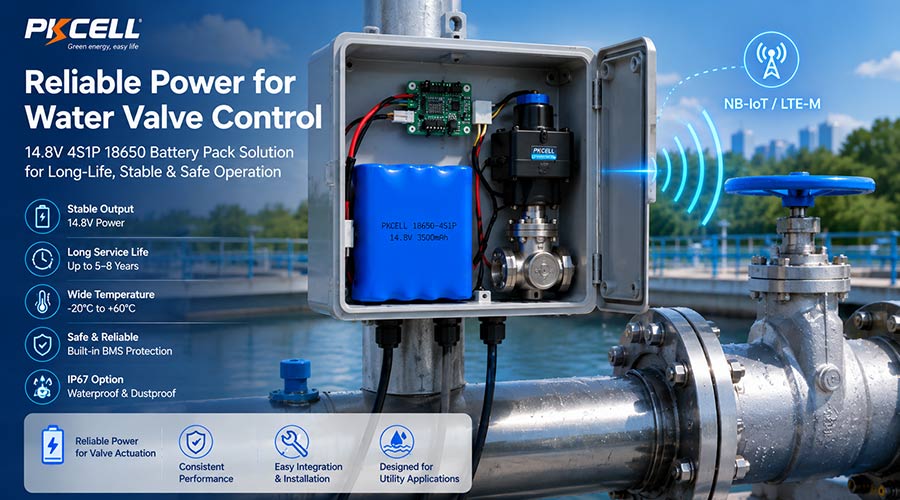
Water valve actuators in utility infrastructure need more than a battery with enough capacity. They need stable voltage, proper discharge capability, suitable BMS protection, reliable wiring, and a compact pack structure that can support remote valve operation in real field conditions.
This guide explains how a 14.8V 4S1P 3500mAh 18650 lithium-ion battery pack can be used in water valve actuator systems, what project parameters should be checked before selection, and when a customized 4S2P or higher-discharge solution may be more suitable.
In this article:
- Why water valve actuators require stable battery pack design
- How valve actuator power profiles affect battery selection
- Where standard 14.8V battery packs may fail
- How to evaluate 4S1P vs 4S2P for valve operation
- What information to provide before customizing a valve actuator battery pack
1. Why Battery Selection Matters in Water Valve Actuator Systems
Modern water utility systems increasingly use electric valve actuators for remote shut-off, pressure zone control, pipeline maintenance, irrigation control, and smart water infrastructure. In these applications, the battery pack may stay in standby for long periods and then deliver short bursts of power when the valve opens or closes.
This working pattern is different from a simple continuous-load device. A valve actuator battery must be selected according to voltage, motor startup current, operation time, standby current, environmental conditions, and maintenance schedule.
2. Typical Power Challenges in Water Valve Actuators
3. Understanding the Power Profile of Water Valve Actuators
A water valve actuator usually does not consume power evenly. The battery pack must support several different working stages, from low-power standby to motor startup and valve movement.
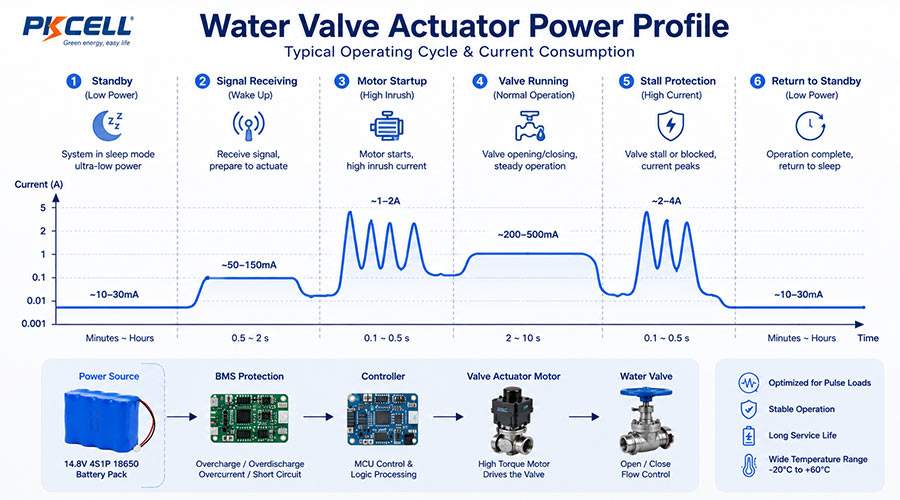
For valve actuator projects, battery capacity alone is not enough. Engineers should also confirm startup current, running current, stall current, valve operation duration, operation frequency, and BMS protection settings.
4. Why a 4S1P 18650 Battery Pack Can Fit Compact Valve Control Systems
A 4S1P battery pack uses four 18650 lithium-ion cells connected in series. This configuration increases the pack voltage while keeping the structure compact. For many small and medium electric valve actuators, a 14.8V nominal lithium-ion pack can support a higher operating voltage than a single-cell or two-cell pack.
The 4S1P 3500mAh format is especially useful when the project requires compact size, moderate operating current, rechargeable design, and stable voltage output for a valve control board and actuator motor.
5. Product Match: PKCELL 14.8V 4S1P 3500mAh ICR18650 Battery Pack
The PKCELL 14.8V 4S1P 3500mAh ICR18650 Battery Pack is designed for compact high-voltage lithium-ion applications. For water valve actuator projects, it can be considered when the actuator current demand is within the pack design range and the system requires a rechargeable 14.8V battery solution.
View the related product page: 14.8V 4S1P 3500mAh ICR18650 Battery Pack.
6. Why Standard 14.8V Battery Packs May Fail in Valve Actuator Projects
Many battery pack failures in valve actuator projects are not caused by nominal voltage or capacity mismatch alone. They often happen because the battery pack was selected without checking the real actuator load profile.
If the valve actuator requires more than 1750mA continuous discharge, or has a high motor startup current, do not directly copy a standard 4S1P pack design. A 4S2P configuration, high-discharge cells, or customized BMS may be more suitable.
7. 4S1P vs 4S2P: Which Battery Pack Should You Choose?
A 4S1P 3500mAh battery pack is suitable for compact valve systems with moderate current demand and limited installation space. If the project needs longer runtime, higher operation frequency, or more current margin, a 4S2P or custom high-discharge pack may be a better direction.
8. What Information Should You Provide Before Customizing a Valve Actuator Battery Pack?
To improve project evaluation speed and avoid wrong battery selection, engineers and purchasing teams should provide the following information before requesting a customized battery pack.
9. Typical Applications in Water Utility Infrastructure
A rechargeable 14.8V 18650 battery pack can be considered for water infrastructure devices that require compact size, controlled output, and rechargeable operation.
10. PKCELL Custom Battery Pack Support for Valve Projects
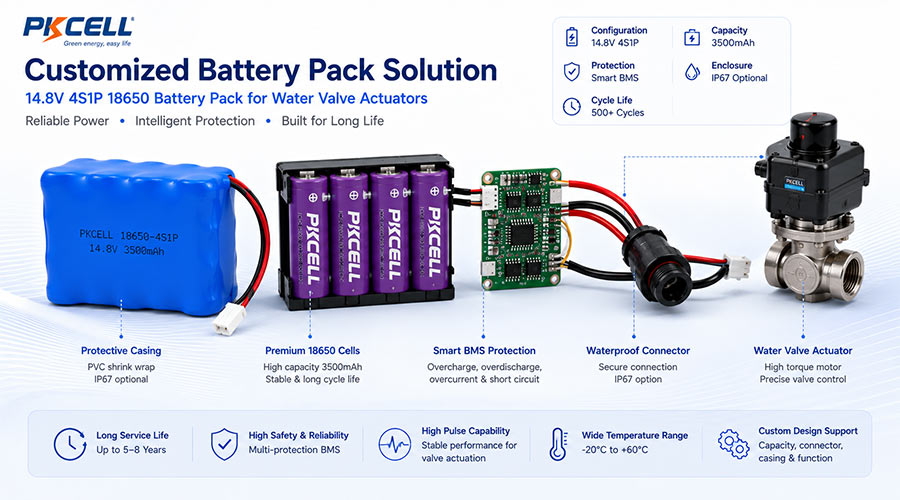
PKCELL can support customized 18650 lithium-ion battery pack design based on project voltage, capacity, BMS, connector, cable, housing, and certification requirements. For valve actuator projects, customization is often necessary when the actuator current, installation space, or operating environment differs from standard battery pack conditions.
- Custom 4S1P, 4S2P, and higher-capacity pack configuration
- BMS protection parameter customization
- Wire length, connector, and plug customization
- Waterproof and shock-resistant structure options
- Labeling, casing, and mounting design support
- Sample evaluation before formal production
Learn more about related products: 18650 Battery Pack and Customized Battery Pack.
11. Conclusion
A 14.8V 4S1P 3500mAh 18650 battery pack can be a practical rechargeable power solution for compact water valve actuator systems when the actuator current demand, operating frequency, and environmental conditions match the pack design.
For B2B water utility projects, the best approach is to evaluate the complete valve power profile instead of selecting a pack by voltage and capacity only. If the valve motor requires higher startup current, longer runtime, or stronger environmental protection, PKCELL can help adjust the cell configuration, BMS, connector, and pack structure.
FAQ
Need a 14.8V 18650 Battery Pack for Your Water Valve Actuator Project?
Share your valve motor voltage, startup current, operation duration, standby current, installation space, and environmental requirements. PKCELL can help evaluate whether a 4S1P 3500mAh pack is suitable or whether a customized 4S2P / high-discharge solution is needed.
Post time: Jul-03-2026


