
How to Calculate Lithium Battery Pack Runtime from a Real Device Load Profile
Calculating lithium battery pack runtime is easy when the load is constant. Real devices are different. IoT sensors, CCTV systems, medical devices, GPS trackers, portable lighting, and industrial electronics often switch between sleep, standby, active, communication, and peak-load states. The most reliable method is to build a real device load profile, convert each operating state into watt-hours, and compare the result with the usable energy of the battery pack. This guide explains the calculation step by step for engineers, OEM buyers, and product teams choosing a custom lithium battery pack.
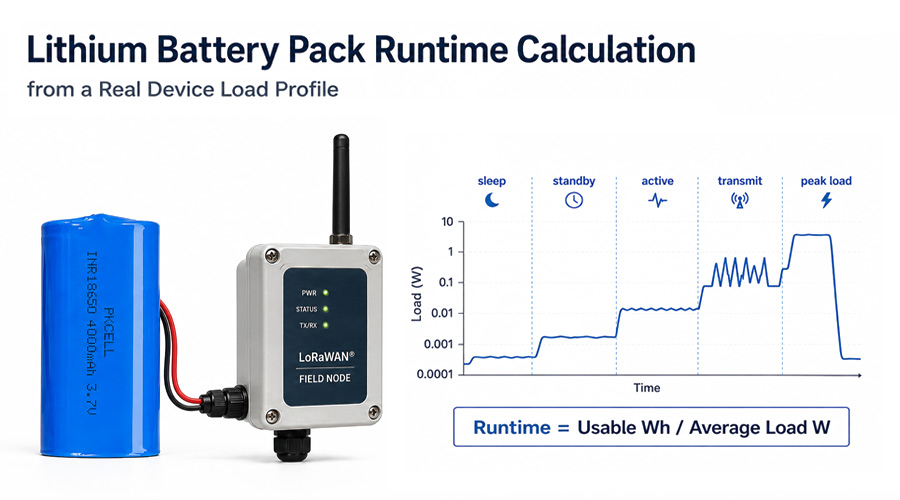
Why a Real Load Profile Matters
A basic runtime estimate uses average power. But many devices do not draw one fixed current. A smart sensor may sleep most of the time, then briefly draw high current during wireless transmission. A CCTV device may have different loads for standby, infrared night mode, recording, and data upload. If you only use the maximum current, the battery may look too small. If you only use the standby current, the battery may fail in real operation. A load profile helps you calculate the true energy demand across the full operating cycle.
The Core Runtime Formula
For a constant load, lithium battery pack runtime can be estimated with this formula:
Usable battery energy is not always the same as the battery nameplate rating. You need to include depth of discharge and system efficiency:
For example, a 14.8V 10Ah lithium battery pack has a nameplate energy of 148Wh. If the allowed depth of discharge is 85% and the device power system is 90% efficient, usable energy is about 113Wh.
Step-by-Step: Calculate Runtime from a Device Load Profile
1. List Every Operating Mode
Start by identifying the main operating states of the device. Common states include sleep mode, idle mode, display on, sensor active, motor startup, wireless transmission, charging control, and peak load.
2. Measure Power and Duration
For each state, record power in watts and duration in hours. If you only have voltage and current, calculate power first:
3. Convert Each State into Watt-Hours
Energy consumption for each state is calculated as:
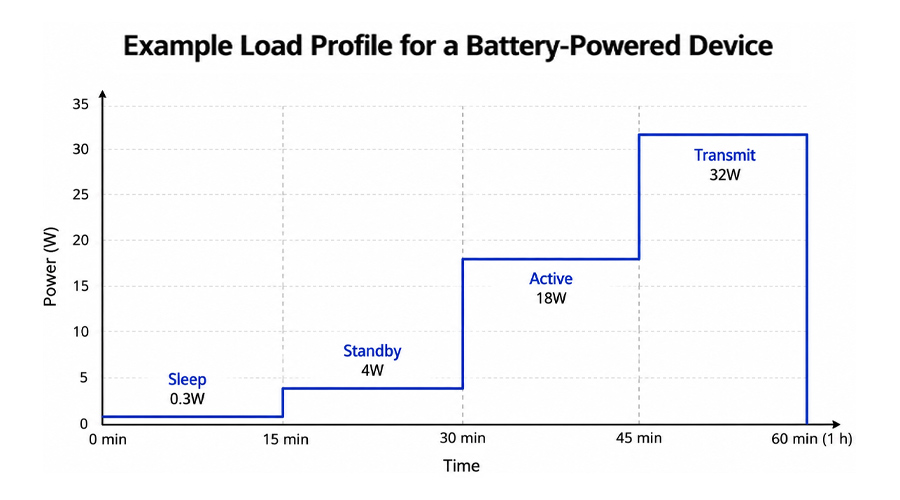
| Device State | Power Draw | Time per Cycle | Energy Used |
|---|---|---|---|
| Sleep mode | 0.3 W | 50 minutes | 0.25 Wh |
| Standby with display | 4 W | 8 minutes | 0.53 Wh |
| Active processing | 18 W | 90 seconds | 0.45 Wh |
| Wireless transmission | 32 W | 30 seconds | 0.27 Wh |
| Total per cycle | - | 60 minutes | 1.50 Wh |
In this example, the device consumes 1.50Wh per one-hour cycle. The average load is therefore 1.50W.
4. Calculate Usable Battery Pack Energy
Suppose the device uses a 14.8V 10Ah pack. The nameplate energy is:
After applying 85% depth of discharge and 90% system efficiency:
5. Divide Usable Energy by Average Load
This estimate should then be adjusted for temperature, battery aging, peak current, and safety margin.
What Can Reduce Real Battery Runtime?
Depth of Discharge Limits
Lithium packs should not always be sized around 100% usable capacity. Leaving reserve capacity can improve reliability and cycle life.
Power Conversion Losses
DC-DC converters, inverters, motor drivers, and the BMS all introduce losses. A device that requires multiple voltage rails should be calculated at the battery input whenever possible.
Peak Current and Startup Surge
A pack can have enough watt-hours but still fail if the BMS, cell discharge rating, connector, or wiring cannot handle peak current. This is especially important for pumps, motors, RF modules, drones, and high-power lighting.
Temperature and Aging
Cold temperatures can reduce usable capacity and increase voltage sag. Battery aging also reduces available capacity over time. For commercial products, runtime should be tested under real operating conditions.
Battery Pack Options for Different Applications
Different devices need different battery pack structures. For cylindrical cell designs, an 18650 battery pack is common in portable electronics, IoT equipment, CCTV devices, and industrial instruments. For applications requiring longer cycle life or improved thermal stability, a LiFePO4 battery pack may be suitable. PKCELL also provides battery solutions for Internet of Things devices, CCTV battery packs, GPS applications, and medical devices.
FAQ
How do I calculate lithium battery pack runtime?
Calculate usable battery energy in watt-hours, then divide it by the average load power in watts. For a real device, calculate the energy used in each operating state first.
Why is watt-hour better than amp-hour for runtime calculation?
Watt-hours include voltage, so they represent actual energy. Amp-hours alone can be misleading when comparing battery packs with different voltages.
How much reserve margin should I add?
Many engineering teams start with 10% to 25% reserve margin, then refine the number after real testing. Harsh environments or mission-critical devices may need more.
Can PKCELL help calculate runtime for a custom battery pack?
Yes. You can share your device voltage, average current, peak current, duty cycle, target runtime, size limits, connector needs, and certification requirements with PKCELL for battery pack evaluation.
Conclusion
The best way to calculate lithium battery pack runtime is to start from a real device load profile, convert every operating mode into watt-hours, and compare the total energy demand with usable battery capacity. This method gives OEM teams a more realistic foundation for battery pack selection than a simple amp-hour estimate.
Post time: Jul-28-2026


