
How Portable Gaming and XR Brands Are Shaping Demand for Custom Battery Packs
Portable gaming and extended reality products are asking batteries to do several difficult things at once. A battery must support processors, high-refresh displays, wireless radios, cameras, sensors, audio, cooling, and haptic systems while fitting inside a product that users expect to be lighter, thinner, cooler, and comfortable for long sessions. These competing goals are increasing demand for custom battery packs for portable gaming and XR rather than batteries selected only by voltage and capacity.
Gaming and XR brands are changing battery demand by prioritizing variable high-power workloads, ergonomic weight distribution, compact pack shapes, faster charging, accurate runtime reporting, accessory compatibility, repairability, and controlled supply continuity. The result is a shift from purchasing a standard cell to engineering the battery, BMS, charging path, enclosure, firmware, and user interface as one product system.
Why Standard Battery Selection Is No Longer Enough
Portable gaming once described relatively simple handheld devices and controllers. The category now includes powerful handheld consoles, cloud-gaming terminals, mobile gaming accessories, wireless controllers, portable displays, and compact gaming computers.
XR is similarly broad. It can include standalone VR headsets, mixed-reality devices, AR glasses, tracking controllers, external compute modules, and wearable battery accessories. Each product distributes processing, sensing, display, and wireless tasks differently.
This diversity changes the battery question from “Which standard cell has enough capacity?” to “Which battery architecture supports this specific platform, enclosure, thermal system, charging strategy, and user promise?”
More battery capacity is valuable only when the additional size, weight, charging time, heat, and cost still fit the product experience.
Brands increasingly need a custom lithium battery pack that may combine selected cells with application-specific protection, fuel gauging, temperature sensing, wiring, connectors, insulation, mounting features, identification, and production documentation.
PKCELL’s
consumer electronics battery solutions
include handheld gaming and XR applications and provide a useful starting point for discussing cell format, voltage, capacity, protection, and mechanical integration.
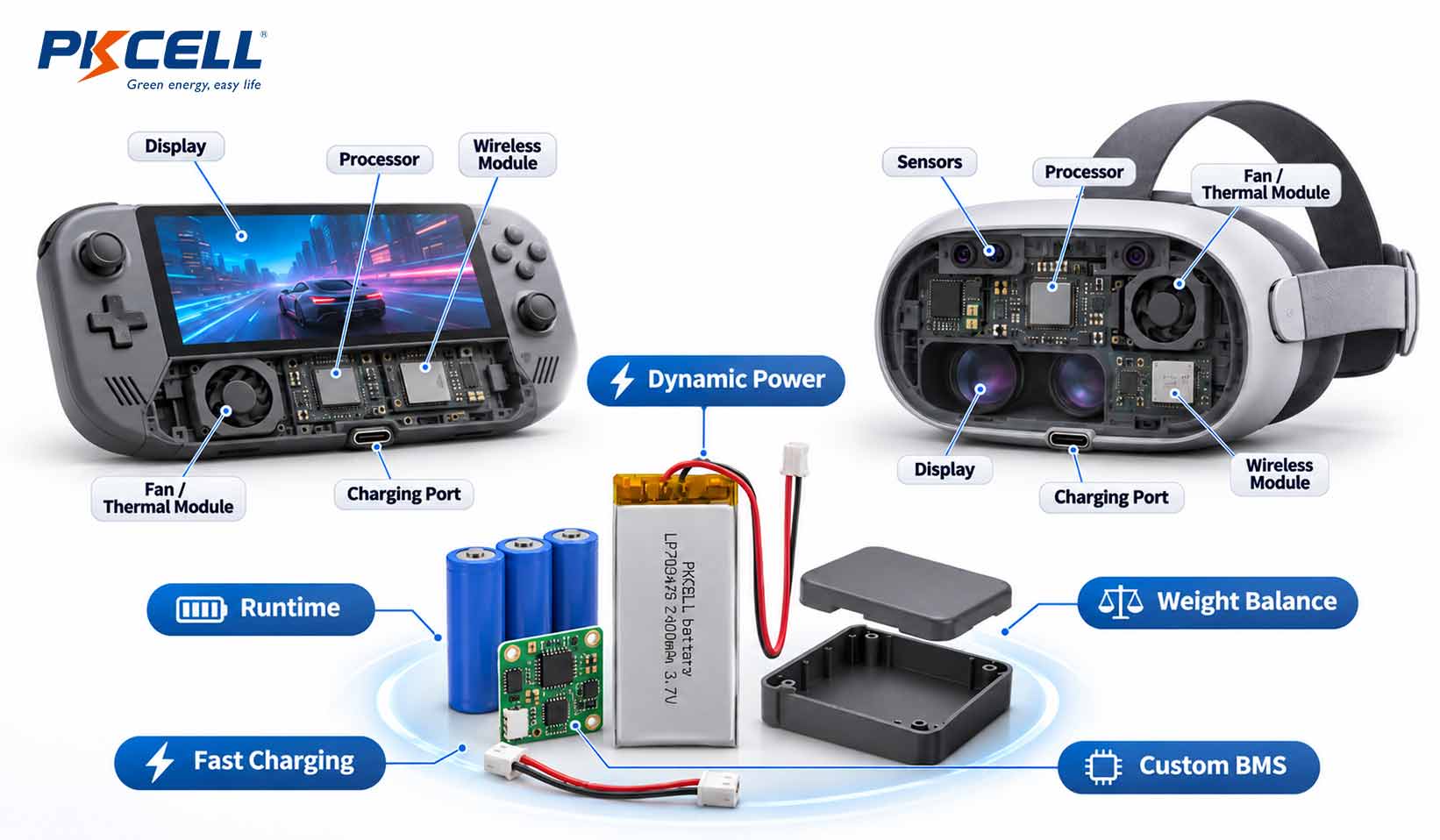
Portable Gaming and XR Do Not Create the Same Battery Problem
The two categories share a need for rechargeable power, but their mechanical and user-experience priorities differ. Treating them as one generic consumer-electronics application can produce an unsuitable battery specification.
| Design factor | Portable gaming devices | XR devices |
|---|---|---|
| Primary user concern | Stable frame delivery, session runtime, grip comfort, and charge-and-play behavior | Head comfort, front-to-rear balance, heat near the face, and freedom of movement |
| Typical load behavior | Processor and display loads change with game complexity, brightness, networking, and performance mode | Continuous sensing, display, tracking, wireless communication, spatial processing, and audio |
| Mechanical priority | Battery placement between grips, display, cooling system, and mainboard | Low headborne mass and controlled center of gravity |
| Charging priority | Fast turnaround, dock compatibility, and operation while connected to power | Convenient charging without increasing face temperature or cable interference |
| Battery architecture | Internal pouch pack, cylindrical pack, removable module, or dock-supported design | Front-integrated pack, rear-mounted pack, split pack, external module, or distributed architecture |
| Runtime communication | Remaining play time may change significantly with performance settings | Remaining use time changes with display, tracking, passthrough, recording, and application load |
These differences explain why a battery developed for a handheld console cannot automatically be transferred into an XR headset, even when the voltage and energy targets appear similar.
Seven Product Decisions Shaping Custom Battery Pack Demand
1. Higher and more variable system power
Gaming and XR workloads are dynamic. A menu screen, a locally rendered game, wireless streaming, mixed-reality passthrough, and recording can create different electrical profiles.
Battery selection should therefore use time-based measurements rather than one average current value. Developers should record sustained load, short peaks, peak duration, repetition rate, startup behavior, and minimum device voltage.
A cell may contain enough energy for the target session but still experience voltage sag during a peak. The cells, BMS, fuse, conductors, connector, and power-conversion stages must all support the complete current path.
2. Runtime is becoming a software-dependent promise
Performance modes, refresh rate, display brightness, wireless activity, haptics, recording, cooling policy, and background downloads can all change energy use. A single runtime claim cannot describe every scenario.
This first calculation should be adjusted for conversion losses, battery aging, temperature, device cutoff, manufacturing variation, and the reserve needed for predictable shutdown behavior.
Brands can improve user trust by estimating remaining time from the active workload rather than converting battery voltage directly into a fixed percentage.
3. Weight placement matters as much as total weight
In a handheld console, battery location affects wrist leverage and grip balance. In XR, front-heavy mass can increase facial pressure even when the total device weight appears competitive.
XR brands may evaluate rear-mounted, split, or external battery arrangements to change the center of gravity. Each architecture creates new questions involving cable routing, connector retention, pack protection, charging, and the behavior of the device if one connection is interrupted.
4. Enclosures are becoming harder to fill with standard packs
Speakers, fans, heat pipes, antennas, cameras, tracking sensors, controller boards, and structural components compete for internal volume. The remaining battery space may be thin, stepped, curved around other components, or divided into separate regions.
A lithium polymer battery can suit flat or space-constrained designs, but its mechanical support, swelling allowance, wire exit, connector location, insulation, and protection circuitry must be considered. A custom footprint should not be specified solely to consume every available millimeter.
5. Charge-and-play changes the thermal problem
Operating a gaming device while it is connected to external power can place charging electronics, processors, displays, and cooling systems under load at the same time. The power-path design must define whether external power runs the system, charges the battery, or does both under different conditions.
Fast charging is not only a charger selection. The cell’s approved charge rate, battery temperature, power-path limits, connector, cable, enclosure, firmware, and adapter negotiation must all be compatible.
USB Power Delivery can provide flexible power negotiation over USB Type-C, but the product still needs a validated charging and thermal policy. A high-rated adapter does not mean the battery can safely accept the adapter’s full advertised power.
6. Accessories are becoming part of the battery ecosystem
Charging docks, controller grips, battery straps, external compute modules, and travel accessories can change how the device receives and stores power. Brands must decide whether an accessory extends runtime, charges the internal pack, replaces it, or powers the system directly.
This creates demand for defined electrical interfaces, connector cycle life, pack identification, safe attachment, controlled hot-plug behavior, and compatible charging logic.
7. Repairability and lifecycle planning are moving earlier
A battery replacement strategy affects screws, adhesives, connectors, spare parts, service documentation, sealing, and the ability to restore the product after repair.
For products placed on the EU market, Article 11 of Regulation (EU) 2023/1542 applies from February 18, 2027 and introduces requirements concerning removability and replaceability of portable batteries incorporated into products. Brands should evaluate the regulation and applicable guidance for their specific product rather than postpone the discussion until after tooling.
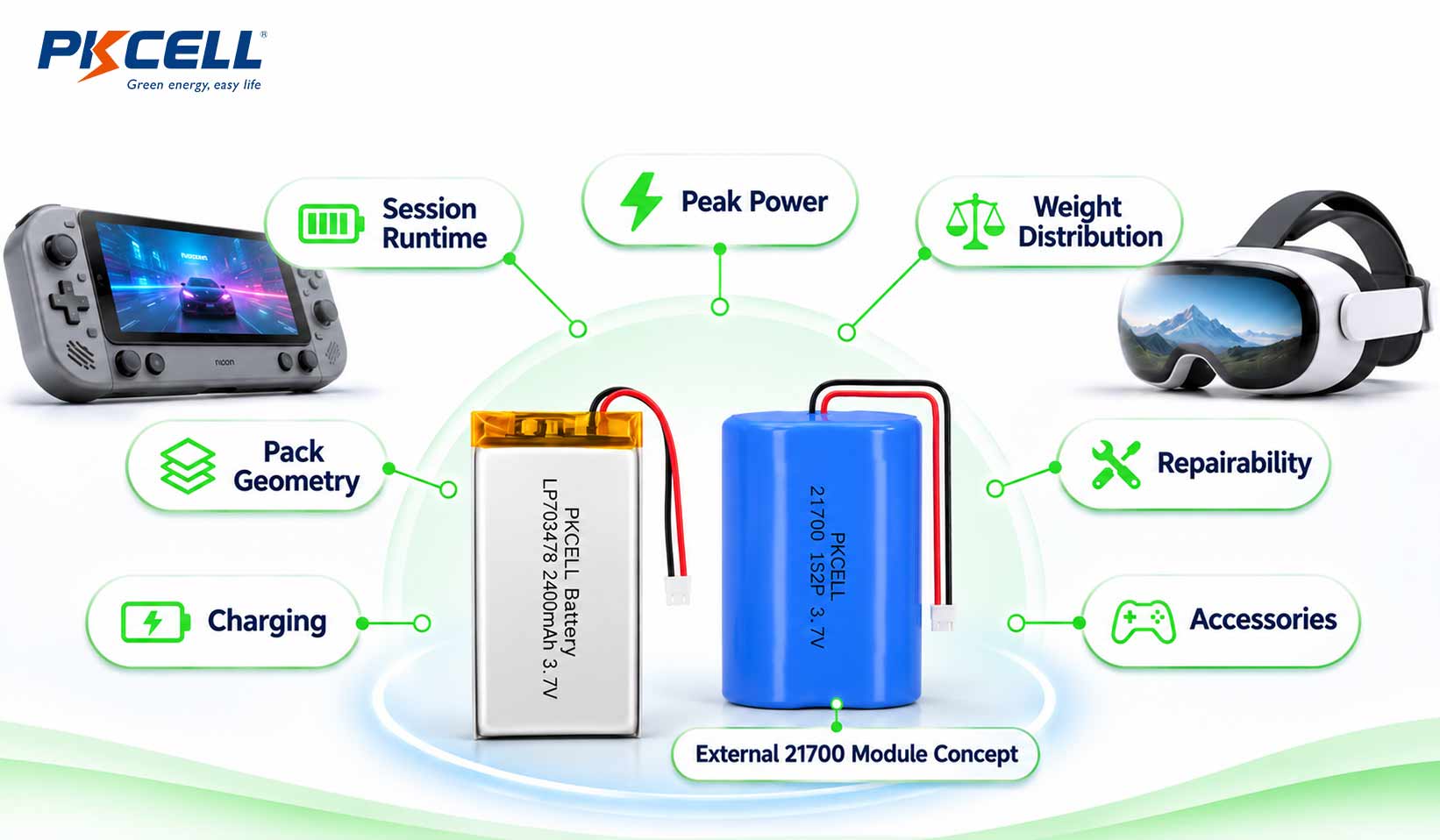
LiPo, Cylindrical Cells, or a Multi-Part Custom Pack?
Cell format should follow the product architecture and measured load. No format is automatically the best solution for every handheld console, controller, AR device, or VR headset.
| Battery approach | Potential design advantage | Engineering questions |
|---|---|---|
| Single LiPo pouch cell | Can fit a thin, rectangular internal space with relatively simple voltage architecture | Does the selected cell support the load, charging target, mechanical protection, and required runtime? |
| Multi-cell LiPo pack | Can provide a higher voltage or distribute energy across available spaces | How will the pack manage balancing, matching, sensing, wiring, swelling clearance, and unequal thermal exposure? |
| 18650 or 21700 pack | Can suit larger handheld, external, belt-mounted, or rear-head battery modules | Does the cylindrical structure fit the product’s thickness, weight, balance, discharge, and protection requirements? |
| Split or distributed battery | May improve space use or balance weight across the product | How are the sections monitored, protected, interconnected, serviced, and charged? |
| Removable battery module | May support service, spare packs, or longer sessions | Can the connector, latch, enclosure, identification, and hot-plug behavior remain reliable over repeated use? |
PKCELL’s
LiPo battery portfolio
provides pouch-cell references for compact electronics. For architectures based on cylindrical cells, review the
cylindrical lithium-ion battery range.
A product requiring specific voltage, pack shape, protection, wire length, connector, sensor, label, or enclosure can be evaluated through PKCELL’s
custom battery pack range.
Evaluate a Gaming or XR Battery Architecture
Share the device load profile, battery-space drawing, weight target, charging method, session goal, connector requirements, target markets, and estimated volume for an initial pack discussion.
The BMS Must Support Both Protection and Product Experience
The protection system may need to monitor overcharge, over-discharge, over-current, short circuit, cell temperature, and series-group balance. More advanced products may also require a fuel gauge, pack authentication, event recording, or communication with the host controller.
Protection thresholds must be coordinated with normal performance. A current limit set too close to a legitimate processor or display peak may create an unexpected shutdown. A temperature policy that reacts too late may produce an uncomfortable housing temperature, while one that reacts too early may unnecessarily reduce performance.
Questions for BMS and firmware development
- What are the continuous and short-duration current requirements?
- How long can a legitimate peak last?
- Where should cell and pack temperature be measured?
- How should charging change when the device is operating?
- How will the host estimate state of charge and remaining session time?
- What should happen after an over-temperature or over-current event?
- Does the product need pack identification or authentication?
- How will firmware respond to an aged battery with higher internal resistance?
PKCELL outlines available protection, sensing, and communication considerations on its
battery pack technology page.
For multi-series architectures, developers can also reference the
lithium battery voltage chart
while confirming the exact minimum, nominal, and maximum voltages from the selected cell and pack datasheets.
Validation Must Reproduce Real Sessions
A battery bench test at constant current cannot reproduce every gaming or XR workload. Validation should include software-controlled scenarios that represent actual device behavior.
Electrical and runtime validation
- idle, menu, streaming, and locally rendered workloads;
- maximum supported display brightness and refresh settings;
- wireless download, multiplayer, or casting activity;
- camera passthrough, tracking, recording, and spatial processing;
- speaker, microphone, and haptic operation;
- performance-mode transitions and short load peaks;
- operation near low state of charge;
- charging while operating, if supported; and
- sleep, standby, and long-term storage behavior.
Mechanical and thermal validation
- cell and pack temperature during peak workloads;
- housing temperature at the hands, face, and forehead contact areas;
- drop and impact in the product’s likely orientations;
- vibration and connector retention;
- head-strap, belt-pack, or removable-module cycle testing;
- cable bending and pull loads;
- pack movement and compression inside the enclosure; and
- aging of foam, adhesive, insulation, and thermal materials.
Testing should cover new and aged battery conditions, relevant temperatures, production tolerances, and final firmware. A cell qualification report alone does not prove that the complete gaming or XR product will meet its runtime, temperature, performance, and safety goals.
Certification and transport planning
IEC 62133-2 specifies requirements and tests for portable sealed secondary lithium cells and batteries under intended use and reasonably foreseeable misuse. UN Manual of Tests and Criteria subsection 38.3 addresses lithium cell and battery testing associated with transport classification.
Applicable requirements depend on the battery configuration, finished product, destination market, shipping method, and project scope. PKCELL’s
certificates page
can be used to prepare questions for a project-specific compliance review.
What Gaming and XR Brands Should Send a Battery Manufacturer
A detailed project brief reduces unsuitable recommendations and makes early feasibility work more efficient. Include:
- product type and use scenario;
- system voltage window and brownout threshold;
- average, continuous, and peak current measurements;
- time-based load profile for several representative applications;
- target runtime and performance modes;
- maximum battery dimensions and weight;
- 3D battery-space drawing and restricted areas;
- center-of-gravity or weight-distribution target;
- connector, wire length, and pin assignment;
- charging input, adapter assumptions, and USB PD profile where relevant;
- operation-while-charging policy;
- BMS communication and fuel-gauge requirements;
- removability, repair, and spare-pack strategy;
- target markets and required project documentation;
- prototype quantity, annual forecast, and production schedule; and
- change-control and supply-continuity expectations.
PKCELL’s
customized battery service
describes the broader path from requirement confirmation and structural design to prototypes, validation, and manufacturing.
Common Specification Mistakes
- Specifying only watt-hours: energy does not define current capability, voltage sag, or thermal behavior.
- Using one average workload: real games and XR modes can create very different load patterns.
- Ignoring center of gravity: total weight alone does not describe handheld or head-worn comfort.
- Assuming a higher-power adapter guarantees faster charging: the cell, charger, thermal policy, and power path set the real limit.
- Treating fuel gauging as a cosmetic feature: inaccurate remaining-time estimates can interrupt sessions and reduce user trust.
- Designing accessories after the battery: docks, straps, removable packs, and external modules affect electrical interfaces and charging logic.
- Freezing the enclosure before service planning: replacement requirements influence fasteners, connectors, adhesives, and spare parts.
- Approving only fresh samples: aged cells may expose voltage sag or thermal limitations hidden in early prototypes.
Frequently Asked Questions
What battery is best for a handheld gaming console?
There is no universal best battery. A flat LiPo pack may suit a thin console, while cylindrical cells may suit larger or removable modules. The choice should follow the measured load profile, voltage window, enclosure, weight target, charging strategy, and thermal validation.
Why do XR headsets need custom battery packs?
XR devices combine continuous sensing, display, tracking, wireless, audio, and processing loads with strict requirements for headborne weight and balance. A custom pack can address cell placement, shape, wiring, protection, temperature sensing, communication, and mechanical integration.
Can a gaming device charge while it is being used?
It can if the power-path, charger, battery, connector, cable, adapter, firmware, and thermal system are designed and validated for simultaneous operation. The system may need to reduce charging current when device power or temperature rises.
Should an XR battery be placed at the front or rear?
The answer depends on the headset structure, total mass, strap design, cable routing, thermal zones, and center-of-gravity target. Rear or split arrangements may improve balance but add interconnection, protection, and service considerations.
When should a gaming or XR brand contact a battery supplier?
The most productive time is after a preliminary platform load profile and battery-space envelope are available but before the enclosure, charging architecture, and tooling are fixed.
Conclusion
Portable gaming and XR brands are not simply asking for larger batteries. They are asking for battery systems that can deliver dynamic power, fit complex enclosures, distribute weight intelligently, communicate remaining runtime, charge efficiently, integrate with accessories, and support longer product lifecycles.
Meeting those expectations requires early collaboration between the brand, platform team, industrial designer, thermal engineer, firmware developer, compliance team, and battery manufacturer. When the battery is treated as part of the product architecture, brands can make clearer tradeoffs between performance, runtime, comfort, charging, repairability, and manufacturing risk.
Discuss a Portable Gaming or XR Battery Project
Have a load profile, enclosure drawing, preliminary battery model, or working prototype? Send the available information to PKCELL to discuss a custom rechargeable battery pack and prototype requirements.
Post time: Nov-04-2026


