
Developing Cordless Beauty Devices: How Battery Integration Shapes Product Design and User Experience
A battery in a cordless beauty device does much more than store energy. Its size, shape, weight, discharge behavior, charging method, thermal characteristics, and protection design affect how the product looks, feels, performs, and ages. Successful cordless beauty device battery integration must therefore begin during product architecture development, before the enclosure, electronics, and charging system are finalized.
The right beauty device battery cannot be selected from capacity alone. Developers must evaluate the complete load profile, peak current, available space, weight distribution, treatment temperature, cleaning environment, charging experience, service strategy, and target-market requirements. The cell, custom battery pack, electronics, and enclosure should be developed as one system.
Why Battery Integration Must Begin with Product Architecture
Cordless facial brushes, microcurrent devices, heated eye-care tools, electric shavers, nail tools, skin analyzers, hair-removal equipment, and portable massagers place very different demands on a rechargeable battery.
Some devices operate at relatively steady power. Others combine motors, pumps, heating elements, LEDs, wireless communication, displays, or high-power treatment electronics. A device may appear to need only a small amount of energy while still producing brief current peaks that influence cell selection and protection settings.
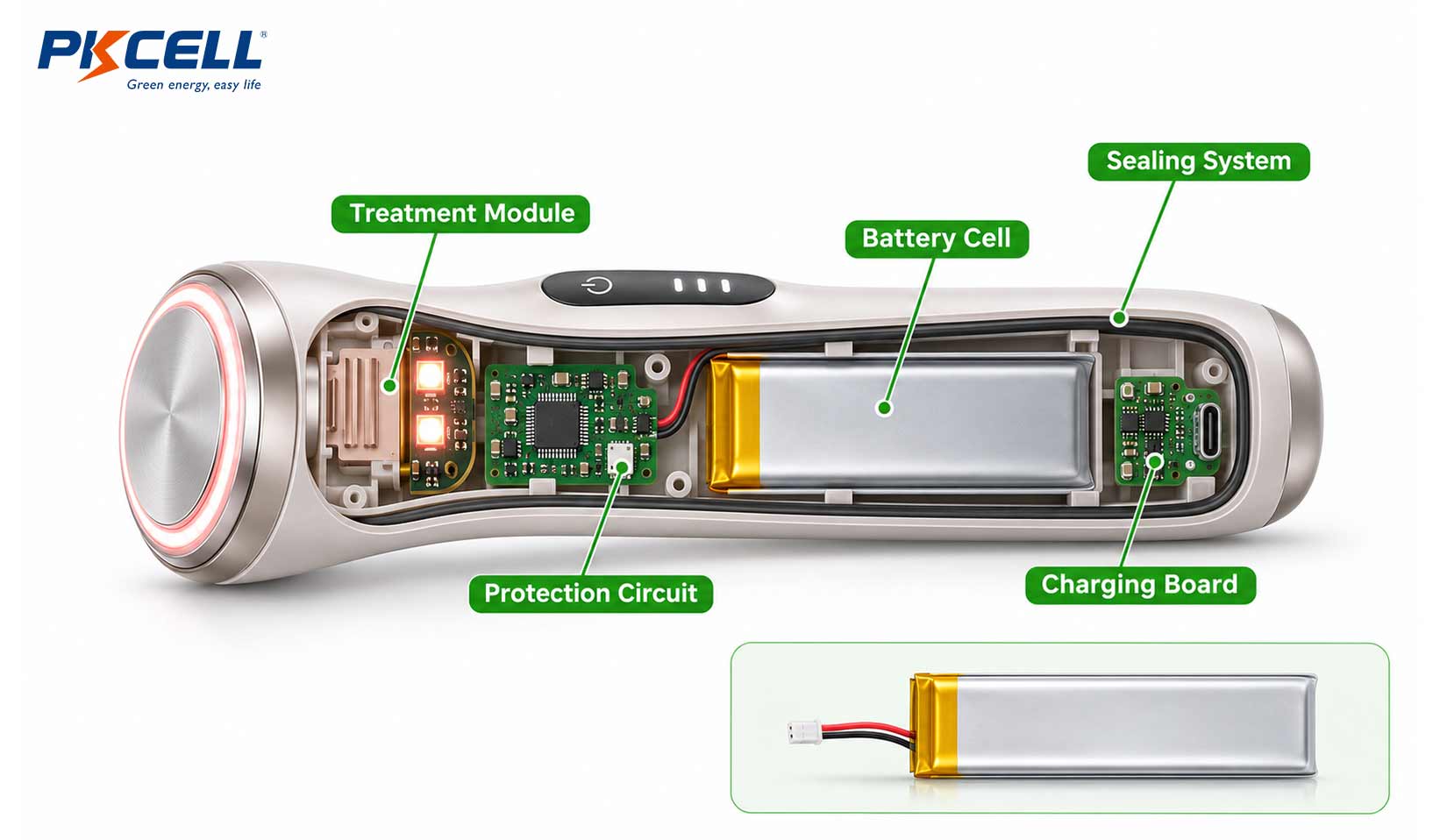
Battery volume competes directly with grip diameter, treatment-head space, thermal separation, sealing features, electronics, and the user’s tolerance for weight.
If the industrial design is frozen before battery evaluation, the team may be forced to accept a thicker handle, reduced runtime, excessive charging time, uncomfortable balance, or an enclosure redesign. Bringing a custom battery pack manufacturer into the project early can help identify electrical and mechanical constraints before tooling is committed.
Product teams can review PKCELL’s
battery solutions for consumer electronics
to understand the application, protection, connector, structure, and production parameters commonly discussed during OEM development.
Different Beauty Technologies Create Different Battery Loads
A useful battery specification begins with a mode-by-mode load profile. Average current alone can hide the events most likely to cause voltage sag, overheating, or a protection shutdown.
| Beauty device category | Typical load characteristic | Key battery integration question |
|---|---|---|
| Facial cleansing brushes | Motor startup, repeated vibration, LEDs, and wet use | Can the battery support startup current while remaining securely mounted and isolated from water exposure? |
| Heated beauty tools | High initial heating power followed by controlled cycling | Can the system reach the target temperature without creating excessive battery or handle temperature? |
| Microcurrent and skincare devices | Electronic treatment output, sensing, display, and control loads | Will falling battery voltage affect treatment consistency or measurement accuracy? |
| Portable suction devices | Pump startup and variable pressure settings | Can the battery and protection circuit tolerate repeated current peaks? |
| Nail drills and grooming tools | Motor load that changes with speed and applied pressure | Does the battery deliver adequate power under mechanical load without nuisance shutdowns? |
| Connected beauty devices | Active treatment plus Bluetooth, displays, and standby power | Has background power consumption been included in the session and storage model? |
Measure the complete operating sequence
Record voltage, average current, peak current, duration, and repetition rate for:
- startup and self-check;
- standby and wireless connection;
- each treatment intensity;
- simultaneous operation of several functions;
- heating, cooling, motor, or pump ramp-up;
- low-battery operation;
- charging and docking; and
- automatic cleaning or drying modes, where applicable.
This data helps distinguish an energy problem from a power problem. A battery may contain enough watt-hours for the desired treatment time but still be unable to support a short current peak at a low state of charge.
Translate runtime into treatment sessions
Users rarely think in milliamp-hours. They care whether the device can finish a treatment and how many sessions are available before charging.
The engineering calculation should then consider conversion efficiency, standby consumption, cell aging, operating temperature, battery variation, device cutoff voltage, and the reserve needed to deliver a predictable final session.
Lithium-Polymer Pouch Cell or Cylindrical Lithium-Ion Battery?
Both formats can be relevant to cordless beauty equipment. The correct choice depends on the device rather than on a general assumption that one format is always more advanced.
Lithium-polymer batteries for compact geometry
A lithium polymer battery can be evaluated when the product has a thin, flat, or asymmetrical internal space. Pouch cells can support compact industrial design, but they require suitable mechanical support and protection against bending, compression, puncture, and contact with sharp internal components.
The design must also account for manufacturing tolerance, wire exit, connector position, insulation, protection circuitry, and any clearance specified for the selected cell. Developers can browse PKCELL’s
lithium-polymer battery range
when comparing possible sizes and capacities.
Cylindrical lithium-ion cells for handle-based products
Cylindrical cells can suit products with a larger handle or devices that need a mechanically defined cell format. However, an 18650 or another cylindrical cell is not automatically suitable because it fits the available diameter. The selected model must still meet the device’s discharge current, runtime, temperature, charging, and lifecycle requirements.
When a custom lithium battery pack is needed
A standard cell becomes part of a custom lithium battery pack when the project requires application-specific protection, wiring, connector, temperature sensor, insulation, mounting, label, or enclosure. These details affect assembly reliability just as much as the cell specification.
PKCELL’s
custom battery pack portfolio
provides a starting point for projects requiring tailored electrical and mechanical integration.
Evaluate Your Beauty Device Battery Concept
Share the device voltage, measured load profile, target sessions per charge, maximum battery dimensions, charging method, target market, and estimated quantity for an initial battery discussion.
How Battery Integration Shapes User Experience
1. Handle diameter and grip comfort
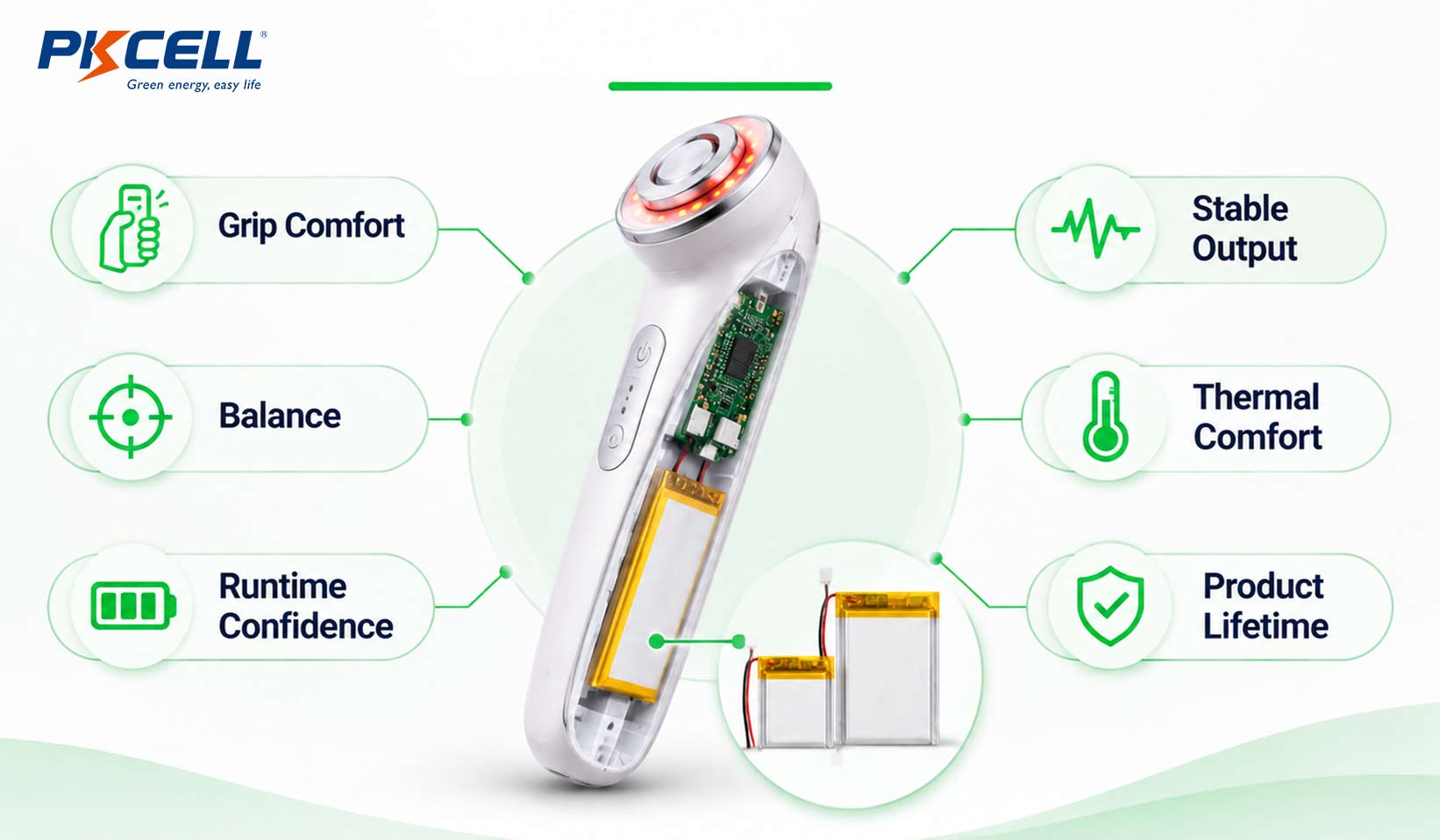
The battery often defines the minimum thickness of a handheld product. A larger cell may extend runtime but make the handle harder to control, especially during precision treatments around the eyes, nose, or jawline.
The battery envelope must include insulation, wires, protection electronics, assembly tolerances, and mounting features. Designing only around the cell’s catalog dimensions can result in an unrealistic enclosure.
2. Weight distribution and precision
Battery placement changes the center of gravity. Too much weight near the treatment head can increase wrist effort. Too much mass at the end of a long handle may make the device feel slow to reposition.
Teams should test balance in realistic treatment orientations rather than evaluating only how the device feels when held vertically in a showroom.
3. Output consistency near low charge
Consumers expect a motor, pump, heater, or treatment circuit to perform consistently until the device requests charging. As battery voltage declines, the electronics may need regulated power, controlled mode reduction, or a defined shutdown threshold.
A product that becomes noticeably weaker before its indicator reaches empty may be perceived as having poor battery quality even when the underlying issue is system-level voltage management.
4. Surface temperature and skin comfort
Beauty equipment may already contain intentional heating or high-power electronics. The battery should be positioned away from the treatment surface and other heat sources where practical.
Temperature sensing should reflect the actual thermal risks. Charging immediately after an intensive treatment also requires evaluation because the battery and internal electronics may still be warm.
5. Battery indication and runtime confidence
The user interface may display a percentage, several battery bars, or a simple low-charge warning. Whatever method is chosen, it should be calibrated against the real discharge behavior under the device load.
A warning that appears too early creates charging anxiety. A warning that appears too late may interrupt a treatment. The remaining usable energy should be linked to a meaningful user action.
6. Noise and vibration quality
A poorly supported cell or battery pack can move inside the enclosure or transmit motor vibration into the housing. Mounting materials must restrain the battery without applying damaging pressure or blocking necessary thermal behavior.
7. Perceived product lifetime
Rechargeable cells lose some performance as they age. A design with almost no energy or power margin when new may produce shorter sessions or earlier shutdowns later in service. Validation should therefore include aged-cell behavior, not only new samples.
Charging and Waterproofing Must Be Developed Together
Many personal-care devices are used near sinks, stored in humid bathrooms, or cleaned with water. “Waterproof” is not a complete engineering specification. The project should define exposure to splashes, rinsing, immersion, condensation, cosmetic residue, cleaning chemicals, and wet charging contacts.
USB charging
USB charging is familiar and convenient, but the port, cover, internal seal, cable assumptions, and contamination risk become part of the reliability strategy. Repeated opening of a protective cover should be included in durability testing.
Charging docks and sealed contacts
A dock can make daily charging easy, but contact alignment, corrosion, residue, wear, and charging while wet need attention. The dock must also hold the product securely without placing stress on the treatment head.
Inductive charging
Inductive charging can support a sealed enclosure, although charging efficiency, coil alignment, temperature, charging time, and cost must be evaluated with the production-intent housing.
For a more detailed enclosure discussion, see PKCELL’s guide to
battery pack ingress protection, water, dust, and condensation.
Plan battery replacement before tooling
Battery replaceability affects adhesives, screws, connectors, seals, spare parts, service instructions, and post-repair water resistance. These decisions should be made during architecture development.
For products placed on the European Union market, Article 11 of Regulation (EU) 2023/1542 applies from February 18, 2027 and introduces requirements concerning removability and replaceability of portable batteries incorporated into products. The regulation includes specific provisions and derogations, including ones relevant to certain products designed primarily for regularly wet environments.
Protection Circuit Design Must Match Normal Operation
Rechargeable lithium-ion battery systems may require overcharge, over-discharge, short-circuit, over-current, and temperature protection. Adding a generic protection circuit does not guarantee reliable operation.
If the current threshold is too close to the device’s normal startup peak, the product may shut down during treatment. If a temperature sensor is positioned far from the cell or isolated by unsuitable material, it may not represent actual battery temperature.
Hardware protection, firmware, the charge controller, device cutoff, cell capability, wiring resistance, and temperature sensing should be coordinated. PKCELL describes related options on its
battery pack technology page.
Recommended validation categories
- runtime in every treatment mode;
- motor, pump, heater, or actuator startup current;
- repeated peak-load performance;
- operation at different states of charge;
- charging after high-power treatment;
- cell, handle, electronics, and treatment-surface temperature;
- drop, vibration, and battery-retention testing;
- water, humidity, condensation, and cosmetic-residue exposure;
- charging-port or dock-contact durability;
- abnormal charging and fault conditions;
- aged-cell and low-temperature performance where relevant; and
- production variation using final materials and assembly methods.
IEC 62133-2 covers safety requirements and tests for portable sealed secondary lithium cells and batteries under intended use and reasonably foreseeable misuse. UN Manual of Tests and Criteria subsection 38.3 addresses testing associated with lithium battery transport classification.
Applicable certification and documentation can vary by cell, battery pack, finished product, market, and transport method. PKCELL’s
battery certificates page
can be used as an initial reference when preparing project questions.
A Practical Development Process for OEM Beauty Devices
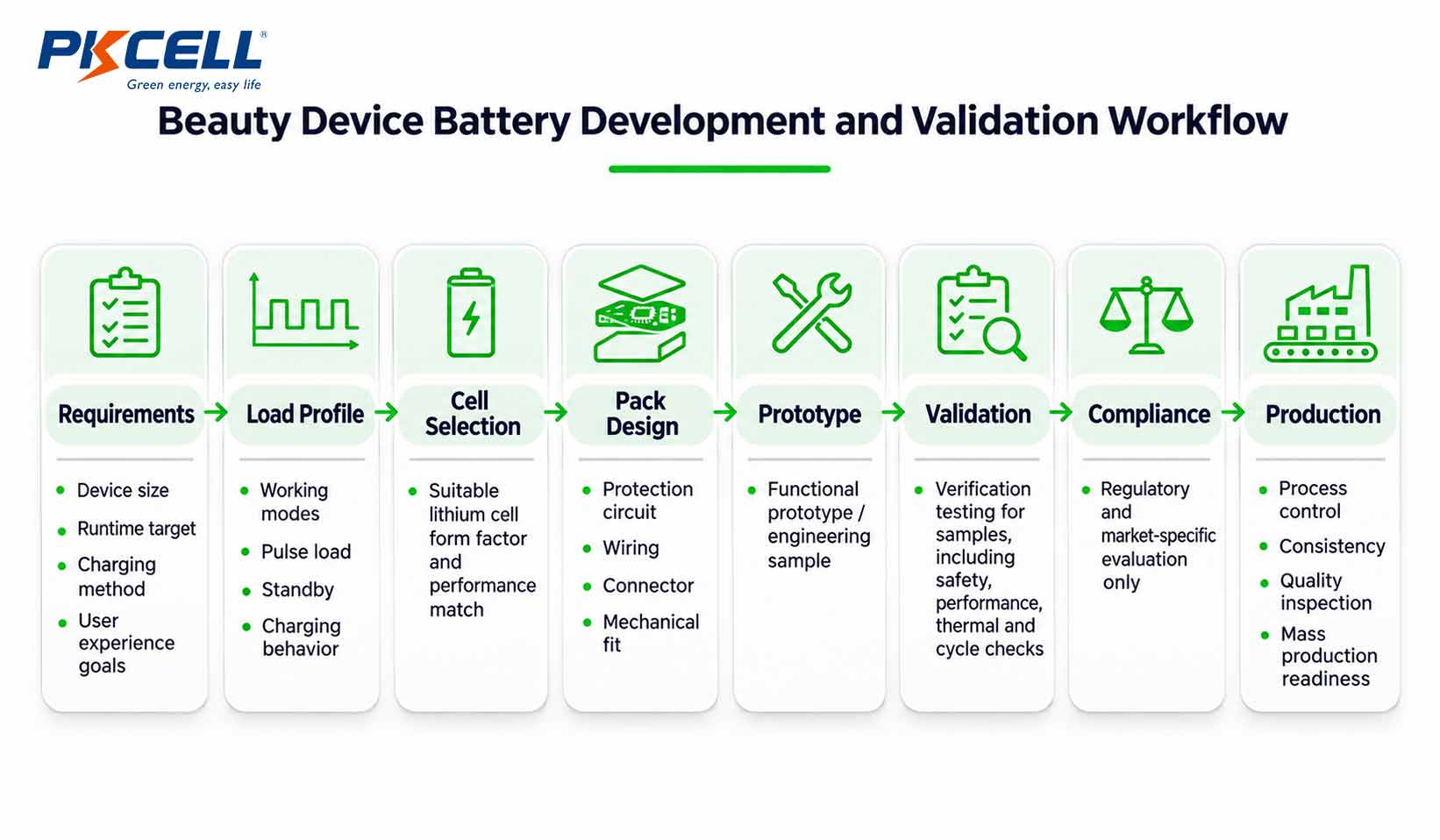
- Define the user promise. Set treatment modes, sessions per charge, charging time, product weight, cleaning method, and expected service life.
- Measure the load profile. Record continuous power, short peaks, startup behavior, standby demand, and minimum operating voltage.
- Reserve a realistic battery envelope. Include the cell, protection circuit, insulation, connector, wiring, tolerances, and mounting structure.
- Compare suitable cell formats. Evaluate usable energy, discharge capability, dimensions, weight, charging limits, temperature range, and supply continuity.
- Co-design charging and protection. Coordinate the cell, PCM or BMS, charger, firmware, temperature sensors, dock, cable, and adapter assumptions.
- Build functional prototypes. Test balance, grip, output consistency, runtime, temperature, noise, and charging behavior.
- Validate production-intent samples. Repeat critical tests using final housing materials, seals, adhesives, firmware, wiring, and assembly tolerances.
- Establish change control. Review changes to the cell, protection circuit, connector, charger, firmware, or enclosure before implementation.
PKCELL’s
customized battery service
outlines the broader route from requirement confirmation and structural design to prototypes, testing, and mass production.
Information to include in a battery inquiry
- beauty device type and treatment technology;
- nominal voltage and acceptable voltage range;
- average, continuous, and peak current;
- load-profile measurements or oscilloscope captures;
- target sessions per charge and charging time;
- maximum battery dimensions and weight;
- battery compartment drawing or 3D file;
- wire length, connector, and pin assignment;
- charging method and adapter specification;
- cleaning method and water-exposure profile;
- target markets and anticipated certification needs;
- sample quantity, annual forecast, and project schedule.
Request an OEM Beauty Device Battery Review
Have a preliminary drawing, load profile, existing battery model, or working prototype? Send the available project details to discuss a lithium-polymer cell, rechargeable lithium-ion battery, or custom battery pack configuration.
Common Battery Integration Mistakes
- Selecting by mAh alone: capacity does not prove peak-current performance or usable energy inside the device’s voltage window.
- Freezing the enclosure first: this leaves insufficient space for protection, wiring, insulation, mounting, and tolerances.
- Testing only the average load: startup and combined-function peaks may define the real battery requirement.
- Ignoring weight distribution: adequate runtime does not compensate for uncomfortable balance.
- Separating waterproofing from charging: ports, docks, contacts, and user behavior are part of the exposure scenario.
- Testing only new cells: aged batteries can reveal voltage-sag and runtime problems hidden during early development.
- Treating compliance as final paperwork: cell choice, pack design, charging architecture, and enclosure decisions can affect the validation route.
Frequently Asked Questions
What is the best battery for a cordless beauty device?
There is no universal best battery. The choice depends on the product’s load profile, available space, treatment temperature, runtime, charging method, weight target, cleaning environment, and compliance requirements. Pouch and cylindrical cells should be compared against the actual device.
Are lithium-polymer batteries suitable for handheld beauty devices?
They can be suitable for thin or tightly packaged devices when their electrical ratings meet the load and the enclosure provides appropriate mechanical protection, mounting, insulation, and space allowances.
Why can a beauty device shut down before the battery indicator reaches zero?
Possible causes include voltage sag, a current peak, unsuitable protection settings, high resistance in the power path, a temperature event, or a device cutoff that does not match the battery’s discharge behavior.
Can a waterproof beauty device use USB charging?
Yes, but the port, cover, sealing structure, contamination risk, wear, drainage, and user instructions must be designed for the intended water exposure. The connector alone does not determine finished-product water resistance.
When should an OEM contact a battery manufacturer?
Ideally, after the team has a preliminary load profile and battery-space envelope but before the enclosure and tooling are finalized. This allows battery, protection, charging, and mechanical requirements to influence the architecture.
Conclusion
A strong cordless beauty device is not created by placing the largest available battery into the space left after industrial design. It is created by translating the intended treatment experience into measurable electrical, mechanical, thermal, charging, sealing, service, and compliance requirements.
Early battery integration gives product teams more control over runtime, grip size, weight, treatment consistency, charging convenience, and long-term reliability. It also provides a clearer path from prototype testing to scalable manufacturing.
Develop a Battery Solution Around Your Product
Send PKCELL your device requirements to discuss cell selection, protection, wiring, connector, battery structure, sample development, and production planning.
Post time: Nov-04-2026


