
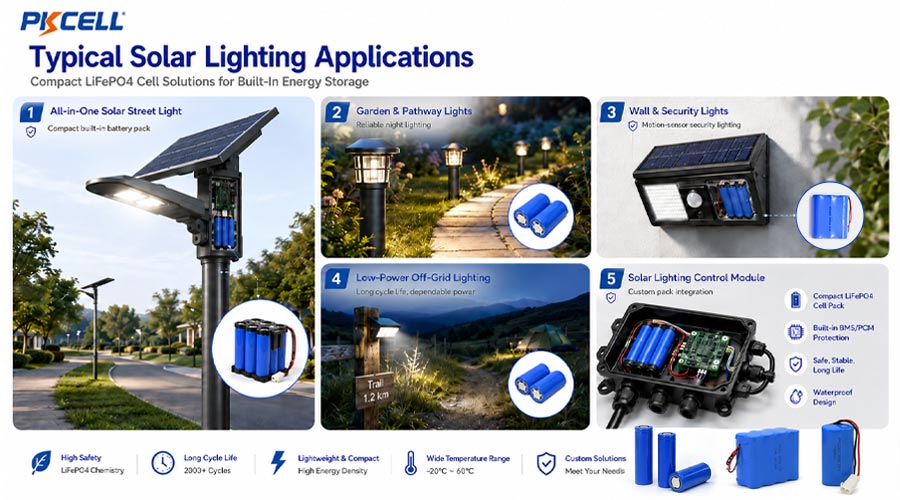
In solar street lights and compact solar lighting systems, the battery is more than a simple energy storage component. It determines how long the light can operate at night, how well the system handles daily charge and discharge cycles, and how often the product requires maintenance after installation.
PKCELL 3.2V 800-2000mAh IFR18650 Li-FePO4 Battery and PKCELL 3.2V 800-1000mAh IFR18500 Li-FePO4 Battery are compact cylindrical LiFePO4 cells designed for battery pack applications where safety, cycle life, stable output, and space efficiency are important.
Application focus: This article explains how IFR18650 and IFR18500 LiFePO4 cells can be used as building blocks for built-in solar lighting battery packs, including compact solar street lights, solar garden lights, pathway lights, wall lights, security lights, and low-power off-grid lighting systems.
Engineering note: These cells are usually used as part of a custom battery pack, not as standalone power sources for high-power municipal street lights. For solar lighting projects, the final battery pack should be designed according to LED power, lighting hours, backup days, system voltage, solar panel output, and available battery compartment space.
Why Built-In Energy Storage Matters in Solar Lighting
A solar lighting system typically works in a simple daily cycle. During the day, the solar panel charges the battery through a solar charge controller. At night, the battery powers the LED module, control board, sensors, and sometimes a wireless communication module.
For OEM manufacturers, the built-in battery system affects several product-level results:
- Nighttime lighting duration
- Brightness stability
- Cycle life and replacement frequency
- Product safety in outdoor environments
- Battery compartment design
- Warranty cost and after-sales maintenance
This is why solar lighting battery selection should not be based only on capacity. The chemistry, size, current capability, thermal performance, and pack-level protection design all matter.
Power Challenges in Compact Solar Street Light Battery Systems
Compact solar street lights, solar wall lights, and all-in-one solar lamps often place the battery inside the lamp body, lamp pole, control box, or battery compartment. This creates several engineering challenges.
Small solar lighting products have limited room for the battery pack, controller, wiring, and mechanical mounting. IFR18650 and IFR18500 cells are useful when designers need compact cylindrical cells that can be arranged into custom battery packs.
Solar lights usually charge during the day and discharge at night. This repeated cycling makes long cycle life an important factor for reducing battery replacement and long-term maintenance.
Solar lighting products may face high daytime temperature, low nighttime temperature, humidity, and seasonal weather changes. A stable chemistry and proper pack design help improve field reliability.
Many solar lights use PIR sensing, microwave sensing, timer dimming, low-brightness standby, or remote monitoring. The battery must support both long standby periods and stable power delivery when the light switches to higher brightness.
Why LiFePO4 Chemistry Fits Solar Lighting Applications
LiFePO4 chemistry is widely valued in energy storage and outdoor lighting because it offers a strong balance of safety, cycle life, and voltage stability. For solar street lights and compact solar lighting products, these characteristics are often more important than simply maximizing energy density.
- High safety: Suitable for unattended outdoor lighting products.
- Long cycle life: Supports frequent solar charge and night discharge cycles.
- Stable voltage platform: Helps support consistent LED and controller operation.
- Low self-discharge: Helps preserve energy during storage and standby periods.
- Battery pack flexibility: Cylindrical cells can be configured into different voltage and capacity combinations.
Why IFR18650 and IFR18500 Cells Fit Compact Built-In Battery Packs
Both IFR18650 and IFR18500 are cylindrical LiFePO4 cell formats. They are suitable for compact pack designs where the battery must be integrated into a restricted space.
IFR18650 cells provide a wider capacity range and stronger current capability, making them suitable for compact solar lighting systems that need longer lighting time or more energy reserve. IFR18500 cells are shorter and more compact, making them useful for smaller lamp bodies, slim housings, or space-constrained battery compartments.
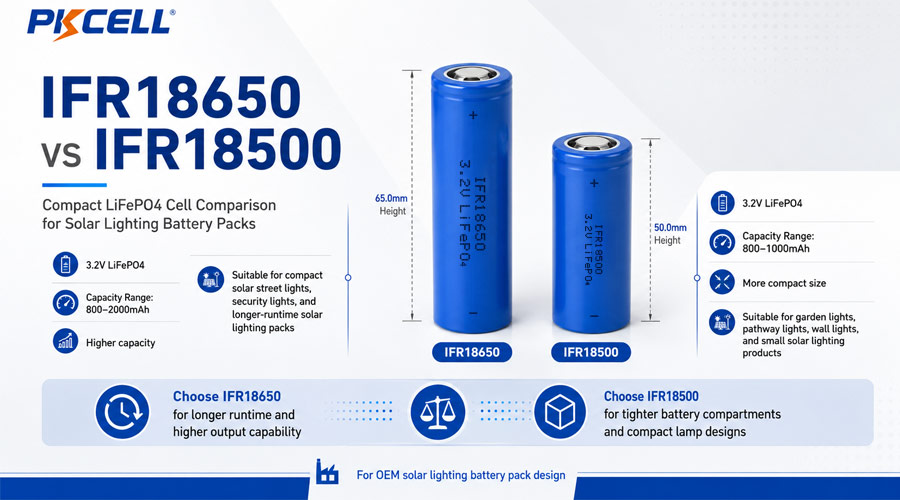
Product Overview: PKCELL IFR18650 and IFR18500 LiFePO4 Cells
The right choice depends on the lighting system’s available space, LED power, required lighting time, current demand, and target cost. For many solar lighting projects, these cells are assembled into a customized battery pack with suitable BMS or PCM protection.
How These Cells Work in Solar Street Light Battery Packs
In a typical built-in solar lighting system, the battery pack connects with the solar panel, charge controller, LED module, and control circuit. The battery pack stores solar energy during the day and releases it at night.
The solar panel charges the LiFePO4 battery pack through a solar charging controller. The charging design should match the cell chemistry, system voltage, current limit, and BMS or PCM protection requirements.
At night, the battery pack powers the LED module and control system. For products using dimming or sensing functions, the discharge profile may include low-power standby and short high-brightness periods.
Solar lighting systems may need energy reserve for cloudy or rainy days. This reserve depends on the battery pack capacity, LED power, local sunlight conditions, and lighting control strategy.
The battery pack may be installed inside the lamp head, pole, bottom battery compartment, or waterproof control box. Mechanical design should consider waterproofing, vibration resistance, heat dissipation, and easy maintenance.
Typical Application Scenarios
1. Compact All-in-One Solar Street Lights
All-in-one solar street lights integrate the solar panel, LED module, controller, and battery system into one compact structure. For small and medium-low-power designs, IFR18650 LiFePO4 cells can be used to build compact battery packs that balance size, capacity, and cycle life.
2. Solar Garden and Pathway Lights
Solar garden lights and pathway lights are often installed in parks, residential areas, courtyards, campuses, and landscape projects. These products usually require compact batteries, safe chemistry, and long service life rather than very high power output.
IFR18500 cells are useful for smaller lamp bodies and slim battery compartments, while IFR18650 cells are better for designs that need longer lighting time or higher energy reserve.
3. Solar Wall Lights and Security Lights
Solar wall lights and security lights may combine LED lighting with PIR sensors, microwave sensors, or timing control. The battery must support long standby time and stable power delivery when the light switches to higher brightness after motion detection.
4. Low-Power Off-Grid Lighting
Low-power off-grid lighting is used in rural paths, small roadside signs, camping areas, temporary lighting systems, and remote locations where grid wiring is difficult. In these products, low maintenance, stable energy storage, and reliable cycling performance are critical.
5. Solar Lighting Control Modules
In some smart solar lighting products, the battery pack powers not only the LED but also the control board, sensors, wireless communication module, or monitoring electronics. These systems require battery pack design based on the total energy consumption of all components.
IFR18650 vs IFR18500: How to Choose for Solar Lighting Battery Packs
Neither cell is simply “better” in every project. The right choice depends on the lighting product design. A larger-capacity cell can improve runtime, while a smaller cell can make the mechanical design easier in compact lamp housings.
Engineering Considerations for OEM Solar Lighting Designers
1. LED Power
A 3W solar garden light and a 20W compact solar street light have very different battery needs. Battery pack capacity should be calculated from the actual LED power and control strategy.
2. Lighting Hours
Daily lighting time directly affects capacity requirements. A light designed for 6 hours per night may use a smaller pack than a light designed for 10 or 12 hours per night.
3. Backup Days
Many solar lighting projects require backup energy for cloudy or rainy days. The number of backup days should be defined early because it has a major impact on the required battery capacity.
4. Battery Configuration
Single cells are usually combined into a battery pack to meet the required voltage and capacity. The final configuration may use series, parallel, or series-parallel combinations depending on the lighting system voltage.
5. Solar Panel and Charging Conditions
The solar panel power, local sunlight hours, charging efficiency, and controller design must match the battery pack. A larger battery is not useful if the solar panel cannot recharge it effectively.
6. BMS or PCM Protection
Battery protection should include overcharge, overdischarge, overcurrent, short-circuit, and temperature-related protection as required by the application.
7. Thermal and Mechanical Design
Built-in solar lighting batteries may be exposed to heat inside the lamp body. Designers should consider heat dissipation, waterproofing, vibration resistance, connector reliability, and service accessibility.
8. Certifications and Export Requirements
For overseas solar lighting projects, buyers may need IEC, CE, MSDS, UN38.3, RoHS, or other project-specific certification documents. These requirements should be confirmed before mass production.
When a Custom Battery Pack Is Better Than a Single Cell
For most solar street light and solar lighting projects, the battery solution is not just one cell. The final product usually needs a battery pack with the correct voltage, capacity, protection circuit, connector, wire length, and mechanical structure.
A custom battery pack is recommended when your project needs:
- Longer lighting time
- Higher system voltage
- More backup days for cloudy weather
- Special pack shape for a built-in battery compartment
- Waterproof or vibration-resistant structure
- Custom wire harness and connector
- BMS or PCM protection customization
- Solar controller compatibility
- Project-specific certification support
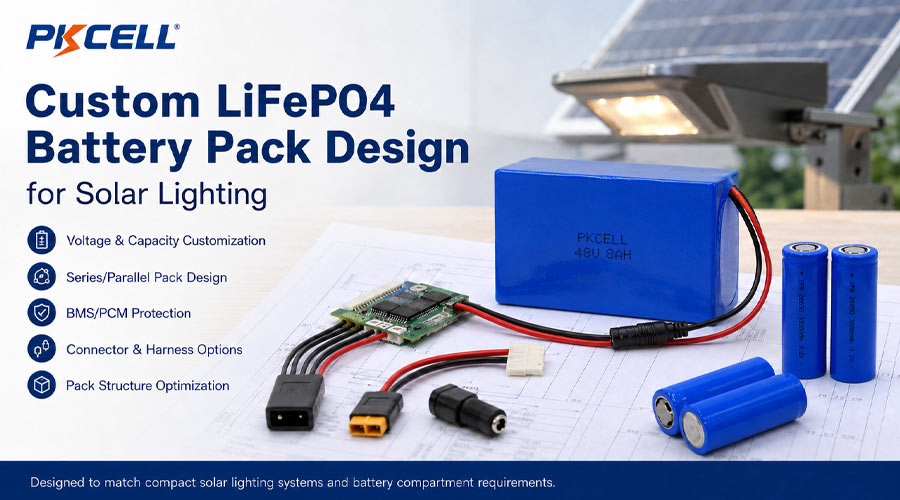
Why Choose PKCELL for Solar Lighting Battery Solutions?
PKCELL supports compact LiFePO4 cell supply and custom battery pack development for solar lighting OEM and ODM projects. Whether the application is a small solar street light, garden light, pathway light, wall light, or sensor-based solar security light, the battery pack can be designed around the actual product requirements.
For solar lighting manufacturers, PKCELL can help evaluate cell format, pack voltage, capacity, BMS or PCM protection, connector type, wire length, enclosure design, waterproof requirements, and certification needs.
- IFR18650 and IFR18500 LiFePO4 cell options
- Custom series and parallel battery pack configurations
- BMS or PCM protection design
- Connector, cable, and structure customization
- Battery pack support for compact built-in solar lighting systems
- Sample testing and mass production support
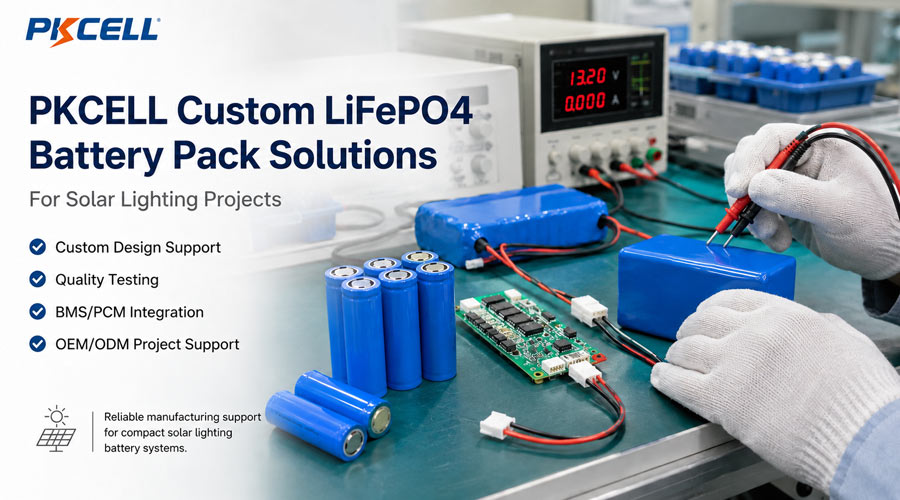
PKCELL can support custom LiFePO4 battery pack development for compact solar lighting applications.
FAQ: LiFePO4 Cells for Solar Street Lights and Solar Lighting Systems
Conclusion
Solar lighting performance depends not only on the solar panel and LED module, but also on the built-in battery system. A compact and reliable LiFePO4 battery solution can help improve lighting duration, cycle life, safety, and long-term maintenance performance.
PKCELL 3.2V 800-2000mAh IFR18650 Li-FePO4 Battery and PKCELL 3.2V 800-1000mAh IFR18500 Li-FePO4 Battery are practical cell options for compact solar street lights and solar lighting systems. IFR18650 is more suitable for projects that need higher capacity and stronger output capability, while IFR18500 is more suitable for smaller lamp structures and tight battery compartments.
For OEM solar lighting projects, the best solution is often a customized battery pack matched to the exact lighting system, battery compartment, charging method, and certification requirements.
Need LiFePO4 Cells or Custom Battery Packs for Solar Lighting Projects?
Contact PKCELL to customize voltage, capacity, BMS or PCM protection, connectors, wire harnesses, enclosure design, and certification support for your solar street light or solar lighting application.
Post time: Jun-18-2026


