
Canada’s 2026 Button Cell Safety Update: OEM Design Checks for Rechargeable Coin-Cell Devices
Regulatory news for OEM product teams | November 2026
On September 18, 2026, Health Canada added products containing button or coin batteries and the packaging of button/coin batteries to Table 3 of its General Prohibitions approach under the Canada Consumer Product Safety Act (CCPSA). The decision focuses on the serious injury risk when a small battery becomes accessible and is swallowed.
This is not a ban on all button batteries, and it is not a new Canadian certification scheme for individual rechargeable cells. It is a determination that consumer products and battery packaging presenting the identified ingestion danger must meet relevant safety performance criteria, or equivalent measures, to be manufactured, imported, advertised or sold in Canada.
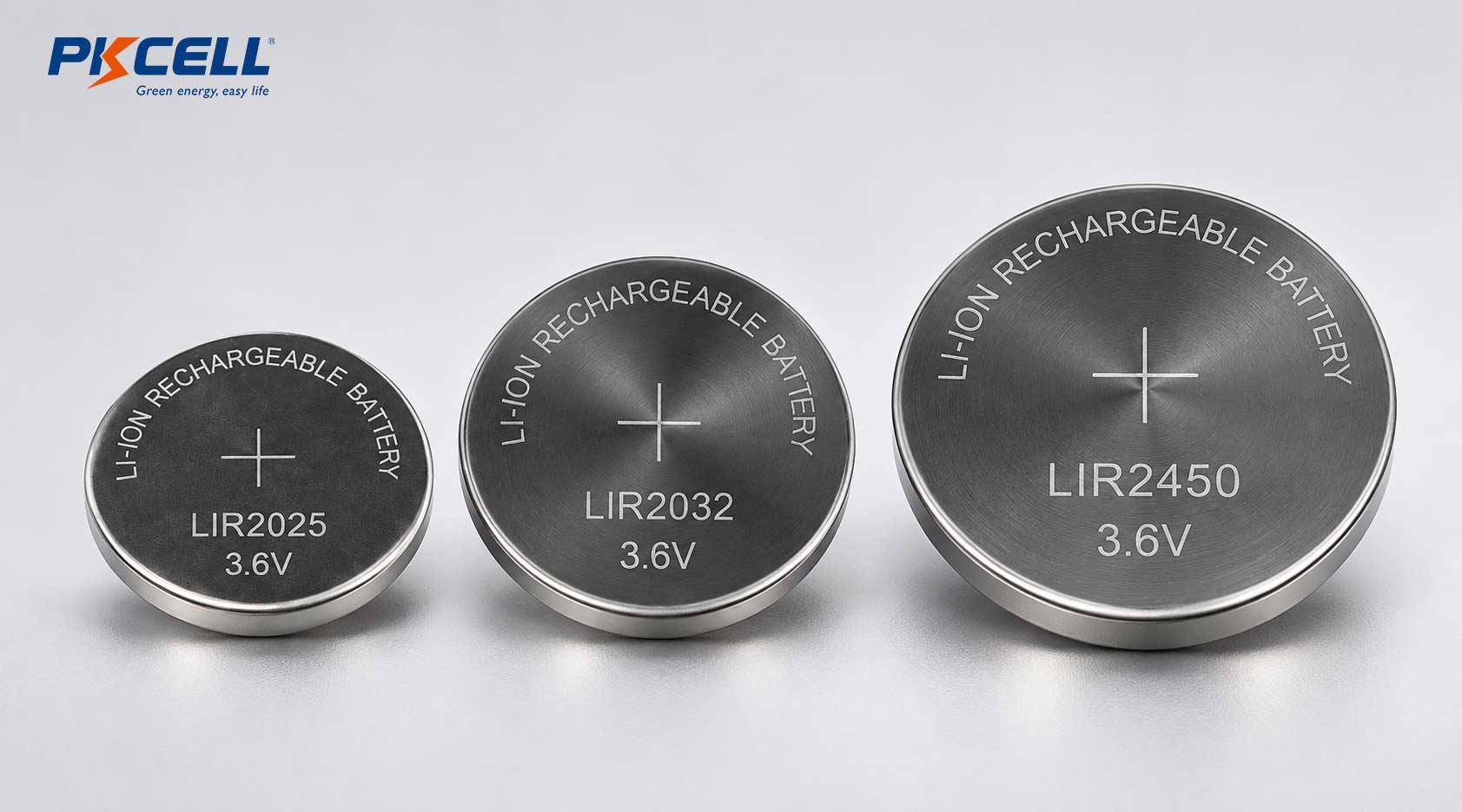
For OEMs developing compact rechargeable electronics, the practical task is to review the finished device, battery retention, foreseeable damage, warnings and any separately supplied batteries. Devices designed around LIR2032, LIR2025 or LIR2450 cells should not assume that a rechargeable chemistry removes the ingestion hazard.
1. What Changed in Canada’s Button Battery Safety Requirements in September 2026?
The September 18 update followed Health Canada’s assessment of the ingestion hazard associated with button/coin batteries. The product class was added to Table 3: Determination of dangers to human health or safety. Health Canada’s official Table 3 listing identifies performance criteria for affected products and battery packaging.
For manufacturers, importers and other businesses supplying the Canadian consumer market, three points deserve attention:
- Products are not prohibited simply because they contain a coin cell. The concern is a product or battery package that presents a danger and does not meet the applicable identified safety criteria or equivalent measures.
- There is no newly legislated transition period for the Table 3 addition. The underlying CCPSA general prohibitions were already in force. Health Canada says it will prioritize compliance promotion following the update, while retaining enforcement powers.
- Compliance is the supplier’s responsibility. Health Canada describes consumer product safety as a post-market regime, without routine pre-market review or approval. A single test report cannot be treated as official approval of the entire product.
The issue is not theoretical. In the government’s danger assessment, approximately 1,400 button-battery ingestion incidents were recorded in the Canadian Hospitals Injury Reporting and Prevention Program from 2011 to April 30, 2025; 79% involved children younger than five.
OEM implication: Review the Canadian version of the complete product before finalizing enclosure tooling, retail packaging or launch documentation—not just the electrical characteristics of its battery.
2. Does the Update Affect Rechargeable Coin Cell Batteries?
Potentially, yes. Health Canada’s assessment defines button and coin batteries primarily by their small, flat single-cell form factor, rather than limiting the concern to disposable batteries. Its stated scope includes consumer products incorporating button/coin batteries, with an exclusion for products using zinc-air button/coin batteries. The packaging assessment covers lithium, alkaline and silver-oxide button/coin batteries, and excludes zinc-air packaging.
Rechargeable lithium-ion coin cells such as LIR2032, LIR2025 and LIR2450 therefore deserve the same product-scope review when used in consumer devices sold in Canada. Whether particular requirements apply depends on the finished product, intended use and how the battery is supplied, not merely on the LIR model number.
Consider three different supply configurations:
- A consumer device with a removable LIR cell: The battery cover, retention method and accessibility after foreseeable misuse become central design questions.
- A compact device with a fixed or tabbed LIR cell: The battery may not be intended for user replacement, but an impact or damaged enclosure could still make it accessible.
- An LIR replacement cell sold or supplied separately: Review its retail or spare-cell packaging and warnings as a distinct workstream from the finished device.
An industrial-only product may require a different regulatory scope analysis from a consumer product. The OEM and Canadian importer should establish that classification rather than applying one blanket conclusion to every application.
For the rechargeable models available on this website, see PKCELL’s Li-ion button cell range.
3. Battery Compartment Safety: What Should OEMs Review?
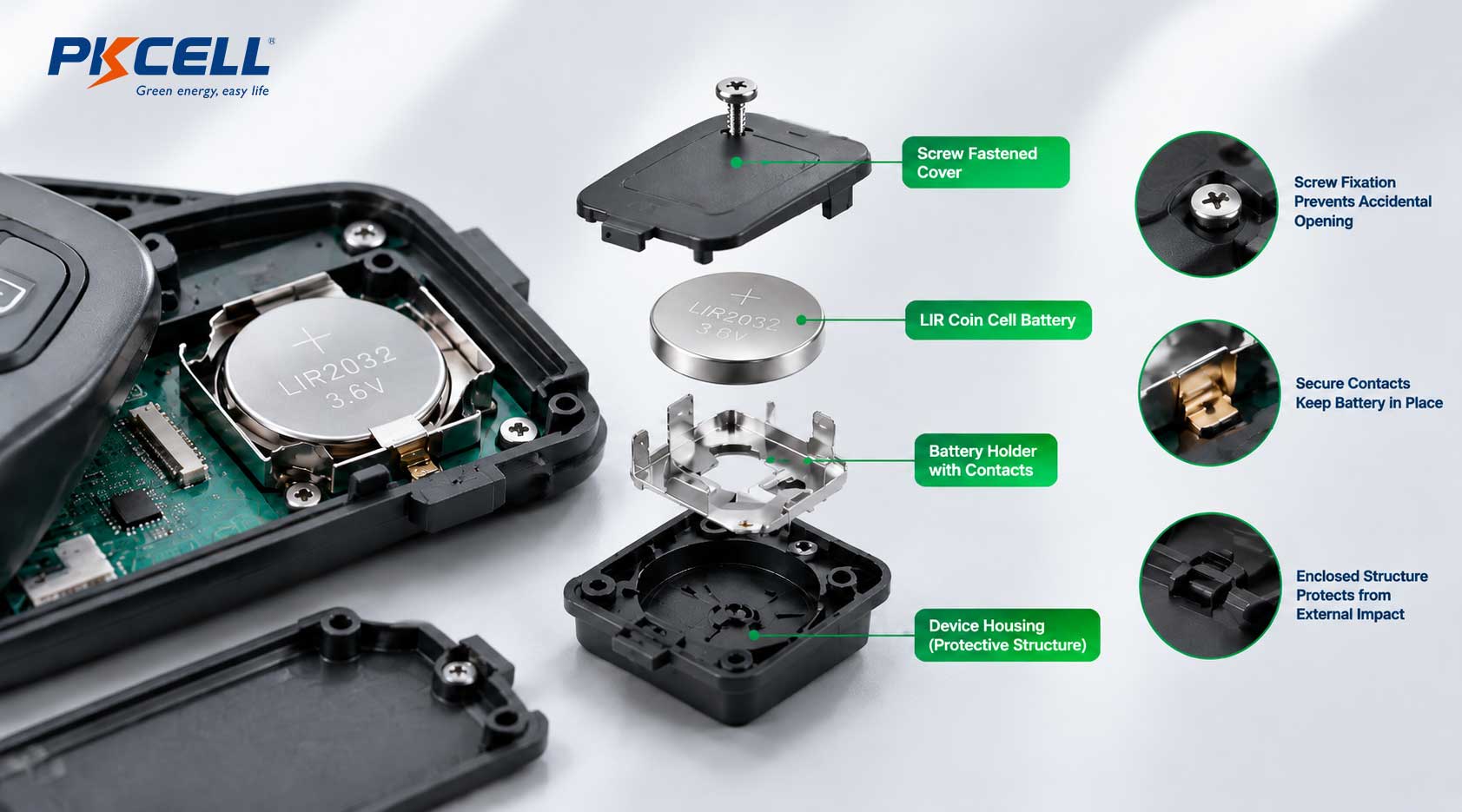
A design that charges correctly can still create an ingestion hazard if the cell is released from its holder or housing. Health Canada’s assessment highlights access through easily opened covers and through damage after dropping or rough handling. For a new compact-device design, review the following points against the applicable standard and test plan.
Secure closure and child accessibility
Check how the battery door or enclosure is secured, whether relevant fasteners are retained, and whether opening requires the controls specified by the applicable criteria. A simple snap-fit that is convenient for adults may not remain secure after repeated use or assembly variation.
Battery retention inside the housing
Review holder spring force, clips, weld tabs, PCB mounting and clearances. If the cover separates, could the cell fall out? If an internal component breaks, could the battery be removed without further tools? Assess the complete assembly rather than treating the battery holder as an isolated component.
Mechanical performance after foreseeable damage
Test production-representative housings for the relevant drop, impact and other use-and-abuse conditions identified by the selected standard. Record not only visible cracks but also whether the battery remains inaccessible and securely retained after the test.
Manufacturing tolerances and service life
Account for cover wear, plastic variation, screw engagement, contact movement and assembly tolerances. A compliant-looking CAD model does not show how a mass-produced battery compartment behaves after handling or repair.
Fixed-cell designs are not automatic exemptions
Welded tabs or an enclosed battery can improve retention, but they do not independently prove that the entire consumer product addresses the ingestion hazard. Confirm the actual accessibility and retention outcome of the assembled device.
4. Packaging, Warning Labels, and Applicable Safety Standards
The 2026 determination distinguishes products containing coin cells from packaging for button/coin batteries sold alone. That distinction matters when a device is sold with a fitted battery, includes a spare cell in the box, or offers replacement cells through a distributor.
Health Canada’s notice of danger and risk mitigation identifies the following reference routes, or equivalent criteria:
| Product or packaging scenario | Identified reference criteria | OEM review focus |
|---|---|---|
| Non-toy consumer product containing a coin cell | ANSI/UL 4200A-2023, or equivalent | Battery accessibility, compartment security, performance and warnings in the finished product |
| Toy containing a coin cell | ASTM F963-23, or equivalent | Toy-specific battery access, abuse testing and warning requirements |
| Reclosable packaging for separately supplied coin cells | CAN/CSA Z76.1-99 (R2003), ISO 8317:2015, or equivalent | Child-resistant packaging design and verification |
| Non-reclosable packaging for separately supplied coin cells | Applicable referenced criteria, including ISO 28862:2018, or equivalent | Validate the specific pack format; do not assume standards written for primary batteries automatically apply to rechargeable LIR cells |
| Labels and instructions on products or separately sold batteries | Applicable labeling criteria listed in the notice, including relevant product and battery standards | Warning content, placement, legibility, instructions and Canadian language review |
Important distinction: ANSI/UL 4200A-2023 addresses consumer products incorporating button or coin batteries. It is not evidence that an individual, separately supplied LIR cell has received a standalone ANSI/UL 4200A certification. Similarly, Health Canada’s labeling references include CSA C22.2 No. 62133-2:20 for secondary lithium cells and batteries, but that reference does not replace finished-device access or battery-packaging assessments.
The official notice also lists some packaging and label references associated with primary batteries, including parts of the IEC 60086 family. Rechargeable lithium-ion cells require chemistry-appropriate review; the standards list should not be applied indiscriminately.
Health Canada’s assessment provides warning examples in English and French. Canadian market artwork should be reviewed for the appropriate wording, language, placement and product-specific requirements, rather than simply copying a warning label from another market.
5. OEM Product Development Checklist Before Entering Canada
Use the following release-gate checklist before the finished product enters manufacturing or import approval. Assign a person responsible for each item and retain traceable evidence.
| Release gate | What to verify | Evidence to retain |
|---|---|---|
| 1. Product and market scope | Is the SKU a consumer product, a toy or another category? Is the battery replaceable or fixed? Are spares included? | Scope rationale, sales configurations and applicable-criteria review |
| 2. Enclosure and battery access | Can the cell be accessed during normal or foreseeable use, or after applicable mechanical tests? | Final drawings, representative samples and test results |
| 3. Battery and charging integration | Does the exact LIR model match the holder, load and approved charging design? | Approved cell datasheet, electrical verification and revision record |
| 4. Packaging and warnings | Are device packaging, separately supplied cell packaging, warnings and instructions reviewed for the Canadian SKU? | Approved artwork, packaging assessment and language review |
| 5. Manufacturing and change control | Will a holder, screw, enclosure material or cell change affect the validated design? | BOM, inspection controls, revision history and re-test triggers |
| 6. Importer documentation | Can the responsible parties explain the chosen safety route and provide supporting records? | Risk assessment, supplier documents, reports and product traceability |
One useful practice is to review the same physical sample across mechanical safety, battery fit, charging and packaging teams. This prevents a late enclosure change made for battery clearance from invalidating an earlier access test.
The final product manufacturer and Canadian importer remain responsible for establishing compliance with all applicable requirements. Supplier battery data supports that work; it does not substitute for a full product assessment.
6. Integrating Rechargeable Coin Cells Into Compact Devices
Regulatory design checks should run in parallel with cell selection. A battery that fits the first prototype may be unsuitable once the OEM accounts for holder tolerances, enclosure strength, charging requirements and service access.
Match the exact LIR cell to the mechanical design
Start with the available space, battery retention method, operating voltage range and real load profile. PKCELL lists LIR2032 rechargeable coin cells and LIR2025 models among its product offerings. Different part numbers and revisions can have different limits, so use a confirmed datasheet and drawing rather than relying on a cell-size designation alone.
Verify the charging circuit independently
Rechargeable LIR chemistry requires a matched charging system. Review charge-voltage limits, charge-current control, termination behavior, temperature limits, polarity and system load during charging. A non-rechargeable CR2032 must never be charged simply because it has a similar external size. For circuit-specific considerations, consult PKCELL’s LIR2032 charger design guide.
Validate samples in the complete product
Prototype testing should include cell fit and retention, operating and pulse loads, the actual charging circuit, enclosure durability and any foreseeable battery access pathway. Where tabbed cells, fixed mounting or spare batteries are involved, include the final assembly and supply configuration in the review.
Planning a compact rechargeable device for the Canadian market? PKCELL can discuss LIR cell selection, mechanical integration options and sample evaluation based on your project’s confirmed requirements. Share the target LIR model, device drawing, charging method, installation approach, expected annual volume and sample needs via Contact PKCELL.
Final takeaway: Canada’s September 2026 update is a reason to evaluate the whole product and the way the battery reaches the user, not merely to request a generic coin-cell certificate. Secure access, suitable packaging and warnings, correct rechargeable-cell integration and documented device testing should be reviewed together before launch.
Official sources
Post time: Nov-09-2026


