
Key Highlights
- Lawn mower battery types vary by equipment. Riding mowers, cordless electric mowers, and robotic mowers can use different battery systems.
- Voltage compatibility is the first specification to check. A battery should match the mower’s specified electrical system.
- For rechargeable packs, capacity, energy, discharge capability, size, connector, and charger compatibility also affect whether a battery is suitable.
- Lithium-ion batteries are common in cordless electric equipment, while lead-acid batteries remain common in many riding mower starting systems.
- For OEM projects, PKCELL can evaluate custom rechargeable battery packs according to application and mechanical requirements.
Introduction
Choosing a lawn mower battery is not simply a matter of finding the highest Ah rating or the product described as the “best.” The best lawn mower battery is the one that matches the mower’s electrical, mechanical, and charging requirements. The correct battery depends on the mower’s electrical system, battery chemistry, required voltage, capacity, current demand, physical interface, and charging method.
This guide focuses on the practical differences between common lawn mower battery types and the specifications that should be checked before selecting a replacement battery or developing a rechargeable battery pack for lawn equipment.
Understanding Lawn Mower Battery Types
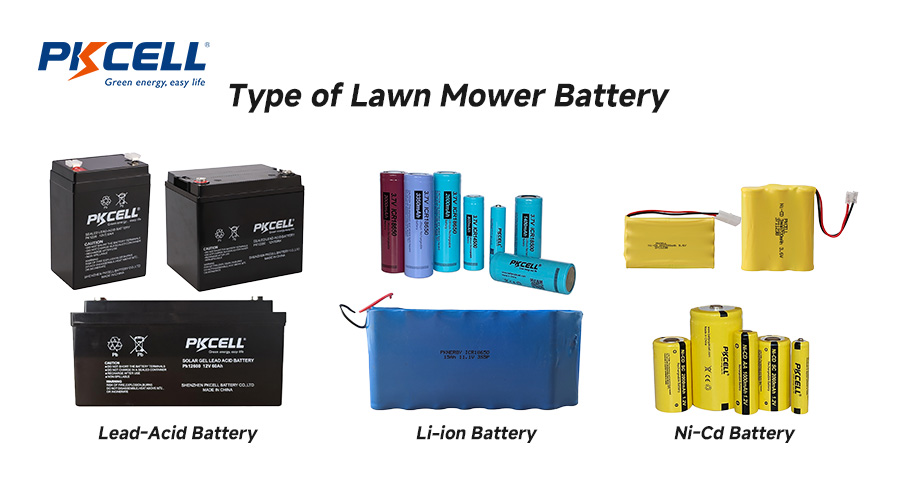
The appropriate battery depends on how the mower uses electrical power. A riding mower may need a starter battery, while a cordless electric mower uses a rechargeable pack to power its motor. Robotic mowers can use another model-specific rechargeable pack.
| Mower Type | Common Battery System | Main Requirement |
|---|---|---|
| Riding mower / lawn tractor | Lead-acid or AGM starter battery in many designs | Starting current, voltage, capacity, terminals and physical fit |
| Cordless electric mower | Rechargeable lithium-ion battery pack | Pack voltage, usable energy, discharge capability, connector, charger and protection |
| Robotic mower | Model-specific rechargeable battery pack | Voltage, capacity, dimensions, connector and charging interface |
| Older cordless equipment | NiCd or NiMH may be found in legacy designs | Original battery chemistry, voltage and charger specification |
Lithium-Ion Batteries
Lithium-ion batteries are widely used in rechargeable cordless equipment because they can provide relatively high energy in a compact package. For a mower battery pack, however, the exact cell and pack design still need to match the motor load, voltage range, charging system, protection requirements, and available space.
The advantages of lithium-ion include high energy density and lower weight compared with many traditional battery systems. For lawn equipment lithium ion batteries, the exact pack configuration should still be selected from the equipment load and operating requirements. Temperature, charging conditions, and discharge demand can still affect performance, so the exact battery specification matters.
Lead-Acid Batteries
Lead-acid batteries remain relevant for many riding mowers and lawn tractors that use a conventional starter-battery system. They are a mature technology, but they are generally heavier than lithium-ion alternatives for comparable stored energy.
When selecting a lead-acid lawn mower battery, check the required voltage, capacity, battery dimensions, terminal position, and starting requirement. Sealed lead-acid and AGM designs may have different maintenance requirements from flooded lead-acid batteries.
NiCd and NiMH Batteries
NiCd and NiMH batteries may still be found in older cordless equipment. They should be treated as model-specific replacement systems rather than assumed to be interchangeable with lithium-ion packs. If the original mower uses a nickel-based battery, verify the original chemistry and charger before selecting a replacement.
Lawn Mower Battery Voltage, Capacity and Runtime
Voltage and capacity should be evaluated together when comparing lawn mower battery options. Voltage defines the nominal electrical level of the battery system, while amp-hours (Ah) describe rated charge capacity under specified test conditions.
Key specifications to compare:
- Voltage (V): Match the mower’s specified battery voltage. Do not assume that a higher-voltage battery is a better replacement. When comparing lawn mower battery voltage, use the equipment specification rather than the number alone.
- Capacity (Ah): Indicates rated charge capacity, but Ah alone does not determine how long a mower will run.
- Energy (Wh): A useful comparison value that can be estimated from nominal voltage × rated Ah.
- Discharge capability: The pack must be able to supply the current required by the motor and control system without exceeding its specified limits.
For example, a 40V 5Ah pack has approximately 200Wh of nominal energy, while a 56V 5Ah pack has approximately 280Wh. The same Ah value therefore does not represent the same stored energy at different voltages.
Actual runtime also depends on motor power, cutting load, grass conditions, terrain, temperature, battery condition, and the mower’s control system. For this reason, a fixed Ah-to-runtime or Ah-to-lawn-size table should not be used as a universal rule.
Selection note: Do not choose a replacement solely because its Ah rating is higher. Confirm voltage and system compatibility first, then evaluate capacity, current capability, physical fit and charging requirements.
How to Choose the Right Lawn Mower Battery
If you are trying to identify what battery will work on your lawn mower, check the following specifications in order:
| Check | What to Verify |
|---|---|
| 1. Battery type | Identify whether the mower requires lithium-ion, lead-acid/AGM, NiMH, NiCd, or another specified chemistry. |
| 2. Voltage | Match the nominal battery voltage and the equipment’s permitted operating range. |
| 3. Capacity and energy | Compare Ah and, when useful, Wh against the required runtime and equipment load. |
| 4. Current requirement | Check continuous and peak current requirements, especially for motor-driven equipment. |
| 5. Battery size and interface | Confirm the lawn mower battery size, mounting method, terminals, connector, cable arrangement and polarity. |
| 6. Charger, fast charging and protection | For rechargeable lithium-ion packs, verify charger compatibility and the required protection/BMS configuration. For fast-charging lawn equipment batteries, confirm the specified charging current and charging method for the exact pack. |
Physical fit alone does not prove battery compatibility. A battery that has the correct dimensions but a different voltage, chemistry, connector, or charging requirement may not be a suitable replacement. Always check the mower documentation or original battery specification before replacing it.
Lithium-Ion vs Lead-Acid for Lawn Mowers
The better battery chemistry depends on the mower system. Lithium-ion is common for cordless electric mower packs, while lead-acid remains widely used for starter applications in riding mowers and lawn tractors.
| Feature | Lithium-Ion | Lead-Acid |
|---|---|---|
| Common mower use | Cordless electric mower and other rechargeable equipment | Riding mower and lawn tractor starting systems |
| Weight | Generally lower for comparable stored energy | Generally higher for comparable stored energy |
| Key selection factors | Voltage, capacity, discharge current, BMS, connector and charger | Voltage, capacity, starting requirement, dimensions and terminals |
Basic Charging and Storage Tips
Charging and storage should follow the battery manufacturer’s requirements. General points include:
- Use the specified charger: Do not use a charger with incompatible voltage or charging characteristics.
- Control storage conditions: Keep rechargeable batteries in conditions recommended by the manufacturer and avoid unsuitable heat or moisture.
- Follow seasonal storage guidance: If the mower will not be used for an extended period, follow the battery supplier’s recommended storage state and procedure.
For detailed lithium-ion maintenance information, see PKCELL’s guide to extending lithium-ion battery life.
PKCELL Custom Battery Pack Solutions
For lawn equipment manufacturers and OEM projects, a battery pack may need to be designed around specific voltage, capacity, dimensions, connector, protection, and application requirements. PKCELL provides customized battery pack services for rechargeable battery projects.
If you are developing cordless lawn equipment or another battery-powered product, provide the target voltage, capacity, available battery space, connector requirements, expected load, operating environment, and estimated quantity when requesting a solution.
Conclusion
The right lawn mower battery is determined by the mower’s electrical and mechanical requirements, not by capacity or price alone. The same principle applies when comparing the best lawn mower batteries for a specific equipment platform. Start with the battery type and voltage, then check capacity, energy, current capability, dimensions, connector, terminals, and charging requirements.
For modern cordless equipment, lithium-ion is a common rechargeable option, while lead-acid remains relevant for many riding mower starting systems. Matching the battery to the actual mower design is the most important step in selecting a reliable battery solution.
For OEM projects requiring a customized rechargeable battery pack, contact PKCELL with your electrical, mechanical, and application requirements.
Frequently Asked Questions
What types of batteries are used in lawn mowers?
The battery type depends on the mower. Many riding mowers use lead-acid or AGM starter batteries, while many cordless electric mowers use rechargeable lithium-ion battery packs. Older cordless equipment may use NiCd or NiMH batteries.
What voltage battery does a lawn mower need?
There is no single voltage for all lawn mowers. The correct voltage depends on the mower’s electrical design. Check the original battery label, owner’s manual, or equipment specification before selecting a replacement.
How do I know if a battery is compatible with my lawn mower?
Check the battery chemistry, voltage, capacity, current requirement, dimensions, terminals or connector, polarity, and charger requirements. Physical size alone is not enough to confirm compatibility.
Post time: Jul-09-2025


