
Battery Pack Quality Inspection Before Bulk Orders
A battery pack can pass a prototype demonstration and still create expensive problems in volume production. A hand-built sample may use the correct cells, carefully adjusted welds and extra attention from an engineer, while the bulk order depends on routine materials, operators, fixtures, firmware and production test limits. That is why battery pack quality inspection should take place before a purchase order releases full-volume production. The goal is not simply to inspect a few attractive samples. It is to prove that the approved configuration can be built, tested and traced repeatedly.
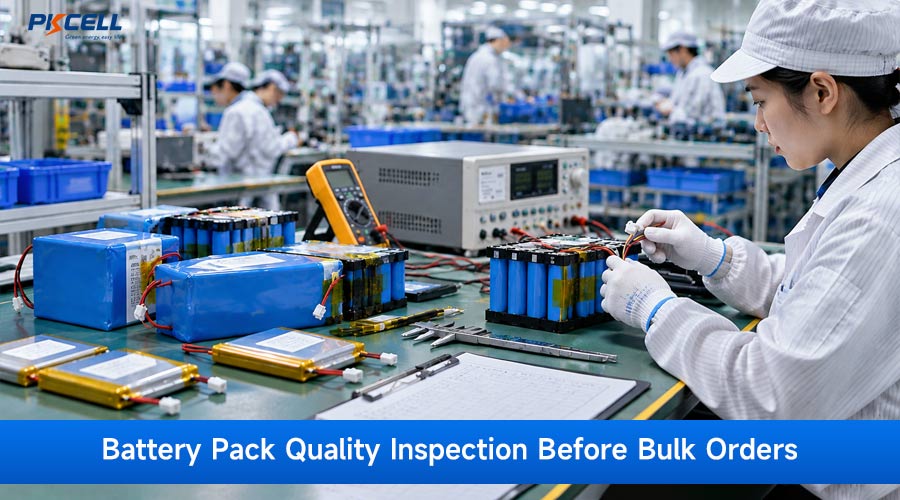
Why a Good Prototype Is Not Enough
Prototype testing answers an important question: can the proposed battery design work? A pre-production inspection answers a different question: can the supplier reproduce that design under controlled manufacturing conditions? The gap between those questions can include cell-lot variation, substituted components, connector crimping, spot-weld settings, insulation placement, BMS programming, label revisions and test-fixture accuracy. Some defects are visible; others appear only under load, after charging or inside the finished device.
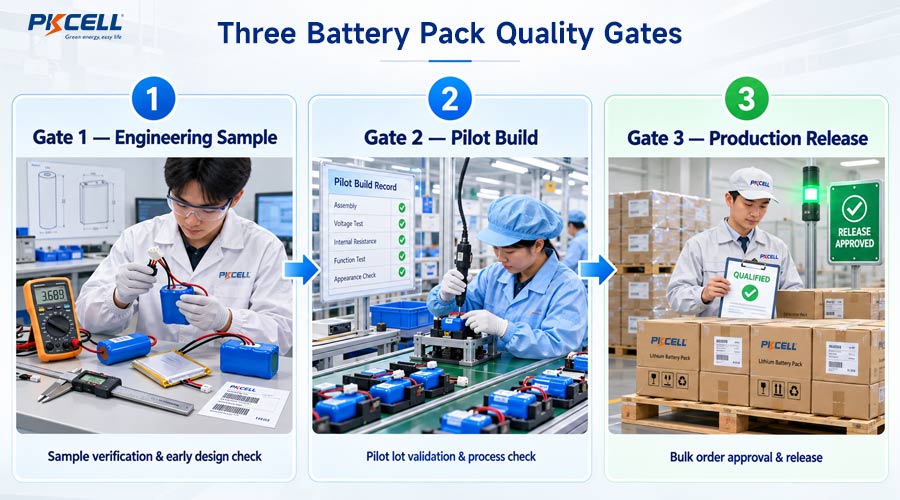
A sample should demonstrate the design. A pilot lot should demonstrate the production system.
Buyers developing a new pack should complete these checks as part of a structured custom battery pack development process. The exact inspection plan should reflect the chemistry, pack architecture, application risk, operating environment and destination market.
Build the Inspection Plan Before Requesting Samples
Inspection cannot produce a clear pass or fail result when the requirements remain open to interpretation. Before samples are ordered, convert the application needs into controlled documents and measurable limits.
Freeze the Product Definition
The approval package should identify, where applicable:
- Battery chemistry, exact cell model, manufacturer and approved alternatives
- Series and parallel configuration, nominal voltage and minimum capacity
- Continuous, peak and pulse current, including pulse duration and repetition
- BMS hardware, firmware, parameter file and communication protocol revisions
- Protection thresholds, delays, recovery behavior and temperature limits
- Connector manufacturer, part number, pinout, wire size, length and polarity
- Pack dimensions, tolerances, weight, casing, insulation and mounting features
- Label artwork, serial-number format, date code and regulatory markings
- Charger requirements, device interface and expected delivery state of charge
- Packaging, carton quantity, terminal protection and storage conditions
Do not approve a battery by model name alone. A model can contain multiple controlled elements that affect compatibility and safety. Revision status should be visible on the drawing, specification, bill of materials and test report.
Create a Golden Sample with Limits, Not Just Signatures
A golden sample is useful only when it is connected to approved documentation. Store its serial number, build date, component revisions and test results. If the sample is sealed and cannot be inspected internally, retain approved photographs or a separate sectioned reference unit showing internal construction. The golden sample should not replace dimensional tolerances or performance limits. Terms such as “same as sample” are too subjective for voltage, weld quality, connector retention or protection behavior.
Use Three Quality Gates Before Mass Production
Battery Pack Inspection Checklist
The following matrix can be adapted into a supplier quality agreement or pre-production inspection form. Test methods and acceptance limits must come from the approved project specification rather than generic values.
| Inspection Area | What to Verify | Evidence to Retain | Typical Risk |
|---|---|---|---|
| Identity and revision | Model, drawing, BOM, cell lot, BMS hardware and firmware | Configuration record and lot traceability | Unapproved material or firmware change |
| Appearance | Damage, swelling, contamination, insulation, workmanship and label | Inspection sheet and photographs | Handling damage or assembly defects |
| Dimensions and weight | Envelope, cable exit, connector position and critical tolerances | Measured results and calibrated-tool ID | Device fit or assembly interference |
| Electrical output | Polarity, open-circuit voltage, output state and communication | End-of-line test record | Reverse polarity, wrong wiring or inactive output |
| Capacity and runtime | Defined charge, rest and discharge procedure at controlled temperature | Charge-discharge curves and equipment ID | Insufficient energy or inconsistent cells |
| Load performance | Voltage sag, peak current, temperature rise and repeated pulses | Voltage, current and temperature plots | Device reset, nuisance protection or overheating |
| BMS protection | Thresholds, delays, recovery and fault response specified for the project | Functional-test report and parameter revision | Unsafe limits or unexpected shutdown |
| Interconnections | Weld pattern, conductor material, crimping, soldering and fasteners | Process parameters and destructive-test samples | Resistance growth, heat or intermittent output |
| Mechanical integrity | Connector retention, cable strain relief, enclosure and mounting points | Force-test results and visual records | Field disconnection or internal damage |
| Documentation | Specification, reports, compliance scope, packaging and storage instructions | Approved document index | Incorrect use or missing shipment records |
Inspect the Details Most Likely to Escape Visual Checks
Cell Consistency and Traceability
Record the cell manufacturer, model, production lot and relevant incoming inspection results. Voltage, capacity and resistance measurements are meaningful only when their test conditions are defined. Temperature, state of charge, rest time, fixture contact and instrument method can all affect the result. For a technical explanation of matching criteria, see battery cell matching by voltage, capacity and resistance.
Spot Welds and Current-Carrying Connections
A neat weld mark does not prove adequate fusion or mechanical strength. Production validation may combine controlled weld parameters, sample peel or pull tests, conductor inspection and electrical checks. Destructive verification should use an agreed sampling method and trained personnel; it is not a substitute for process control. PKCELL’s guide to validating spot weld quality in cylindrical battery packs provides additional detail for 18650 and 21700 assemblies.
BMS Configuration and Protection Behavior
Confirm the programmed settings, not only the BMS part number. Two packs using the same circuit board can behave differently when their firmware or parameter files differ. Inspection should verify normal operation and the specified protection responses without assuming that one threshold suits every application. Protection settings must also leave appropriate engineering headroom. Review PKCELL’s explanation of battery pack safety margins when defining normal operating targets and protection boundaries.
Connector, Polarity and Device Fit
Confirm the mating connector, keying, pin order, cable direction and strain relief. A connector family name or photograph is not a complete specification. Test the pack in the actual device or a controlled interface fixture and verify voltage at the device during its real startup and peak-load conditions.
Delivery State and Shipping Mode
If the BMS uses sleep or shipping mode, specify the expected terminal behavior and approved wake-up method. A pack showing no output should not automatically be rejected or forced awake with an improvised procedure. The receiving plan should distinguish shipping mode from low voltage, wiring faults and damage. The article on BMS shipping mode and no-output battery packs explains this receiving-inspection issue in more detail.
Set Lot Acceptance Rules Before the Purchase Order
Buyers and suppliers should agree on how the pilot lot and later production lots will be sampled. The plan should define lot size, inspection level, defect categories, acceptance criteria, test frequency and responsibility for destructive testing. Classify defects according to product risk. For example:
- Critical: conditions that may create a safety hazard, such as reversed polarity, exposed conductors or an incorrect protection configuration.
- Major: defects likely to prevent intended use, such as inadequate capacity, dimensional interference or connector retention failure.
- Minor: workmanship or cosmetic deviations that do not affect safety, function or regulatory information.
Review the Quality Evidence, Not Just the Result
A one-page statement saying “all tests passed” provides limited protection. Request enough information to connect the result to the exact product and lot. A useful pre-production evidence package may include:
- Signed drawing, specification, BOM and golden-sample record
- Pilot-lot quantity, build date and serial or lot numbers
- Incoming cell and critical-component inspection records
- Measurement results rather than pass/fail marks alone
- Charge-discharge, load and temperature curves where relevant
- BMS hardware, firmware and configuration identification
- Spot-weld, crimp, soldering or fastening process records
- Test-equipment identification and calibration status
- Nonconformance reports, root-cause analysis and corrective actions
- Packaging photographs and approved carton or label samples
PKCELL describes laboratory capabilities for electrical, mechanical, thermal, environmental and aging evaluation on its battery R&D and testing page. Buyers should confirm which project-specific tests, records and sample quantities are included in their quotation.
Confirm Compliance Scope Without Treating It as Lot Inspection
Certification and transport documentation are important, but they answer different questions from production inspection. A certificate may apply to a particular cell, battery configuration or evaluated product. It does not, by itself, prove that every unit in a new purchase lot matches the approved build. Verify the document holder, model, configuration, standard, report number and validity for the intended market. PKCELL lists certification and quality-system information on its battery certificates page. Final applicability should be confirmed for the selected cell, finished pack and end product.
Control Changes After Approval
Quality inspection loses value when components or processes can change without notification. The quality agreement should identify changes that require written approval or requalification, including:
- Cell manufacturer, model, production site or approved supplier
- BMS components, PCB layout, firmware or programmed parameters
- Connector, terminal, wire, insulation, adhesive or enclosure material
- Welding, crimping, soldering, potting or sealing process
- Production location, tooling, fixture or end-of-line test software
- Label, packaging, state of charge or transport configuration
Define notification timing, required evidence and responsibility for validation. Also agree on lot traceability, record-retention time and how affected inventory will be identified if a field problem occurs.
Questions to Ask Before Releasing the Bulk Order
- Does the pilot build use the intended production BOM and processes?
- Are all drawings, specifications and firmware revisions approved?
- Can every inspected unit be traced to its critical cell and component lots?
- Are test methods, environmental conditions and acceptance limits documented?
- Were failures investigated and corrective actions verified on new units?
- Does the evidence cover real device loads, charging and mechanical fit?
- Are compliance documents applicable to the ordered configuration?
- Are lot sampling, critical checks and inspection responsibilities agreed?
- Must material, firmware or process changes receive buyer approval?
- Are packaging, delivery state, storage and receiving instructions approved?
Request a Production-Ready Battery Pack Review
Send PKCELL your voltage, capacity, load profile, drawing, connector, temperature range, destination market, sample quantity and annual forecast. Ask for the proposed inspection plan and quotation before approving volume production. Request a Battery Pack Quote
Frequently Asked Questions
Should every battery pack receive a capacity test?
Not automatically. Full capacity testing takes time and affects production throughput. The appropriate test frequency depends on product risk, process capability, customer requirements and the agreed quality plan. Some electrical and safety-related characteristics may require 100% end-of-line verification, while longer performance tests can use controlled sampling.
What is a golden sample for a battery pack?
It is an approved reference unit linked to controlled drawings, specifications, component revisions and test results. It helps confirm construction and workmanship but should never replace measurable tolerances or written acceptance limits.
Is pre-shipment inspection the same as pre-production inspection?
No. Pre-production inspection qualifies the design, pilot process and release criteria before volume manufacturing. Pre-shipment inspection checks a completed production lot before dispatch. A robust purchasing program may use both.
Can a certificate replace battery pack quality inspection?
No. Certification or transport documentation may demonstrate that a defined configuration completed a particular evaluation. Lot inspection verifies that production units match approved requirements and workmanship. Confirm both the document scope and the production controls.
When should a buyer use a third-party inspection company?
Independent inspection can be useful for high-value orders, new suppliers, remote factories or programs requiring buyer-defined witness tests. The inspector still needs an approved specification, sampling plan, equipment list and clear acceptance criteria.
Conclusion
Effective battery pack quality inspection is a release process, not a final visual check. It connects the approved design to production materials, process controls, measured results and traceable records. By qualifying a production-intent pilot lot and agreeing on acceptance and change-control rules, buyers can identify problems while corrections are still less expensive than a rejected shipment or field failure. Prepare the checklist before requesting samples, close every critical issue before release and retain an evidence package for the approved configuration. This gives both buyer and manufacturer a clearer foundation for stable bulk production.
Post time: Oct-13-2026


