
OEM Battery Pack Enclosure Engineering
Battery Pack Ingress Protection: Water, Dust, and Condensation Design
A battery enclosure can pass a short water test and still develop moisture problems after months of temperature cycling. Water jets, fine dust, humid air, condensation, connector leakage, seal aging, pressure changes, and assembly variation are different failure mechanisms. Reliable battery pack ingress protection must address all of them as a system.
Start with a documented exposure profile and the correct enclosure test standard. Design continuous gasket compression, sealed penetrations, compatible connectors, controlled pressure equalization, dry assembly, corrosion protection, and a safe drainage strategy where appropriate. Validate the complete production-intent pack after thermal cycling, vibration, aging, cable loading, and connector use. An IP rating does not automatically prove condensation resistance, chemical resistance, corrosion durability, or lifetime sealing.
This guide explains how OEM teams can translate an outdoor or industrial environment into practical enclosure requirements. It focuses on rechargeable lithium battery packs, but the same design logic applies to many custom battery systems containing cells, a BMS, fuses, wiring, connectors, and temperature sensors.
Define the Real Environment Before Choosing an IP Rating
“Outdoor,” “waterproof,” and “dustproof” are not engineering requirements. Before selecting seals or requesting an IP rating, define how the product will actually be installed, cleaned, transported, stored, and serviced.
Create an exposure matrix that covers:
- Water source: Rain, splash, spray, hose jet, pressure washing, temporary flooding, or immersion
- Water direction: Expected installation angles, underside spray, pooling, and inverted handling
- Duration and frequency: Occasional events, repeated daily exposure, or continuous wet conditions
- Temperature: Ambient extremes, solar heating, cold soak, rapid transitions, and internal cell heat
- Dust: Particle size, concentration, conductivity, abrasiveness, and whether dust becomes mud when wet
- Chemicals: Salt, cleaning agents, oils, fuels, fertilizers, sweat, or industrial fluids
- Mechanical stress: Vibration, shock, cable pull, enclosure flex, impact, and service cycles
- Altitude and transport: Pressure changes during use, shipping, or air transport
- Maintenance: Connector mating, cover opening, gasket replacement, and field cleaning
For outdoor cameras, locks, sensors, and connected devices, PKCELL’s smart-home battery solutions highlight design considerations such as waterproofing, temperature variation, vibration, and serviceability.
Select the ingress requirement from the exposure, then prove the assembled design against that requirement.
What an IP Code Does and Does Not Mean
IEC 60529 classifies degrees of protection provided by electrical enclosures. In a two-digit IP code, the first characteristic numeral relates to access and solid foreign objects, including dust. The second relates to harmful effects from water ingress under specified tests.
| Design question | What an IP test can address | What requires additional evaluation |
|---|---|---|
| Dust entry | Protection against solid foreign objects under the selected dust test | Abrasive wear, conductive contamination, mud, salt, and long-term seal aging |
| Water entry | Protection under the selected drip, spray, jet, immersion, or other defined test | Chemicals, surfactants, hot wash, repeated field exposure, and corrosion |
| Condensation | Not automatically demonstrated by a water-ingress result | Humidity cycling, dew formation, trapped assembly moisture, and drying behavior |
| Lifetime performance | Performance of the tested configuration at the test stage | UV, thermal aging, vibration, compression set, connector wear, and service damage |
| Battery safety | Enclosure protection against specified external ingress | Cell venting, thermal propagation, pressure release, insulation, and electrical protection |
For road-vehicle electrical equipment, ISO 20653:2023 specifies IP-code protection against foreign objects, water, and access, with tests for confirming the relevant degree. Choose the standard that applies to the product and market rather than treating all similarly named IP tests as interchangeable.
Design the Main Enclosure Seal as a Controlled Joint
A gasket is only one part of a sealing system. Reliable performance depends on the cover, base, groove, flange, fasteners, stiffness, tolerances, surface finish, material, assembly process, and environmental aging.
Control gasket compression
Too little compression can leave leak paths. Too much compression can damage the gasket, distort the housing, increase assembly force, or create long-term compression-set problems. Compression stops or hard stops can help control the final joint geometry when properly designed.
- Gasket cross-section and groove geometry
- Minimum and maximum compression across tolerance stack-up
- Cover and base flatness
- Fastener location, spacing, torque, and tightening sequence
- Corner radii and transitions
- Housing creep, flange bowing, and local stiffness
- Compression set after temperature and time
- Material compatibility with cleaners, oils, salt, and other fluids
Parker notes that physical validation remains necessary even when seal contact pressure and compression stack-up are modeled. Simulation can screen concepts, but it does not replace testing of molded parts, production gaskets, and actual assembly conditions.
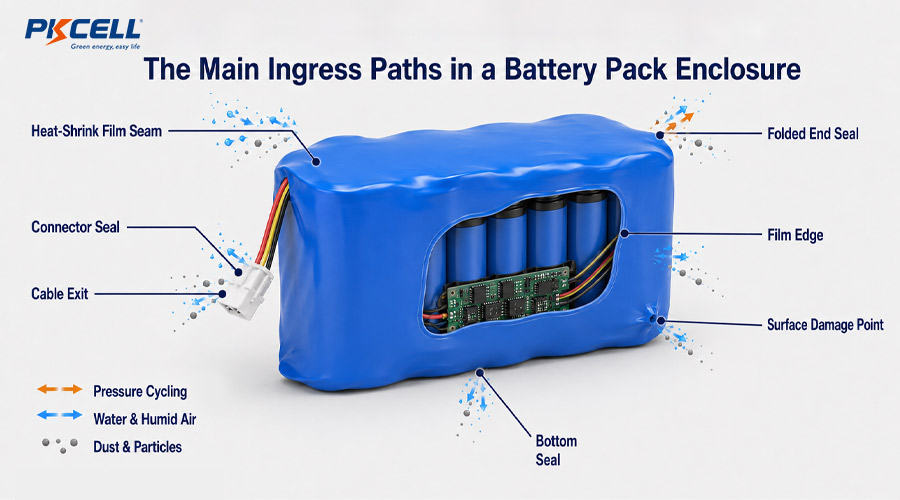
Every Penetration Is a Potential Leak Path
Battery housings rarely consist of one uninterrupted sealed shell. The ingress review should include every feature crossing or interrupting the enclosure boundary.
- Power and communication connectors
- Cable glands, pigtails, and strain reliefs
- Pressure-equalization vents
- Fasteners and threaded inserts
- Indicator windows, switches, and buttons
- Charge ports and service covers
- Welded, bonded, or heat-staked seams
- Drain features and valves
- Labels or membranes covering functional openings
Connectors must be rated in the actual mating state
A sealed connector may provide its intended protection only when fully mated with the correct counterpart, seals, cavity plugs, wire range, and assembly process. Define whether the product must remain protected while connected, disconnected, capped, charging, or being serviced.
Wire seals and cable glands must match the production cable’s outer diameter, insulation material, roundness, and surface. Pulling or bending the cable can disturb a seal that passed a static test, so cable-load and flex tests should be included where relevant.
PKCELL’s custom battery pack service supports configurable pack structures, wires, cables, connectors, terminations, and protection options for different device environments.
Pressure Equalization Protects the Seals
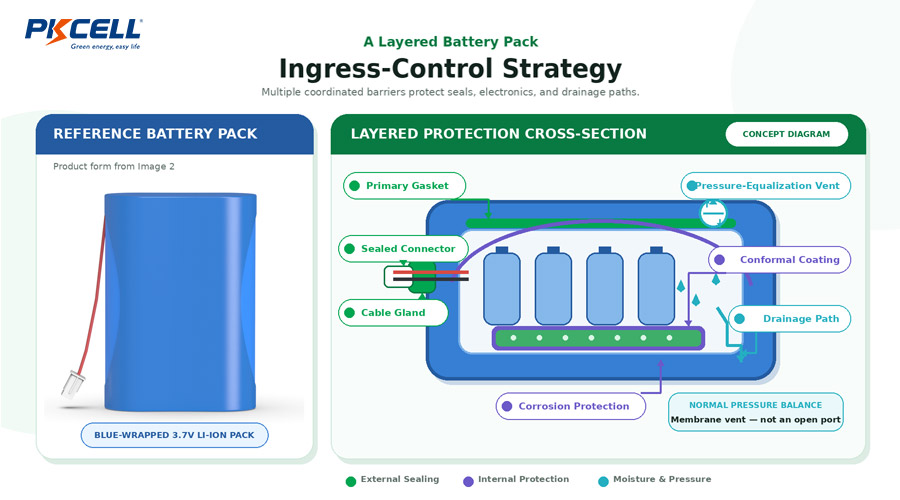
A nominally sealed enclosure experiences pressure changes as internal air heats and cools, altitude changes, or the pack generates heat during charge and discharge. Pressure differential can load gaskets, bonded seams, connector seals, and thin housing walls. It can also drive air and moisture through small leak paths during repeated cycles.
A qualified protective vent can allow controlled gas exchange while resisting specified contaminants. Vent selection should consider:
- Enclosure free volume
- Temperature-change rate
- Required pressure-equalization time
- Membrane airflow and water-entry performance
- Dust, oil, salt, cleaning-fluid, and chemical exposure
- Mounting orientation and risk of standing water
- Adhesive, snap-fit, or threaded installation process
- Long-term contamination and membrane damage
Gore describes pressure equalization as a way to reduce stress on sealed battery enclosures and notes that vent type, enclosure size, and application conditions affect performance. A vent should be engineered as part of the complete housing rather than added after seal failures appear.
Pressure equalization is not the same as emergency venting
A breathable membrane designed for normal thermal cycling may not provide the flow area or opening behavior needed during an abnormal cell gas-release event. Battery safety analysis must separately address cell vents, gas pathways, emergency pressure release, ignition risk, propagation, and the direction of any discharged material.
PKCELL’s battery pack technology and BMS capabilities provide context for thermal management, temperature monitoring, protection, and application-specific pack design.
Why Condensation Can Appear Inside a Sealed Pack
Condensation occurs when a surface falls below the dew point of the surrounding air. Moisture can already be trapped during assembly, enter through a leak, permeate through materials, or be exchanged during pressure cycles. A pack can therefore contain liquid water even without a visible external leak during the event.
- A warm, humid pack cooling rapidly overnight
- A cold-soaked product entering warm humid air
- Solar heating followed by rain or nighttime cooling
- Repeated charge and discharge heating cycles
- Wet assembly parts or high-humidity air trapped during closure
- Pressure-driven moisture exchange through small leak paths
Condensation-control options
- Dry assembly: Control component dryness, wash-process residue, ambient humidity, and time before enclosure closure.
- Pressure equalization: Reduce pressure stress and uncontrolled breathing through weak seals.
- Thermal design: Reduce cold surfaces and steep internal gradients where practical.
- Drainage: Direct liquid away from cells, BMS electronics, terminals, and insulation-critical areas.
- Conformal coating: Protect qualified PCB areas from moisture and contamination while controlling keep-out zones.
- Potting or encapsulation: Add local protection where serviceability, thermal stress, mass, and rework tradeoffs are acceptable.
- Desiccant: Use only with a calculated moisture capacity, life, packaging process, and replacement strategy.
- Material selection: Use corrosion-resistant metals, finishes, and compatible polymers.
Henkel describes conformal coatings as protection for circuit boards in harsh environments and gasketing as a means of sealing battery housings against environmental influences and fluids. These measures are secondary layers; they should complement rather than excuse a poor enclosure boundary.
Need an enclosure concept for an outdoor battery pack?
Send PKCELL your application, pack configuration, installation orientation, water and dust exposure, temperature range, connector requirements, dimensions, service needs, volume, and target certifications.
Drainage: Keep Water Away From Critical Areas
Some products are designed to exclude all liquid under the specified exposure. Others benefit from controlled drainage as a secondary defense. Drain features must be evaluated carefully because an opening that releases condensate can also admit dust, insects, splash, or pressurized water.
- Define the permitted mounting orientations.
- Place drains at real low points, including tolerance and installation variation.
- Keep water paths away from cells, busbars, fuses, BMS, and connectors.
- Avoid pockets created by ribs, foam, labels, wires, or cell holders.
- Prevent capillary traps between overlapping parts.
- Check blockage by dust, mud, ice, adhesive, or debris.
- Retest the required enclosure protection with the drain installed.
Balance Ingress Protection With Thermal Design
Sealing the pack can reduce natural airflow and trap heat. Higher temperature can accelerate aging, raise internal pressure, soften materials, change gasket behavior, and increase the need for derating. Thermal and ingress design should therefore be developed together.
- Cell and BMS losses during maximum continuous and pulse loads
- Heat paths through holders, thermal pads, enclosure walls, and mounting points
- Solar load and hot-surface installation
- Insulating effects of potting, foam, coatings, and double-wall housings
- Vent airflow versus the required contaminant barrier
- NTC placement and temperature-response delay
- Charge and discharge derating under sealed hot conditions
Available cell formats and example pack configurations can be reviewed in PKCELL’s rechargeable battery product range and OEM lithium-ion battery pack options.
Validate the Complete Production-Intent Pack
An empty enclosure test is useful for development, but the release test should represent the finished product. Cells, foam, wiring, connectors, labels, vents, fasteners, potting, PCB heat, and assembly forces can change housing deformation, pressure response, drainage, and leak paths.
- Define the exposure specification. Record water, dust, humidity, temperature, pressure, chemicals, orientation, duration, cleaning, and service conditions.
- Select applicable standards and tests. Confirm the IP code, vehicle requirements, customer specifications, and any chemical or corrosion tests.
- Map the enclosure boundary. Identify every seam, connector, cable, vent, fastener, window, valve, and drain.
- Design sealing and pressure management. Control gasket compression, penetrations, housing stiffness, vent performance, and emergency pressure strategy.
- Control internal moisture. Define dry assembly, coatings, drainage, material compatibility, and condensation mitigation.
- Build production-intent samples. Use intended parts, gasket lots, cables, connectors, fasteners, vents, coatings, tooling, and assembly instructions.
- Precondition before ingress testing. Apply relevant thermal aging, humidity, vibration, shock, cable pull, connector cycles, UV, and chemical exposure.
- Run required dust and water tests. Test all defined orientations, connector states, caps, operating modes, and test sequences.
- Run condensation and pressure-cycle tests. Measure internal humidity, liquid formation, drying, corrosion, electrical leakage, and pressure response.
- Inspect systematically. Locate ingress paths, water marks, seal displacement, corrosion, coating defects, and vent contamination.
- Repeat after corrective changes. Revalidate changes to housings, seals, vents, connectors, cables, coatings, fasteners, or assembly parameters.
- Correlate production leak tests. Link factory leak tests to the qualified ingress performance.
Production Controls That Preserve the Seal
- Incoming inspection for gaskets, vents, cables, seals, housings, and connectors
- Controlled cleanliness of gasket grooves and sealing surfaces
- Gasket presence, orientation, splice, and damage inspection
- Fastener torque, angle, sequence, and tool calibration
- Adhesive quantity, cure time, surface preparation, and environmental limits
- Cable-gland torque, cable diameter, insertion depth, and strain relief
- Vent placement, adhesion, installation force, and contamination protection
- In-line leak testing with calibrated limits and reference standards
- Traceability for enclosure, gasket, vent, connector, and assembly process
- Periodic destructive audits and environmental requalification
Leak-test limits should be correlated with known-good and known-defect units. A pressure-decay number is useful only when the fixture, stabilization time, temperature, pack compliance, test pressure, and reject threshold are controlled.
Common Ingress-Protection Mistakes
- Selecting an IP rating before defining the actual exposure
- Calling a product “waterproof” without naming a standard and test configuration
- Assuming an IP result proves condensation, corrosion, or chemical resistance
- Testing an empty housing instead of the production-intent battery pack
- Ignoring connector protection when unmated, charging, or serviced
- Calculating gasket compression without full molding and assembly tolerances
- Using fastener torque alone to compensate for a flexible flange
- Adding a vent without sizing airflow and checking contamination exposure
- Treating a pressure-equalization vent as an emergency gas-release device
- Using desiccant without a moisture-capacity and service-life calculation
- Potting electronics without checking heat, stress, rework, and trapped moisture
- Skipping thermal cycling, vibration, cable pull, and connector aging
- Changing materials or suppliers without requalification
What to Include in a Custom Battery Pack Inquiry
- Product application, target market, installation location, and orientation
- Required IP code and applicable standard or customer test specification
- Expected rain, spray, immersion, wash, dust, mud, salt, and chemical exposure
- Operating, charging, storage, and transport temperature ranges
- Altitude, pressure-cycle, humidity, and condensation conditions
- Pack voltage, capacity, cell configuration, current, and heat generation
- Maximum enclosure dimensions, mounting method, and weight target
- Connector, cable, vent, switch, indicator, and service-access requirements
- Cooling, heating, potting, coating, and drainage preferences
- Prototype quantity, annual volume, launch schedule, and certifications
Frequently Asked Questions
Does an IP67 battery pack prevent condensation?
Not automatically. An IP result addresses specified solid-object and water-ingress tests. Condensation can form from moisture already inside the enclosure or from humidity and pressure cycles. It requires separate humidity, temperature-cycle, material, venting, and drainage analysis.
Is IP68 always better than IP67?
IPX8 immersion conditions are specified by agreement and should be evaluated against the real product exposure. A higher numeral does not eliminate the need to define water jets, cleaning, duration, depth, temperature, orientation, and aging tests.
Why does a sealed battery enclosure need a vent?
Temperature and altitude changes can create pressure differentials that load seals and housing walls. A qualified protective vent can equalize normal pressure while providing a defined contaminant barrier. It must be sized and validated for the enclosure and exposure.
Can conformal coating replace a sealed enclosure?
Usually not. Conformal coating can protect qualified PCB areas as a secondary defense, but it does not protect every cell, busbar, connector, fuse, or exposed interface. Coating coverage, adhesion, cure, keep-out areas, repair, and compatibility also require validation.
How should battery-pack sealing be tested in production?
Use a leak-test method and limits correlated with the qualified environmental performance. Control fixture volume, stabilization, temperature, pack compliance, test pressure, cycle time, reference artifacts, calibration, and traceability.
What certifications and compliance documents can PKCELL support?
PKCELL operates quality and environmental management systems including ISO 9001 and ISO 14001. Depending on the exact cell, battery-pack design, destination market, and project scope, available product or transport support may include UL 1642, CB/IEC 62133, CE, RoHS, REACH, UN 38.3, MSDS, KC, PSE, UKCA, and other project-specific documents.
Certification coverage must be confirmed for the exact production configuration. Review PKCELL’s battery certificates and compliance information and include the target market and required standards in the RFQ.
What is PKCELL’s manufacturing capacity for bulk battery orders?
PKCELL’s published company information describes a 28,000 m² manufacturing facility, more than 20 automated production lines, and a professional team of more than 400 people. Current public product content cites annual production capacity of up to 500 million battery units.
Available capacity for a specific ingress-protected pack depends on the cells, housing, seals, vent, BMS, assembly, leak testing, certification, and forecast. Buyers should request a project-specific capacity and delivery review.
How can I get a bulk price for an ingress-protected battery pack?
Provide the chemistry, nominal voltage, capacity, current, dimensions, S/P configuration, target IP code and standard, installation orientation, water and dust exposure, connector, wire, BMS, NTC, annual quantity, first-order quantity, destination country, certification requirements, and requested Incoterm.
What is the MOQ, and can buyers order samples before production?
Samples are available for evaluation, subject to the selected product and project status. Some PKCELL product pages state a minimum formal-order value starting from USD 500, but the actual MOQ depends on the battery model, customized parts, tooling, certification, sealing process, and production requirements.
Ask for separate sample, pilot-build, and mass-production quantities so ingress and device validation can be completed before volume release.
Can PKCELL provide a custom IP-rated battery pack?
PKCELL can support custom structures, casings, wires, connectors, PCM/BMS, NTCs, seals, vents, and environmental design. The inquiry should state the required IP code, applicable standard edition, connector state, mounting orientation, water depth or jet exposure, dust conditions, condensation cycles, chemicals, and preconditioning tests.
The agreed rating should be validated on the complete production-intent pack, not inferred from the enclosure material alone.
What quality checks should a buyer request for a bulk order?
Define incoming-cell inspection, cell traceability, electrical checks, BMS functional testing, aging, final inspection, sealing-process controls, gasket and vent traceability, and a production leak test correlated with the qualified ingress result.
The quality agreement should also define sampling plans, acceptance criteria, change notification, certificate retention, lot traceability, and corrective-action expectations.
Conclusion: Design for the Environment, Not Just the IP Label
Battery pack ingress protection is a layered engineering problem. The external barrier must resist defined dust and water exposure, penetrations must remain sealed under mechanical use, pressure must be managed, internal moisture must be controlled, and any condensate must be kept away from critical electrical areas. Validate these functions after realistic aging and preserve them with correlated production controls.
Develop a Custom Battery Pack for Harsh Environments
Share your pack requirements, exposure profile, enclosure space, connector, temperature range, current, installation, volume, and compliance targets with PKCELL. Our engineering team can help evaluate cells, BMS, wiring, housing, ingress protection, and prototype testing.
Post time: Aug-10-2026


