
OEM Lithium Battery Pack Engineering
Battery Cell Matching: Voltage, Capacity, and Internal Resistance Criteria
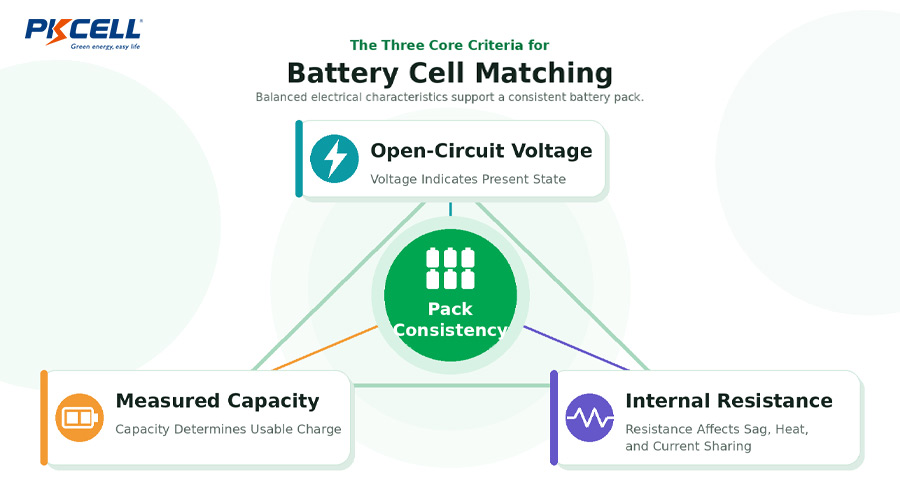
Battery cell matching is the process of selecting cells that behave closely enough to operate as one pack. Matching only open-circuit voltage is not sufficient: cells with similar voltage can still have different usable capacity, internal resistance, self-discharge, age, or load response.
Match cells by exact model and history first, then compare open-circuit voltage, measured capacity, and internal resistance under controlled and identical conditions. Use absolute acceptance limits to reject unsuitable cells and tighter within-group limits to build consistent series and parallel groups. Confirm the result with pack-level voltage, load, thermal, balancing, and aging tests. A BMS can manage limited state-of-charge imbalance, but it cannot repair a low-capacity or high-resistance cell.
There is no universal rule such as “within a fixed number of millivolts, milliamp-hours, or milliohms” that applies to every lithium-ion chemistry, cell size, test instrument, pack architecture, and load profile. OEM criteria should be derived from the approved cell specification, measurement capability, pilot-lot distributions, system limits, warranty target, and validated production pack.
Start With Cell Identity and History
Electrical sorting should not be used to justify mixing fundamentally different cells. Before measuring voltage, capacity, or resistance, confirm that cells belong to the approved production population.
- Manufacturer and exact model: Similar dimensions or nominal ratings do not make cells equivalent.
- Chemistry and voltage window: Charge voltage, discharge cutoff, and behavior must match.
- Grade and approved supplier: Use the qualified product and supply channel.
- Production lot and date code: Lot control supports consistency, investigation, and change management.
- Storage and handling history: Time, temperature, SOC, and transport conditions can affect results.
- Cycle history: Do not mix new cells with used cells or cells of unknown history in an OEM production pack.
- Physical condition: Reject cells with damage, corrosion, contamination, deformation, sleeve defects, or abnormal terminals.
Cell format selection is also part of the design. PKCELL’s 21700 vs. 18650 comparison can support early format screening, but matching must always use data from the exact approved cell model.
Matching narrows variation within an approved cell population; it does not make unlike cells interchangeable.
Criterion 1: Open-Circuit Voltage
Open-circuit voltage (OCV) is the cell voltage measured without an external load. It is useful for checking state consistency, conditioning cells before assembly, and identifying abnormal self-discharge when measured over a controlled time interval.
Measure OCV only after controlled conditioning
A cell’s terminal voltage immediately after charging or discharging includes relaxation effects. To compare cells meaningfully, use the same:
- Charge or discharge procedure
- Target SOC or conditioning endpoint
- Rest duration before measurement
- Ambient and cell temperature
- Instrument, range, fixture, and contact method
- Measurement sequence and time window
Hioki notes that lithium-ion OCV varies with temperature and that controlled timing is important when OCV change is used to detect abnormal self-discharge. A single voltage reading confirms neither capacity nor long-term stability.
Use OCV change to screen self-discharge
After equal conditioning, measure OCV at a defined initial time and again after a specified aging interval. Cells whose voltage falls abnormally relative to the qualified population may require quarantine and investigation.
The limit should account for instrument uncertainty, temperature variation, fixture repeatability, normal cell distribution, and the cell supplier’s requirements. Different chemistries also have different OCV-versus-SOC curves, so the same voltage spread does not always imply the same SOC spread.
Criterion 2: Measured Capacity
Capacity matching helps series-connected groups reach their charge and discharge endpoints at similar times. A lower-capacity cell or parallel group can limit the usable capacity of the full series string because the BMS must protect the first group that reaches a voltage limit.
Capacity results are comparable only when the complete test method is standardized:
- Charge current, maximum voltage, CV termination, and rest time
- Discharge current or C-rate
- Discharge cutoff voltage
- Cell temperature and chamber conditions
- Rest periods between charge and discharge
- Tester calibration, channel accuracy, and connection resistance
- Number of conditioning cycles before the recorded result
A gentle room-temperature capacity test may be suitable for production grading but may not predict usable capacity at high load, cold temperature, or the product’s earlier cutoff. OEM validation should therefore include the real duty cycle in addition to the standardized sorting test.
Match parallel-group totals, not just individual cells
In an S/P pack, the capacity of each parallel group is approximately the sum of its cells. The series string is then constrained by the group with the lowest usable capacity.
Cells can be distributed so parallel groups have closely matched total capacity when permitted by the validated process. However, this should not be used to hide a clearly abnormal cell. Every individual cell must first pass its absolute quality limits.
Criterion 3: Internal Resistance
Internal resistance affects voltage sag, resistive heat, efficiency, and current sharing. In a series string, the same current flows through every group, so a higher-resistance group experiences more voltage drop and heat. In parallel, branches with different total impedance may initially carry different currents.
Resistance is not one fixed cell property. It changes with temperature, SOC, age, chemistry, and measurement method. AC internal resistance at a specified frequency, DC resistance from a defined current pulse, and electrochemical impedance spectroscopy are different measurements.
Hioki recommends four-terminal measurement for low resistance because a two-terminal method includes lead and contact resistance. For cell matching, use the same instrument type, fixture, contact pressure, AC frequency or DC pulse profile, SOC, temperature, rest time, and calculation window.
Resistance matching should therefore be tied to the product’s real load profile and thermal limits rather than treated as an isolated incoming-inspection number.
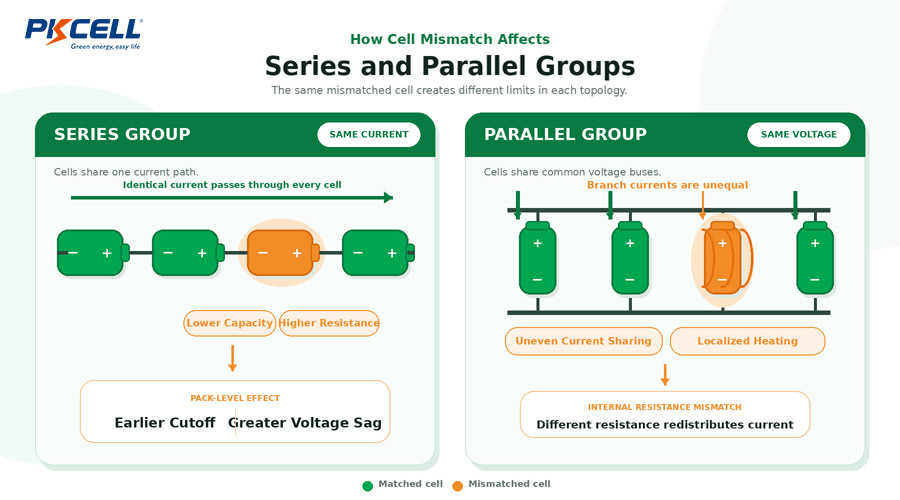
How Mismatch Behaves in Series and Parallel Packs
| Mismatch | Series-connected effect | Parallel-connected effect | What the BMS can do |
|---|---|---|---|
| OCV or SOC difference | Groups reach charge or discharge limits at different times | Connection can cause equalization current if voltages differ | Balancing may reduce limited SOC differences after safe assembly |
| Capacity difference | Lowest-capacity group can determine usable string capacity | Group capacity is shared, but individual cycling may differ | Cannot restore missing cell capacity |
| Resistance difference | Higher-resistance group shows more sag and heat at the same current | Lower-impedance branches may initially carry more current | Cannot remove cell or connection resistance |
| Self-discharge difference | Affected group drifts lower during storage | Neighboring cells may feed the abnormal branch | May detect imbalance, but cannot repair the root defect |
| Temperature difference | Changes resistance, capacity, aging, and voltage response by location | Can disturb branch current sharing | Can monitor or derate only where sensing and logic provide coverage |
Texas Instruments identifies capacity mismatch, impedance imbalance, manufacturing variation, and temperature gradients as contributors to cell imbalance. This is why cell sorting, pack layout, interconnect symmetry, cooling, and BMS design must be treated as one system.
Why the BMS Does Not Replace Cell Matching
Cell balancing helps align state of charge between series groups so they approach the top or bottom of the operating window more consistently. It is valuable, but its current, operating window, time, and thermal limits are finite.
A BMS cannot:
- Add capacity to a weak cell
- Reduce abnormal internal resistance
- Repair high-resistance welds or connectors
- Stop an internally defective cell from self-discharging
- Make cells of different chemistry or voltage limits compatible
- Eliminate thermal gradients created by the enclosure or cooling system
PKCELL’s battery pack technology and BMS capabilities cover balancing, temperature monitoring, protection, and communication options.
Need cell selection and matching support for an OEM pack?
Send PKCELL your cell preference, pack voltage, capacity, load profile, runtime, operating temperature, enclosure, annual volume, and certification requirements. The engineering team can review cell selection, S/P configuration, BMS, matching criteria, and prototype validation.
Set Two Types of Matching Limits
Absolute acceptance limits
Absolute limits determine whether an individual cell is suitable for the project at all. They may cover:
- Minimum measured capacity
- Maximum internal resistance under the defined method
- Permitted OCV range after conditioning
- Maximum OCV decay or self-discharge over the aging interval
- Physical appearance, dimensions, mass, and terminal condition
- Traceability, lot, date code, and approved supplier status
Within-group matching limits
Cells that pass individually may still be too widely spread to build one consistent pack. Within-group limits control the maximum range or statistical spread of OCV, capacity, and resistance among cells assigned to the same pack or parallel group.
Both limits should include measurement uncertainty. If the tester and fixture cannot reliably distinguish the proposed tolerance, the matching specification is not production-capable. Perform measurement-system analysis before making the sorting bands tighter than the process can support.
A Practical Cell-Matching Data Structure
| Data field | Purpose | Control requirement |
|---|---|---|
| Cell serial or trace code | Links all measurements and assembly position | Unique and machine-readable where practical |
| Model, lot, and date code | Controls approved population and investigations | Prevent unintended mixing |
| Conditioning state | Provides measurement context | Same procedure, SOC, rest, and temperature |
| Initial and aged OCV | Checks state consistency and self-discharge | Controlled time interval and temperature |
| Measured capacity | Supports grading and group-capacity balance | Defined charge/discharge protocol |
| AC-IR or DC-IR | Supports power, heat, and consistency screening | One defined method and controlled fixture |
| Bin or grade assignment | Guides pack grouping | Validated rules and revision control |
| Pack and physical position | Supports field and process analysis | Maintain cell-to-pack genealogy |
A Production Cell-Matching Workflow
- Verify identity and appearance. Confirm the approved model, supplier, lot, date code, dimensions, insulation, and terminal condition.
- Condition cells consistently. Use the defined charge or discharge procedure, SOC target, temperature, and rest time.
- Measure initial OCV. Record temperature, time, instrument, and fixture.
- Run the aging or self-discharge screen. Store cells under controlled conditions and measure OCV again at the specified interval.
- Measure internal resistance. Use the approved AC-IR or DC-IR method with controlled SOC, temperature, timing, and four-wire contacts where applicable.
- Test capacity. Apply the qualified charge, rest, discharge, and cutoff protocol.
- Apply absolute limits. Quarantine or reject cells that fail any required criterion.
- Assign matching bins. Group passing cells using validated OCV, capacity, and resistance bands.
- Balance parallel-group totals. Build groups with controlled total capacity and resistance distribution without hiding abnormal cells.
- Record assembly genealogy. Link each cell and its data to the pack and physical position.
- Test the assembled pack. Verify group voltages, pack resistance, BMS readings, balancing, capacity, load response, and temperature distribution.
- Audit and improve limits. Use production, reliability, and field data to maintain capable screening criteria.
PKCELL’s custom battery pack service supports application-specific cell selection, configuration, structure, wiring, connectors, protection, and prototype testing. OEM pack options are also available through the custom lithium-ion battery pack range.
Validate the Pack After Matching
Cell data does not capture every resistance or thermal effect introduced during assembly. Welds, busbars, fuses, connectors, BMS MOSFETs, PCB traces, compression, cooling, and sensor placement can create new differences.
- Individual series-group voltage before and after charge
- Voltage spread during maximum continuous and pulse loads
- Usable capacity and energy to the product cutoff
- Pack and group resistance or load-response checks
- Cell, weld, connector, fuse, and BMS temperature mapping
- Current sharing where parallel branches can be instrumented
- Balancing start, stop, duration, and temperature behavior
- Charge and discharge at ambient-temperature limits
- Storage drift and self-discharge after pack assembly
- Aged or end-of-life load performance
OEM teams can review PKCELL’s battery development workflow for consumer electronics, including requirements, cell selection, BMS and structural design, prototyping, testing, and production support.
Common Cell-Matching Mistakes
- Matching by resting voltage alone
- Mixing cell models, chemistries, suppliers, grades, lots, or ages
- Combining new cells with used or reclaimed cells
- Comparing OCV before cells have rested for the same duration
- Ignoring temperature during voltage and resistance measurements
- Comparing AC-IR with DC-IR or using different test frequencies
- Using two-wire resistance readings dominated by contact resistance
- Testing capacity with different currents, cutoffs, or channel calibration
- Using group averages to hide one abnormal cell
- Assuming the BMS can correct capacity or resistance mismatch
- Ignoring self-discharge because initial voltage was acceptable
- Skipping pack-level load and thermal validation after cell sorting
- Creating tolerances tighter than the measurement system can resolve
- Failing to maintain cell-to-pack traceability
What to Include in a Custom Battery Pack Inquiry
- Application, target markets, and expected operating life
- Required pack voltage, capacity, energy, and S/P configuration
- Continuous, peak, startup, and charging currents
- Pulse duration, repetition rate, and device cutoff voltage
- Operating, charging, and storage temperatures
- Available space, weight target, enclosure, and cooling conditions
- Preferred cell model or required chemistry and format
- BMS, balancing, communication, NTC, connector, and wire requirements
- Prototype quantity, annual production volume, and launch schedule
- Transport, safety, quality, and product certification requirements
Available cells and pack examples can be reviewed in PKCELL’s rechargeable battery product range.
Frequently Asked Questions
How closely should battery cell voltages match?
The limit depends on chemistry, SOC, temperature, rest time, instrument accuracy, assembly process, and pack architecture. Define an absolute OCV acceptance range and a tighter within-pack spread using validated data from the exact cell and application.
Can cells with the same voltage have different capacities?
Yes. OCV indicates present electrical state under specific conditions, not how much usable charge a cell will deliver. Capacity requires a controlled charge-discharge test.
Which is more important: capacity or internal resistance?
Both matter. Capacity affects usable energy and endpoint timing, while resistance affects voltage sag, heat, efficiency, and current sharing. The priority and tolerance depend on whether the product is energy-focused, power-focused, or both.
Can a BMS balance mismatched cells?
A BMS can reduce limited SOC differences between series groups. It cannot restore lost capacity, lower internal resistance, repair self-discharge, or make incompatible cells safe to combine.
Should cells in parallel be matched?
Yes. Parallel cells share terminal voltage, but differences in capacity, resistance, temperature, and branch connections can produce unequal current and aging. Use qualified individual cells and control total group characteristics and interconnect symmetry.
What certifications and compliance documents can PKCELL support?
PKCELL operates quality and environmental management systems including ISO 9001 and ISO 14001. Depending on the exact cell, battery-pack configuration, target market, and project scope, available product or transport support may include UL 1642, CB/IEC 62133, CE, RoHS, REACH, UN 38.3, MSDS, KC, PSE, UKCA, and other project-specific documents.
Certification coverage must be confirmed for the exact production design. Review PKCELL’s battery certificates and compliance information and list the required standards in the RFQ.
What is PKCELL’s manufacturing capacity for bulk battery orders?
PKCELL’s published company information describes a 28,000 m² manufacturing facility, more than 20 automated production lines, and a professional team of more than 400 people. Current public product content cites annual production capacity of up to 500 million battery units.
Available capacity for a matched custom pack depends on the cell model, grading tests, S/P configuration, BMS, assembly, aging, certification, and forecast. Buyers should request a project-specific production-capacity and delivery review.
How can I get a bulk quote for a cell-matched battery pack?
Provide the application, chemistry, preferred cell model, nominal voltage, capacity, S/P configuration, continuous and peak current, operating temperature, dimensions, BMS, connector, wire, certification requirements, annual forecast, first-order quantity, destination country, and requested Incoterm.
If your project has defined OCV, capacity, AC-IR, DC-IR, self-discharge, lot-control, or traceability limits, include the test method and acceptance criteria.
What is the MOQ, and can buyers evaluate samples first?
Samples are available for evaluation, subject to the selected product and project status. Some PKCELL product pages state a minimum formal-order value starting from USD 500, while the actual MOQ depends on the cell model, matching requirements, custom BMS, enclosure, tooling, certification, and production process.
Ask for separate sample, pilot-build, and mass-production quantities so cell data and pack performance can be reviewed before volume release.
Can PKCELL customize cell-matching limits for an OEM project?
Yes. Matching rules can be developed around the approved cell specification, application load, temperature range, measurement capability, pilot-lot distribution, pack architecture, and warranty target.
The purchase specification should define conditioning SOC, rest time, temperature, OCV timing, capacity protocol, AC-IR or DC-IR method, absolute rejection limits, within-pack spread, and required data retention.
What cell-matching records should a bulk buyer request?
Request cell model, supplier, lot and date code, trace ID, conditioning status, initial and aged OCV, capacity result, resistance result and test method, bin assignment, pack serial number, and physical group position.
The quality agreement should also define tester calibration, measurement-system analysis, inspection requirements, data-retention period, change notification, nonconformance handling, and pack-level validation records.
Conclusion: Match Cells as a Measured System
Reliable battery cell matching combines identity control, OCV and self-discharge screening, standardized capacity testing, controlled resistance measurement, statistical grouping, and pack-level validation. No single number proves that cells belong together. The criteria must reflect the exact cell, measurement method, pack configuration, duty cycle, thermal design, BMS, and production capability.
Develop a More Consistent Custom Battery Pack
Share your voltage, capacity, load profile, cell preference, enclosure, temperature range, volume, and compliance requirements with PKCELL. Our engineering team can help evaluate cell selection, matching, BMS design, pack construction, and prototype validation.
Post time: Aug-10-2026


