
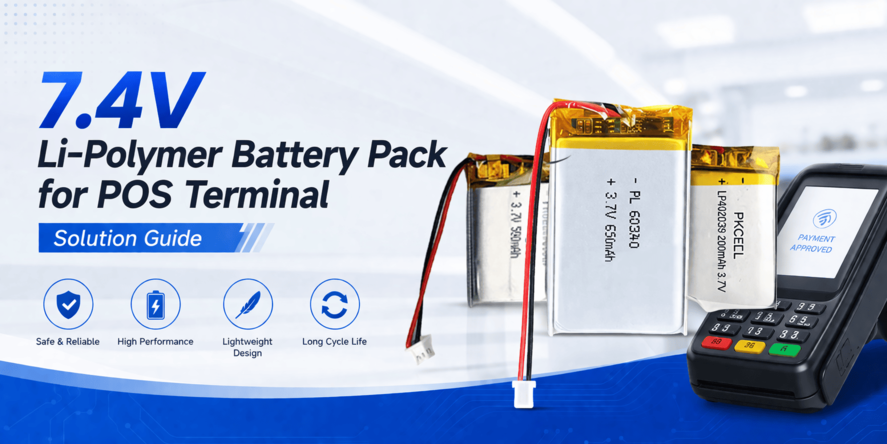
Modern handheld POS terminals integrate touchscreen displays, thermal printers, wireless communication modules, and embedded processors into compact portable housings. Because these subsystems generate continuous and peak power demand simultaneously, selecting the correct battery architecture is one of the most important design decisions in POS terminal development.
This guide explains how POS terminal power requirements determine battery selection and why dual-cell Li-polymer battery packs are widely adopted in portable payment systems.
Power Requirements of Modern Handheld POS Terminals
Today’s smart POS terminals function as compact mobile computing platforms. The thermal printer and wireless modules inside the POS terminals create the highest peak current demand.
As a result, battery packs designed for POS terminals must support both steady background consumption and short-duration high-current bursts without voltage instability.
Why Most POS Terminals Use 7.4V Battery Packs Instead of 3.7V
One of the most common engineering questions during handheld POS terminal design is whether a single-cell 3.7V battery is sufficient.
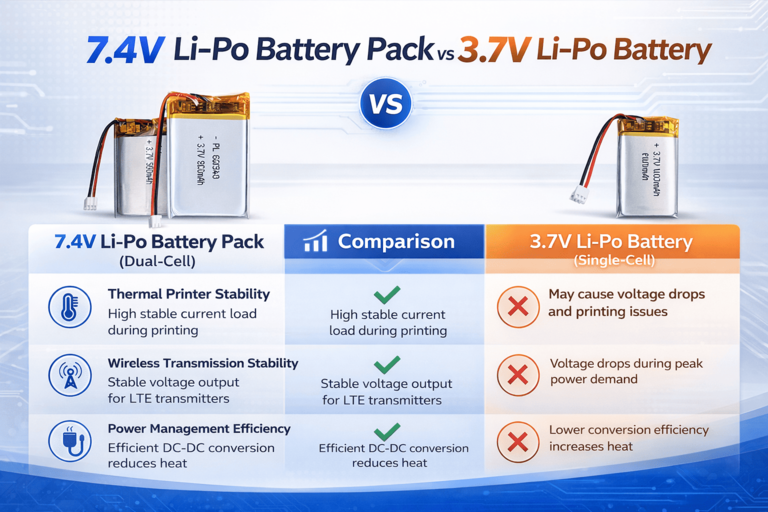
In practice, most professional POS terminals adopt 7.4V dual-cell battery pack configurations for three important reasons.
1. Thermal printers require higher instantaneous current during receipt printing. A higher voltage platform reduces current load per cell and improves printing stability.
2. Wireless communication modules such as LTE transmitters generate periodic peak power demand. Dual-cell battery architectures help maintain stable voltage output during transmission cycles.
3. A 7.4V battery pack improves DC-DC conversion efficiency inside the power management system, which reduces heat generation inside compact handheld enclosures.
For these reasons, 7.4V Li-polymer battery packs have become the preferred architecture for smart POS terminals used in retail, logistics, and restaurant environments.
LP757080 10.8Ah Li-Polymer Battery Pack Overview
The LP757080 7.4V 10.8Ah battery pack is a dual-cell high-capacity lithium-polymer solution designed specifically for portable intelligent terminals requiring extended runtime and stable peak-load performance.
Typical electrical characteristics:
|
Parameter |
Specification |
|
Nominal voltage |
7.4V |
|
Nominal capacity |
10.8Ah |
|
Configuration |
2S |
|
Battery chemistry |
Li-polymer pouch |
|
Application target |
handheld POS terminals |
This configuration provides approximately 80Wh usable energy, which supports continuous device operation across full working shifts in most mobile payment scenarios.
Runtime Design Logic for POS Terminal Battery Selection
Battery capacity selection should match the real operating power profile of the POS terminal rather than relying only on nominal device specifications.
Typical subsystem power consumption in smart handheld POS devices:
|
Module |
Typical Consumption |
|
Display |
1–2W |
|
Processor |
1–2W |
|
Wireless module |
2–3W |
|
Thermal printer |
6–12W peak |
Using this load profile, engineers typically target 8–12 hours of continuous shift operation without intermediate charging.
Battery energy estimation follows:
Available energy:
7.4V × 10.8Ah ≈ 80Wh
This capacity level allows stable operation across a full working shift depending on printer usage frequency and wireless communication duty cycle.
Because receipt printing generates intermittent peak load rather than continuous consumption, the LP757080 battery pack provides sufficient energy reserve for most handheld POS terminal platforms.
Why Li-Polymer Batteries Are Preferred for POS Terminal Integration
Compared with cylindrical lithium-ion battery packs, Li-polymer pouch cells provide better structural compatibility with handheld terminal enclosure design.
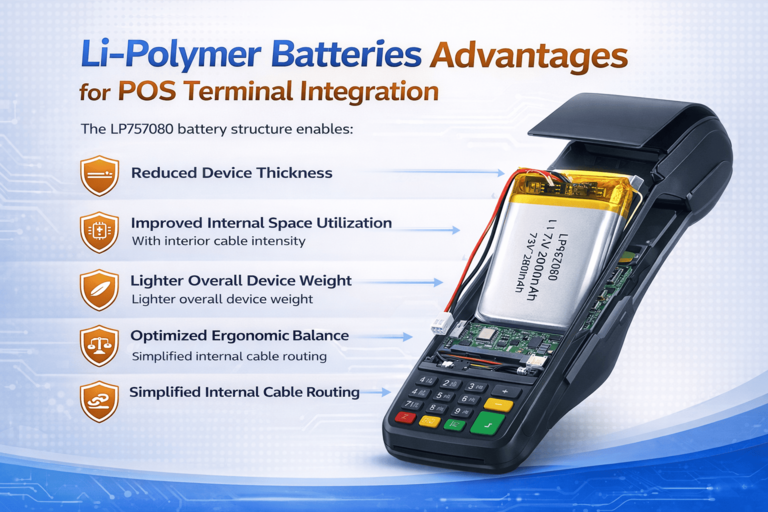
The LP757080 battery structure enables:
-
reduced device thickness
-
improved internal space utilization
-
lighter overall device weight
-
optimized ergonomic balance
-
simplified internal cable routing
These structural advantages make Li-polymer battery packs particularly suitable for compact smart payment terminals.
Safety Protection Requirements for POS Terminal Battery Packs
Portable payment terminals operate in public commercial environments and therefore require stable battery protection mechanisms during repeated charging cycles.
The LP757080 battery pack integrates a protection circuit module designed to ensure safe operation under normal and abnormal electrical conditions.
Typical protection features include over-charge protection, over-discharge protection, over-current protection, short-circuit protection and optional temperature sensing support. These protection mechanisms extend battery lifecycle performance while maintaining reliable operation during daily field use.
Mechanical Integration Advantages of the LP757080 Battery Structure
The LP757080 pouch battery format supports flexible integration into compact terminal housings by allowing optimized thickness distribution across the device interior.
This improves:
internal layout efficiency
device balance during handheld operation
impact resistance performance
assembly flexibility during production
As a result, device designers can maintain slim industrial design targets while achieving full-shift runtime capability.
Custom Battery Pack Integration Options for POS Terminal Manufacturers
Different POS terminal platforms require different connector layouts, protection circuit configurations, and mechanical dimensions. For this reason, battery pack customization is often required during product development.
PKCell supports OEM integration with configurable options including:
|
Custom Feature |
Supported Options |
|
Connector type |
JST / Molex / customized |
|
Cable length |
adjustable |
|
Protection circuit |
PCM / smart BMS optional |
|
Battery thickness |
customizable |
|
Temperature sensor |
optional |
|
Communication interface |
optional |
These customization options help manufacturers shorten product development cycles while ensuring compliance with electrical safety requirements.
Typical Application Scenarios for 7.4V 10.8Ah POS Terminal Battery Packs
Dual-cell Li-polymer battery packs are widely used across mobile payment environments where long runtime and stable printer performance are essential.
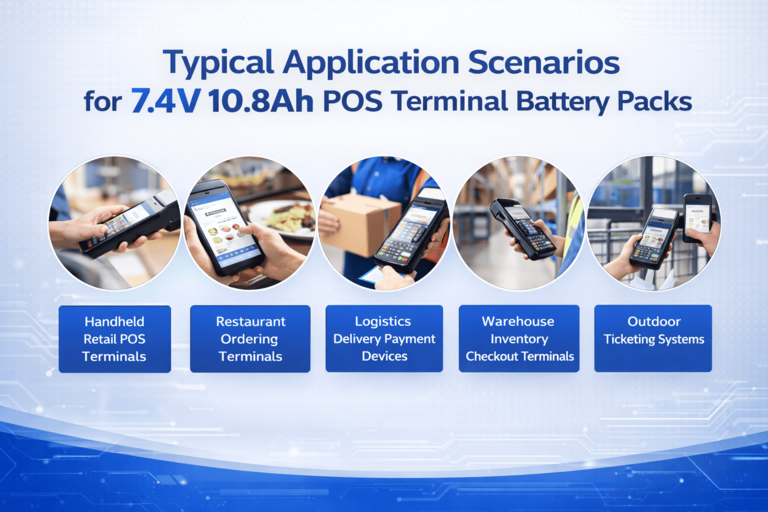
Common deployment scenarios include:
-
handheld retail POS terminals
-
restaurant ordering terminals
-
logistics delivery payment devices
-
warehouse inventory checkout terminals
-
outdoor ticketing systems
In each scenario, stable battery output directly improves transaction reliability and user experience during extended working shifts.
Why Device Manufacturers Choose PKCell Battery Solutions for POS Platforms
As handheld POS terminals continue evolving into multifunction smart computing devices, battery packs must provide stable electrical performance together with flexible mechanical integration capability.
PKCell supports terminal manufacturers with:
- high-energy-density Li-polymer cell platforms
- custom battery pack structural design
- integrated protection circuit engineering
- prototype-to-mass-production support
- global shipment compliance assistance
These capabilities help POS terminal developers integrate reliable rechargeable battery systems into next-generation portable payment devices more efficiently.
Contact Our Engineer for Consultation!
Frequently Asked Questions About POS Terminal Batteries
What battery voltage is typically used in handheld POS terminals?
Most handheld POS terminals use 7.4V lithium battery packs. Dual-cell batteries provide more stable voltage for thermal printers and wireless modules compared with single-cell 3.7V batteries.
How long does a 7.4V 10.8Ah POS terminal battery last?
A 7.4V 10.8Ah Li-polymer battery pack typically supports 8–12 hours of operation, depending on screen brightness, printer usage frequency, and wireless communication activity.
Why are Li-polymer batteries used in POS terminals?
Li-polymer batteries allow thinner device design and better space utilization than cylindrical cells. They also provide stable discharge performance for compact handheld POS terminal structures.
Can a 3.7V battery be used in a POS terminal?
A 3.7V battery is suitable for basic POS devices without thermal printers. Most smart POS terminals require 7.4V battery packs to maintain stable printing performance.
How is battery capacity selected for POS terminals?
Battery capacity depends on device runtime requirements and power consumption. Most handheld POS terminals designed for full-shift operation use 7.4V battery packs between 8Ah and 12Ah.
Are POS terminal battery packs customizable?
Yes. POS terminal battery packs can be customized with different connectors, cable lengths, protection circuits, and battery thickness to match device structure requirements.
What protection features are included in POS terminal battery packs?
Standard protection features include over-charge, over-discharge, over-current, and short-circuit protection, ensuring safe operation during daily charging cycles.
Post time: Apr-16-2026


