
4S2P 18650 Battery Pack Guide: Voltage, Capacity, BMS and Applications
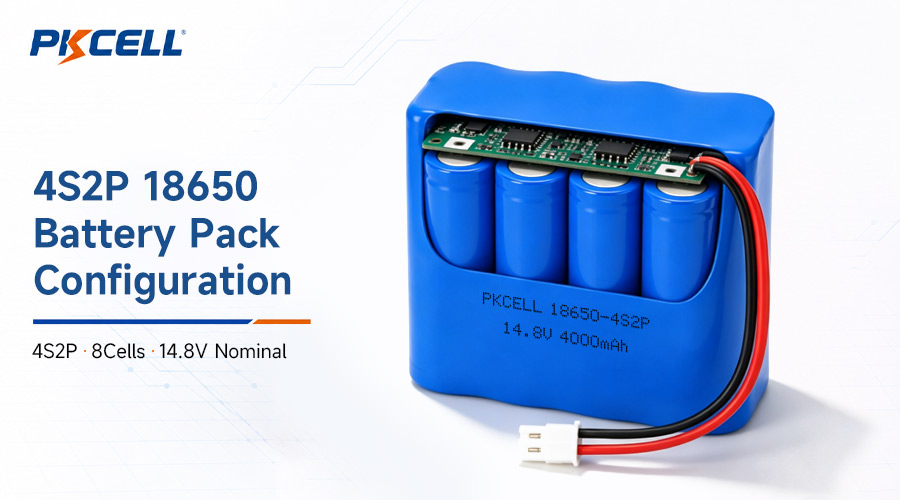
A 4S2P 18650 battery pack combines eight cylindrical lithium-ion cells to create a practical balance of system voltage, runtime, current capability, and package size. Yet “4S2P” is only the electrical arrangement. A production-ready pack also depends on the cell chemistry, discharge rating, BMS settings, charger, interconnects, enclosure, and operating environment.
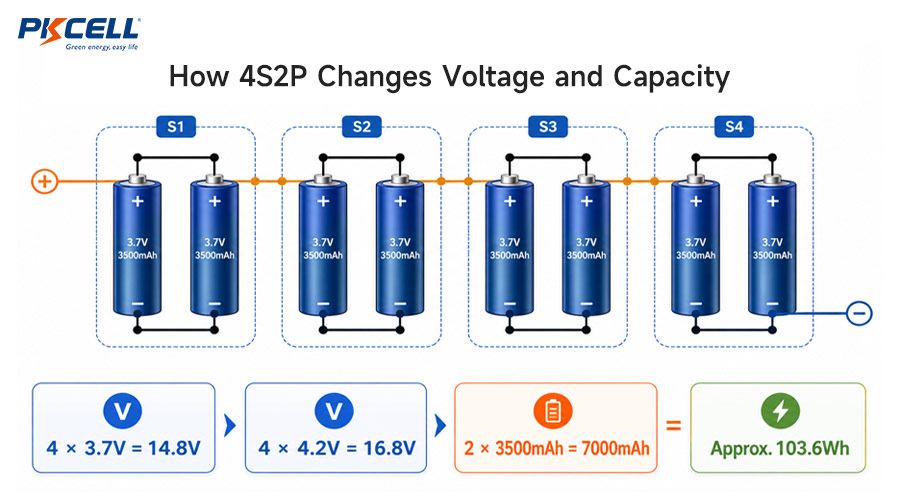
Quick answer: Four cell groups are connected in series, and each group contains two cells in parallel. With 3.7V nominal, 4.2V full-charge cells, the pack is typically 14.8V nominal and 16.8V fully charged. Pack capacity is twice the capacity of one cell. Eight 3500mAh cells therefore produce a nominal 14.8V 7000mAh pack, before application-specific derating.
*Values assume conventional lithium-ion cells rated at 3.7V nominal and 4.2V maximum charge voltage. Always use the actual cell datasheet and approved pack specification.
What Does 4S2P Mean in an 18650 Battery Pack?
This architecture is a common step up from a compact 4S1P pack. It preserves the 4S voltage platform but adds energy and, when the cells, busbars, wiring, and BMS are correctly specified, more load-current headroom. Buyers can review PKCELL’s 4S2P 18650 battery pack range and the broader 14.8V 18650 pack category.
Series count establishes the voltage platform. Parallel count scales capacity, but it does not excuse an underspecified cell, BMS, conductor, connector, or thermal design.
4S2P Voltage, Capacity and Energy Calculations
Nominal and Full-Charge Voltage
For a conventional 3.7V lithium-ion 18650 cell, four cells in series produce 14.8V nominal. At a maximum charge voltage of 4.2V per cell, the pack reaches 16.8V. Some cells are labeled 3.6V nominal, so the same 4S architecture may be marketed as 14.4V. These labels can describe a similar voltage class, but engineers should confirm the complete voltage window rather than relying on the product name.
Maximum charge voltage = 4 × 4.2V = 16.8V
The equipment input stage must tolerate the pack at full charge. The low-voltage limit must align with the cell specification, BMS threshold, load behavior, and desired service life.
Capacity and Watt-Hours
Two cells in parallel double the amp-hour capacity. If each cell is 2600mAh, the pack is 5200mAh; if each is 3500mAh, it is 7000mAh. Watt-hours are more useful than amp-hours when comparing packs with different voltages.
Nominal energy (Wh) = nominal voltage × capacity (Ah)
A 14.8V 7.0Ah pack stores approximately 103.6Wh of nominal energy. Actual usable energy will be lower and varies with discharge current, cutoff settings, temperature, aging, cell variation, and conversion losses.
| Single-Cell Capacity | 4S2P Pack Capacity | Nominal Voltage | Approx. Nominal Energy |
|---|---|---|---|
| 2000mAh | 4000mAh | 14.8V | 59.2Wh |
| 2200mAh | 4400mAh | 14.8V | 65.1Wh |
| 3000mAh | 6000mAh | 14.8V | 88.8Wh |
| 3350mAh | 6700mAh | 14.8V | 99.2Wh |
| 3500mAh | 7000mAh | 14.8V | 103.6Wh |
These are configuration calculations, not guaranteed product outputs. Cell availability, capacity tolerance, current rating, dimensions, and certification scope must be confirmed for each project.
How Much Current Can a 4S2P Pack Deliver?
There is no universal current rating for “4S2P.” In theory, two identical cells in parallel share the load, so the group can support roughly twice the current of one cell. In a real pack, the permitted output is limited by the weakest approved element in the current path.
- Cell ratings: High-capacity cells are not automatically high-power cells.
- BMS capability: It must carry normal current and tolerate legitimate startup pulses.
- Busbar design: Material, thickness, width, weld quality, and path length affect resistance and heat.
- Wire and connector: Long or undersized conductors add voltage drop and local heating.
- Thermal environment: Sealed enclosures and high ambient temperatures can reduce practical output.
A motor, pump, compressor, radio, or actuator may draw several times its running current during startup. Record continuous current, typical peaks, peak duration, repetition rate, and worst-case stall or fault current. PKCELL’s guide to a 4S 18650 pack for water valve actuators shows why motor startup and stall behavior can make a 4S2P or high-discharge design preferable to 4S1P.
Choosing the Right 4S BMS
A 4S BMS monitors four series groups, not eight cells independently. The two cells within each parallel group behave as one electrical node. This makes cell sourcing, matching, construction, and consistent thermal conditions especially important.
Essential Protection Functions
- Overcharge protection for each series group
- Over-discharge protection
- Overcurrent and short-circuit protection
- Temperature monitoring when required
- Cell-group balancing appropriate to the charging strategy and duty cycle
The BMS rating should include engineering margin, but an oversized current label is not a design method. Confirm continuous current under real cooling conditions, transient response, protection delay, MOSFET losses, balancing method, quiescent current, temperature-sensor placement, port arrangement, and reset behavior.
Communication and State Estimation
Simple equipment may only need protection and passive balancing. Medical devices, robotics, smart instruments, and managed fleets may need fuel gauging, event logs, state-of-charge reporting, SMBus, or CAN. PKCELL states that BMS functions and communication can be developed for suitable projects through its custom battery pack service.
Do not use the BMS as the normal on/off control or as a substitute for a compatible charger. Protection thresholds are last-resort boundaries; normal device and charger operation should remain inside the approved working window.
4S2P vs 4S1P and 4S3P
The best parallel count depends on energy, current profile, space, weight, cost, and service target. More parallel cells increase available energy, but they also add cells, welds, volume, weight, qualification work, and failure-analysis complexity.
| Configuration | Cells | Capacity | Typical Direction | Main Tradeoff |
|---|---|---|---|---|
| 4S1P | 4 | 1× cell | Compact equipment with moderate runtime and current | Least energy and current-sharing margin |
| 4S2P | 8 | 2× cell | Balanced runtime, output capability, and package size | Larger and heavier than 4S1P |
| 4S3P | 12 | 3× cell | Longer runtime or higher energy requirement | More volume, weight, cost, and interconnects |
If a product needs 4S voltage but cannot accept eight cells, the answer may be a different cell format or chemistry, not an overloaded 4S1P design. Conversely, adding parallel cells solely to raise current may be inefficient if a properly selected high-power cell can meet the load with fewer cells.
Typical 4S2P 18650 Battery Pack Applications
A 4S2P pack is most useful when the host device accepts a 16.8V fully charged battery and benefits from more runtime than 4S1P can provide. PKCELL’s industrial and commercial 18650 application guide covers the wider use of the cell format.
Robotics and Automated Equipment
Mobile robots, inspection devices, compact AGVs, and actuator systems combine control electronics with intermittent motor loads. Selection must account for acceleration, stall, payload, duty cycle, and regenerative behavior where applicable.
Portable Medical and Diagnostic Devices
Portable monitors, pumps, test equipment, and transportable instruments may value the mature cylindrical format. The battery must be developed within the device’s safety, risk-management, charging, and regulatory plan; a generic pack is not automatically approved for medical use.
Professional Lighting and Emergency Equipment
High-output lighting, emergency lamps, field equipment, and backup modules may need a stable 4S platform and extended runtime. Standby current, storage state of charge, periodic testing, and service access matter as much as headline capacity.
Drones and Portable Instruments
Some endurance-focused UAVs, mapping instruments, communication terminals, and field systems can use 4S2P packs. Weight, peak current, center of gravity, vibration, connector retention, and charging logistics must be evaluated at device level.
Valve Actuators, Pumps and Motorized Devices
Parallel cells can provide more energy and current-sharing margin for devices with startup peaks. The BMS, wiring, connector, and cell must still be selected from measured startup, running, and stall current rather than motor wattage alone.
A Real Product Example: 14.8V 7000mAh 4S2P
PKCELL lists a 14.8V 4S2P 7000mAh ICR18650 battery pack for consumer electronics, portable tools, medical devices, robotics, drones, and portable energy storage. Its published product-page values include a 1750mA maximum constant charging current, 3500mA maximum continuous discharge current, and 500+ cycle life under the stated conditions.
This example shows how a 3500mAh cell can scale to a 7000mAh 4S2P pack. It is not a universal specification for every 4S2P design. Projects with higher current, different temperatures, a tighter enclosure, another chemistry, or special compliance needs require a separately approved specification.
Need a 4S2P Pack Matched to Your Device?
Send PKCELL your voltage window, load profile, runtime target, available space, connector drawing, charging method, environment, annual volume, and required certifications. The team can evaluate the cell, BMS, structure, and sample plan together.
Design and Procurement Checklist
A clear request for quotation reduces redesign cycles and makes supplier comparisons more meaningful. Include measured data whenever possible.
- Nominal and full input-voltage range
- Continuous, peak, startup, and stall current
- Peak duration and repetition
- Runtime target and duty cycle
- Maximum length, width, and height
- Target weight
- Charge voltage, current, and interface
- Operating and storage temperature
- Ingress, vibration, shock, and drop needs
- Wire, cable length, connector, and polarity
- BMS protection and communication
- Housing, mounting, labeling, and service method
- Transport and market-access documents
- Sample plan and annual forecast
Also define whether the battery is removable, charged inside the device, user-replaceable, or serviced only by trained personnel. These decisions affect the connector, enclosure, charger, labeling, and risk controls. For a wider supplier discussion, explore PKCELL’s custom 18650 battery pack capabilities.
Common Selection Mistakes
Choosing by mAh Alone
Capacity predicts runtime only when combined with voltage, efficiency, load profile, cutoff, and environment. It does not prove that a cell can deliver the required current.
Ignoring the 16.8V Full-Charge Condition
A device described casually as “12V” or “14.8V” may not tolerate 16.8V. Verify the host electronics, motor driver, capacitors, regulators, and charger.
Selecting a BMS by Its Printed Current Rating
Protection thresholds, thermal performance, transient delay, and real operating conditions matter. A nominal rating without the board specification and validation test is not enough.
Mixing Cells or Replacing Only Part of a Pack
Cells should be sourced and matched for the approved design. Mixing models, capacities, ages, or unknown histories can create imbalance and unpredictable current sharing. Pack repair belongs with qualified personnel under a controlled process.
Using an Incompatible Charger
A 4S conventional lithium-ion pack normally needs a charger designed for its chemistry and maximum voltage. Do not infer compatibility from the connector shape or a similar nominal voltage.
Frequently Asked Questions
How many cells are in a 4S2P 18650 battery pack?
Eight cells: four series groups, each containing two parallel cells.
Is a 4S2P 18650 pack 14.4V or 14.8V?
It can be labeled either way depending on whether the cell is specified at 3.6V or 3.7V nominal. With standard 4.2V maximum-charge cells, the full pack voltage is 16.8V.
What is the capacity of a 4S2P pack?
Twice the capacity of one cell. Two 2600mAh cells per group create 5200mAh; two 3500mAh cells create 7000mAh.
Can it deliver twice the current of one cell?
Parallel cells can share current, but approved output is limited by the cells, BMS, interconnects, wires, connector, temperature, and construction. Use the finished pack specification.
What BMS does a 4S2P pack need?
Use a four-series lithium-ion BMS matched to the chemistry, charge voltage, continuous load, peaks, temperature, and communication needs. The “2P” does not require an 8S BMS.
How do I estimate runtime?
Divide nominal watt-hours by average device watts, then allow for conversion loss, peaks, cutoff voltage, temperature, aging, and reserve. Validate with the final duty cycle and samples.
Can PKCELL customize the connector, BMS, and housing?
PKCELL lists customization for voltage, capacity, dimensions, wires, connectors, packaging, BMS functions, and communication. Define certification needs at project start.
Conclusion
A 4S2P 18650 battery pack is a versatile 8-cell architecture for equipment that needs a 4S voltage platform plus more energy than 4S1P can offer. For conventional 3.7V cells, the headline values are straightforward: 14.8V nominal, 16.8V full charge, and twice the capacity of one cell. The engineering work begins after that calculation.
Reliable performance depends on matching the cell, BMS, charger, conductors, connector, mechanics, temperature conditions, and load profile as one system. Share your real device requirements with PKCELL to move from a configuration label to a validated, manufacturable battery pack.
Contact PKCELL for a 4S2P 18650 battery pack evaluation and quotation.
Post time: Aug-28-2026


