
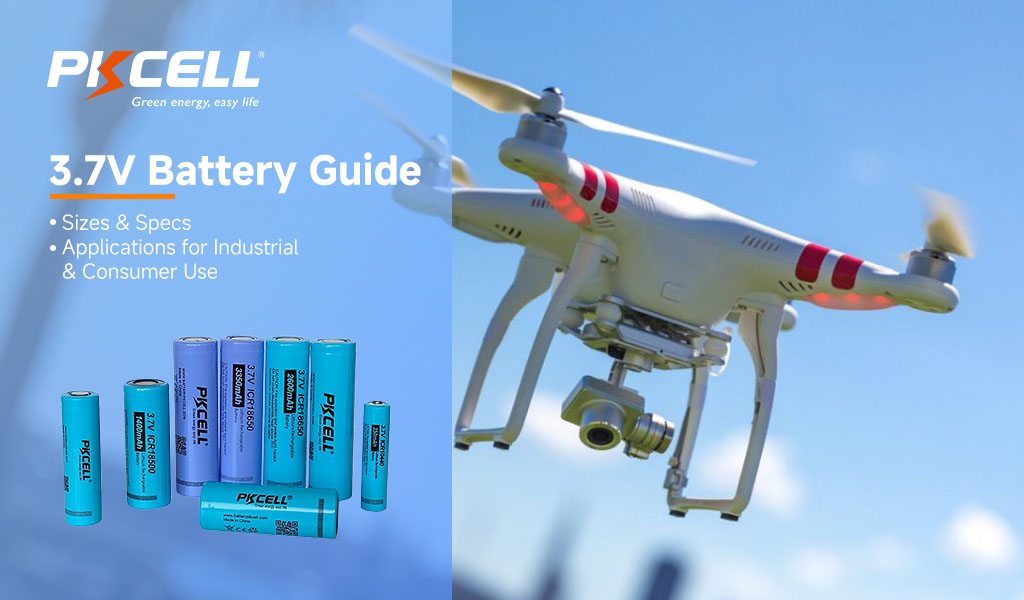
Quick answer: A 3.7V battery usually refers to a rechargeable lithium-ion cell with a nominal voltage of about 3.6-3.7V. Common cylindrical formats include 10440, 14500, 16340, 18650, 21700 and 26650. These numbers describe approximate cell dimensions, not capacity or discharge current. Many conventional 3.7V Li-ion cells charge to about 4.2V; always follow the specific cell datasheet.
What Is a 3.7V Battery?
A 3.7V battery is a common rechargeable power source used in portable electronics and industrial devices. When people search for a 3.7 volt battery, they are usually referring to a lithium-ion cell with a nominal voltage of 3.6V or 3.7V, depending on its chemistry and manufacturer specification. These cells combine compact size with relatively high energy density.
Why it matters: A suitable 3.7V lithium battery can power flashlights, portable instruments, IoT devices, handheld electronics and battery packs. However, two cells marked 3.7V may differ significantly in dimensions, capacity, maximum discharge current and protection requirements.
3.7V Battery Voltage Explained: Nominal, Fully Charged and Cutoff
The 3.7V rating is a nominal voltage, not a fixed output voltage throughout the discharge cycle. For many conventional single-cell Li-ion chemistries, the voltage changes as the battery charges and discharges.
| Voltage specification | Common value (single cell) | What it means |
|---|---|---|
| Nominal voltage | 3.6-3.7V | Rated voltage used for basic cell selection. |
| Typical full-charge voltage | About 4.2V | Typical maximum for many standard Li-ion cells, not all lithium chemistries. |
| Discharge cutoff | Often around 2.5-3.0V | Minimum operating limit varies by cell, load and protection design. |
Important: The values above are illustrative, not universal charging instructions. Some high-voltage Li-ion variants and LiFePO4 cells use different charge limits. Use a compatible charger and the exact manufacturer’s datasheet; never select a charger from nominal voltage alone.
Common 3.7V Battery Sizes and Specifications
Rechargeable lithium-ion cells are available in multiple cylindrical battery sizes. A size designation such as 18650 describes an approximate physical format. It does not guarantee a particular voltage, capacity, chemistry or current rating. The following chart focuses on common 3.7V-class Li-ion examples.
3.7V Lithium Battery Size Chart: Dimensions and Example Capacities
| Li-ion cell size | Approx. dimensions (mm) | Illustrative capacity (mAh) | Common selection point |
|---|---|---|---|
| 10440 | 10 x 44 | 320-350 | AAA-like size; check voltage compatibility. |
| 14500 | 14 x 50 | 500-800 | AA-like size; not a direct 1.5V AA substitute. |
| 16340 | 16 x 34 | 700-950 | Compact cylindrical devices. |
| 18650 | 18 x 65 | 2,000-3,000 | Portable electronics and many custom packs. |
| 21700 | 21 x 70 | 4,000-5,000 | Higher capacity per cell in many designs. |
| 26650 | 26 x 65 | 3,400-5,000 | Larger-diameter applications; check chemistry. |
Data note: Dimensions are nominal size-code references. Capacity figures illustrate examples within PKCELL’s 3.7V-class product range; they are not a guaranteed range for every cell of that size. Protected cells, button tops and packaging may change overall dimensions. Some 18650 and 26650 products use other chemistries, including 3.2V LiFePO4. Confirm voltage, capacity, continuous discharge current, size tolerances and availability for the exact SKU.
For concrete product examples, see PKCELL’s 3.7V 800mAh 14500 cell and 3.7V 5000mAh 21700 cell. Their specifications illustrate why capacity and current capability must be checked by exact model.
Comparison of Popular Battery Models
- 18650 vs. 21700: A 21700 cell has a larger physical format and can offer more capacity per cell, depending on the specific design. Check both capacity and continuous discharge current against the application.
- 14500 vs. AA alkaline: Although their dimensions are similar, a 14500 Li-ion cell is typically 3.7V nominal rather than 1.5V. Never substitute it unless the device explicitly supports the higher voltage.
- 10440 vs. AAA: The 10440 has an AAA-like size, but its 3.7V nominal voltage is much higher than a standard AAA cell. It is not a drop-in replacement.
3.7V Cylindrical Li-ion vs. LiPo Battery Sizes
Not every 3.7V rechargeable lithium battery is cylindrical. Lithium-polymer (LiPo) pouch cells are commonly selected when an enclosure requires a thin or rectangular battery. Both forms can be built around 3.7V-class rechargeable lithium chemistry, but dimensions, mechanical protection and electrical ratings vary.
| Feature | Cylindrical Li-ion | LiPo pouch cell |
|---|---|---|
| Common size format | 10440, 14500, 18650, 21700, etc. | Thickness x width x length; model-specific. |
| Typical shape | Round metal can | Flat or rectangular pouch |
| Design consideration | Cell holders, metal can, pack layout | Thickness, swelling allowance, enclosure support |
| Typical applications | Flashlights, instruments, battery packs | Wearables, handheld electronics, thin devices |
For thin or custom enclosures, review PKCELL Li-Polymer battery options. For round-cell designs, explore cylindrical Li-ion batteries.
Key 3.7V Lithium Battery Specifications to Consider
Choosing a 3.7V lithium battery requires more than matching the size code or comparing nominal capacities. Engineers and buyers should evaluate the following specifications for the actual operating load:
- Capacity (mAh) and energy (Wh): Higher rated capacity can extend runtime under comparable test conditions. For an energy comparison, use watt-hours (Wh) and account for voltage, load and cutoff behavior.
- Continuous and peak discharge current: The cell must safely support the application’s load; not all 18650 or 21700 batteries are high-drain models.
- Cycle life: Check the supplier’s test conditions, including depth of discharge, charge/discharge rate, temperature and remaining-capacity threshold.
- Operating temperature: Charge and discharge temperature limits differ. Do not assume every cell can be charged below freezing or used throughout the same temperature range.
- Dimensions and protection: Confirm the finished cell length, top configuration, connector design and whether a protection circuit or pack BMS is required.
- Standards and documentation: UN 38.3 concerns lithium-battery transport testing; IEC 62133-2 addresses safety requirements for applicable portable rechargeable lithium cells and batteries. CE marking and RoHS obligations depend on the product and market and are not interchangeable battery safety certifications. Request the test reports and declarations relevant to your exact product and destination market.
Applications of 3.7V Batteries
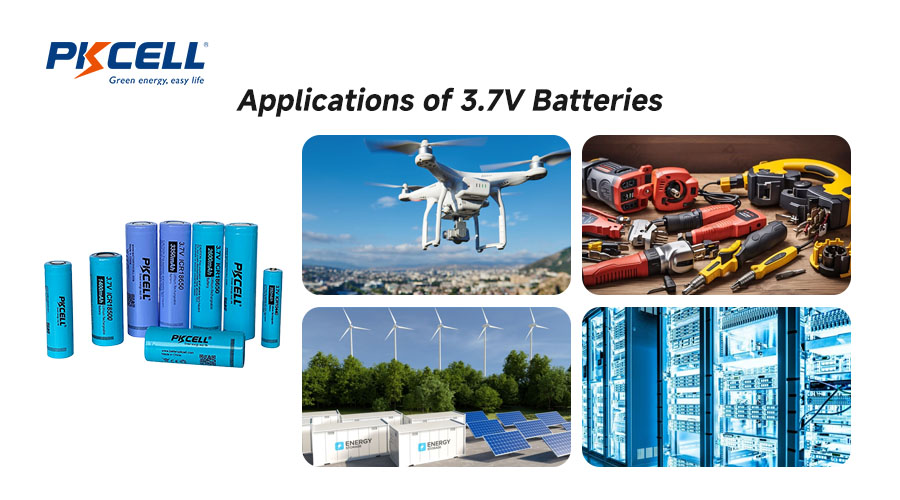
3.7V-class lithium-ion cells can be used individually or assembled into series/parallel battery packs, depending on the voltage and runtime required by the equipment.
Electric Tools and Equipment
18650 and 21700 cells are widely used in multi-cell packs for cordless equipment. The correct design depends on continuous discharge current, short-duration peak loads, pack voltage, BMS selection and thermal management; a complete tool pack commonly operates above 3.7V.
IoT Devices, Sensors and Monitoring Systems
Compact 10440, 14500 and pouch-cell formats may suit wireless sensors, trackers, smart locks and monitoring products where size, standby current and power-management efficiency are important.
Drones, Robotics and Automated Systems
For drones and robots, weight, usable energy and peak current all matter. Some designs use high-rate LiPo packs rather than a single 3.7V cylindrical cell, so the finished battery configuration must match the motor and controller requirements.
Energy Storage and Backup Systems
18650 and 21700 cells can be assembled into larger battery modules for backup and energy-storage applications. System-level protection, pack configuration and applicable compliance requirements must be assessed separately from the specifications of a single cell.
Choosing Between Different 3.7V Battery Sizes
Use the device’s available space, voltage tolerance, runtime target and discharge-current requirements to narrow the choice.
| Design priority | Formats to evaluate | Main checks before selection |
|---|---|---|
| Very small enclosure | 10440, 14500 or compact LiPo | Voltage tolerance, available volume, minimum runtime |
| General-purpose cylindrical cell | 18650 | Cell grade, capacity, current rating, terminal length |
| Higher capacity per cell | 21700, some 26650 models | Pack dimensions, total weight, actual discharge test |
| Thin rectangular device | 3.7V LiPo pouch | Thickness, swelling allowance, protection and connector |
These are starting points for selection, not universal recommendations. Final decisions should be based on verified model datasheets and prototype testing.
Safety and Handling Considerations
Rechargeable lithium batteries require correct charging, mechanical protection and appropriate electrical safeguards. Follow the exact manufacturer’s instructions.
- Use a charger compatible with the cell chemistry, charge-voltage limit and pack configuration.
- Never short-circuit, puncture, crush or charge visibly damaged or swollen cells.
- Do not combine cells of different ages, chemistries, capacities or states of charge in a pack.
- Use suitable cell protection or a properly specified pack BMS where required by the design.
- Store away from heat and moisture, within the supplier’s stated storage-temperature and charge-state limits.
PKCELL 3.7V Battery Solutions
PKCELL provides 3.7V-class rechargeable lithium-ion cells and custom battery solutions for equipment and OEM projects. Available formats vary by product line and include:
- 18650, 21700 and 26650 for applications needing larger cylindrical formats;
- 10440, 14500 and 16340 for compact electronic devices;
- 3.7V LiPo pouch batteries for thin or shaped enclosures;
- Custom battery packs with application-specific protection, connectors and pack configuration.
For product comparison, explore 3.7V rechargeable battery solutions, cylindrical Li-ion cells or LiPo batteries.
When asking for an OEM quotation, include the required voltage, capacity or energy, continuous and peak discharge current, maximum dimensions, operating temperature, charger, connector and estimated order volume.
Need a 3.7V Battery for Your Device or OEM Project?
Share your electrical specifications and mechanical requirements with PKCELL to discuss suitable cell and battery-pack options.
Conclusion
3.7V-class lithium batteries are available in a broad range of cylindrical and pouch-cell formats. Choosing a suitable battery starts with voltage and charging compatibility, followed by physical dimensions, usable energy, discharge current and safety requirements. A 10440 or 14500 may suit a compact device, while an 18650, 21700 or LiPo pouch may be more appropriate for other designs. Always confirm the exact product specification before making a final selection.
FAQs: 3.7V Battery Questions Answered
What are the most common 3.7V battery sizes?
Common cylindrical Li-ion formats include 10440, 14500, 16340, 18650, 21700 and 26650. LiPo pouch batteries are also available in many thickness, width and length combinations. Size codes alone do not determine voltage, capacity or chemistry.
How long do 3.7V lithium batteries last?
Cycle life varies widely by cell model, temperature, charge and discharge rate, and depth of discharge. Check the manufacturer’s cycle-life test conditions and remaining-capacity threshold rather than assuming one number for all 3.7V batteries. Calendar aging and storage conditions also affect service life.
Are all 3.7V batteries rechargeable?
Many batteries described as 3.7V are rechargeable lithium-ion cells, but voltage labeling alone is not enough to identify chemistry or whether a cell can be recharged. Never attempt to recharge a primary (non-rechargeable) lithium battery. Verify the label and datasheet first.
Can I replace an 18650 with a 21700?
Usually not without redesigning the device or holder. A 21700 is wider and longer than an 18650, and its current rating, protection, terminal style and charger requirements must also be compatible.
What safety standards or documentation should I check?
For applicable lithium products, ask about UN 38.3 transport test documentation, relevant safety test standards such as IEC 62133-2, and market-specific conformity requirements. CE and RoHS have different regulatory meanings and should not be treated as substitutes for battery safety or transport testing.
What voltage is a 3.7V battery when fully charged?
Many standard 3.7V-class Li-ion cells reach approximately 4.2V when fully charged. Some lithium chemistries use different limits, so confirm the datasheet and charger compatibility.
Can a 3.7V 14500 battery replace a 1.5V AA battery?
Not in a device intended only for 1.5V AA batteries. The similar size does not make them electrically interchangeable; the higher voltage can damage incompatible electronics.
Post time: Sep-12-2025


