
18650 vs 32650 Battery: Size, Energy and Cell Selection
Choosing between an 18650 and a 32650 battery is not simply a matter of selecting the larger cell. The two cylindrical formats have different diameter requirements, packaging implications and potential energy capacities. For OEM product developers, the better choice depends on the available enclosure space, the exact cell chemistry, required operating time, discharge current and overall battery pack design.
18650 vs 32650: The Key Difference
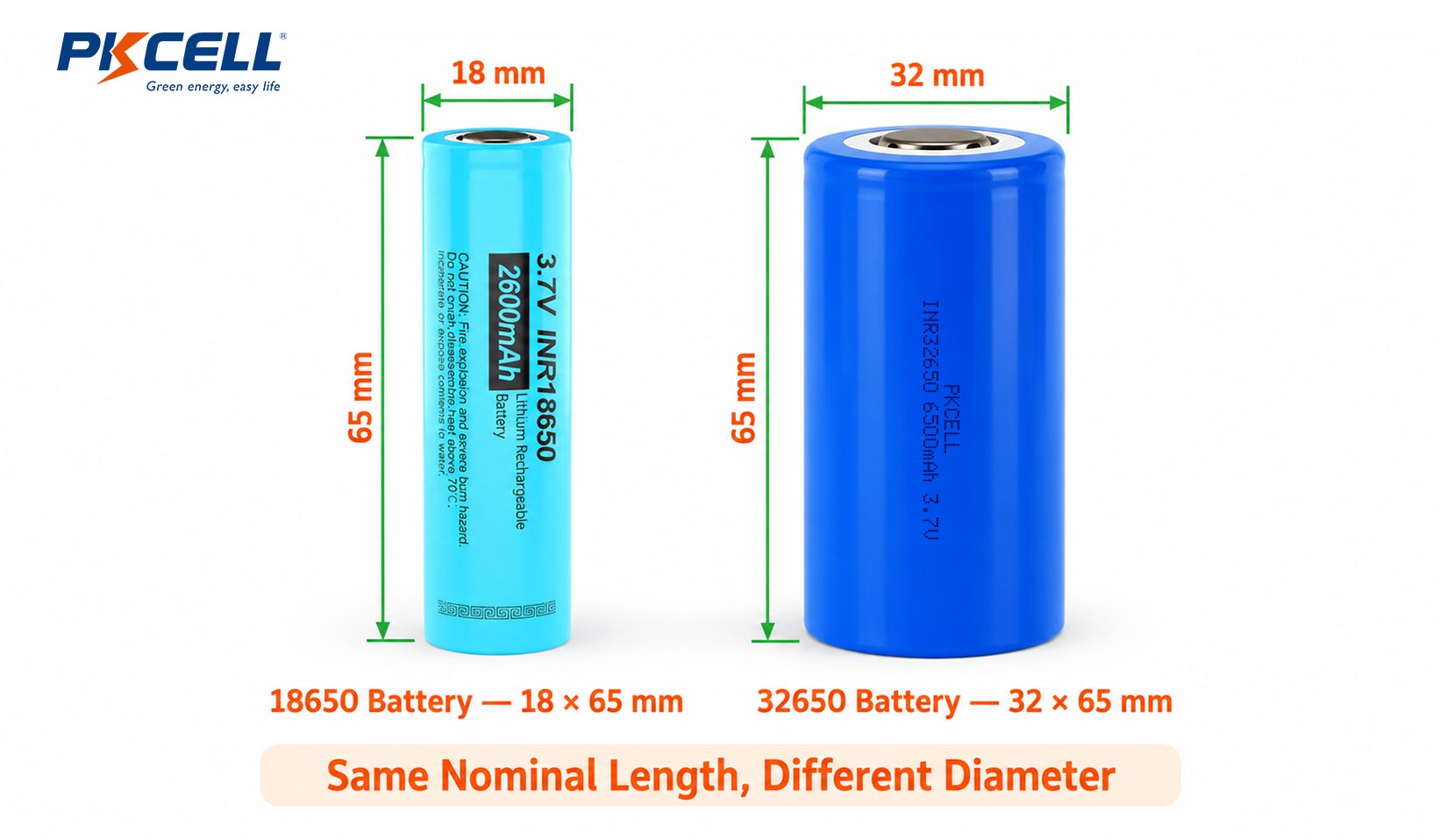
An 18650 battery is nominally 18 mm in diameter and 65 mm long. A 32650 battery is nominally 32 mm in diameter and 65 mm long. The 32650 therefore requires substantially more diameter clearance, while both formats have a similar nominal length.
A larger cell may provide more energy per cell in a suitable design, but size alone does not determine capacity, discharge performance or service life. Compare the actual product specifications and design the battery around the device’s electrical and mechanical requirements.
18650 vs 32650: Dimensions and Enclosure Space
The numbers in these cylindrical battery designations indicate approximate physical dimensions. An 18650 cell is nominally about 18 mm in diameter and 65 mm long. A 32650 cell is nominally about 32 mm in diameter and 65 mm long.
| Design consideration | 18650 format | 32650 format |
|---|---|---|
| Nominal diameter | Approximately 18 mm | Approximately 32 mm |
| Nominal length | Approximately 65 mm | Approximately 65 mm |
| Cross-sectional space | Smaller | Substantially larger |
| Cell arrangement | More options for narrow spaces and closely arranged cells | Requires more width per cell |
| Pack design implication | Cell count and interconnections may be important constraints | Cell diameter and available enclosure area may be important constraints |
Based on the nominal dimensions, a 32650 cell has approximately 3.16 times the cylindrical envelope volume of an 18650 cell. This is a geometric comparison only. It does not mean that the 32650 automatically provides 3.16 times the capacity or usable energy.
The final dimensions of a cell may vary with terminal construction, insulation and protective components. For a production enclosure, use the supplier’s dimensional drawing, maximum dimensions and tolerances. Include clearance for cell holders, electrical connections, insulation and assembly.
18650 vs 32650: Capacity and Nominal Energy
Capacity, expressed in milliamp-hours (mAh), describes the charge a cell can deliver under specified test conditions. For product selection, it is also useful to calculate nominal energy in watt-hours (Wh), especially when comparing the capacity of cells with different nominal voltages.
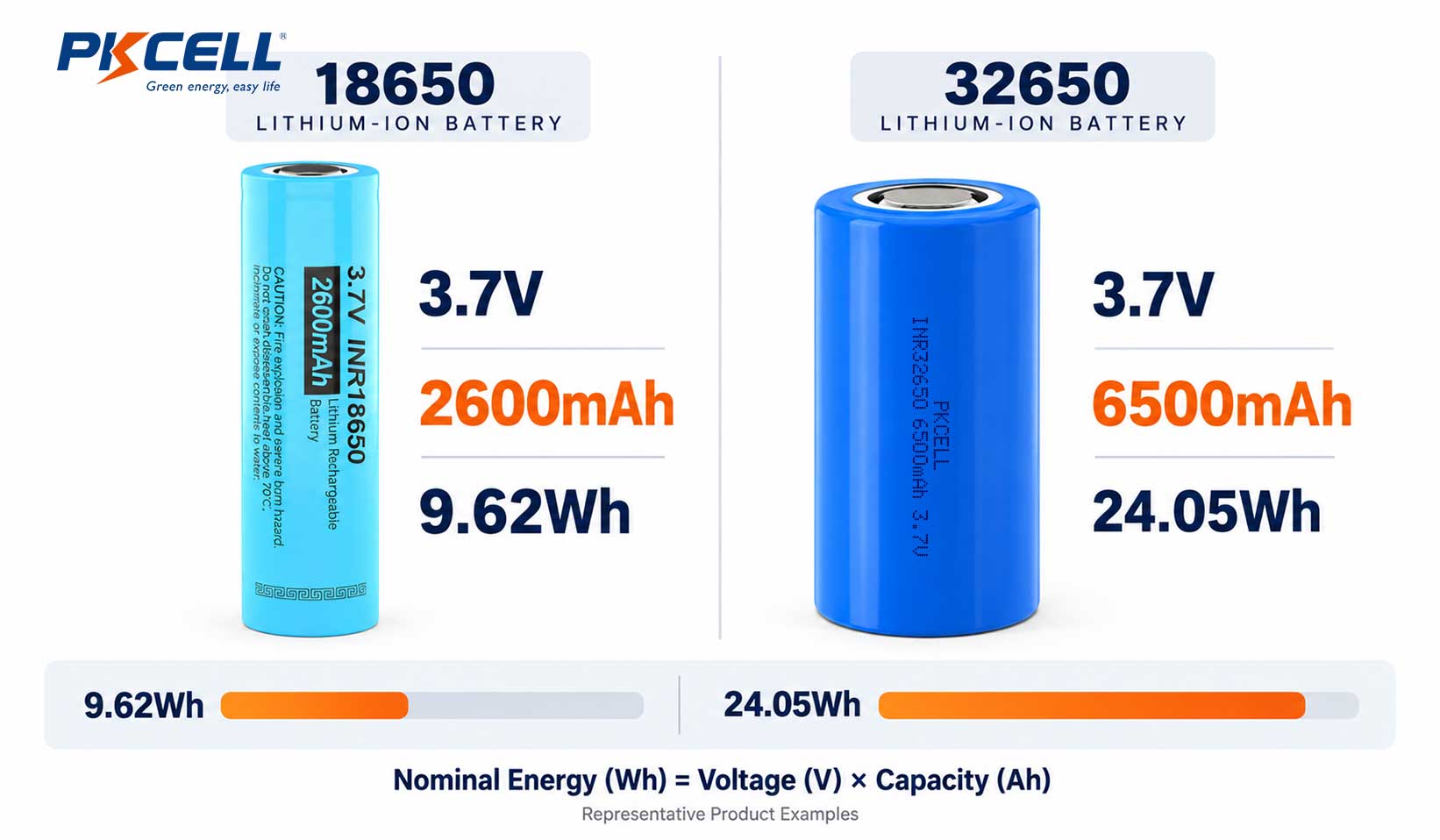
The following comparison uses two specific PKCELL product examples: a 3.7V 2600mAh 18650 cell and a 3.7V 6500mAh INR32650 cell. These figures describe the referenced models, not every cell in either format.
| Specification | 18650 example | 32650 example |
|---|---|---|
| Nominal format dimensions | About 18 × 65 mm | About 32 × 65 mm |
| Nominal voltage | 3.7V | 3.7V |
| Nominal capacity | 2600mAh | 6500mAh |
| Capacity in amp-hours | 2.6Ah | 6.5Ah |
| Calculated nominal energy | 9.62Wh | 24.05Wh |
View the detailed specifications for the
3.7V 2600mAh 18650 lithium-ion battery
and the
3.7V 6500mAh INR32650 lithium-ion battery.
How to Calculate Nominal Energy
Nominal Energy (Wh) = Nominal Voltage (V) × Capacity (Ah)
- 18650 example: 3.7V × 2.6Ah = 9.62Wh.
- 32650 example: 3.7V × 6.5Ah = 24.05Wh.
For these examples, the 32650 stores approximately 2.5 times the nominal energy of the 18650. Actual runtime does not necessarily follow the same ratio. Device load, voltage cutoff, temperature, conversion efficiency, aging and discharge conditions all affect usable energy.
Why Battery Chemistry Must Be Considered Separately
A cell format describes its physical size, not its complete electrochemical characteristics. Both 18650 and 32650 cells may be available in different lithium battery chemistries. Their nominal voltages, charging limits, discharge characteristics and service-life profiles can therefore differ.
Conventional Lithium-Ion Cells
Many conventional rechargeable lithium-ion cells have a nominal voltage around 3.6V or 3.7V. The correct charging voltage and current depend on the specific cell model. The 3.7V INR32650 used in the comparison above is one specific example.
LiFePO4 Cells
Lithium iron phosphate (LiFePO4) cells commonly have a nominal voltage around 3.2V. Their charging limits and voltage behavior differ from those of conventional 3.7V lithium-ion cells.
PKCELL also lists a
3.2V 5000mAh 32650 LiFePO4 battery.
It must be evaluated separately from the 3.7V INR32650 example. The two cells should not be treated as direct electrical substitutes merely because their physical formats are similar.
When comparing candidate cells, confirm chemistry, nominal voltage, charging cutoff, discharge cutoff, continuous current, temperature limits and the manufacturer’s recommended operating conditions.
How Cell Size Affects Battery Pack Layout
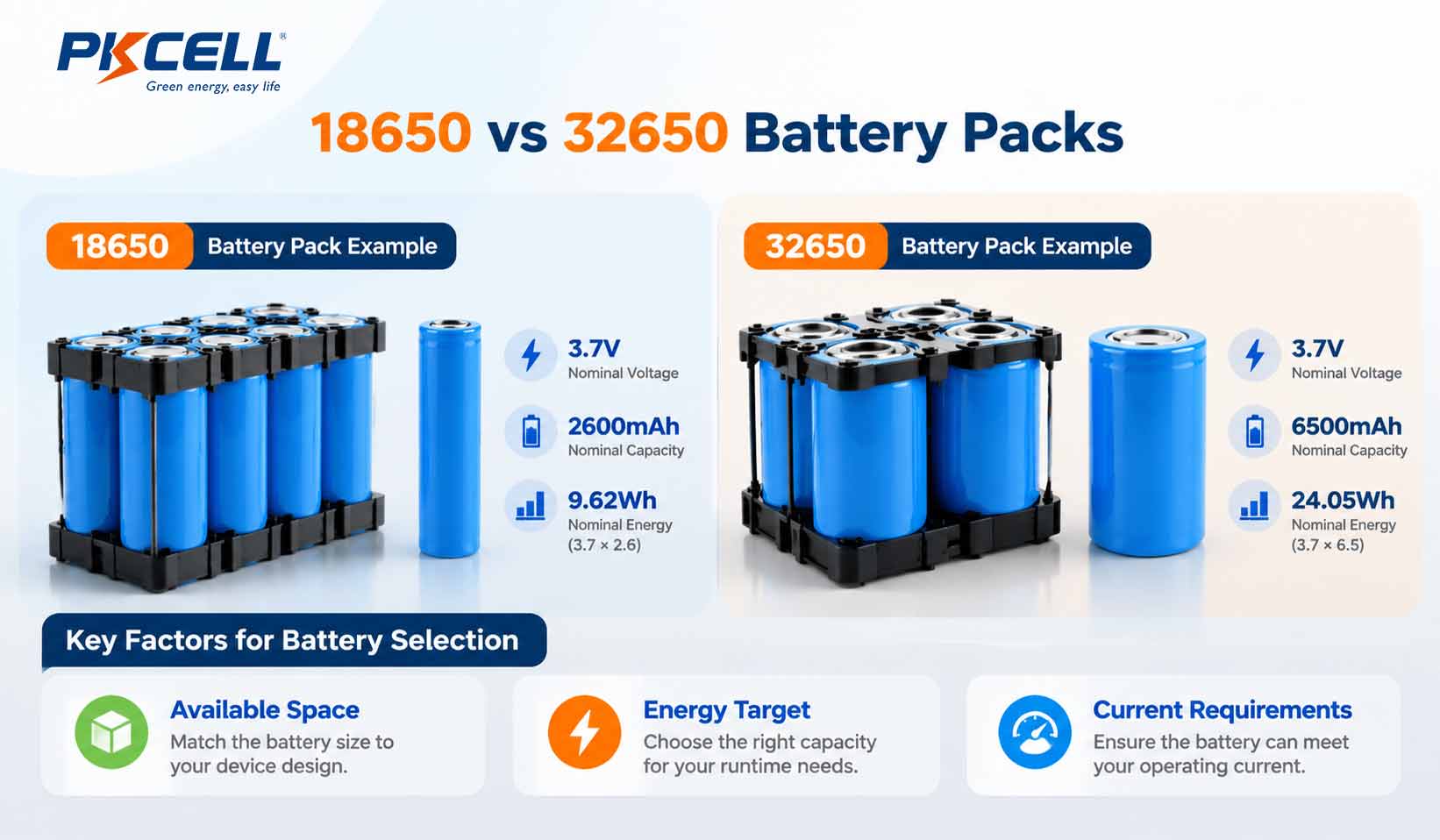
For OEM products, selecting a cell format is also a packaging decision. A larger-capacity cell may reduce the number of parallel cells required for a particular capacity target, but the finished pack may not be smaller, lighter or cheaper in every design.
1. Calculate the Complete Enclosure Space
Allow for cell holders, insulation, busbars or connecting wires, the battery management system (BMS), connectors, enclosure walls, mounting points and service access. The final pack envelope is larger than the sum of the bare cell dimensions.
2. Match the System Voltage and Energy Target
Series-connected cells increase pack voltage; parallel-connected cells increase capacity and current capability, subject to the selected cell specifications and pack design. The series and parallel configuration must be matched to the device’s voltage range, usable energy target and protection strategy.
3. Check Current and Thermal Requirements
Review continuous load current, peak current, pulse duration, voltage sag and cell temperature. A higher capacity rating does not automatically mean a higher permissible discharge current. Cell selection and pack design should account for the actual load profile and thermal limits.
4. Compare Total Pack Cost
The complete cost includes cells, interconnections, BMS, enclosure, assembly, testing, logistics and applicable compliance requirements. A larger cell may simplify one design while creating additional space constraints in another.
For projects that require series/parallel configurations, connectors or customized wiring, explore
PKCELL 18650 battery pack solutions
and the
customized battery service.
How to Select the Right Cell for Your Product
Consider 18650 When
- The enclosure has limited diameter clearance.
- A multi-cell arrangement is suitable for meeting the energy target.
- You need to compare different capacity or discharge-rate models within the format.
- The existing product platform is designed around 18650 cells.
Consider 32650 When
- The enclosure can accommodate a cell with a nominal diameter around 32 mm.
- A higher capacity per cell may simplify the intended pack configuration.
- The selected chemistry, voltage and discharge capability meet the system requirements.
- The pack layout can accommodate the larger cell diameter and required clearances.
Prepare These Details Before Requesting a Quote
- Required nominal voltage and operating voltage range
- Target capacity or usable energy
- Average current, peak current and pulse duration
- Available battery compartment dimensions
- Operating and storage temperature range
- Charging method and protection requirements
- Connector, wiring and enclosure requirements
- Sample quantity, estimated annual demand and destination market
Providing these details allows the supplier to evaluate the actual product requirements rather than recommending a cell based only on its size designation.
Application Considerations: Match the Cell to the Design
Neither format is universally better for industrial equipment. The right choice depends on the combination of energy, space, current, temperature, service life and cost requirements.
18650: Flexible Cell Arrangement
The narrower cylindrical body can be useful in compact equipment or battery packs that need multiple cells arranged within a limited cross-section. Depending on the selected model, potential applications include portable industrial instruments, monitoring equipment, robotics and custom rechargeable battery packs.
32650: Larger Cell Format
The wider cylindrical body may suit a design that has sufficient diameter clearance and benefits from higher capacity per cell. Depending on chemistry and model specifications, potential applications may include industrial equipment, selected backup-power assemblies and custom energy-storage packs.
These are application categories, not blanket approvals. Before committing to a cell, confirm the actual product datasheet, current rating, voltage range, thermal behavior and the device manufacturer’s requirements.
For additional product options, browse the
PKCELL 18650 battery range
or request an application-specific recommendation through the contact link below.
Need Help Selecting an 18650 or 32650 Cell?
Share your voltage, energy target, load profile, available dimensions, chemistry preference and estimated order quantity. PKCELL can help review the relevant cell specifications and discuss a suitable rechargeable battery pack configuration for your OEM project.
Request a Battery Quote
Explore 18650 Batteries
View 32650 Battery
Frequently Asked Questions
1. What is the main difference between 18650 and 32650 batteries?
The main physical difference is diameter. An 18650 is nominally about 18 mm in diameter and 65 mm long, while a 32650 is nominally about 32 mm in diameter and 65 mm long. Capacity and electrical performance depend on the specific cell model.
2. Does a 32650 always have more capacity than an 18650?
No fixed capacity is guaranteed by the format number. The larger format can accommodate more active material in suitable designs, but actual capacity must be confirmed from the manufacturer’s specification for the exact cell.
3. Are all 32650 batteries 3.7V?
No. The 32650 format is available with different chemistries. For example, PKCELL lists a 3.7V INR32650 and a 3.2V LiFePO4 32650. They have different electrical specifications and must be evaluated separately.
4. Does a larger cell provide longer runtime?
It may provide more nominal energy in a particular product comparison, but actual runtime depends on the load, usable voltage range, temperature, conversion efficiency, aging and discharge conditions. Compare watt-hours and validate performance under the intended load.
5. Can 18650 and 32650 cells be mixed in one battery pack?
Do not assume that different cell formats can be mixed safely. Differences in chemistry, capacity, internal resistance, voltage behavior and current limits can affect pack performance and safety. Any mixed-format design requires a qualified engineering assessment and appropriate validation.
6. What information is needed for an OEM battery recommendation?
Provide the voltage range, capacity or energy target, current profile, available dimensions, operating temperature, charging method, protection requirements, quantity and target market. These details help determine which cell and pack configuration may be suitable.
Conclusion
The 18650 and 32650 formats offer different options for mechanical integration and energy storage. The 18650 has a narrower cylindrical body that can support flexible multi-cell layouts, while the wider 32650 may offer higher capacity per cell in suitable designs. Neither format is automatically the better choice for every application.
Compare exact cell specifications, including chemistry, voltage, capacity, discharge capability, temperature limits and dimensions. For an OEM project, contact PKCELL to discuss your battery requirements and evaluate an appropriate cell or custom battery pack.
Post time: Oct-22-2026


