18650 vs 18350 Battery: Size, Capacity and Uses
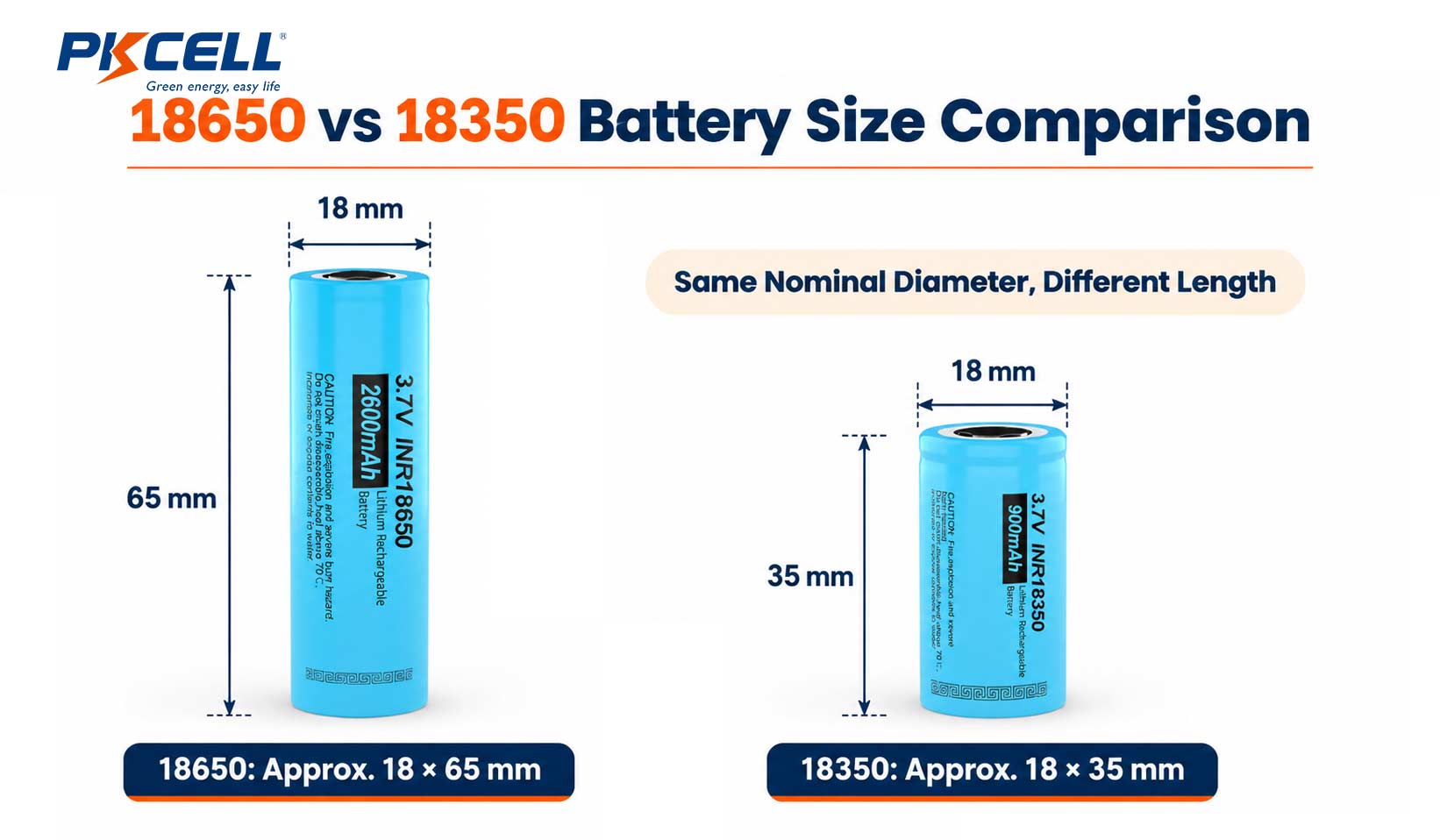
The 18650 and 18350 are both cylindrical rechargeable battery formats with a nominal diameter of about 18 mm. The crucial difference is length: an 18650 is approximately 65 mm long, while an 18350 is approximately 35 mm long. That dimensional difference affects available capacity, runtime, device layout and replacement compatibility.
18650 vs 18350: The Quick Answer
Choose an 18650 battery when runtime, energy capacity, sourcing flexibility and multi-cell pack design are the priorities. Consider an 18350 battery when the product must be significantly shorter and its energy requirement can be met by a smaller cell.
They should not be treated as direct substitutes. Before changing formats, confirm the voltage range, charge profile, discharge current, terminal type, protection circuit and maximum finished dimensions.
What Do 18650 and 18350 Mean?
The format names provide a useful indication of a cylindrical cell’s nominal dimensions:
- 18650: approximately 18 mm in diameter and 65 mm long.
- 18350: approximately 18 mm in diameter and 35 mm long.
The final zero identifies the cylindrical form. However, this code is a size designation, not a complete electrical specification. It does not by itself guarantee chemistry, voltage, capacity, maximum current or charging requirements.
Actual dimensions may also exceed the nominal size. A button top, protection circuit, insulation disc, wrapper or welded tab can add length or diameter. Product designers should therefore use the approved dimensional drawing rather than building an enclosure around the format name alone.
18650 vs 18350 Battery Comparison
| Comparison Point | 18650 Battery | 18350 Battery |
|---|---|---|
| Nominal format size | About 18 × 65 mm | About 18 × 35 mm |
| Relative length | Longer format | Approximately 46% shorter by nominal length |
| Available internal volume | About 86% more nominal cylindrical volume than an 18350 | Smaller energy-storage envelope |
| Capacity tendency | Generally higher | Generally lower |
| Runtime tendency | Usually longer at the same load and efficiency | Usually shorter but supports a more compact product |
| Typical design priority | Runtime, energy and mature pack configurations | Short enclosure and reduced device length |
| Common uses | Portable equipment, lighting, sensors, medical devices and battery packs | Compact flashlights, handheld electronics and space-limited devices |
| Directly interchangeable? | No. Mechanical fit and electrical specifications must both be verified. | |
A smaller battery is not automatically the better compact-design choice. It is only suitable when it can deliver the required energy, peak current and service life within the available thermal and mechanical limits.
Capacity and Runtime: Why the Longer Cell Usually Wins
Because both formats have a similar nominal diameter, most of their size difference comes from length. Based on the nominal dimensions, the cylindrical envelope of an 18650 is approximately 1.86 times that of an 18350. The extra volume can accommodate more active material, although usable capacity still depends on chemistry, electrode design and current capability.
PKCELL’s published 18650 battery range includes capacity options from 1300mAh to 3500mAh. By comparison, representative 18350 manufacturer datasheets reviewed for this guide list examples around 1100mAh and 1400mAh. These are product examples, not universal capacity limits.
Compare Watt-Hours, Not Only Milliamp-Hours
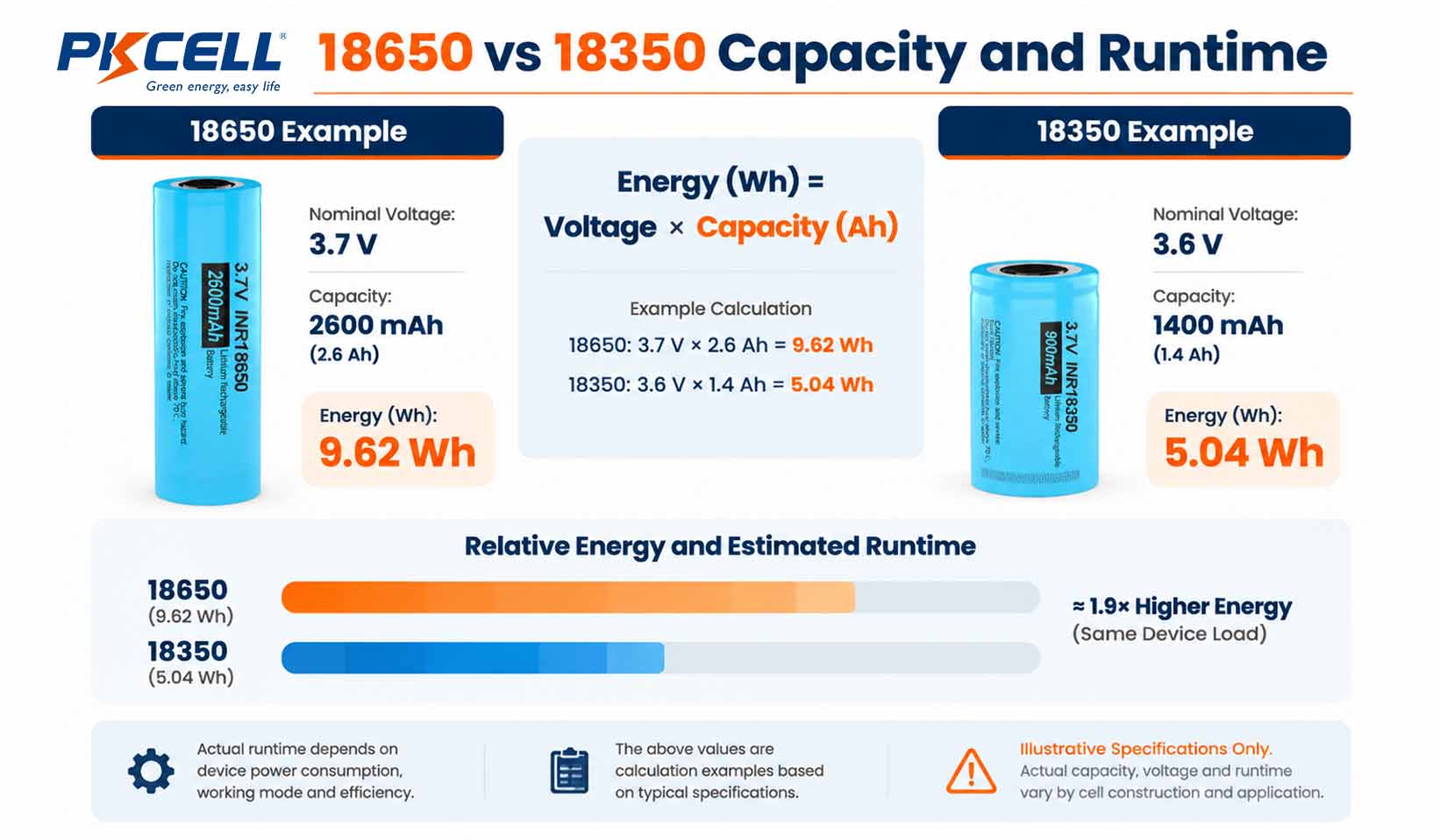
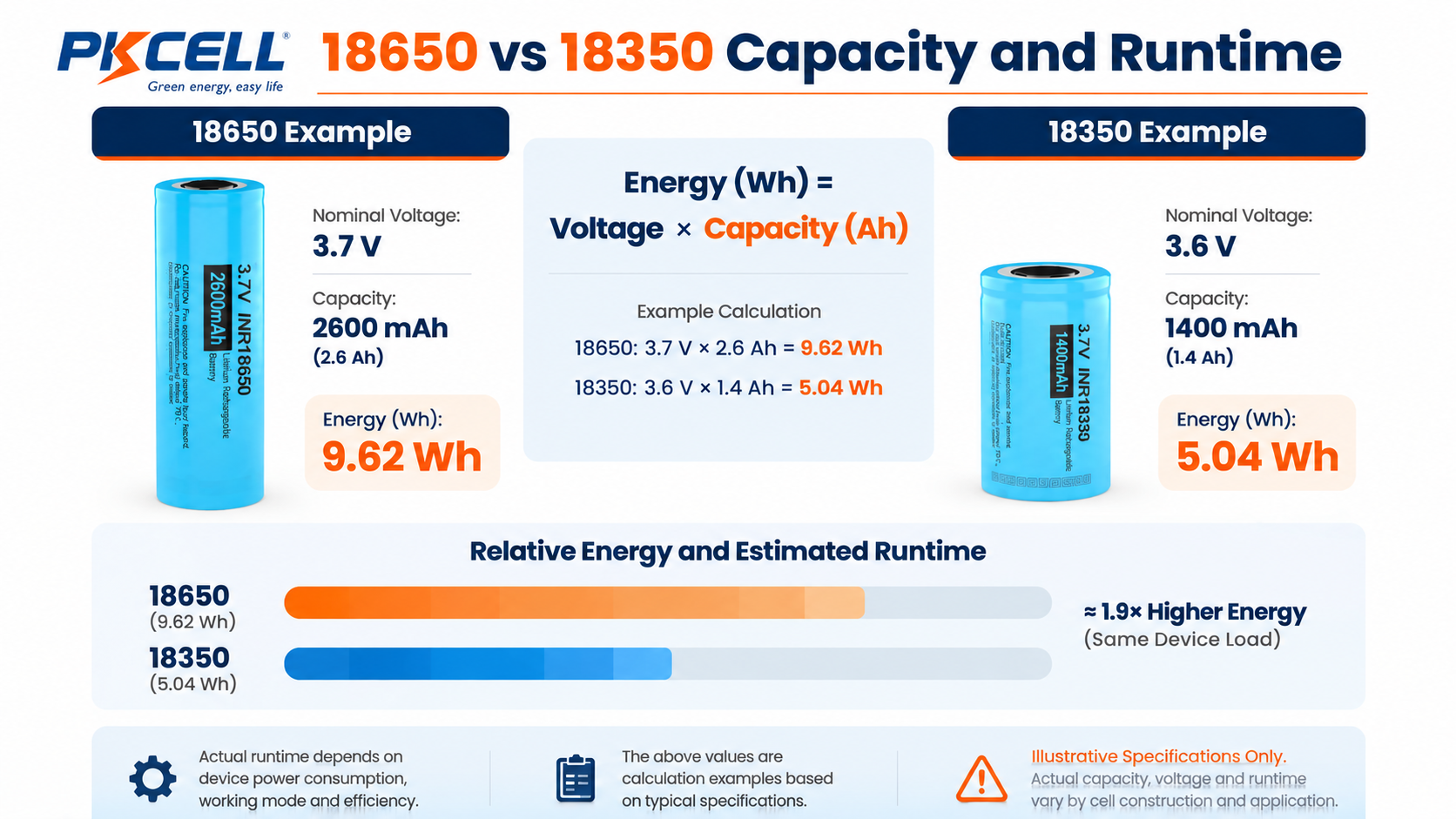
Milliamp-hours can be misleading when batteries have different nominal voltages. Watt-hours provide a more useful estimate of stored energy:
For illustration, a 3.7V, 2600mAh cell provides a nominal 9.62Wh, while a 3.6V, 1400mAh cell provides 5.04Wh. Actual runtime will be lower after accounting for conversion losses, cutoff voltage, temperature, aging and discharge rate.
18650 and 18350 Battery Uses
Where an 18650 Battery Makes Sense
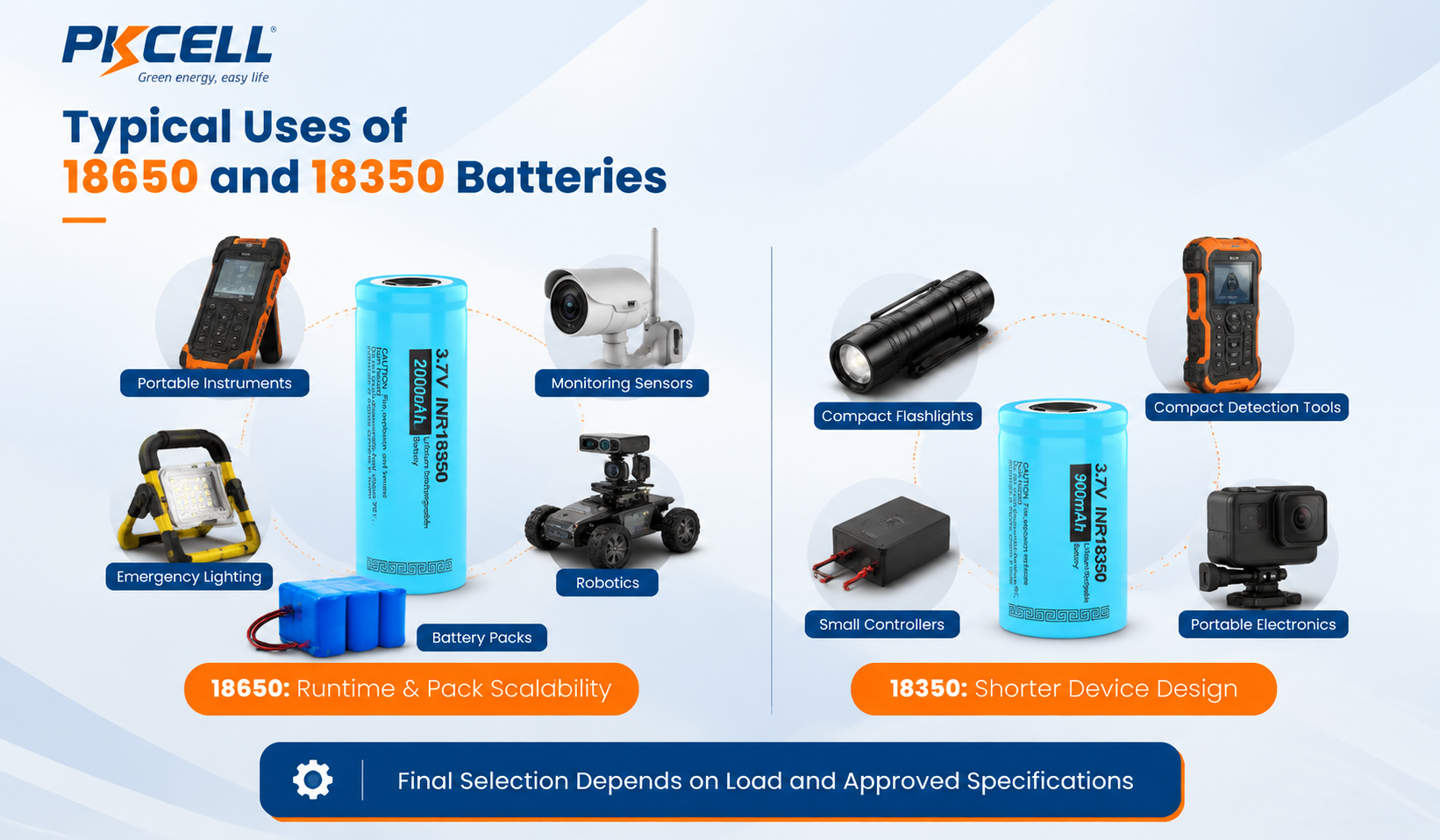
An 18650 is a practical starting point when the enclosure can accept its length and the product benefits from longer runtime. Common application categories include:
- Industrial sensors and remote monitoring equipment
- Rechargeable flashlights and portable lighting
- Medical and diagnostic equipment, subject to application-specific approval
- Robotics, handheld instruments and portable electronics
- Security, GPS and IoT equipment
- Multi-cell packs requiring higher voltage or capacity
For multi-cell projects, review PKCELL’s 18650 battery pack solutions, including common series and parallel configurations.
Where an 18350 Battery Makes Sense
The 18350 is useful when device length is tightly constrained and the load can be supported by its lower energy reserve. Potential applications include:
- Short-body rechargeable flashlights
- Compact optical and inspection equipment
- Small handheld controllers
- Portable instruments with limited internal length
- Specialized sensors and embedded electronics
These examples describe possible application categories, not automatic approvals. The exact cell still needs to be validated against peak current, heat generation, charging method and expected runtime.
Can an 18350 Replace an 18650 Battery?
Usually not without mechanical or electrical changes. Although the nominal diameter is similar, an 18350 is about 30 mm shorter. A loose cell may create unreliable contact, increased resistance or intermittent power. A spacer does not solve differences in capacity, current rating, protection or charging behavior.
Before replacing either format, verify all of the following:
- Cell chemistry: confirm the exact lithium-ion chemistry and specification.
- Nominal and maximum voltage: confirm compatibility with the charger and device electronics.
- Discharge current: check continuous load, startup current and pulse duration.
- Physical dimensions: use maximum dimensions, including the wrapper and terminals.
- Terminal style: determine whether the device requires a flat top, button top, tab or wire lead.
- Protection: confirm whether protection is inside the battery, holder or device.
- Polarity and connection: verify contacts, connector pinout and wire polarity.
- Compliance: review the required test reports and destination-market documentation.
A lithium-ion cell should also be used with an appropriate charge method and protection strategy. Do not modify, solder directly to or mechanically improvise around a cell unless the work is covered by a qualified battery design process.
How to Choose Between 18650 and 18350 for an OEM Product
Choose 18650 When
- Longer runtime is a primary requirement.
- The enclosure can accept a 65 mm-class cell.
- A mature multi-cell pack format is preferred.
- Several capacity options or broader sourcing flexibility are needed.
Consider 18350 When
- The device must be substantially shorter.
- The energy budget is modest and well defined.
- The cell’s peak and continuous current ratings satisfy the load.
- Shorter runtime is acceptable or charging is readily available.
Start With the Product Requirements
The safest selection process begins with the device rather than a preferred cell number. Document:
- Available battery-space drawing and dimensional tolerances
- Average, peak and sleep current
- Required operating time between charges
- Charging input and charge-management design
- Operating and storage temperatures
- Connector, wire, NTC and protection requirements
- Expected annual quantity and target market
- Required certification and shipping documentation
If neither cylindrical format fits the enclosure efficiently, a lithium polymer battery may provide more dimensional flexibility. For a complete engineered assembly, explore PKCELL’s customized battery service.
Need Help Selecting a Battery for Your Device?
Send PKCELL your available space, operating voltage, average and peak current, runtime target, connector details, order quantity and destination market. The team can review a suitable cell or custom battery pack configuration for your project.
Frequently Asked Questions
Is an 18350 battery half the size of an 18650?
It has approximately the same nominal diameter but is about 46% shorter. Based on the nominal cylindrical dimensions, its external volume is roughly 54% of an 18650′s volume.
Do 18650 and 18350 batteries have the same voltage?
Many commercial examples use similar rechargeable lithium-ion voltage systems, but the format name does not define voltage or chemistry. Confirm the datasheet for the exact model before charging or installing it.
Which battery has more capacity, 18650 or 18350?
An 18650 generally offers more capacity because its longer can provides more internal volume. Capacity still varies by model, chemistry and discharge design, so compare approved specifications rather than size alone.
Can I use a spacer to install an 18350 in an 18650 device?
A spacer may address length but does not prove electrical compatibility. Voltage, current capability, protection, polarity, contact resistance and charger behavior still need to be checked by a qualified designer.
Are protected cells longer than their nominal battery size?
They can be. A protection board, terminal cap and wrapper may increase the final length or diameter. Always confirm maximum finished dimensions from the supplier’s drawing.
Which format is better for a custom battery pack?
The better format is the one that meets the pack’s energy, current, thermal, mechanical, compliance and cost requirements. The 18650 is often preferred when runtime and pack scalability matter, while an 18350 may suit a shorter, lower-energy device.
Conclusion
The main difference in the 18650 vs 18350 battery comparison is length. Both are approximately 18 mm in nominal diameter, but the longer 18650 generally provides more capacity and runtime. The shorter 18350 can enable a compact device when its lower energy reserve still satisfies the application.
Neither size should be selected or replaced based on dimensions alone. Confirm the exact electrical specification, maximum dimensions, terminal construction, protection design and required documentation before approving a cell for production. For an application-specific recommendation, submit your battery requirements to PKCELL.
Post time: Oct-22-2026