
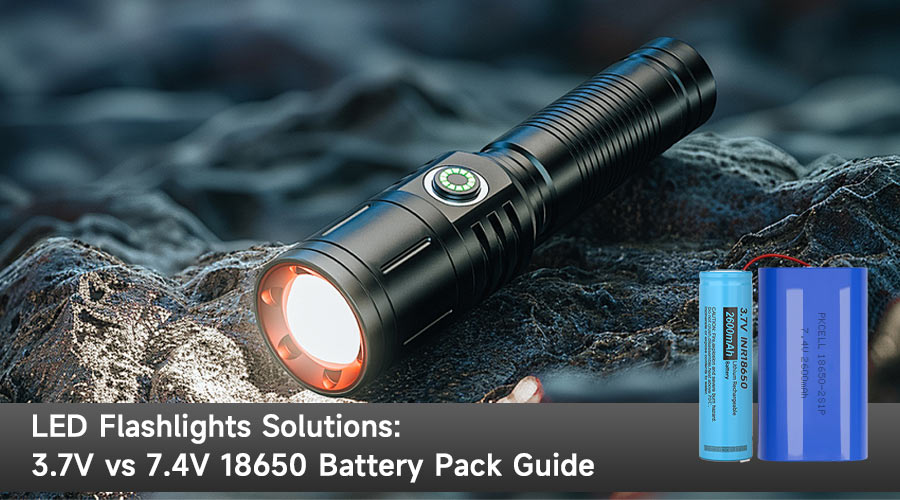
Modern LED flashlights require compact and reliable power systems. Lithium-ion 18650 battery packs provide high energy density and improved lifecycle efficiency, making them the preferred solution for both consumer and professional flashlight designs.
This guide explains how to choose between 3.7V and 7.4V 18650 battery pack solutions using practical engineering considerations.
Why 18650 Batteries Are Widely Used in LED Flashlights
Typical ICR18650 electrical characteristics include:
|
Parameter |
Value |
|
Nominal voltage |
3.7V |
|
Typical capacity |
2600mAh |
|
Charge voltage |
4.2V |
|
Cycle life |
500+ cycles |
|
Rechargeable |
Yes |
Compared with AA battery solutions, a single 18650 2600mAh battery delivers higher usable energy while reducing replacement frequency and long-term operating cost.
For flashlight manufacturers, this also simplifies the mechanical structure and enables compact product housing design.
Understanding Flashlight Power Requirements Before Selecting a Battery Pack
Most modern LED flashlights use constant-current drivers to maintain stable brightness during discharge. These drivers behave differently depending on LED configuration: single high-power LED, multiple LEDs connected in series, multi-mode brightness control drivers or high-lumen tactical lighting drivers.
A single LED flashlight typically operates efficiently from a 3.7V battery pack, while multi-LED or long-distance beam flashlights usually benefit from a 7.4V battery pack platform that improves driver efficiency and reduces current stress.
Common 18650 Battery Pack Configurations for Flashlight Systems
Two configurations dominate rechargeable flashlight design: 1S1P (3.7V) and 2S1P (7.4V). The difference is not just voltage — it affects runtime stability, driver complexity, and brightness capability.
3.7V 2600mAh 1S1P Battery Pack
A single-cell configuration is widely used in compact flashlight products. It matches the operating voltage range of most single high-power LEDs and supports USB rechargeable flashlight designs.
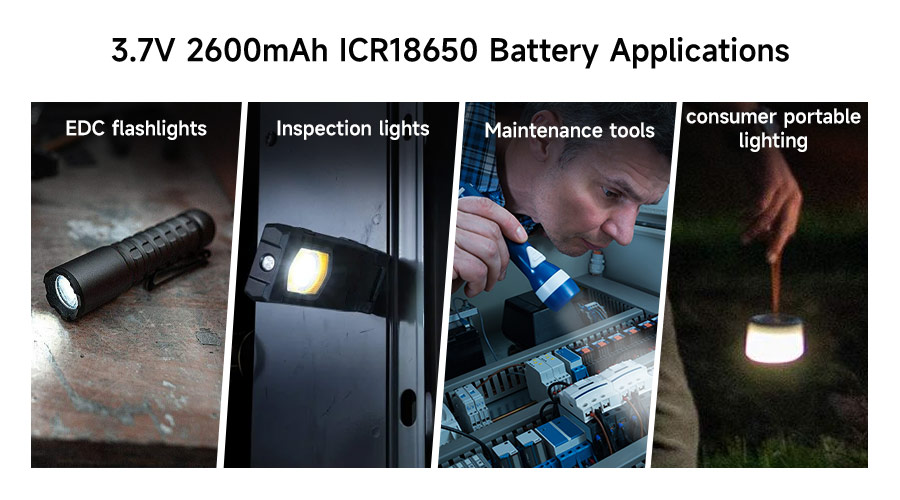
Typical applications include:
-
EDC flashlights
-
inspection lights
-
maintenance tools
-
consumer portable lighting
Advantages:
-
compact structure
-
simplified driver design
-
lower system cost
-
easier charging integration
7.4V 2600mAh 2S1P Battery Pack
Dual-cell configurations are preferred when higher brightness output or longer beam distance is required.
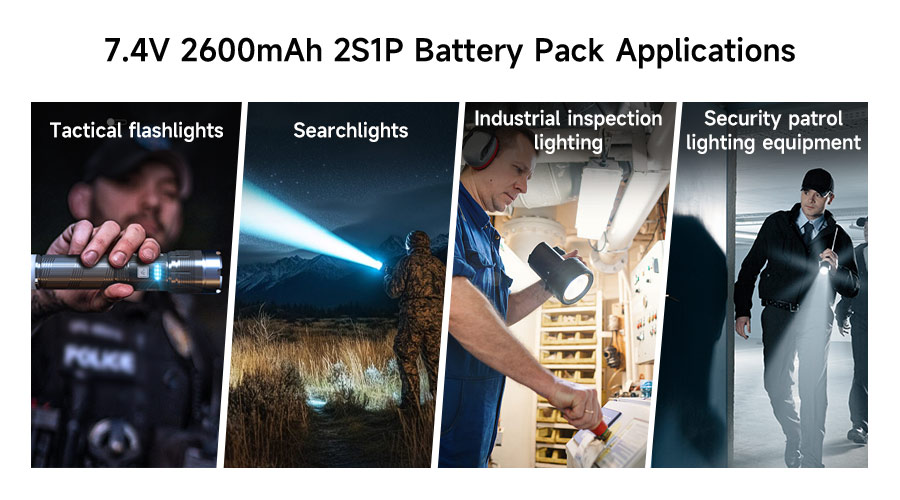
Typical applications include:
-
tactical flashlights
-
searchlights
-
industrial inspection lighting
-
security patrol lighting equipment
Advantages:
-
higher brightness capability
-
improved driver efficiency
-
lower current stress per cell
-
better thermal stability
Quick Configuration Comparison
|
Feature |
3.7V |
7.4V Pack |
|
Structure |
single cell |
2S1P |
|
Brightness level |
medium |
high |
|
Driver complexity |
low |
medium |
|
Charging design |
simple |
moderate |
|
Typical flashlight type |
compact |
professional |
Runtime Estimation Example for 18650 Flashlight Battery Packs
Battery energy can be estimated using:
For example, a 3.7V 2600mAh battery pack provides approximately 9.6Wh of available energy. When powering a 5W LED flashlight, the expected runtime is typically close to two hours after considering driver efficiency losses.
A 7.4V 2600mAh battery pack doubles the available energy platform and is commonly used in 10W-class tactical flashlight systems.
Typical runtime expectations are shown below:
|
LED Power |
Battery Configuration |
Estimated Runtime |
|
5W |
3.7V 2600mAh |
~2 hours |
|
10W |
7.4V 2600mAh |
~2 hours |
These values help designers select the correct battery architecture during early product planning stages.
Protection Circuit Design for Rechargeable Flashlight Battery Packs
Because lithium-ion batteries operate within a defined voltage range, protection electronics are essential for safe flashlight operation. Proper protection circuit modules, such as over-charge protection, over-discharge protection, over-current protection and short-circuit protection, ensure stable performance during repeated charging cycles and prevents abnormal electrical conditions.
Mechanical Integration Considerations for Flashlight Battery Packs
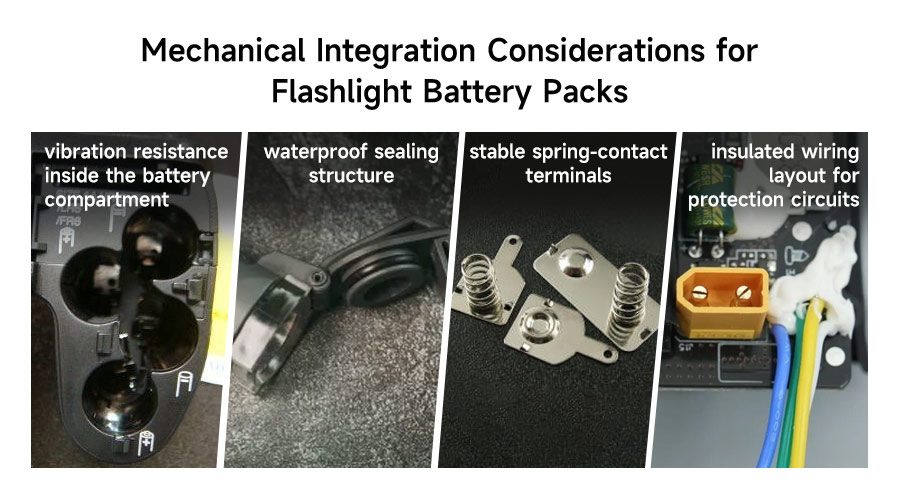
Mechanical integration also affects long-term reliability in real-world applications. Designers should consider vibration resistance inside the battery compartment, whether waterproof sealing structure is needded, and carefully choose stable spring-contact terminals and insulated wiring layout for protection circuits.
Proper mechanical structure helps maintain consistent battery contact even during outdoor movement or impact conditions.
Future Trends in Rechargeable Flashlight Battery Design
Rechargeable flashlight battery systems continue evolving alongside LED driver technology and portable electronics charging standards.
Emerging trends include:
-
USB-C charging interfaces
-
smart battery level indication systems
-
modular replaceable battery structures
-
higher-efficiency LED driver integration
As portable lighting performance requirements increase, optimized 18650 lithium-ion battery pack solutions will remain the core power architecture for professional flashlight products.
Battery Pack Solutions for Flashlight Manufacturers
Standard battery packs cannot always meet the structural requirements of modern flashlight designs. Many lighting manufacturers therefore adopt customized lithium-ion battery pack solutions.
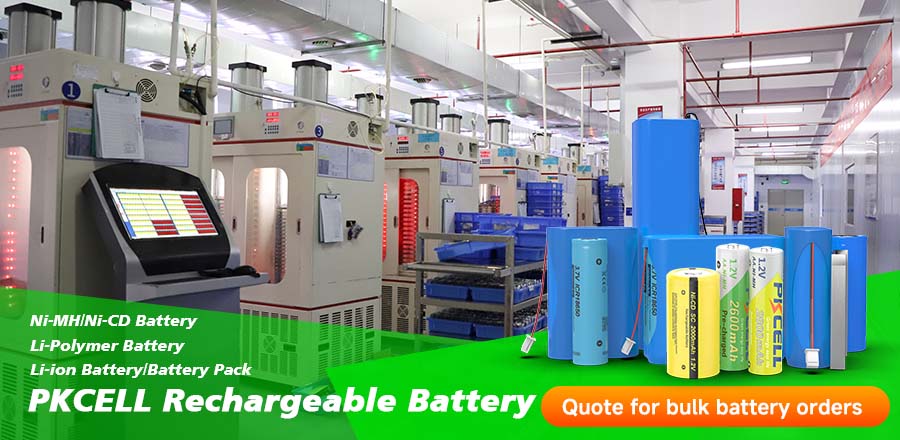
A reliable battery manufacturer like PKCell offers OEM battery service, as well as battery qualifications to ensure battery safety and compliant international shipping. Our engineer will also help with battery pack design. If you have any questions, just contact us today!
Contact PKCell for Battery Solution
FAQs
What battery is best for LED flashlights?
Rechargeable 18650 lithium-ion battery packs provide the best balance between runtime, brightness stability, and lifecycle performance.
Is 18650 better than AA batteries for flashlights?
Yes. 18650 batteries deliver higher energy density and support rechargeable operation, making them more suitable for modern LED flashlight systems.
How long does a 2600mAh flashlight battery last?
A typical 5W flashlight powered by a 3.7V 2600mAh battery usually operates for about two hours depending on driver efficiency.
Can flashlight battery packs be customized?
Yes. Voltage configuration, wiring structure, protection circuits, and connector types can all be customized for specific flashlight designs.
Post time: Apr-16-2026


