
18650 Battery Cycle Life: Causes and Ways to Extend It
How long do 18650 batteries last? A cycle-count label offers only part of the answer. Real 18650 lifespan depends on chemistry, temperature, charge voltage, depth of discharge, current, storage state of charge, cell matching, pack design, and the point at which the device can no longer meet its runtime or power requirement.
Quick answer: PKCELL product pages commonly list around 500 or 500+ cycles for specific 18650 models under stated conditions, while some pack specifications define at least 300 cycles before capacity falls below 80% of rated value. These figures are not contradictory: cycle life changes with the cell, test rate, temperature, voltage window, depth of discharge, rest periods, and end-of-life criterion.
Always compare cycle-life claims using the complete test conditions. “500 cycles” without charge rate, discharge rate, temperature, cutoff voltages, depth of discharge, and remaining-capacity threshold is incomplete.
What Does 18650 Cycle Life Mean?
Cycle life is the number of charge-discharge cycles a cell or battery completes before reaching a defined performance limit. A common laboratory endpoint is 80% of rated capacity, but the exact threshold belongs to the specification.
One cycle does not always mean one connection to a charger. Partial discharges can be combined as equivalent full cycles. For example, two 50% discharges represent approximately one full cycle of energy throughput, although aging is not perfectly proportional because voltage range, current, temperature, and time also matter.
PKCELL’s published 7.4V 5200mAh pack specification, for example, defines cycle testing at 25°C using a 0.2C charge and discharge process and continues until discharge capacity falls below 80% of rated capacity. Its requirement is at least 300 cycles. By contrast, several current PKCELL cell pages list 500+ cycles under their stated cell-level conditions.
This is why OEM teams should compare the test method, not just the largest number. Explore PKCELL’s 18650 battery range and verify the exact model datasheet before forecasting service life.
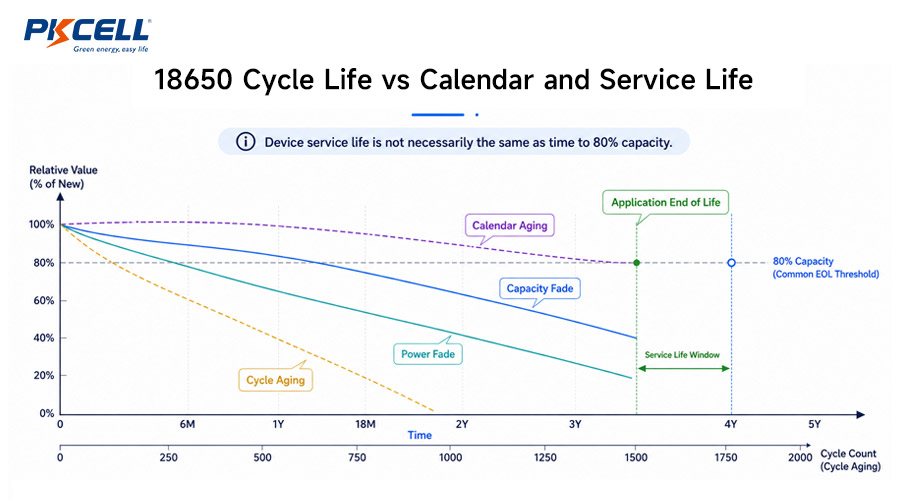
Cycle Life, Calendar Life, and Service Life
These terms describe different limits:
| Life Metric | What It Measures | Main Stress Factors | Typical OEM Question |
|---|---|---|---|
| Cycle life | Charge-discharge throughput before a defined endpoint | Depth of discharge, C-rate, voltage window, temperature | How many operating cycles can the battery deliver? |
| Calendar life | Degradation with time, including storage and standby | Temperature, state of charge, time, chemistry | Will the pack still perform after years in service? |
| Capacity life | Decline in usable amp-hours or watt-hours | Loss of lithium inventory and active material | When will runtime fall below the requirement? |
| Power life | Ability to deliver current without excessive voltage sag or heat | Resistance rise, interconnect aging, cell imbalance | Can the pack still start the motor, radio, pump, or tool? |
| Service life | Time until the battery no longer meets the device requirement | All electrical, mechanical, environmental, and maintenance factors | When should the product replace the pack? |
A low-duty backup battery can age mainly by time even if it completes few cycles. A power tool can reach its cycle or power limit quickly. A hot outdoor tracker may experience both calendar aging and cycling stress.
The battery reaches end of service when it fails the application requirement—not necessarily when a laboratory cycle counter reaches 300 or 500.
How Long Do 18650 Batteries Last in Years?
A rough cycle-based estimate divides the rated cycle count by equivalent full cycles per day. It is useful for planning, but it does not include calendar aging.
| Example Rated Life | Equivalent Full Cycles per Day | Cycle-Based Estimate | Important Limitation |
|---|---|---|---|
| 300 cycles | 1.0 | About 0.82 years | Calendar aging, heat, high state of charge, current, cell variation, and device requirements can shorten or change the result. |
| 500 cycles | 1.0 | About 1.37 years | |
| 500 cycles | 0.5 | About 2.74 years | |
| 500 cycles | 0.25 | About 5.48 years |
These are arithmetic examples, not PKCELL lifespan guarantees. A battery stored hot and fully charged can lose capacity without completing cycles; a moderate-duty battery can remain in service after the nominal cycle count if it still meets the approved performance threshold.
For an accurate forecast, define the device duty cycle, daily energy throughput, temperature history, charge profile, storage periods, voltage window, current peaks, and end-of-life requirement. Then test representative cells or packs under an accelerated profile that preserves the relevant aging mechanisms.
What Causes 18650 Capacity Loss?
Lithium-ion capacity fade is not one reaction. Several mechanisms interact, and the dominant mechanism changes with chemistry and use.
SEI Growth and Loss of Lithium Inventory
A protective solid-electrolyte interphase forms on the negative electrode. Continued side reactions can thicken this layer, consume cyclable lithium, and increase resistance. NREL-supported life modeling identifies SEI growth and cycling-driven acceleration of SEI growth among important capacity-fade processes.
Electrode Cracking and Loss of Active Material
Repeated lithium insertion and removal changes particle dimensions. Mechanical stress can crack electrode particles, isolate active material, expose fresh surfaces, and trigger additional interphase growth. This reduces available capacity and can raise impedance.
Lithium Plating
Charging too quickly, especially at low temperature or high state of charge, can cause metallic lithium to deposit on the anode instead of intercalating normally. Research on fast charging links plating with lithium loss, SEI damage, resistance change, and accelerated capacity fade.
Electrolyte and Cathode Degradation
High voltage and heat accelerate parasitic reactions. Cathode structure can change, electrolyte can decompose, and interfacial resistance can grow. The effect depends strongly on the exact chemistry and operating window.
Cell Imbalance in a Battery Pack
A series pack is limited by its weakest group. Differences in capacity, impedance, temperature, leakage, weld resistance, or aging can make one group reach charge or discharge limits first. The BMS then cuts off the entire pack even though other groups retain usable energy.
The Seven Biggest 18650 Lifespan Stress Factors
1. High Temperature
Heat accelerates side reactions and calendar aging. It can come from ambient conditions, direct sunlight, charging, high current, nearby electronics, or poor enclosure ventilation. Cell-to-cell temperature gradients also cause uneven aging in packs.
2. Long Time at High State of Charge
Holding a lithium-ion cell near full charge increases electrode potential and can accelerate parasitic reactions. Products that remain plugged in continuously need a deliberate charge-maintenance strategy rather than assuming 100% state of charge is always best.
3. Deep Discharge
Using the full voltage window creates more cycling stress than shallower operation. Discharging below the approved limit can damage the cell and make recovery unsafe. The device should shut down normally before last-resort BMS protection.
4. High Charge Current
Faster charging increases concentration gradients and heat. At low temperature or high state of charge, it can increase lithium-plating risk. Use the cell’s specified charge profile and derating rules.
5. High Discharge Current
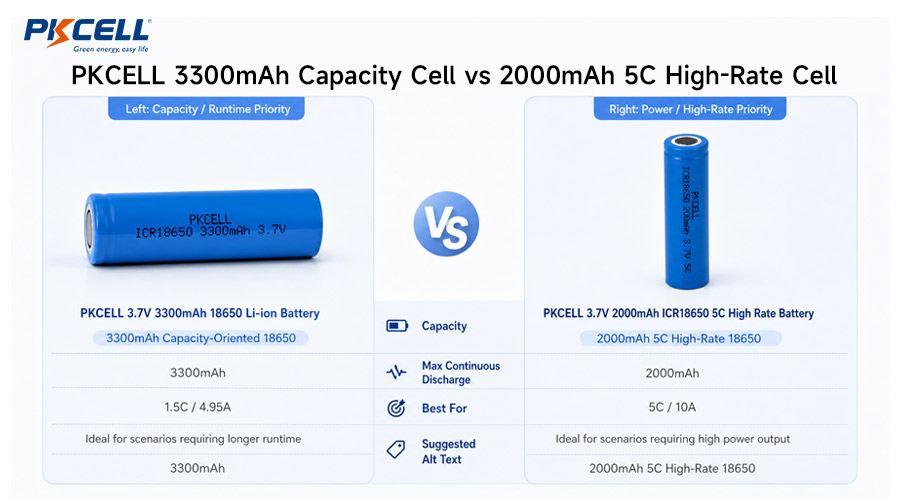
High current creates internal heat and voltage sag. A cell marketed for maximum capacity may not be suitable for power tools, motors, or radio pulses. Parallel count, busbars, wires, connectors, cooling, and duty cycle all affect pack stress.
6. Charging at Low Temperature
Cold cells accept charge less readily. Charging outside the approved temperature range can cause rapid degradation or lithium plating even when the charger voltage is correct. Temperature sensing and charge inhibition are important.
7. Poor Cell Matching or Pack Design
Mixing models, batches, capacities, ages, or unknown histories creates uneven current sharing and earlier cutoff. Asymmetric interconnects, weak welds, poor BMS sensing, and hot spots can shorten usable pack life even when the cells are genuine.
How to Extend 18650 Battery Service Life
Keep the Battery Cool
Design airflow, heat spreading, enclosure materials, and charging schedules so cells remain within the approved range. Avoid storing packs in hot vehicles, near heaters, or in direct sun. Measure cell temperature rather than relying only on ambient temperature.
Avoid Unnecessary Full-Charge Dwell
If the application does not need maximum runtime every cycle, evaluate a lower normal charge ceiling or a delayed final charge. The tradeoff is less energy per use, so the strategy must be validated against the product requirement.
Use a Moderate Depth of Discharge
Recharge before the device repeatedly reaches its lowest allowed voltage. Partial cycles can reduce cycling stress, although they do not stop calendar aging. Do not deliberately deep-cycle lithium-ion batteries for “calibration” unless the product manufacturer specifies a controlled procedure.
Match Current to the Cell
Select high-energy or high-power cells according to the real load. Use moderate charge current when turnaround time allows, and reduce current at temperature or state-of-charge conditions required by the datasheet.
Use the Correct Charger and BMS
The charger should control voltage, current, termination, and temperature. The BMS should monitor series groups and provide suitable overcharge, over-discharge, overcurrent, short-circuit, and temperature protection. Neither component compensates for an unsuitable cell.
Store at a Moderate State of Charge
For long storage, follow the specific datasheet. PKCELL’s industrial storage guide recommends partial state of charge rather than leaving cells completely full or empty, along with a cool, controlled environment and periodic inspection.
Control Pack Consistency
Use matched cells from an approved production lot, symmetrical current paths, verified welds, correctly placed sensors, and controlled assembly. Track lot, capacity, impedance, BMS revision, and pack test results.
PKCELL’s article on extending lithium-ion battery life also emphasizes temperature, state of charge, and current. Its 18650 storage guide covers charge level, storage environment, and terminal protection for industrial inventories.
When Should an 18650 Battery Be Replaced?
Capacity below 80% is a common laboratory endpoint, but application retirement criteria should be defined from system risk and performance. Replace or investigate a cell or pack when:
- Runtime falls below the minimum service requirement
- Voltage sag causes resets or early BMS cutoff
- Charging or discharging produces unusual heat
- Cell-group imbalance grows beyond the approved limit
- Charge time changes unexpectedly
- The pack is swollen, dented, leaking, corroded, or physically damaged
- The BMS records repeated overcurrent, temperature, or undervoltage events
- Internal resistance or delivered power exceeds the device acceptance limit
How OEMs Should Specify Cycle Life
A useful cycle-life requirement contains a complete test profile:
- Exact cell and chemistry
- Minimum initial capacity
- Charge voltage and current
- Charge termination current
- Discharge current and cutoff
- Depth of discharge
- Cell and ambient temperature
- Rest time between steps
- End-of-life capacity threshold
- Power or resistance threshold
- Measurement interval
- Sample quantity and lot coverage
- Pack configuration and BMS
- Calendar-aging requirement
- Storage and standby profile
- Pass/fail statistical method
PKCELL’s lithium-ion datasheet guide explains how capacity, voltage, current, impedance, temperature, and cycle conditions translate into pack-level requirements.
Need an 18650 Cell or Pack for a Long-Life Device?
Send PKCELL your voltage, runtime, daily duty cycle, peak current, charge profile, temperature history, storage state, mechanical envelope, target cycle life, end-of-life threshold, annual volume, and certification requirements.
Frequently Asked Questions
How long do 18650 batteries last?
Many specific 18650 products are rated around 300–500+ cycles under defined tests, but service life in years depends on daily energy throughput, temperature, state of charge, current, storage time, and the device’s retirement threshold.
What does 500 cycles mean for an 18650 battery?
It means the cell completed the specified charge-discharge test 500 times while meeting the stated endpoint. It does not mean failure occurs suddenly on cycle 501, and the claim is incomplete without the test conditions.
Is an 18650 battery dead at 80% capacity?
Not necessarily. Eighty percent is a common cycle-test endpoint. A device may require earlier replacement because of power fade, or it may continue operating at lower capacity if safety and performance requirements are still met.
Do partial charges count as cycles?
Partial charge-discharge events contribute to equivalent full cycles. Two 50% discharges represent approximately one full cycle of energy throughput, though aging also depends on voltage, temperature, current, and time.
Does fast charging reduce 18650 lifespan?
Higher charge current can increase heat, concentration gradients, and lithium-plating risk, especially when cold or near full charge. The effect depends on the exact cell and charging controls.
Is it bad to keep an 18650 battery fully charged?
Long periods at high state of charge can accelerate calendar aging, especially at elevated temperature. If full runtime is not always required, an OEM can evaluate a lower normal charge limit.
Should I fully discharge an 18650 before charging?
No. Lithium-ion batteries do not need routine deep discharge to avoid memory effect. Repeated deep cycling generally adds stress and risks reaching the low-voltage limit.
Why does an old 18650 shut down under load?
Internal resistance typically rises with age. A current peak then causes greater voltage sag, which can trigger the device or BMS undervoltage cutoff even when some capacity remains.
Can cells from different brands or ages be mixed?
They should not be mixed in an engineered pack without a qualified design and matching process. Different capacity, impedance, age, and temperature behavior can cause imbalance and uneven current sharing.
Conclusion
18650 cycle life is not one universal number. A rating of 300 or 500+ cycles describes performance under a particular test, while real 18650 lifespan also includes calendar aging, capacity fade, resistance rise, device load, pack imbalance, temperature, and storage history.
The most effective service-life strategy is systematic: choose the correct cell for energy and power, keep it within the approved temperature and voltage range, avoid unnecessary high-SOC dwell and deep discharge, use moderate current where practical, design a suitable charger and BMS, control cell matching, and define an application-specific replacement threshold.
Post time: Sep-01-2026


