
14500 vs 16340 Battery: Size, Capacity, Voltage and Compatibility
Choosing between a 14500 and a 16340 battery involves more than comparing capacity. Both formats are used for rechargeable cylindrical lithium-ion cells, and both have 3.7V nominal-voltage options. However, the 16340 is wider and shorter, while the 14500 is narrower and longer. These differences affect battery-holder design, available capacity, runtime and whether a cell can fit an existing device.
14500 vs 16340: The Quick Answer
Choose a 14500 battery when the design calls for a narrower, AA-sized cylindrical format. Consider a 16340 battery when a wider, shorter cell fits the enclosure and its energy output meets the device’s requirements.
Neither format is automatically interchangeable with the other. Confirm the actual dimensions, chemistry, operating voltage range, current capability, terminal design and charging requirements before approving a replacement.
14500 vs 16340 Battery Size: What Is the Difference?
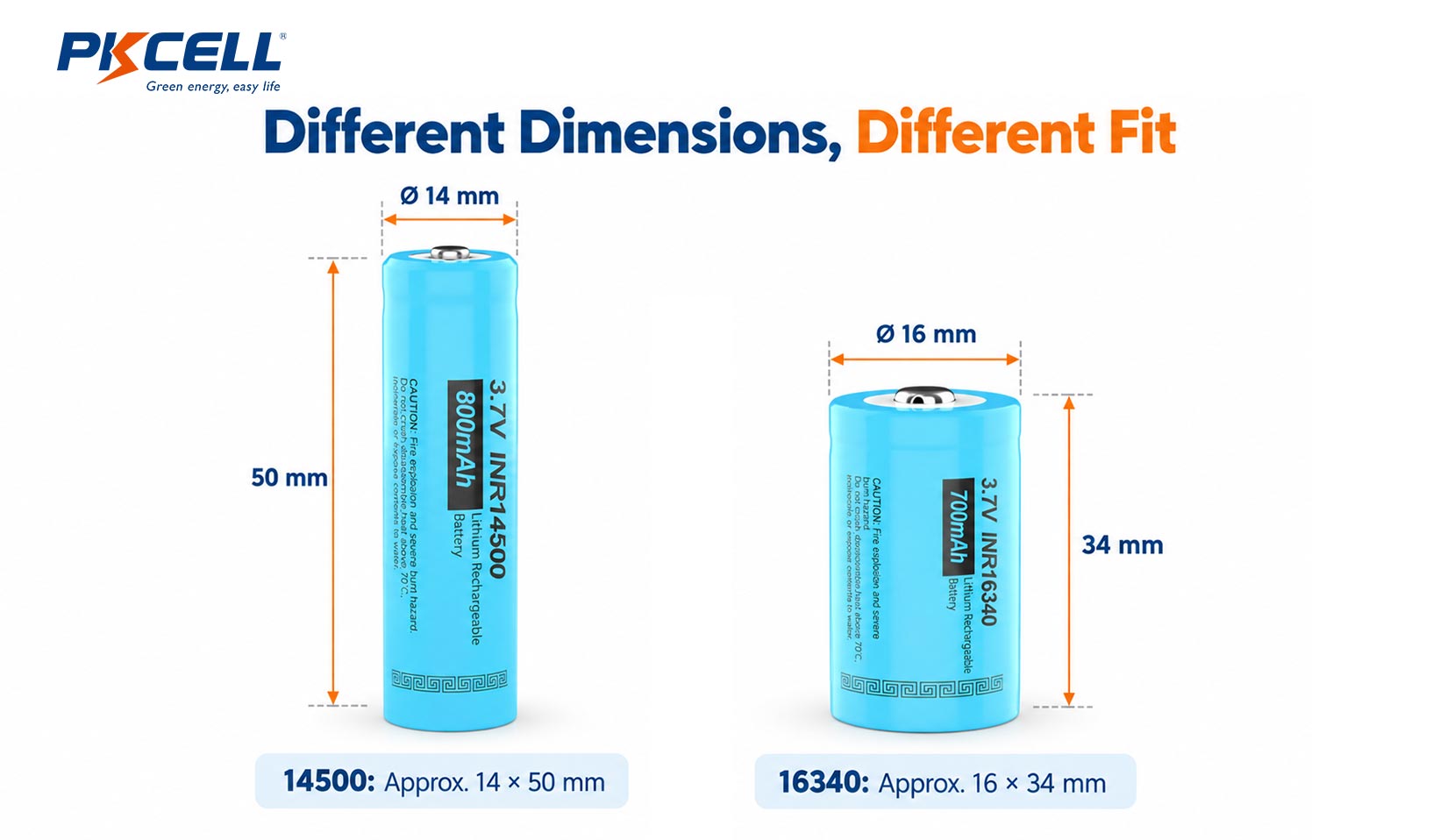
The numbers in these battery format names indicate approximate dimensions. A 14500 cell is nominally about 14 mm in diameter and 50 mm long. A 16340 cell is nominally about 16 mm in diameter and 34 mm long.
This means the 16340 is approximately 2 mm wider, but about 16 mm shorter. For product designers, the distinction matters when a battery sits inside a molded enclosure, a cylindrical holder, a compact lighting product or a custom battery compartment.
| Dimension | 14500 Battery | 16340 Battery |
|---|---|---|
| Nominal diameter | Approximately 14 mm | Approximately 16 mm |
| Nominal length | Approximately 50 mm | Approximately 34 mm |
| Shape | Narrower and longer | Wider and shorter |
| Mechanical design priority | Smaller diameter and greater length | Shorter length with a larger diameter |
Actual finished dimensions can vary by manufacturer and construction. Button-top terminals, protection circuits, wrappers and welded tabs may increase the overall size. Always use the approved product drawing and maximum dimensional tolerances when designing a holder or enclosure.
14500 vs 16340 Battery Specifications
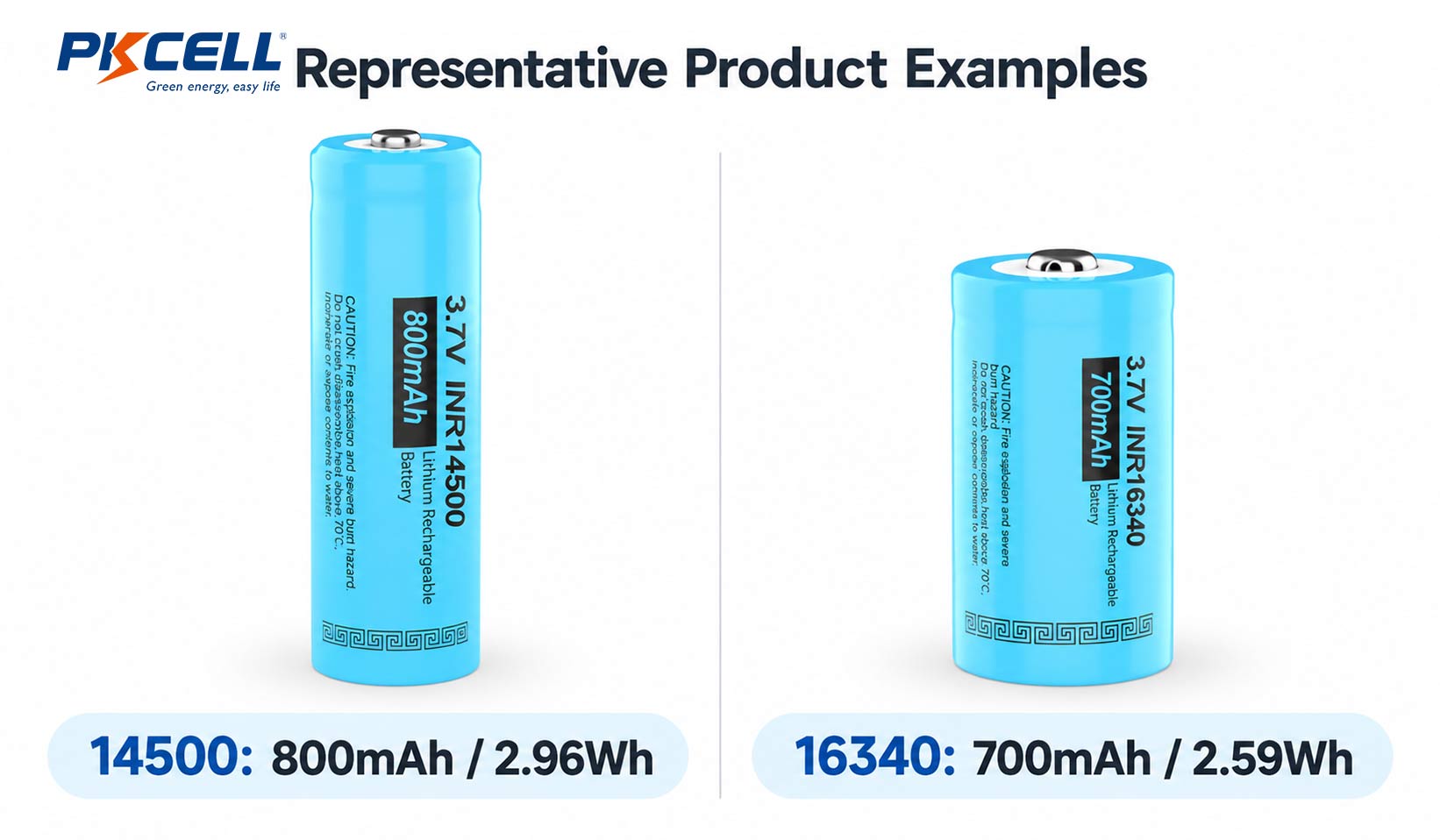
PKCELL lists representative 14500 and 16340 rechargeable lithium-ion cells with a nominal voltage of 3.7V. The following figures illustrate two specific product configurations rather than fixed specifications for every cell in either format.
| Specification | 14500 Example | 16340 Example |
|---|---|---|
| Nominal voltage | 3.7V | 3.7V |
| Capacity | 800mAh | 700mAh |
| Published dimensions | Approximately 14.2 × 50.2 mm | Approximately 16.8 × 34 mm |
| Nominal energy calculated from listed ratings | 2.96Wh | 2.59Wh |
| Main dimensional characteristic | Narrower, longer | Wider, shorter |
Explore the 14500 lithium-ion battery specifications and the 16340 lithium-ion battery product page for model-specific information.
Do not assume that every 14500 cell has an 800mAh capacity or every 16340 cell has a 700mAh capacity. Available capacity depends on the particular model, electrode design, chemistry, discharge conditions and other manufacturer specifications.
14500 vs 16340 Capacity: Which Lasts Longer?
Capacity, expressed in milliamp-hours (mAh), indicates how much electric charge a battery can deliver under specified test conditions. For the representative products above, the 14500 cell has a higher rated capacity: 800mAh compared with 700mAh.
However, capacity alone does not establish which battery will deliver longer runtime in every application. Actual performance depends on the device’s current demand, cutoff voltage, temperature, conversion losses, battery age and discharge characteristics.
Compare Stored Energy as Well as Capacity
Watt-hours (Wh) combine nominal voltage and capacity to provide a useful estimate of stored energy.
Energy (Wh) = Nominal Voltage (V) × Capacity (Ah)
- 14500 example: 3.7V × 0.8Ah = 2.96Wh.
- 16340 example: 3.7V × 0.7Ah = 2.59Wh.
These calculations suggest that the listed 14500 example stores more nominal energy. They do not guarantee a particular operating time. For a device with variable loads, measure the average power demand and validate the result under realistic operating conditions.
14500 vs 16340 Voltage: Are They the Same?
Both 14500 and 16340 are available as 3.7V nominal lithium-ion cells. This shared nominal voltage can make them appear electrically similar, but it does not make them universal substitutes.
For a conventional single-cell 3.7V lithium-ion product, the fully charged voltage is commonly 4.2V. The exact permitted voltage range and charging conditions must be confirmed using the selected cell’s datasheet.
Three voltage checks are especially important:
- Nominal voltage: the reference voltage used to describe the cell.
- Maximum charging voltage: the upper charging limit specified for the particular chemistry and model.
- Operating and cutoff voltage: the voltage range the device can accept under actual load conditions.
Do Not Confuse 16340 With CR123A
A rechargeable 16340 is also commonly called an RCR123A in the market. However, a rechargeable 16340 lithium-ion cell is not automatically interchangeable with a primary CR123A battery.
Standard primary CR123A cells typically have a nominal voltage of 3.0V, whereas rechargeable 16340 lithium-ion cells commonly have a nominal voltage of 3.6V or 3.7V, depending on the model. Their fully charged voltage and charging requirements also differ.
Before replacing a CR123A with a rechargeable cell, check the device manufacturer’s approved battery types, voltage limits and charging instructions. Similar dimensions do not establish electrical compatibility.
For a broader overview of cell chemistries and voltage ranges, see PKCELL’s 3.7V battery guide.
Can You Replace a 14500 Battery With a 16340?
In most devices, a 14500 and a 16340 should not be treated as direct replacements. The 16340 is wider and shorter, so it may not fit a holder designed for a narrower 14500. Even if the cell can be physically installed, electrical and terminal compatibility must still be verified.
Check These Six Compatibility Factors
- Physical fit: confirm the maximum cell diameter and length, including terminals, wrapper and protection components.
- Voltage range: confirm that the device accepts the cell’s nominal, fully charged and loaded voltages.
- Capacity and runtime: verify that the selected cell meets the required operating time.
- Discharge capability: check continuous current, peak current and allowable temperature rise.
- Terminal and polarity: confirm flat-top or button-top construction, contact layout and electrical polarity.
- Charging and protection: use a compatible charging system and verify the protection requirements of the device.
Never assume that a spacer or modified holder makes the two formats interchangeable. An improvised connection can introduce unstable contact, additional resistance or other electrical and mechanical risks.
14500 vs 16340: Which Battery Is Better for Your Application?
When a 14500 May Be the Better Choice
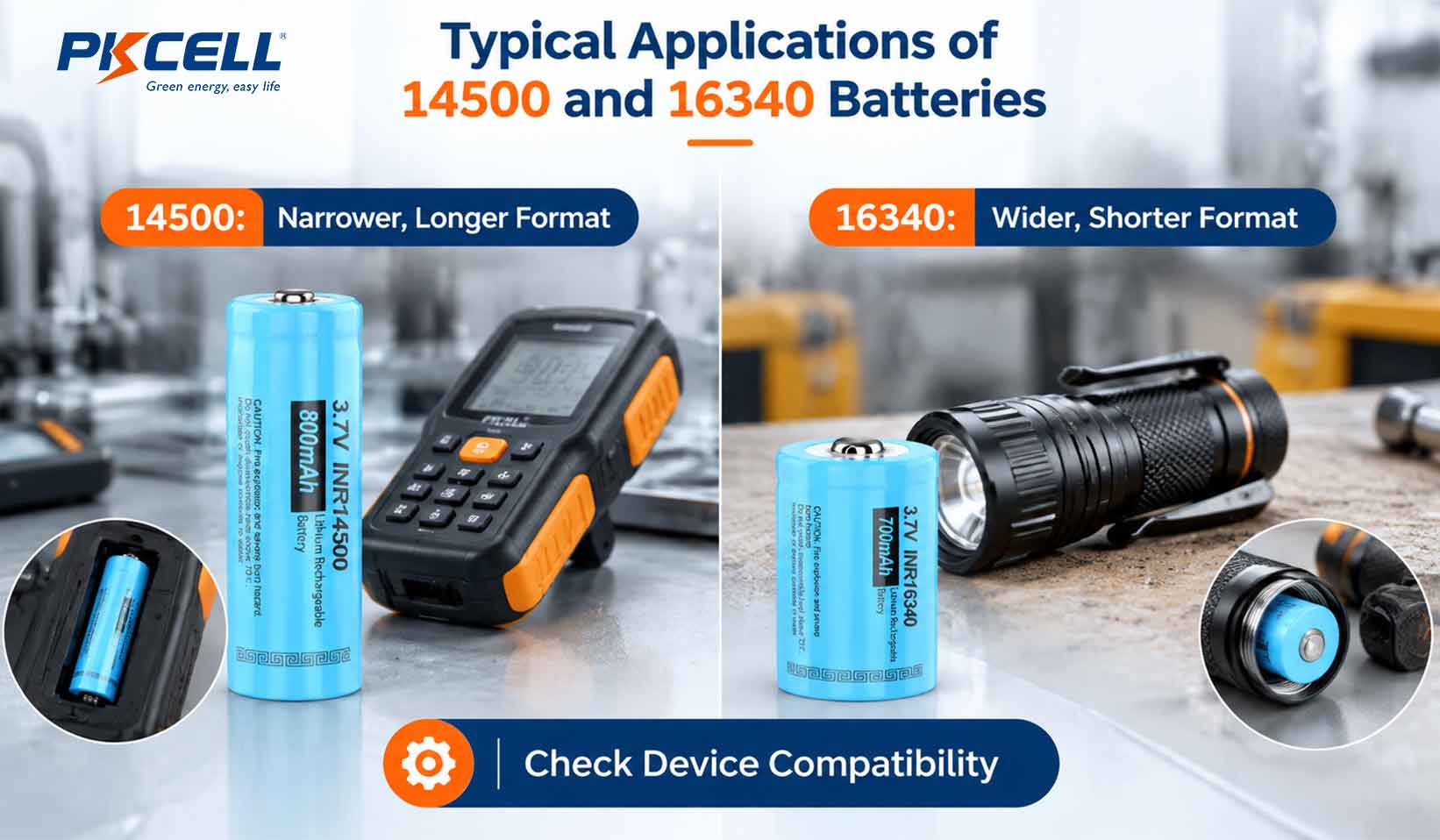
A 14500 is worth evaluating when the product requires a relatively narrow cylindrical cell and the enclosure has sufficient length. Potential application categories include:
- Compact electronic equipment designed for the 14500 format
- Portable instruments and handheld devices
- Selected lighting products with compatible voltage requirements
- Small electronic assemblies and custom battery packs
Its AA-like dimensions can simplify some mechanical layouts, but a rechargeable 14500 must not be assumed to replace a 1.5V AA alkaline battery. Their voltage characteristics are different.
When a 16340 May Be the Better Choice
A 16340 may be appropriate when the enclosure has limited length but can accommodate a wider cell. Possible application categories include:
- Compact lighting products designed for rechargeable 16340 cells
- Space-constrained handheld electronics
- Selected monitoring or control devices with compatible power systems
- Equipment originally engineered around the 16340 form factor
The correct choice depends on the approved electrical specification, available space, expected runtime, current profile and charging design. Application examples alone do not establish suitability for a specific device.
Choosing Cells for a Custom Battery Project
For OEM products, the battery decision should start with the device’s electrical and mechanical requirements rather than the cell model number. Document the available battery space, average and peak current, operating time, temperature range, terminal type and expected production quantity.
If your device requires a wired connection, protection circuit, temperature sensor or a non-standard arrangement, review PKCELL’s customized battery solutions. A custom design can be evaluated against the actual enclosure and power requirements instead of forcing a standard cell into an unsuitable space.
Looking for the Right 14500 or 16340 Battery?
Share your required voltage, capacity, discharge current, available dimensions, terminal style, application and estimated order quantity. PKCELL can help review the appropriate cell specification or discuss a customized rechargeable battery solution for your project.
Request a Battery Quote
View 14500 Battery
View 16340 Battery
Frequently Asked Questions
1. What is the main difference between 14500 and 16340 batteries?
The main difference is their nominal size. A 14500 is approximately 14 × 50 mm, while a 16340 is approximately 16 × 34 mm. Capacity and other electrical characteristics depend on the specific model.
2. Do 14500 and 16340 batteries have the same voltage?
Both formats are available as 3.7V nominal lithium-ion cells. However, exact voltage limits, chemistry and charging requirements must be checked against the selected cell’s datasheet.
3. Which has a higher capacity, 14500 or 16340?
Capacity varies by product. In the representative PKCELL examples used in this guide, the 14500 is rated at 800mAh and the 16340 at 700mAh. Other models may have different ratings.
4. Is a 16340 battery the same as a CR123A?
No. A rechargeable 16340 is commonly referred to as an RCR123A, but a primary CR123A generally has a nominal voltage of 3.0V. Confirm device compatibility before substituting one type for another.
5. Can I use a 14500 battery in an AA battery device?
Only if the device is explicitly designed to accept the 14500′s voltage range. A rechargeable 3.7V nominal lithium-ion cell is not a universal replacement for a 1.5V AA alkaline battery.
6. Which battery is better for a compact electronic product?
Neither format is universally better. A 14500 may suit a narrower, longer battery compartment, while a 16340 may suit a wider, shorter compartment. Select the cell that meets the electrical and mechanical requirements of the device.
Conclusion
The 14500 vs 16340 battery comparison comes down to more than physical dimensions. A 14500 offers a narrower, longer form factor, while a 16340 is wider and shorter. Both are available in rechargeable lithium-ion versions with a nominal voltage of 3.7V, but capacity, discharge performance and terminal construction vary by model.
Before selecting or replacing either cell, verify the datasheet, dimensional drawing, voltage range, charging method and current requirements. For an OEM project or bulk purchase, contact PKCELL to discuss your battery requirements and identify a suitable product for your application.
Post time: Oct-22-2026


